Your rep opens Slack before an account call and finds a new SEC filing alert. The company has appointed a finance leader, but the notification contains only a document link. Nobody knows whether to change the meeting agenda, update the buying committee, or keep running the existing sequence.
That's the difference between monitoring filings and using them. SEC filing alerts should tell a rep what changed, why it matters to the deal, and how long they still have to respond. The filing timestamp starts your workflow. The buyer's situation determines the response window.
Where SEC Filing Alerts Come From
The U.S. Securities and Exchange Commission reported 7,750 total reporting issuers in 2025. A revenue team can't monitor that universe by hand, and it shouldn't try. Start with named accounts, then choose the source that matches the job.
SEC filing data sources compared
| Source | Best for | Freshness | Main limit |
|---|---|---|---|
| EDGAR company submissions JSON | Primary change feed for each target company | Updated as filings are disseminated, usually under one second | Shared fair-access request ceiling |
| EDGAR RSS feeds | Quick market-wide view of recent filings | Near real time during EDGAR operating hours | Little filtering; you parse each entry yourself |
| EDGAR daily and full-index files | Gap checks and historical backfills | Daily index updates; bulk submissions ZIP published nightly | Too slow for immediate event alerts |
| Vendor alert feeds | Alerts joined with context, contacts and CRM sync | Source ingestion plus the vendor's processing and delivery schedule | Verify source coverage and filing link-backs |
Choose the foundation before the delivery channel
For a team starting from zero, I'd use company submissions JSON as the primary feed. It keeps monitoring focused on target issuers rather than forcing you to filter the whole market. RSS is useful for discovery, but a broad feed creates extra parsing and account-matching work.
The SEC's EDGAR access guidance sets a maximum rate of 10 requests per second. Use a shared poller across accounts, not an independent request loop for every rep. Cache unchanged records and reserve capacity for retries and document retrieval.
Vendor feeds make sense when the expensive part isn't collecting documents, but interpreting them. Compare whether the service delivers an actionable account event or merely forwards a headline. Contacts, account context, and CRM synchronization can reduce manual work, but only if reps can inspect the underlying filing.
Build decision: Choose speed, coverage, or context as your first priority. Don't assume the same source is best at all three.
Place filings alongside the other enterprise sales signals worth monitoring. A disclosure becomes more useful when it connects to an active initiative, a stakeholder, or an upcoming decision.
Which Filings Deserve an Alert and How Fast to Act
Start with Form 8-K. It reports specified corporate events between periodic reports. The SEC's Form 8-K instructions generally require reporting within four business days after the event, unless the relevant item sets a different deadline.
That's the company's disclosure window, not your rep's outreach allowance. By the time an alert arrives, the executive appointment or financing decision may already be underway. Read the event date as well as the filing date before deciding how urgently to act.
Filing types ranked by sales urgency
| Filing | What it signals | Timing rule | Sales response |
|---|---|---|---|
| Form 8-K | Executive changes, acquisitions, financing, material agreements | Generally within four business days of the event | Tier 1 alert to account owner the same day |
| Form 4 | Insider share transactions by officers and directors | Generally within two business days of the transaction, subject to exceptions | Weekly digest unless paired with another trigger |
| Form 10-K | Annual results, risk factors, strategy changes | Generally 60 days after fiscal year-end for large accelerated filers; longer for other categories | Refresh the account brief the same day |
| Form 10-Q | Quarterly results and potential guidance updates | Generally 40 days after quarter-end for large accelerated filers; longer for other categories | Check material changes within one business day |
| Form S-1 | New securities offerings and IPO plans | Offering-specific registration process, not a recurring reporting deadline | Map funding needs and growth plans |
Classify the event, not just the form
An 8-K needs item-level interpretation. Item 5.02 covers relevant director and officer departures or appointments. Item 2.01 concerns completed acquisitions and dispositions, while Item 2.03 concerns direct financial obligations and certain off-balance-sheet obligations.
Item 1.01 identifies entry into a material definitive agreement. Item 1.03 covers bankruptcy or receivership. These aren't interchangeable sales signals: an executive appointment might change sponsorship, while bankruptcy calls for an internal commercial-risk review rather than a congratulatory email.
Periodic reports need different handling. Their timing is more predictable, but changed risk language, operating priorities, and financial commentary can alter an account plan. The SEC's accelerated-filer rulemaking illustrates why filer classification matters when interpreting reporting deadlines; don't build a universal due-date clock from fiscal period-end alone.
Keep insider transactions in context. An officer's share sale doesn't establish budget pressure or dissatisfaction with company prospects.
My starting rule: monitor 8-Ks across target accounts, add detailed 10-K and 10-Q analysis for active deals, and keep standalone Form 4 activity in a digest. Urgency should follow commercial relevance, not document volume.

“Salesmotion is instrumental in helping me prioritize net-new accounts, understand their strategic initiatives, and cover more ground. With a lot of green-field accounts, I'm heavily leaning on the AI insights to tier my accounts and focus my time. The platform is incredibly intuitive and easy to use.”
Rob Webster
Enterprise Account Executive, Synthesia
How to Build the Alert Pipeline Step by Step
Build a recoverable workflow before adding advanced summaries. The SEC's API documentation describes submissions updates with a typical processing delay of less than one second, while XBRL facts generally follow in under one minute, with possible delays during peak periods.
Those are SEC processing timings, not guaranteed end-to-end alert delivery times. Your polling schedule, parsing, validation, and notification queue add their own latency.
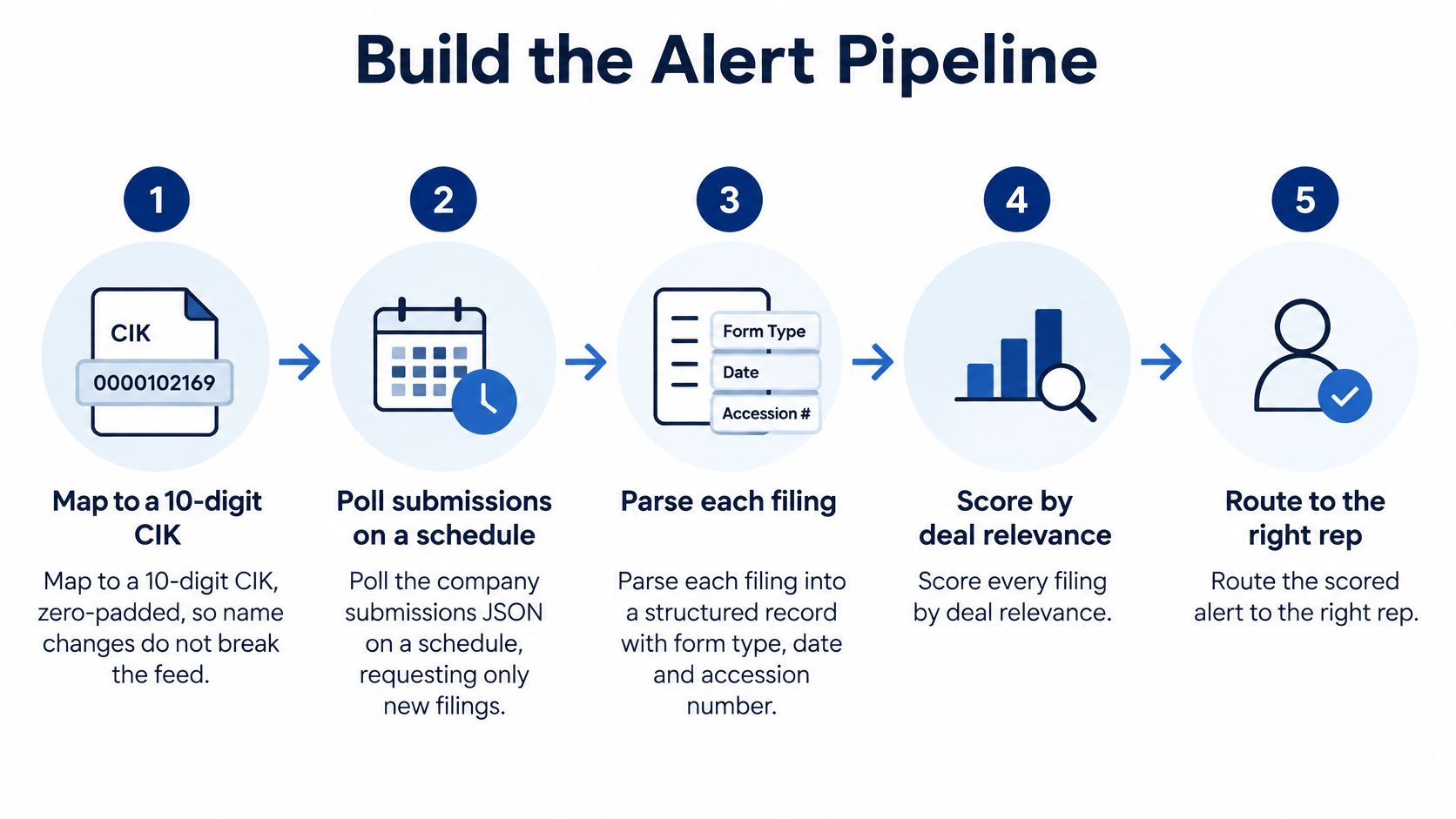
Build in a recoverable order
-
Map companies to issuer identifiers. Store each company's zero-padded, 10-digit CIK alongside its CRM account ID. Resolve subsidiaries and parent companies explicitly so a familiar brand name doesn't attach a filing to the wrong account.
-
Poll submissions with a saved cursor. Compare incoming records with the last successfully processed accession and filing date. Save progress only after durable processing, so an outage doesn't leave an invisible gap.
-
Deduplicate on accession number. Don't use headlines or filing dates as unique keys. Separate records can share both, while retries can deliver the same accession repeatedly.
-
Classify forms and amendments. Preserve suffixes such as 10-K/A, 10-Q/A, and 8-K/A. Extract relevant item numbers and associate the record with its reporting period or underlying event.
-
Retrieve supporting documents. Pull the primary document and relevant exhibits, then validate issuer, form, timestamp, and accession metadata. Exhibit content can explain an agreement more precisely than the filing's introductory text.
-
Deliver a validated initial event. Send the issuer, event classification, accession, and filing reference without waiting for every financial field. Mark unfinished extraction as pending rather than reporting missing information as a business problem.
-
Enrich asynchronously. Add structured financial facts and material-change analysis when available. Update the existing event instead of generating another notification for the same filing.
-
Route through a shared delivery queue. Push the qualified event into Slack and the CRM with retry-safe delivery. Separate ingestion from notification so a Slack failure doesn't force you to download and parse the filing again.
Make the output usable
A hypothetical Slack template could read:
Tier 1 | Acme Corp, sample company | Form 8-K, Item 5.02
Accession: 0000000000-26-000000
New CFO appointed, illustrative filing date 13 November 2026.
Why it matters: Verify whether the finance sponsor or evaluation criteria changed before the next discovery call.
Next action: Account owner reviews the appointment and updates the stakeholder map. Attach the actual EDGAR filing before delivery.
Don't turn a new appointment into an unsupported claim that the executive will replace tooling. Treat that as a discovery hypothesis.
Write the same event into last_sec_event_type, last_sec_event_date, last_sec_accession, and enrichment_status. A good first version has a defined account list, a narrow form list, and a designated alert channel. Add complexity after the basic workflow survives retries, outages, and account changes.
Score and Route Alerts Without Flooding Your Team
Fewer, sharper alerts give reps a reason to keep notifications enabled. A filing deserves interruption when it changes an active decision, stakeholder relationship, or commercial risk. Everything else can wait for a brief or digest.

Route according to the decision at risk
| Tier | Qualification | Owner and response | Concrete example |
|---|---|---|---|
| Tier 1 | Relevant executive change, acquisition, financing, or bankruptcy at an account with an open deal | Account owner reviews immediately; same-day internal action | A hypothetical software account appoints a CRO while your proposal awaits revenue leadership approval |
| Tier 2 | Material periodic-report change affecting the account plan | Account owner reviews the same-day digest and updates the brief | A quarterly report describes a new cost-reduction program that changes the business case |
| Tier 3 | Standalone insider trades, routine exhibits, nonmaterial formatting changes | RevOps reviews a weekly digest | A bank officer reports a routine share sale with no related account trigger |
A material restatement shouldn't remain in a digest merely because it appeared in a periodic report. Escalate when the content threatens an active proposal, procurement process, or commercial exposure. The tier describes the required response, not the form's permanent importance.
Suppress repetition without hiding developments
Use these as starting workflow rules:
- Consolidate related notifications. Send one alert per account, event type, and day, then append related records to it. Allow escalation when a separate material development changes the interpretation.
- Suppress cosmetic changes. Exhibit reformatting alone shouldn't interrupt a rep. Preserve it in the audit record.
- Keep a disposition. Record whether the owner acted, deferred, dismissed, or escalated the event. Use those decisions to tune routing.
Review tiers monthly with account owners. Ask which notifications changed a call, stakeholder map, or opportunity plan, rather than which summaries sounded interesting. The distinction between signal relevance and volume is operational: relevance earns an action; volume consumes attention.
If you're combining filings with broader coverage, Finzer's guide on how to configure market news alerts provides useful context for setting up the news side of that workflow. Keep filing and news notifications connected to the same account event so reps don't receive competing versions.
A rep shouldn't have to decide whether the alert matters before discovering what actually happened.

“The Business Development team gets 80 to 90 percent of what they need in 15 minutes. That is a complete shift in how our reps work.”
Andrew Giordano
VP of Global Commercial Operations, Analytic Partners
Amendments and False Urgency to Avoid
The common mistake is treating every newly retrieved document as a new business event. An amendment may revise an existing disclosure, and an access-related retry may retrieve something you already processed. Neither deserves an automatic fresh-event message.
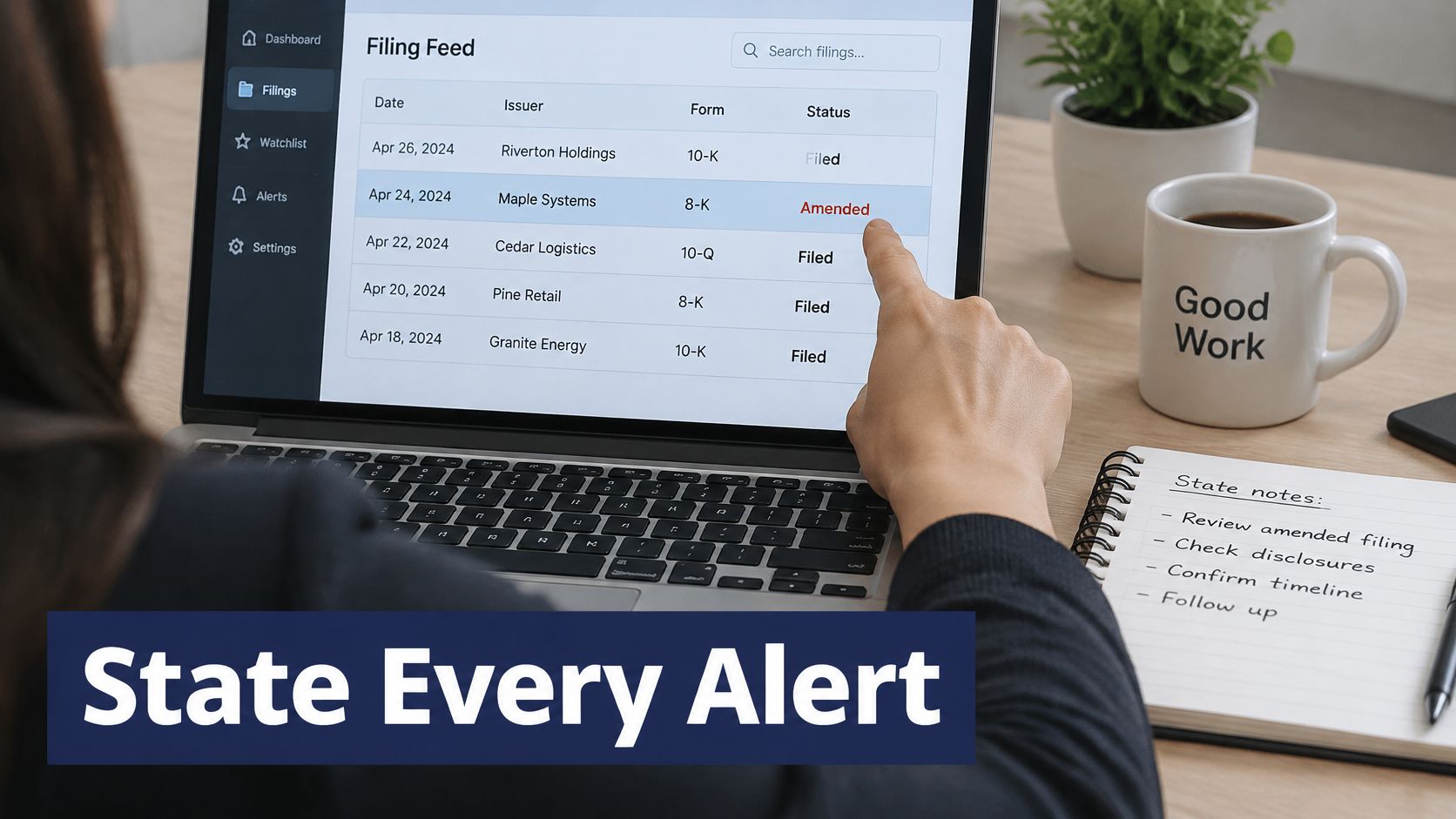
Give every event an explicit state
- New: A validated filing introduces an event not already represented.
- Amended: A subsequent filing changes or supplements an existing disclosure.
- Superseded: Earlier information should no longer guide the rep's action.
- Unavailable: Retrieval or validation failed; the system can't yet establish the content.
- Enrichment-pending: The filing is available, but additional extraction remains incomplete.
Say an acquisition disclosure is later amended to revise the consideration. The useful notification identifies the changed terms, links both documents, and flags any account brief or draft outreach containing the earlier figure. Another acquisition-announced alert would obscure the correction.
An amendment can change urgency without creating a new event. Escalate substantive revisions to financial statements, controls, executive arrangements, or deal terms. Keep administrative corrections out of the immediate channel.
Separate access health from account activity
A quiet feed isn't proof that nothing happened. Failed polls, throttling, and parser errors can all produce apparent silence. Reconcile against the daily index after an unexplained monitoring gap before marking the period complete.
Infrastructure changes also need careful interpretation. The SEC filing concerning EDGAR Next identifies September 15, 2025 as the filing compliance date for new account-management and authentication requirements; disclosure obligations and filing deadlines remained unchanged.
Don't automatically label an overdue filing as a broken feed or blame an authentication transition. Investigate retrieval health and the issuer's reporting situation separately. Your operating rule should be simple: preserve the event's history, surface substantive changes, and never mistake silence for verified completeness.
Outreach Playbooks for Each Filing Type
Outreach playbook by filing event
| Filing event | Angle for the email | First question to ask | Owner and timing |
|---|---|---|---|
| 8-K, new CFO appointed | Close and forecast tooling for a new owner's first 90 days | What did you inherit in the close process? | Account executive, same-day review |
| 8-K, acquisition announced | Integration workload and systems consolidation | Which systems are you combining first? | Account executive, within two business days |
| 8-K, new financing or credit facility | Budget aligned to growth priorities | What will the new capital fund this year? | Account executive, within two business days |
| 10-Q, guidance lowered | Cost discipline and fast payback | Which spend lines are under review? | Account owner, within one week |
| Form 4, officer share sale | Weak alone; pair with another trigger | Hold outreach | Weekly RevOps digest only |
These are recommended response windows, not regulatory deadlines. Review promptly, but don't confuse same-day internal action with a requirement to email a newly appointed executive immediately.
Match the message to the event and your existing relationship. A new CFO at an active opportunity may warrant checking sponsorship with your champion before contacting the executive. Financing deserves a question about priorities, not an assertion that fresh capital has created software budget.
Build the CFO message line by line
Use this fictional example as a structure, not a ready-to-send claim:
- Subject: Acme Corp's first 90 days on the close.
- Opening: Congratulations on the CFO appointment Acme Corp announced in its 8-K filed on 13 November 2026.
- Problem hypothesis: If you're reviewing an inherited close calendar, reconciling the close timetable with the first forecast may be a useful starting point.
- Evidence: Include a documented customer outcome only when you have an approved, verifiable case study. If you don't, describe the workflow you can demonstrate instead.
- Ask: Would a 20-minute walkthrough of how finance teams organize their first close be useful?
The company and date above are illustrative. Replace them with the actual issuer, appointment details, and filing date after opening the source document.
Don't invent days saved to make the evidence line sound stronger. A credible process explanation is better than a fabricated customer result, and an executive appointment doesn't prove the company has a slow close.
Check the message before sending
Verify the executive's role, effective date, and whether the appointment is permanent or interim. Confirm that an acquisition was announced or completed rather than treating those stages as equivalent.
Use signal-based outreach examples to vary the approach without weakening that discipline. The filing supplies a factual reason to investigate. The rep still needs a relevant problem, defensible evidence, and a low-pressure next step.
Measure Alert Quality and Start with Five Accounts
Measure delivery quality, coverage, and usefulness, not just uptime. The SEC's EDGAR data access guidance provides index and bulk-access mechanisms that support reconciliation. Use those records to test whether your pipeline received the filings it was meant to monitor.
Track these operational definitions:
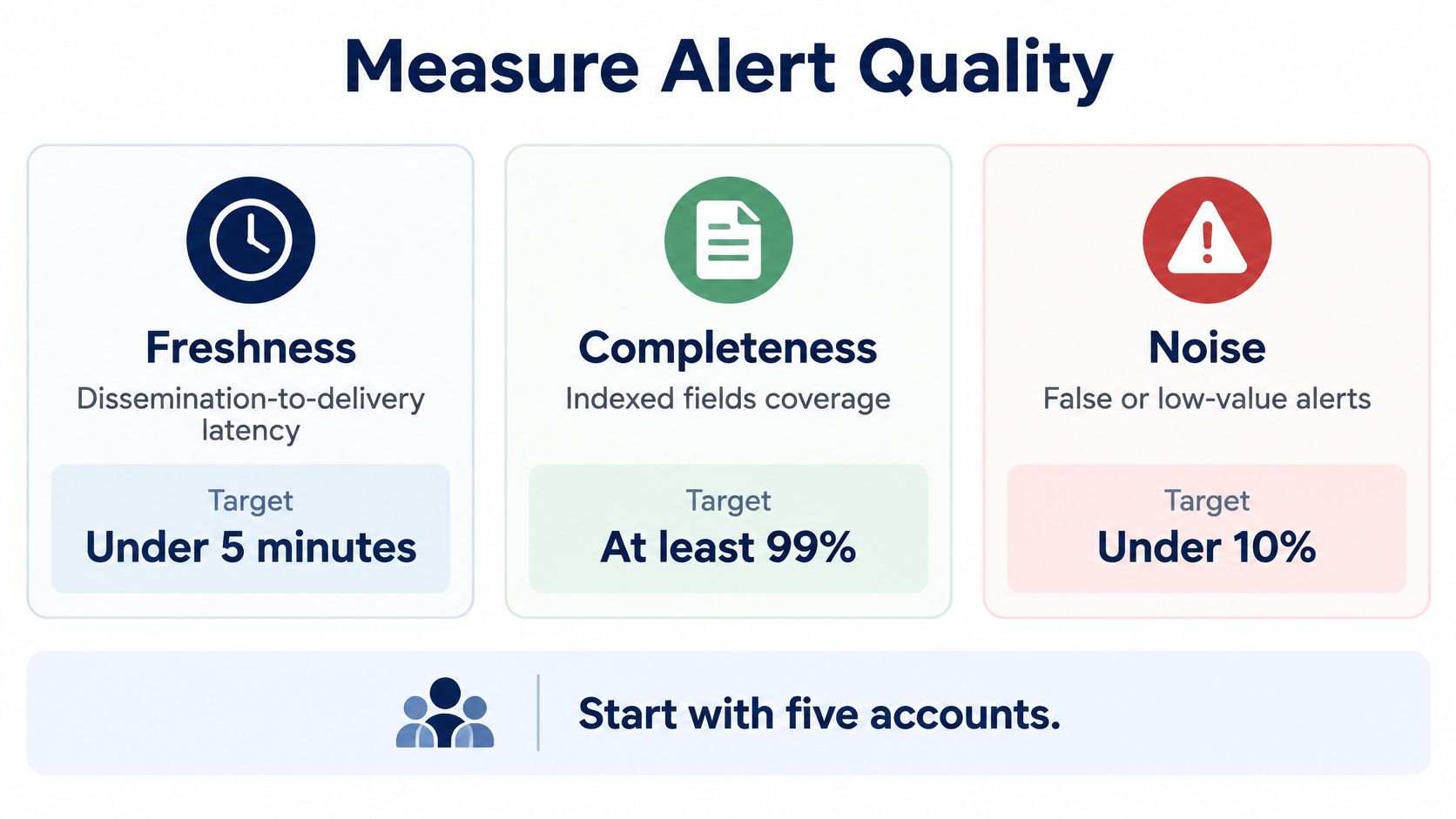
- Freshness: Dissemination-to-delivery latency. Measure when the event became public against when it reached the intended owner.
- Completeness: Indexed filings received divided by expected filings for your monitored issuers, forms, and period.
- Precision: Actionable alerts divided by total alerts. Define actionable as a documented next step, not merely an opened notification.
The targets shown below are proposed pilot acceptance criteria, not SEC guarantees or published industry benchmarks.
For completeness, count filings, not extracted fields. Track extraction coverage separately, or a parser that captures many fields from a few documents could conceal missing filings.
Run a bounded pilot
I'd start Monday with this two-week experiment:
- Choose five accounts with open deals. Name a RevOps owner and confirm the account executive for each.
- Enable 8-K monitoring only. Keep the first evaluation narrow enough to diagnose failures.
- Establish the baseline during week one. Log delivery timing, missing records, owner dispositions, and any meeting, reply, or deal update associated with an alert.
- Review precision on day fourteen. Inspect dismissed alerts alongside successful ones. A rep's silence may mean poor routing, not poor content.
- Expand only after quality improves. Add periodic-report analysis for the pilot accounts before broadening account coverage.
Connect those measures to your signal-based outbound metrics, but don't attribute every subsequent meeting to the filing. Record the alert's actual contribution to the rep's decision.
If maintaining ingestion and interpretation in-house is too heavy, evaluate the monitoring layer separately from your sales process. Salesmotion links each insight to the filing, article, or transcript it came from; our Smart Alerts send automated email alerts for earnings calls, hiring changes, and custom keywords.
Pick the pilot accounts this week, assign the owner, and put the review on the calendar before enabling notifications. That makes the feed accountable to a decision rather than another dashboard.
Salesmotion turns account monitoring into cited research briefs, buying-signal alerts, and draft outreach, helping reps connect SEC disclosures to their next action. Visit Salesmotion to explore a workflow built around your target accounts and the events that matter to your deals.