Most sales goals fail for a simple reason: they measure what the company wants (revenue) without connecting to what reps can actually control (activity, quality, and focus). A target of "$1.2M in new ARR this quarter" tells a rep nothing about how to get there. The best revenue organizations decompose ambitious targets into leading indicators that reps can influence daily and weekly, creating a clear line of sight from activity to outcome. Here's how top-performing teams set sales goals that actually drive behavior change and revenue growth.
TL;DR: Effective sales goals are structured in three tiers: outcome goals (revenue, pipeline), activity goals (calls, meetings, outreach volume), and quality goals (win rate, average deal size, signal response time). The SMART framework (Specific, Measurable, Achievable, Relevant, Time-bound) is the foundation, but the real differentiator is connecting outcome goals to daily behaviors through clear math. If a rep can't calculate what they need to do this week to hit their quarterly number, the goal isn't actionable.
Why Most Sales Goals Don't Work
They're too high-level. "Grow revenue 30%" gives the team a direction but not a path. Without decomposition into pipeline creation targets, meeting rates, and win rate assumptions, the goal is aspirational rather than operational.
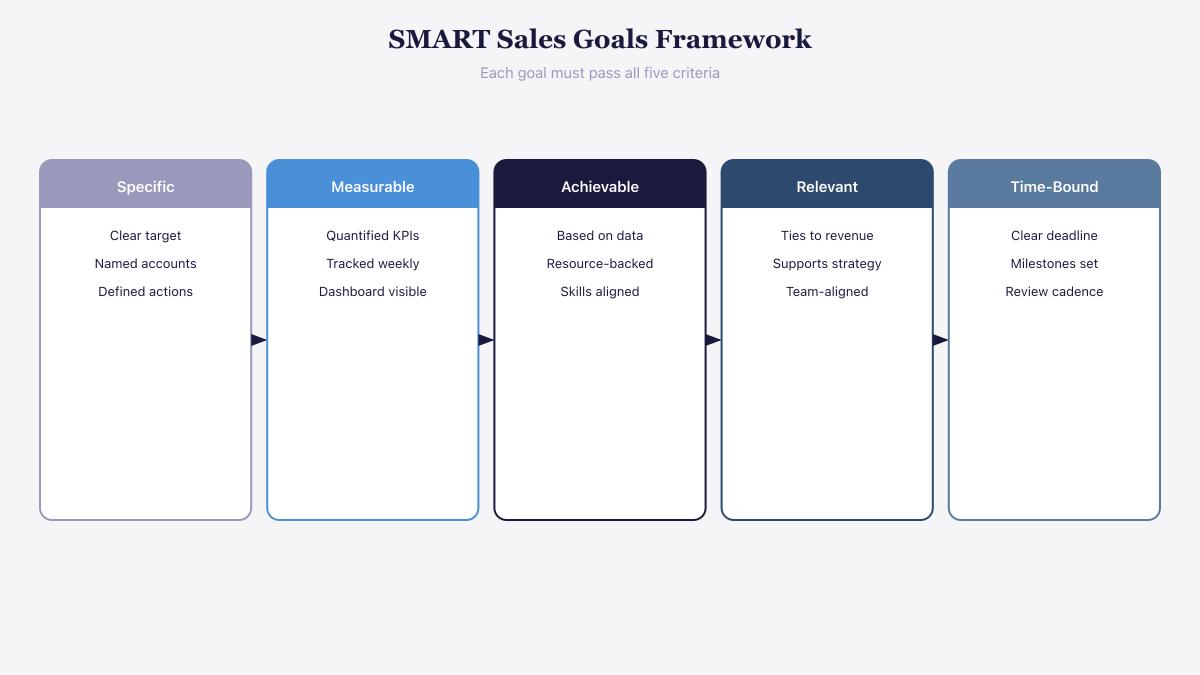 Every sales goal should pass all five SMART criteria before committing resources.
They're lagging only. Revenue is a lagging indicator. By the time you measure it, the actions that produced it happened weeks or months ago. Teams that only track revenue goals discover problems too late to correct them.
They're set without capacity math. A $5M pipeline target sounds reasonable until you calculate that it requires 50 qualified meetings per rep per quarter, and your reps currently average 15. The goal isn't wrong. The plan to achieve it is missing.
They ignore quality. Activity-only goals (make 100 calls per day) drive volume without direction. Reps optimize for the metric being measured, which means logging dials without regard for account fit, timing, or preparation quality.
The Three-Tier Goal Framework
Tier 1: Outcome Goals (What You Want to Achieve)
These are the revenue and pipeline targets that connect directly to company objectives.
Examples:
| Goal | Metric | Timeline |
|---|---|---|
| Close $300K in new ARR | Closed-won revenue | Quarterly |
| Generate $900K in qualified pipeline | Pipeline created (3x coverage) | Quarterly |
| Expand 15 existing accounts | Expansion revenue | Quarterly |
| Maintain 95% gross retention | Churn rate | Annual |
How to set them: Work backward from the company revenue target. If the company needs $12M in new ARR this year and you have 10 quota-carrying reps, each rep needs $1.2M/year or $300K/quarter. Apply your historical win rate (say 25%) to determine that each rep needs $1.2M in qualified pipeline per quarter, or $3.6M per year.
Tier 2: Activity Goals (What You Need to Do)
These decompose outcome goals into daily and weekly actions reps can directly control.
Examples:
| Goal | Metric | Timeline | Math |
|---|---|---|---|
| Book 12 qualified meetings | Meetings booked | Monthly | $1.2M pipeline / $100K avg deal / 12 months = ~1 new deal/month = 4 meetings to find 1 deal × 3 = 12/month |
| Send 200 personalized outreach messages | Outreach volume | Weekly | 12 meetings × ~15% meeting rate = 80 touches/month ÷ 4 weeks ≈ 200/month |
| Make 40 strategic calls | Calls completed | Weekly | Phone remains highest-converting channel for enterprise |
| Respond to all Tier 1 signals within 24 hours | Signal response time | Ongoing | Time-sensitivity of buying signals degrades rapidly |
The key: Every activity goal should trace back to an outcome goal through explicit conversion math. If you can't show the connection between "200 outreach messages" and "$300K in closed revenue," the activity goal is arbitrary.
Tier 3: Quality Goals (How Well You Do It)
Quality goals prevent the gaming that activity-only metrics encourage. They measure effectiveness, not just effort.
Examples:
| Goal | Metric | Timeline | Why It Matters |
|---|---|---|---|
| Achieve 30% meeting-to-opportunity conversion | Meeting quality | Monthly | Prevents reps from booking meetings with unqualified accounts |
| Maintain 35% win rate on qualified pipeline | Win rate | Quarterly | Measures deal execution quality |
| Increase average deal size to $110K | Deal size | Quarterly | Prevents reps from closing easy small deals to hit volume targets |
| Contact 3+ stakeholders in every Tier 1 account | Multi-threading depth | Ongoing | Single-threaded deals are the #1 reason enterprise deals stall |
| Complete account research before every Tier 1 outreach | Preparation quality | Ongoing | Outreach informed by account intelligence converts at 2-3x cold outreach rates |
See the product in action
Take a self-guided tour of the Salesmotion platform — no signup required.
Sales Goal Examples by Role
SDR / BDR Goals
| Category | Goal | Metric |
|---|---|---|
| Outcome | Generate $400K in qualified pipeline per quarter | Pipeline created |
| Activity | Book 15 qualified meetings per month | Meetings set |
| Activity | Execute outreach to 50 new accounts per week | Accounts touched |
| Quality | Achieve 70% meeting show rate | Show rate |
| Quality | 80%+ of meetings accepted by AE as qualified | Qualification rate |
Account Executive Goals
| Category | Goal | Metric |
|---|---|---|
| Outcome | Close $300K new ARR per quarter | Closed-won revenue |
| Outcome | Maintain $1.2M in active pipeline (4x coverage) | Pipeline value |
| Activity | Conduct 8 discovery calls per month | Discovery meetings |
| Activity | Deliver 4 proposals per month | Proposals sent |
| Quality | Achieve 30%+ win rate on qualified pipeline | Win rate |
| Quality | Average deal size above $100K | ACV |
Sales Manager Goals
| Category | Goal | Metric |
|---|---|---|
| Outcome | Team achieves 90%+ of collective quota | Quota attainment |
| Outcome | Pipeline coverage maintained at 3x+ | Pipeline ratio |
| Activity | Conduct weekly 1:1 coaching with each rep | Coaching sessions |
| Activity | Review top 10 deals weekly with each AE | Deal reviews |
| Quality | Forecast accuracy within 10% of actual | Forecast variance |
| Quality | New rep ramp time under 4 months | Time to productivity |
How Top Teams Set and Track Goals
Start With the Math, Not the Aspiration
Before setting any goal, validate it's achievable with current capacity:
- Revenue target: $300K per rep per quarter
- Average deal size: $100K
- Deals needed: 3 per quarter
- Win rate: 25%
- Opportunities needed: 12 per quarter
- Meeting-to-opportunity rate: 33%
- Meetings needed: 36 per quarter (9 per month)
- Outreach-to-meeting rate: 5%
- Outreach touches needed: 720 per quarter (180 per month)
Now validate: Can a rep realistically send 180 quality outreach touches per month while also running discovery calls, managing proposals, and closing deals? If not, something in the stack needs to change: hire more reps, improve conversion rates, increase deal sizes, or invest in tools that reduce the time per outreach touch.
Use Leading Indicators for Weekly Check-ins
Don't wait until month-end to discover a rep is off track. Monitor leading indicators weekly:
- Pipeline created this week vs. target pace
- Meetings booked this week vs. target pace
- Outreach volume and response rates
- Signal response time (how quickly reps act on account triggers)
These leading indicators give managers 4-8 weeks of correction time before quarterly targets are at risk.
Connect Goals to Account Quality
Raw activity targets (100 calls/day, 50 emails/day) without account quality filters produce busy reps, not productive reps. The most effective approach ties activity goals to account tier:
- Tier 1 accounts (strongest ICP fit + active signals): Minimum 3 personalized touches per week, multi-threaded into 3+ stakeholders
- Tier 2 accounts (ICP fit, no current signals): Automated nurture with signal-triggered escalation
- Tier 3 accounts: Automated sequences only
This prevents the most common goal-gaming behavior: reps hitting activity numbers by contacting low-fit accounts because they're easier to reach.
Teams like Frontify saw 42% sales velocity improvement by connecting rep goals to signal-driven account prioritization rather than raw activity volume, ensuring that outreach effort was concentrated on accounts showing real buying intent.

“Salesmotion has been a game-changer for me. I used to spend 12 hours a week on prospect research, now it's down to 4. Plus I'm finding stuff I was totally missing - podcasts, news mentions, the good bits.”
George Treschi
Account Executive, FY25 President's Club, Sigma
Key Takeaways
- Structure goals in three tiers: outcome (revenue/pipeline), activity (daily/weekly actions), and quality (effectiveness metrics). All three are necessary. Any single tier alone creates perverse incentives.
- Decompose every outcome goal into activity requirements using explicit conversion math. If reps can't calculate what they need to do this week to hit their quarterly number, the goal isn't actionable.
- Validate goals against capacity. A $300K/quarter target requiring 180 quality outreach touches per month is realistic for a rep with the right tools. It's unrealistic for a rep spending 3 hours researching each account manually.
- Track leading indicators weekly (pipeline created, meetings booked, signal response time) rather than waiting for lagging indicators (revenue) to reveal problems too late.
- Connect activity goals to account quality tiers. Volume without direction produces activity without pipeline.
- Quality goals (win rate, deal size, multi-threading depth) prevent the gaming that pure activity metrics encourage.
Frequently Asked Questions
What are SMART goals for sales?
SMART sales goals are Specific (close $300K, not "sell more"), Measurable (tracked in CRM with clear metrics), Achievable (validated against capacity math and historical conversion rates), Relevant (connected to company revenue objectives), and Time-bound (quarterly or monthly targets with weekly leading indicators). The framework applies to all three goal tiers: outcome, activity, and quality. The most common mistake is creating SMART outcome goals without SMART activity goals to support them.
How many sales goals should a rep have?
Most effective teams set 2-3 outcome goals, 3-4 activity goals, and 2-3 quality goals per rep. More than 10 total goals creates measurement fatigue and dilutes focus. Prioritize the 2-3 metrics that have the strongest correlation with revenue outcomes in your specific sales motion. For example, if your data shows that multi-threading depth is the strongest predictor of enterprise deal success, make it a primary quality goal rather than tracking 10 metrics equally.
How do you set realistic sales quotas?
Build quotas bottom-up from capacity analysis: available selling time × activity conversion rates × average deal size × historical win rate. Validate against top-down targets (company revenue / number of reps). If the two approaches produce significantly different numbers, investigate the gap. Common causes include: overestimating rep selling time (reps spend only 30-35% of their time actually selling), using aspirational conversion rates instead of historical ones, or not accounting for ramp time for new hires.
What's the difference between a sales goal and a sales KPI?
A sales goal is a target to achieve within a specific timeframe (close $300K this quarter). A sales KPI (key performance indicator) is a metric you monitor continuously to track health and performance (current win rate, pipeline velocity, average sales cycle length). Goals drive behavior change. KPIs monitor system health. The best frameworks use KPIs as the metrics within goal setting: "Improve win rate from 22% to 30% by Q3" turns a KPI into a goal.