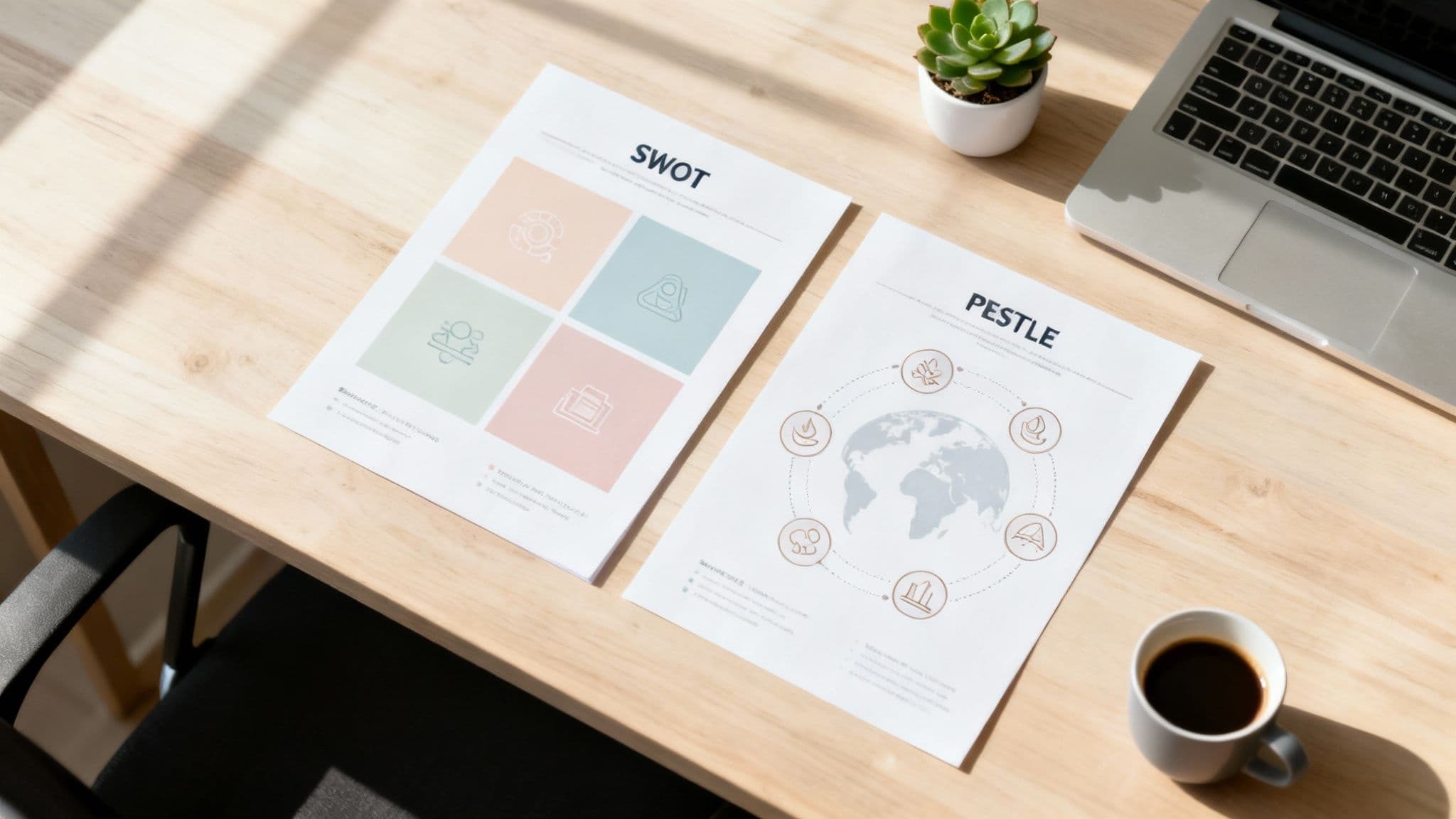
When comparing SWOT and PESTLE analysis, the main difference is scope. A SWOT analysis looks at a company's internal health and its immediate environment, while PESTLE scans the big-picture, macro-environmental forces shaping an entire industry.
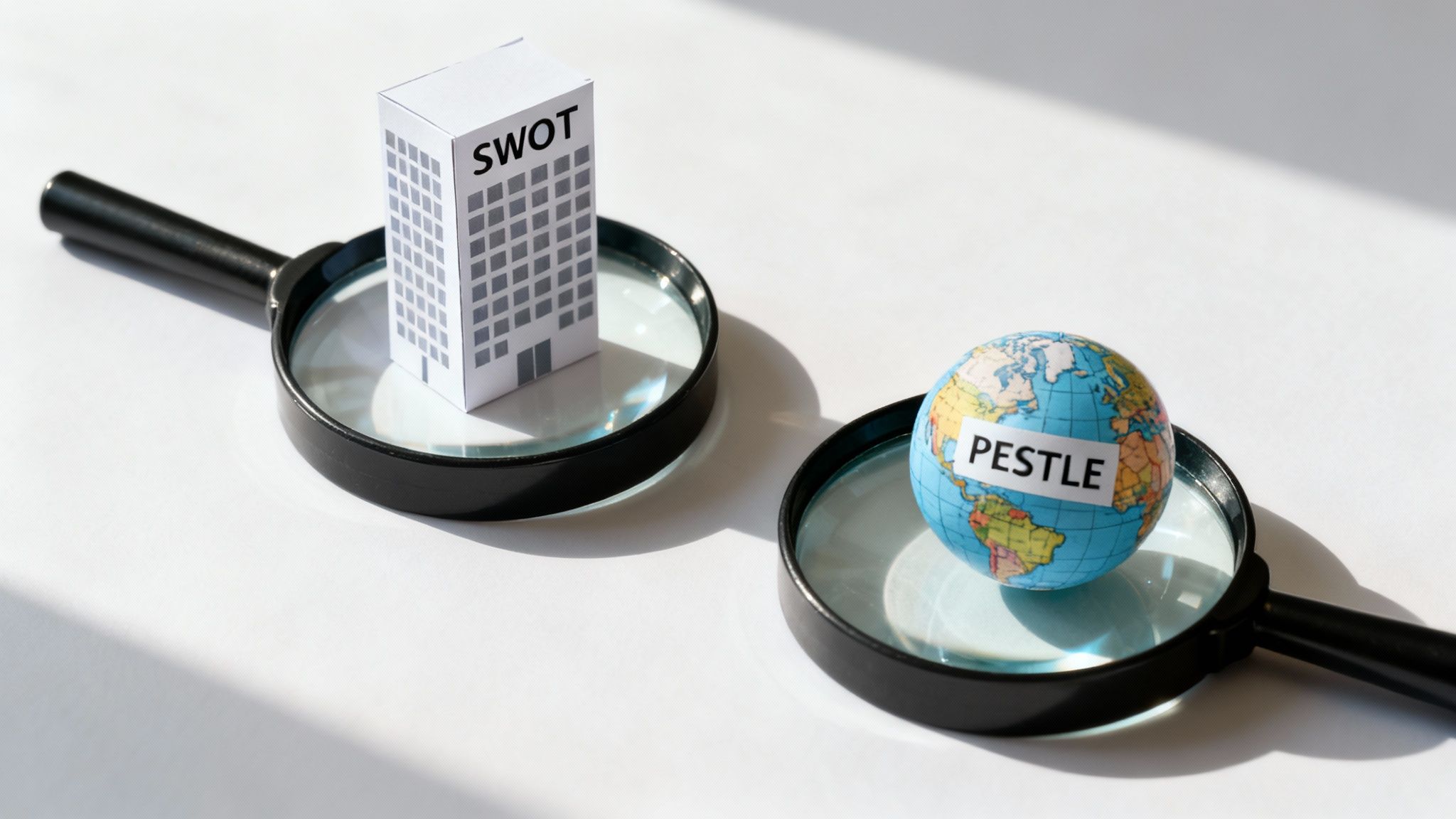
Think of SWOT as a business health check and PESTLE as a long-range weather forecast.
SWOT vs PESTLE: Understanding the Core Difference
While often mentioned together, SWOT and PESTLE aren't interchangeable. They serve distinct but complementary roles in strategic planning, especially for B2B account teams trying to understand their clients better.
Each framework offers a unique lens. Knowing when to use which—or how to combine them—is what separates a good strategy from a great one. The key distinction is their focus: SWOT looks inward at the company and its direct environment, while PESTLE looks outward at the broader world it operates in.
The Internal and Near-External Lens
SWOT stands for Strengths, Weaknesses, Opportunities, and Threats. It’s designed to give you a clear picture of an organization's current state.
- Strengths and Weaknesses are internal factors. These are things a company can largely control, like its brand reputation, intellectual property, or operational efficiency.
- Opportunities and Threats are external factors. These are typically closer to home, like new competitors, shifting customer tastes, or a new market opening.
Developed in the 1960s at the Stanford Research Institute, SWOT quickly became a cornerstone of strategic planning. Its simplicity and directness help businesses connect what they do best with what’s possible in the market. It’s estimated that by 2025, over 70% of Fortune 500 companies will use SWOT in their planning cycles, highlighting its lasting relevance. You can read more about its strategic applications to see how it’s used in practice.
The Wide-Angle Macro Lens
PESTLE analysis, on the other hand, zooms out to look at the bigger picture through six distinct lenses: Political, Economic, Social, Technological, Legal, and Environmental. This framework helps you grasp the large-scale forces that shape entire industries and markets—factors that are often beyond a single company's control.
A PESTLE analysis reveals the currents and tides affecting all ships in the harbor. A SWOT analysis inspects the condition of just one of those ships.
For instance, a new international trade policy (Political) or a major shift in consumer values (Social) can create ripple effects across an entire sector. PESTLE is the tool that helps you see those shifts coming.
For a quick side-by-side comparison, this table breaks down the key differences.
SWOT vs PESTLE at a Glance
| Attribute | SWOT Analysis | PESTLE Analysis |
|---|---|---|
| Primary Focus | Internal capabilities and immediate external factors | Macro-environmental external forces |
| Scope | Micro/Meso (Company-specific and its direct market) | Macro (Industry, national, or global level) |
| Controllability | High (Strengths/Weaknesses are internal) | Low (Factors are largely uncontrollable) |
| Time Horizon | Short to medium-term tactical planning | Medium to long-term strategic foresight |
| Main Use Case | Assessing competitive position, operational improvements | Market assessment, risk analysis, strategic direction |
This table shows that while both are essential for planning, they answer very different questions about a business and its environment.
Ultimately, these frameworks are most powerful when used together. PESTLE provides the broad context, helping you spot the big-picture Opportunities and Threats that you can then feed into a more focused SWOT analysis. This combination creates a complete, actionable view for any strategic initiative, from market entry to B2B account planning. Some teams automate this entirely — platforms like Salesmotion auto-generate SWOT analyses from public sources like earnings calls, filings, and news, so reps get a ready-made strategic view in minutes rather than hours.
A Deep Dive into SWOT Analysis

Let's get practical with SWOT. If PESTLE is the high-level weather forecast, SWOT is your on-the-ground report, examining a specific company’s condition right now. It’s about uncovering company-level intelligence that’s immediately useful for B2B sales teams.
The framework is simple, breaking down into four quadrants: Strengths, Weaknesses, Opportunities, and Threats.
The first two—Strengths and Weaknesses—are internal. These are factors the company has a real degree of control over. The other two—Opportunities and Threats—are external, reflecting the immediate environment the business has to navigate.
Understanding the Four Quadrants
To master the SWOT analysis and PESTLE analysis combination, you need to understand what each part of SWOT tells you. Every quadrant prompts a different line of questioning, revealing a complete snapshot of an account's current state.
-
Strengths: This is what your target account does exceptionally well. Think of it as their competitive edge—perhaps it's fierce brand loyalty, proprietary tech, or a hyper-efficient sales process. Knowing their strengths helps you understand what they value and where they feel confident.
-
Weaknesses: These are the internal vulnerabilities. You might find outdated technology, high customer churn, or a gap in their product line. For a sales pro, weaknesses are often the most direct path to a conversation because they point to obvious pain points.
-
Opportunities: These are external factors the company could exploit. This could be an underserved market segment, a competitor's recent mistake, or surging demand for a product they offer. Opportunities show you where the company wants to go.
-
Threats: These are external risks that could cause real harm. Think new competitors, negative press, or changing regulations that disrupt their industry. Threats create urgency, making them powerful motivators for a company to act.
Applying SWOT in B2B Sales
Let's run through a quick example. Imagine you're selling an AI-powered inventory management system to a mid-sized e-commerce business. A quick SWOT analysis can uncover powerful insights.
A B2B Sales Example
-
Strength: They have a loyal customer base that loves their curated products. You can align your pitch by showing how your tool ensures their best-sellers are always in stock, protecting that customer experience.
-
Weakness: You discover through industry news that they struggle with stockouts during peak seasons, leading to lost sales. This is a direct pain point your solution can solve.
-
Opportunity: The market has a growing demand for next-day delivery. Your system can help them optimize fulfillment to compete with larger players.
-
Threat: A larger competitor just launched an aggressive marketing campaign in their core region. Your target needs every efficiency gain to defend their market share.
By mapping your solution to these specific SWOT elements, your sales pitch transforms from a generic feature list into a strategic proposal. You're no longer just selling software; you're offering a direct solution to their challenges and a clear path to seizing their next opportunity.
This is how you gather actionable data to tailor your pitch. When you address their specific weaknesses and threats while aligning with their strengths and opportunities, you position your solution as the only logical choice.

“My ultimate goal is to know more about the company than they know themselves. Before, that took hours across multiple tools. With Salesmotion, I can get there in 30 minutes or less and walk into a Fortune 500 conversation fully prepared.”
Jeff Dalo
Senior Director Business Development, Analytic Partners
Zooming Out With PESTLE Analysis
Now, let's pull back. If a SWOT analysis puts your client's company under a microscope, a PESTLE analysis is the telescope you use to scan the entire horizon. This framework is about understanding the broad, external forces shaping your target’s industry—long before they become immediate issues.
PESTLE is an acronym for Political, Economic, Social, Technological, Legal, and Environmental factors. These are macro-level forces no single company can control. Instead, they have to navigate them to survive and grow. For B2B account planning, PESTLE gives you the context to see what’s coming, spot long-term market shifts, and understand risks.
Breaking Down the PESTLE Factors
Each letter in PESTLE represents a different external influence. Looking at them one by one helps you build a map of the world your client operates in and spot the early tremors of change.
-
Political: This covers government policy, political stability, trade tariffs, and tax laws. A new administration might introduce regulations that create a massive opening for compliance software.
-
Economic: Think inflation rates, economic growth, exchange rates, and consumer spending. An economic downturn might suddenly make cost-saving solutions a top priority.
-
Social: This looks at cultural trends, demographics, and public attitudes. For example, growing demand for corporate social responsibility is pressuring businesses to adopt sustainable practices.
-
Technological: This covers R&D, automation, and the pace of tech evolution. The rapid adoption of generative AI is a perfect example, creating huge opportunities for some and existential threats for others.
-
Legal: These are the laws and regulations an industry must follow, like data protection laws (think GDPR), health and safety rules, or employment laws. New legal requirements often create an immediate need for new systems.
-
Environmental: This is about ecological factors like climate change, weather patterns, and sustainability goals. Growing pressure to reduce carbon footprints can drive demand for green technologies.
From Macro Forces to Account Strategy
Thinking about these big-picture forces helps you shift from reactive selling to proactive partnership. You’re no longer just solving today’s problems; you’re helping your client prepare for tomorrow's.
PESTLE analysis is your early warning system. It turns abstract global trends into specific, actionable signals that can inform a powerful sales strategy.
Let’s apply this to our e-commerce company example.
- A Political move to regulate online marketplaces could create a sudden need for new compliance features.
- An Economic forecast of rising inflation might make your flexible pricing model more attractive.
- A Social shift toward supporting local businesses could be an opportunity for your client to highlight their community ties.
Originating in the 1980s, PESTLE grew in popularity because it forces leaders to look beyond their immediate competitors. Research shows that over 60% of multinational corporations now regularly use PESTLE or similar frameworks in their strategic planning. This adoption proves its value in building resilient business strategies. By understanding the world your clients operate in, you can position your solution not just as a tool, but as a strategic necessity.
Comparing SWOT and PESTLE for Account Planning
In strategic B2B sales, choosing the right analytical tool shapes your ability to close deals. While both a SWOT analysis and PESTLE analysis are foundational, they answer different questions about your target accounts. The real skill is knowing when to use each and how they work together.
Let’s compare them across three criteria that matter for winning business: Scope, Timescale, and Application. This will clarify when to use the magnifying glass (SWOT) and when to use the telescope (PESTLE).
This simple decision tree helps visualize when each framework should be your go-to.
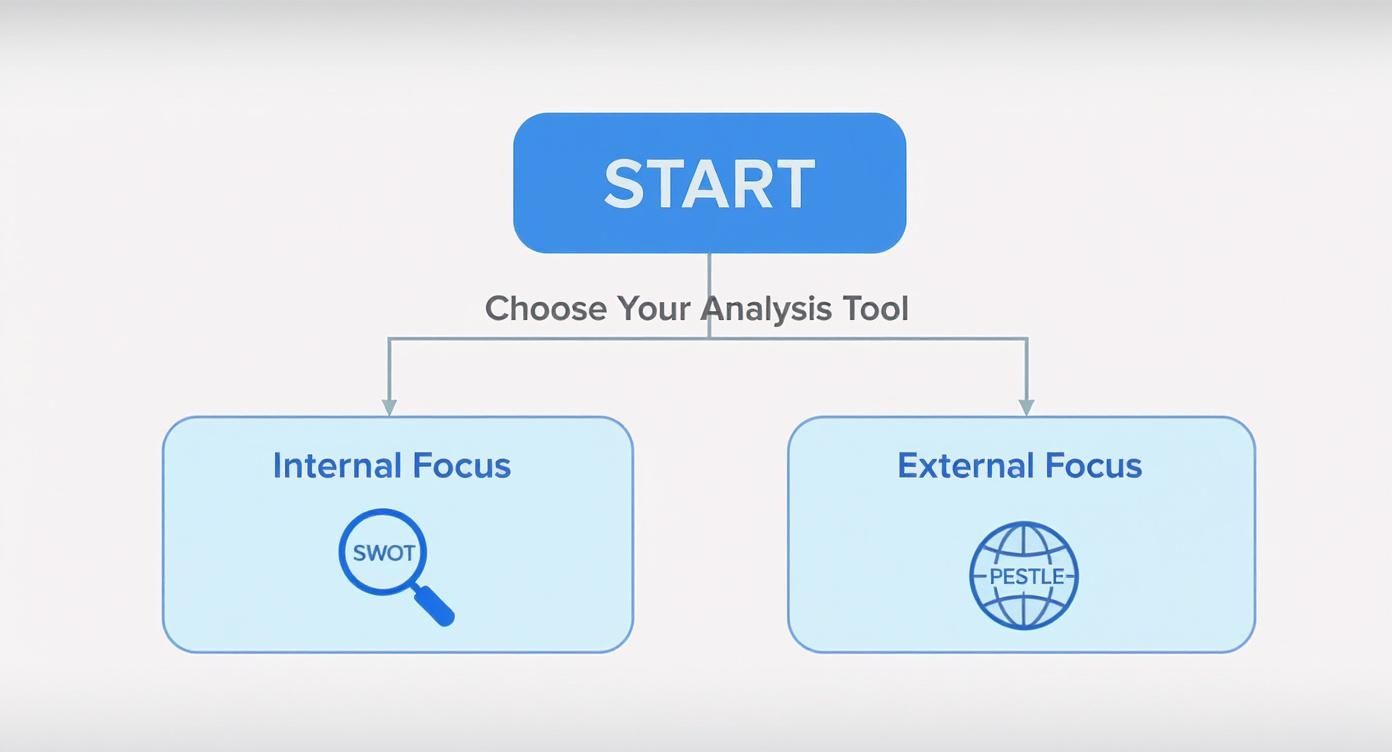
The flowchart lays it out perfectly: if you need to understand an account’s specific capabilities, SWOT is your tool. If you need to grasp the market-wide trends they're facing, PESTLE provides that perspective.
Scope: Internal Micro vs. External Macro
The biggest distinction between the two is scope. A SWOT analysis is focused on the micro level. It’s an internal health check on a single organization (Strengths, Weaknesses) and its immediate competitive environment (Opportunities, Threats). It answers questions like, "What unique advantages does this account have?" or "What specific vulnerabilities could we solve?"
PESTLE operates at the macro level. It scans the entire external landscape for broad forces—Political, Economic, Social, Technological, Legal, and Environmental—that affect every player in an industry. PESTLE answers questions like, "What upcoming regulations will impact my client's market?" or "How will economic shifts change their customers' buying habits?"
Timescale: Immediate Tactics vs. Long-Term Strategy
This difference in scope leads to a difference in timescale. Think of SWOT as your tool for the here and now. Its findings are tactical and immediate. A weakness you identify today is a pain point you can address in a sales call tomorrow.
PESTLE is built for long-term strategic foresight. The trends it uncovers, like demographic shifts or technological disruptions, unfold over months or years. These insights help you position your solution not just for your client's current needs, but for the challenges they'll face in two to three years.
Use SWOT to understand your target account's present. Use PESTLE to understand the future they are walking into.
This forward-looking perspective elevates you from a vendor to a strategic partner, which is crucial for building deep, consultative relationships.
Application: Account-Specific Insights vs. Market-Wide Foresight
For B2B sales teams, the application is distinct. You use SWOT to craft a tailored, account-specific value proposition. It helps you connect your solution’s features directly to an account's known strengths or weaknesses. This is the foundation for a sharp, relevant pitch.
PESTLE’s application is about providing market-wide context. It gives you the "why now" for your sales conversations. For instance, a new environmental regulation (PESTLE) creates a company-wide threat (SWOT) that makes your compliance software an urgent priority. Insights from a PESTLE analysis are invaluable for effective sales account planning, helping you see the bigger picture driving your client's decisions.
The rise of digital transformation illustrates this perfectly. The global digital transformation market exceeded $1 trillion by 2025. Roughly 70% of organizations now have a digital transformation strategy, and over half of them use SWOT to guide it. This shows how a macro trend (a Technological factor in PESTLE) directly influences internal planning (SWOT).
To make this more practical, the table below provides scenario-based recommendations on which framework to prioritize.
Situational Use Cases: SWOT vs. PESTLE
| Business Goal | Primary Framework | Reasoning |
|---|---|---|
| Tailor a sales pitch for a meeting next week | SWOT Analysis | Provides immediate, account-specific pain points and strengths to build a relevant value proposition. |
| Identify long-term risks for a key account | PESTLE Analysis | Uncovers macro-environmental trends that could become significant threats over the next 1-3 years. |
| Understand a competitor's recent market move | SWOT Analysis | Helps analyze a competitor's strengths and weaknesses to understand the logic behind their strategy. |
| Prepare a strategic QBR for a major client | Both (PESTLE first) | Use PESTLE to set the stage with market trends, then use SWOT to discuss how your client can respond effectively. |
These examples show how your immediate goal should dictate your choice of tool. For tactical, short-term planning, SWOT is indispensable. For long-range, strategic conversations, PESTLE provides the necessary context.
Ultimately, a SWOT analysis and PESTLE analysis are partners. PESTLE provides the big-picture context, while SWOT helps you understand how those external forces are specifically affecting your target account.

“We're saving about 6 hours per week per seller on account research alone. That's time they can reinvest in actually selling.”
Derek Rosen
Director, Strategic Accounts, Guild Education
How PESTLE Insights Inform a Smarter SWOT Analysis
On their own, SWOT and PESTLE analyses offer valuable intel. The real magic happens when you bring them together. Think of PESTLE as your reconnaissance mission—it scans the horizon for big, external forces. Those findings then become the evidence you need to build a much smarter, more strategic SWOT for a specific account.
This integration turns broad market trends into a sharp, tailored sales strategy. You stop making assumptions and start connecting the dots directly to your client's world.
From Macro Trends to Micro Realities
The synergy comes from using your PESTLE findings to feed the Opportunities (O) and Threats (T) sections of your SWOT matrix. These two quadrants are focused on external factors, and PESTLE is the perfect tool for identifying them. Without this step, your SWOT can feel hollow, relying more on guesses than on hard data.
For example, a PESTLE analysis might flag the rapid corporate adoption of generative AI. This single insight means very different things depending on the account:
- For an AI SaaS Company: This trend is a massive Opportunity. Their addressable market is exploding.
- For a Business with Legacy Systems: This same trend is a significant Threat. They’re at risk of being outmaneuvered by more agile competitors.
This translation process is what makes the combined SWOT analysis and PESTLE analysis so powerful. It grounds your account strategy in the realities of the wider business environment.
A Step-by-Step Integration Process
To make this connection work, you need a structured approach. Systematically mapping PESTLE factors to your SWOT framework ensures no critical insight gets lost. This turns an academic exercise into an actionable sales playbook.
Here’s a straightforward process:
- Conduct a Thorough PESTLE Analysis: Start by looking at the Political, Economic, Social, Technological, Legal, and Environmental factors shaping your target's industry.
- Identify Key PESTLE Drivers: Zero in on the 2-3 most significant factors in each category that are likely to influence the industry over the next 12-24 months.
- Translate Drivers into Opportunities: For each key driver, ask, "How could our target account use this trend to their advantage?" A new environmental regulation could be a huge opportunity for a company selling green tech. This feeds the 'Opportunities' section of their SWOT.
- Translate Drivers into Threats: Now, flip the question: "How could this trend hurt our target account?" Rising inflation (Economic) could be a serious threat to a luxury goods retailer. This helps you populate the 'Threats' quadrant with real-world risks.
By using PESTLE to inform your SWOT, you move beyond generic statements like "new competitors" and identify the specific market forces creating those threats.
This structured mapping gives you a much deeper level of insight. Strategic analysis often comes down to managing potential risks; knowing how to conduct effective risk assessment is crucial for turning these findings into smart decisions.
Putting It All Together for B2B Sales
This integrated approach sharpens your sales messaging. When you grasp the macro forces shaping your client's world, you can have more strategic conversations. You’re no longer just talking about their immediate pain points; you’re discussing future challenges they might not have considered. This elevates you from a vendor to a strategic advisor.
By tracking external signals, you can spot patterns that show a company is ready to buy. You can learn more in our guide on what is intent data and how it reveals purchasing signals. When you filter that data through a PESTLE lens, it gives your SWOT analysis the "why now" urgency needed to get a deal moving.
Automating Strategic Analysis with Salesmotion

Let’s be honest: manually running a SWOT and PESTLE analysis for every key account is a massive time sink. Worse, the moment you finish your research, it starts going stale. Markets shift, competitors launch campaigns, and your target accounts constantly evolve.
This is where smart automation changes the game. Account intelligence platforms like Salesmotion can turn strategic analysis from a static, quarterly chore into a continuous, real-time advantage. Instead of you spending hours on research, the critical insights come directly to you.
From Manual Research to Real-Time Intelligence
The biggest win with automation is the shift from stale data to live intelligence. Most sales reps spend 6-10 hours every week on manual account research—a full day that could be spent selling. An automated platform does the heavy lifting for you, continuously monitoring a wide range of external signals.
These aren't just random headlines. We're talking about meaningful signals like:
- Financial Disclosures: SEC filings and earnings call transcripts that outline strategic priorities.
- Company Announcements: Press releases about new products, partnerships, or leadership changes.
- Hiring Trends: Job postings that point to new growth areas or technology investments.
- Industry News: Market reports and articles that give you relevant context.
This constant monitoring ensures your understanding of an account is always current. It allows your team to act on fresh information, not a report that's already weeks old.
How Salesmotion Connects the Dots
Salesmotion goes beyond just collecting data; it organizes and interprets it for you. The platform automatically pulls in diverse signals and slots them into the right PESTLE categories. A new environmental regulation (Legal/Environmental) or a competitor's funding announcement (Economic) gets flagged and categorized instantly.
Automation transforms strategic frameworks from academic exercises into a dynamic part of your sales process. It turns raw data into a clear "why now" for your next conversation.
From there, the system helps you map these big-picture PESTLE insights directly to an account’s SWOT profile. For instance, a signal about your client building a new R&D facility becomes a documented Strength, while news of a supply chain disruption becomes a critical Threat.
This automated mapping gives you a constantly updated, strategic view of every target account. It saves time, uncovers insights you might have missed, and gives your team the intelligence needed to have more meaningful conversations. For even deeper insights into what's being said inside your accounts, understanding how tools like Conversation Intelligence can complement this data is also a huge advantage.
Key Takeaways
- SWOT analyzes a company's internal strengths and weaknesses plus its immediate external opportunities and threats, while PESTLE scans the broad macro-environmental forces shaping an entire industry.
- SWOT is best for short-to-medium-term tactical planning and account-specific pitches; PESTLE is built for medium-to-long-term strategic foresight and market-wide risk assessment.
- The two frameworks are most powerful when combined: start with PESTLE to identify macro trends, then feed those findings into the Opportunities and Threats quadrants of your SWOT.
- For B2B sales teams, SWOT turns generic pitches into tailored proposals by mapping your solution directly to an account's specific strengths, weaknesses, opportunities, and threats.
- PESTLE elevates you from vendor to strategic advisor by helping clients prepare for future challenges they may not yet see coming.
- Automation tools like Salesmotion can turn these frameworks from static quarterly exercises into continuous, real-time intelligence feeds that keep account plans always current.
Frequently Asked Questions
Still have questions about how SWOT and PESTLE analysis fit together? Here are clear, straightforward answers to the most common ones.
These quick insights will help you apply these powerful frameworks with confidence.
Can a Small Business Use Both SWOT and PESTLE?
Absolutely. While PESTLE might seem geared toward large corporations, it’s just as valuable for small businesses. Understanding macro trends like a local economic boom (Economic) or new e-commerce regulations (Legal) can reveal huge opportunities and risks.
The best part? Smaller companies can often react to these shifts much faster than larger competitors. Using PESTLE gives you the big-picture context that makes a small business's SWOT analysis far more strategic.
How Often Should You Conduct These Analyses?
There's no single magic number. A good rule of thumb is to refresh your PESTLE analysis annually and your SWOT analysis quarterly. The macro factors in PESTLE, like political shifts and social trends, tend to change more slowly.
In contrast, your internal environment—team strengths, product weaknesses, competitive moves—can shift much faster. A quarterly SWOT review keeps your strategy sharp and grounded in current reality.
Which Analysis Should You Do First?
Always start with PESTLE. By analyzing the external, macro-environmental factors first, you gather the essential context to build a smarter, evidence-based SWOT analysis.
The findings from your PESTLE analysis directly inform the "Opportunities" and "Threats" in your SWOT. Without PESTLE, you're essentially guessing about the external forces shaping your business.
Think of it this way: you wouldn't inspect the condition of your ship (SWOT) without first checking the weather forecast (PESTLE). This sequence ensures your strategic planning is grounded in a solid understanding of the broader market, making your final strategy much more powerful.
Ready to stop spending hours on manual research and start acting on real-time insights? Salesmotion automates the entire strategic analysis process, feeding your team continuous intelligence to build smarter account plans and win more deals. Discover how at https://salesmotion.io.