
If you want to shorten your sales cycle, you have to stop being reactive. It's time to move to a proactive, signal-driven strategy.
This means spotting key business triggers—like a fresh funding round or a new executive joining the team—and using them to build a timely, relevant reason to connect. Your outreach instantly goes from a cold interruption to a strategic conversation, landing right when the buyer is actually listening.
The True Cost of a Lengthy Sales Cycle
Let's have an honest talk about what a slow sales process is really costing you. It’s far more than just delayed revenue. It's a silent drain on momentum, morale, and your competitive edge.
When deals drag on, your customer acquisition costs (CAC) balloon, your forecasts become unreliable, and your team burns out chasing opportunities that may never close.
This isn't a new problem, but it is getting more pronounced. The modern B2B buying journey is a maze. Buying committees are larger, and decision-makers are drowning in digital noise, making it harder than ever to capture their attention.
A lengthy sales cycle leaves the door wide open for competitors. Every extra day a deal spends in your pipeline is another chance for a rival to swoop in with a more compelling, timely, or better-contextualized offer.
Why Deals Are Dragging More Than Ever
Recent data puts this challenge into sharp focus. The average B2B sales cycle has stretched to 84 days overall. For deals over $200K, it’s now a challenging 230 days—that’s a 22% increase since 2022.
A big reason is the expansion of buying committees, which now average 6-10 stakeholders. But the data also points to a clear solution: teams that track real-time signals are winning. For instance, a staggering 81% of weekly AI tool users report shorter deal cycles, proving the power of timely intelligence.
This reality splits sales teams into two camps:
- The Overwhelmed: These reps are buried under manual research, spending hours trying to stitch together a reason to reach out. By the time they do, the window of opportunity has usually slammed shut.
- The Paralyzed: These teams see the signals—news alerts, social media posts, market updates—but are frozen by the sheer volume. They don’t know which signals matter or how to turn that noise into a conversation.
Let's break down where the old way of selling gets stuck and how a signal-driven approach changes the game.
Key Bottlenecks Lengthening Your Sales Cycle
| Bottleneck | The Old Way (Manual Approach) | The New Way (Signal-Driven) |
|---|---|---|
| Prospecting | Reps cold call down a static list, hoping for a lucky break. | Reps prioritize accounts showing active buying signals (e.g., new funding, hiring). |
| Outreach | Generic, product-focused emails get ignored or deleted. | Outreach is hyper-relevant, referencing a specific trigger (e.g., a new initiative). |
| Timing | Engagement is based on the seller's cadence, not the buyer's need. | Engagement is timed to the buyer's moment of need, answering "Why now?". |
| Discovery | Reps ask broad, generic questions to uncover pain. | Reps start with a known pain point inferred from the signal, leading to deeper discovery. |
| Urgency | Urgency is created with discounts or artificial deadlines. | Urgency is inherent because the solution addresses a timely business event. |
As you can see, the shift isn't just about using new tools; it's a fundamental change in strategy that tackles the very chokepoints that cause deals to stall. The new way aligns your entire process with the buyer's reality.
The Hidden Financial and Operational Drain
The consequences of a slow sales process ripple across your entire organization. Stalled deals directly torpedo your pipeline velocity—a critical metric measuring how fast deals move toward close. When velocity drops, so does your ability to generate predictable revenue.
To get ahead of these costs and actually shorten your sales cycle, you have to streamline your marketing strategy for longer B2B buying cycles.
The core issue is a massive shift in buyer expectations. Prospects don't want to hear why they should buy your product anymore. They need to understand why now.
That's a crucial distinction. A sales team that can answer the "why now" question with a credible, timely trigger—like a new company initiative or a recent executive hire—instantly establishes relevance and authority.
Understanding the true business impact of a drawn-out cycle is the first step. It primes you for the strategic shift from being just another reactive seller to becoming a proactive, signal-driven partner who engages with precision and purpose.
See Salesmotion in action
Take a self-guided interactive tour — no signup required.
Build Your Signal-Driven Sales Engine
It’s time to move past guesswork. The best sales teams build their engine on real-world triggers, not wishful thinking.
Ditching generic outreach isn't just about writing better emails. It’s a fundamental shift in how you operate, re-architecting your entire sales motion around your buyer's reality. The goal is simple: stop asking "Why should you buy?" and start explaining "Why you should buy now."
This all comes down to creating an ‘Always-On Account Monitoring’ system that constantly scans your target accounts for crucial buying signals. These are the breadcrumbs that tell you a window of opportunity is opening.
For a B2B SaaS company, that signal might be a target account announcing its Series B funding. For a financial services firm, it could be a major regulatory change hitting their clients. The key is to pinpoint the events that create an immediate, undeniable need for what you sell.
When you miss these signals, the consequences are predictable: a painfully long sales cycle, bloated costs, and, all too often, a lost deal.
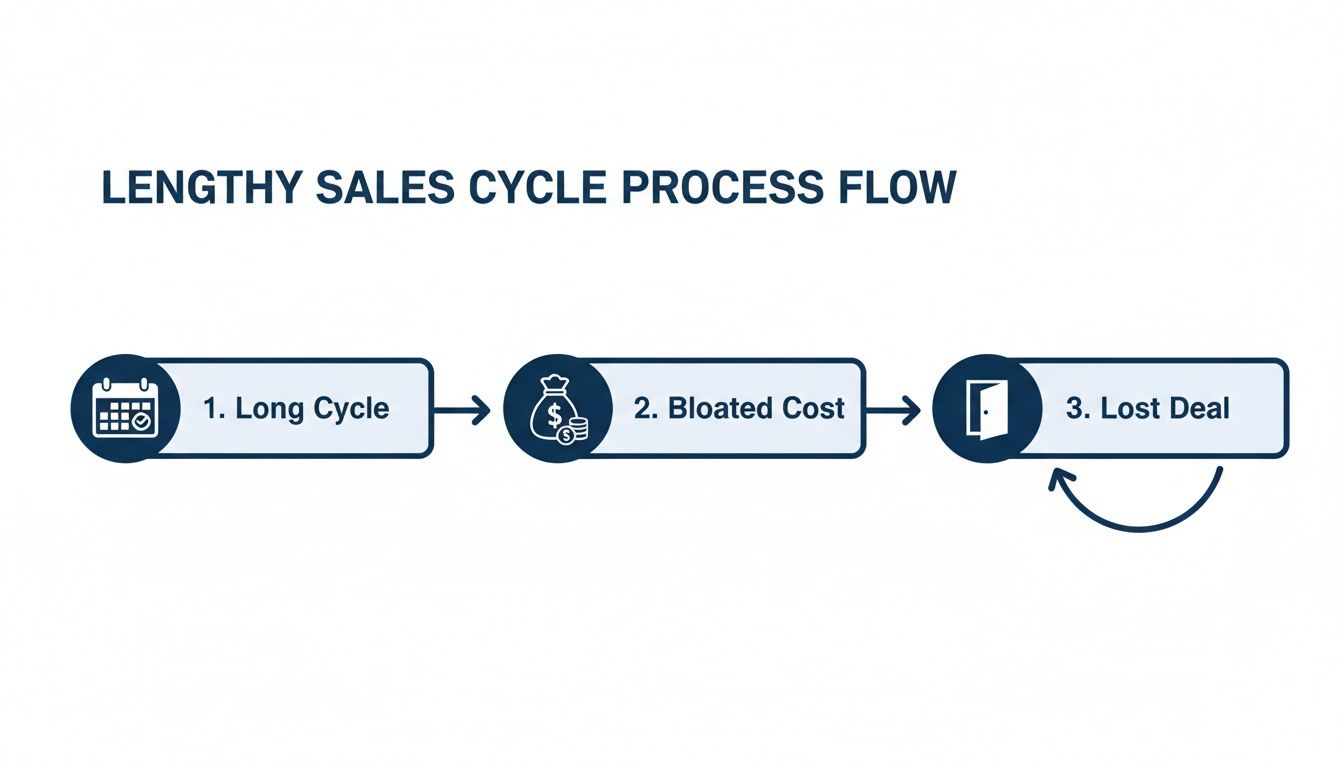
This slow, uninformed process is a direct drain on profitability and pipeline health.
From Data Points to Compelling Conversations
Spotting the right signals is only half the battle. The other half—the part where most teams stumble—is turning those signals into powerful insights your reps can actually use. It’s easy to drown in news alerts without a clear path to action. A true signal-driven engine provides that clarity.
Let's walk through a real-world example. Your team sells supply chain optimization software. A rep gets an alert: a target manufacturing company just posted a job opening for a "VP of Supply Chain Modernization."
- The Old Way: A generic email to the COO with the subject line "Our Supply Chain Software." It gets ignored.
- The Signal-Driven Way: The rep reaches out to the hiring manager and other supply chain leaders. The subject is now, "Regarding your search for a VP of Supply Chain Modernization." The message immediately connects your solution to the company's stated goal of modernizing its operations.
That simple pivot transforms your sales rep from a cold caller into a timely, trusted advisor. They aren't interrupting; they're joining a conversation the company has already started. This is the very essence of signal-based selling in action.
Building Your Signal Framework
So, what signals should you actually track? It depends entirely on your Ideal Customer Profile (ICP) and the value you deliver. The best place to start is by asking: what external events would make a prospect’s need for our product urgent?
Common High-Intent Signal Categories:
- Financial & Corporate Events: This covers everything from funding rounds and M&A activity to IPO filings. A company with fresh funding is ready to invest in growth.
- Leadership & Team Changes: Keep an eye on executive new hires, promotions, and even departures. A new CIO is almost always tasked with evaluating the existing tech stack, creating a perfect entry point.
- Strategic Initiatives: Look for public announcements about new product launches, market expansions, sustainability goals, or digital transformation projects. You'll find these in press releases and annual reports.
- Hiring & Growth: Job postings are a goldmine. A company hiring a dozen new sales reps is going to need sales enablement tools. It’s that simple.
The B2B Sales Benchmarks 2024 study paints a stark picture of today's market. While enterprise sales cycles often drag on for 7-9 months with up to 10 stakeholders in each deal, teams that personalize their approach see wildly different results. In fact, 58% of buyers prefer reps who engage with relevant business context. This is exactly what a signal-driven workflow enables—turning real-time intelligence into value-based messaging that cuts through the noise.
This data proves that relevance isn't just a "nice-to-have" anymore. It's a core requirement for any team serious about shortening their sales cycle.
As you build out your signal-driven engine, consider how others are using automation to gain an edge. Many industries are already leveraging AI Voice Agents to Qualify Leads, Book Appointments, and Close Faster. It's another powerful piece of the puzzle for creating a more responsive and effective sales process, letting your reps focus on the timely, context-rich conversations that accelerate deals.

“The talking points are gold. If they're in Salesmotion, I know they're being discussed inside that business. That makes it easy to spark a real conversation, which is 90 percent of the battle.”
Andrew Giordano
VP of Global Commercial Operations, Analytic Partners
Turn Signal Overload Into Prioritized Action
Capturing signals is the easy part. The real work—what separates the top-performing revenue teams from everyone else—is knowing which signals actually matter and when to act.
Without a clear strategy, your team will quickly drown in a sea of news alerts, social media updates, and company announcements. We call this signal fatigue, and it’s a killer for productivity.
This information overload leads to paralysis. Reps either chase every minor update, wasting precious time on low-value activities, or they become so overwhelmed they just ignore the signals altogether. Either way, high-intent triggers get missed, and your effort to shorten the sales cycle stalls before it even gets going.
The only way out is to move from simply collecting data to intelligently prioritizing it. This needs a RevOps-led strategy that filters the noise and spotlights the accounts genuinely ready for a serious conversation.
Creating a Signal-Based Scoring Model
To fight signal fatigue, you need a system for assigning value to different types of signals. A signal-based scoring model is a framework that helps you rank triggers based on their potential impact on a deal. This isn't about making things complicated; it's about creating clarity for your reps.
Think of it like a tiered system. Not all signals are created equal. An announcement of a Series C funding round is worlds apart from a VP of marketing liking a post on LinkedIn. Your model has to reflect that reality.
Tiers of Buying Signals
-
Tier 1 (High Intent): These are game-changing events that create immediate, budget-backed needs. They demand a swift, personalized response. Examples include new funding rounds, M&A activity, or the announcement of a major strategic initiative that aligns directly with your solution.
-
Tier 2 (Medium Intent): These signals point to a growing need or an internal shift that’s building momentum. They are perfect for nurturing relationships and multi-threading within the account. Think about things like hiring for a key leadership role (e.g., "VP of Digital Transformation"), significant team growth in a relevant department, or a competitor's major product failure.
-
Tier 3 (Low Intent): These are useful for staying top-of-mind and gathering context, but they don't warrant an immediate hard sell. This could be anything from an executive being mentioned in a podcast to attendance at an industry conference or general company awards.
By categorizing signals, you give your reps a clear roadmap. When a Tier 1 signal hits, it’s all hands on deck. When a Tier 3 signal appears, it’s a cue to add value and stay on their radar, not to push for a demo. For a deeper dive, our guide on building an account prioritization framework offers a complete blueprint for getting this set up.
A Real-World Scenario In Manufacturing
Let's make this tangible. Imagine your company sells ESG (Environmental, Social, and Governance) compliance software. A key target account, a large manufacturing firm, just published a press release announcing a new "Net-Zero by 2040" sustainability initiative.
Without a prioritization model, this is just another news alert. With one, it's a Tier 1 buying signal.
This trigger does more than just give you a reason to reach out. It hands you the entire value proposition on a silver platter. The conversation is no longer about your software's features; it's about how your software directly enables their newly publicized corporate goal.
Your outreach becomes hyper-relevant. Instead of a generic "checking in" email, you can lead with, "Saw your new Net-Zero initiative and wanted to share how we helped [Similar Company] cut their compliance reporting time by 40% while tracking progress toward their own sustainability goals."
This approach immediately establishes authority and relevance. You're not just another vendor; you're a potential partner who has clearly done their homework and understands the business context. You've answered the "why now?" question before the prospect even has a chance to ask it.
This is how you shorten the sales cycle. You cut through the clutter by leading with undeniable relevance, turning what would have been weeks of generic discovery calls into a single, high-impact conversation centered on a prospect's most urgent business priorities.
Equip Your Reps for Winning Conversations

A shorter sales cycle is built on a foundation of more effective, timely, and relevant conversations. Prioritizing the right accounts is the first step, but it’s what your reps do with that focus that truly accelerates deals.
Arming them with the right intelligence at the right time transforms every interaction from a hopeful pitch into a winning consultation.
The traditional approach to meeting prep is a huge bottleneck. Reps burn hours sifting through news articles, LinkedIn profiles, and company websites, scrambling to piece together a coherent story. This manual research not only eats into valuable selling time but often produces generic, surface-level talking points.
By the time the meeting starts, the information is stale, or the rep is too exhausted from prep to deliver a sharp, engaging performance. To actually shorten the sales cycle, this entire process needs to be flipped on its head.
Automate Prep to Win the First Five Minutes
Imagine this: your rep has a discovery call in an hour. Instead of scrambling, they get an automated, dynamic meeting brief delivered straight to their Slack, email, or CRM.
This brief isn’t just a pile of links; it’s curated intelligence with the "so what" already figured out for them.
This level of preparation ensures your rep wins the first five minutes of the call, which is where most deals are won or lost. They can open with immediate context and confidence, showing a deep understanding of the prospect's world from the very start.
A great automated brief should include:
- Key Strategic Initiatives: What are the company's public goals? Are they expanding into new markets, launching a new product, or pushing a digital transformation?
- Known Risks and Challenges: What headwinds are they up against? This could be anything from new regulations and supply chain issues to competitive threats mentioned in their latest earnings call.
- Targeted Talk Tracks: Give them specific talking points that directly connect your solution to what’s happening in their business right now. If they just announced a sustainability initiative, the talk track should focus on that, not a generic feature list.
This kind of automated intelligence makes prep a matter of minutes, not hours. It also ensures every rep on your team—from the top performer to the newest hire—walks into every conversation with the same high level of context.
For more ideas on how to start these conversations, check out our guide on effective sales conversation starters.
Multi-Thread Your Way to a Faster Close
In complex B2B sales, relying on a single champion is a recipe for a stalled deal. Buying committees now involve 6 to 10 stakeholders, and if your champion leaves or their project gets deprioritized, your entire deal can evaporate overnight.
The answer is multi-threading—strategically building relationships with multiple decision-makers across the buying committee.
Signal intelligence is what makes multi-threading work. It helps you map out the entire committee and, more importantly, understand what each stakeholder actually cares about.
A deal stalls when you're only speaking to one person who then has to sell your solution internally on your behalf. Successful multi-threading means you are having parallel conversations with key stakeholders, aligning their individual motivations with your overall value proposition.
Think about the different priorities within an organization:
- The CFO (Chief Financial Officer) is focused on ROI, total cost of ownership, and budget impact.
- The CTO (Chief Technology Officer) worries about integration, security, and technical debt.
- The VP of Sales cares about revenue growth, team productivity, and hitting quota.
A one-size-fits-all message will fall flat with all of them. With account intelligence, your reps can tailor their outreach and conversations to each persona. For the CFO, they can lead with a case study on cost savings. For the CTO, they can highlight your robust API and security certifications.
This targeted approach ensures every touchpoint builds momentum and broadens your support within the account. It de-risks the deal and significantly shortens the sales cycle by preventing the common delays caused by internal misalignment or a single point of failure.

“All of the vendors that I've worked with, all of the onboarding that I have had to deal with, I will say, hands down, Salesmotion was the easiest that I have had.”
Lyndsay Thomson
Head of Sales Operations, Cytel
Execute Your Sales Plays With Precision and Speed

A great strategy is worthless without equally great execution. Identifying high-value signals and arming your reps with sharp intelligence are the first steps. Now, it’s time to roll that strategy out across your entire revenue team, turning insights into repeatable, high-speed sales plays that consistently shorten the sales cycle.
This is where the rubber meets the road. It’s about building a system that doesn’t just see an opportunity but acts on it—fast. When your strategy and execution are in lockstep, you create a powerful flywheel that builds momentum with every single customer interaction.
From Signal to Sequence, Automatically
The real goal here is to kill the friction between insight and action. One of the best ways to do this is with trigger-based sequences that automatically turn a high-intent signal into a multi-touch outreach campaign. This ensures no golden opportunity gets lost in a busy inbox or a forgotten to-do list.
Imagine a critical signal pops up: a major competitor of your target account just got acquired. In a manual world, a rep might see the news, get pulled into a meeting, and completely forget to follow up. In an automated, signal-driven world, this trigger instantly kicks off a predefined sales play.
Here’s how that workflow looks in practice:
- Signal Detection: Your system flags the acquisition news. Since this is a massive event (a potential Tier 1 signal), it’s tagged with a "Competitive Threat" trigger.
- Automated Task Creation: A task is immediately created in your CRM and assigned to the account owner, telling them to launch the "Competitive Unseat" sequence.
- Personalized Outreach: This sequence isn't generic. It’s loaded with pre-built email and LinkedIn templates with messaging crafted for this exact scenario, highlighting how your solution stacks up against the newly acquired competitor.
This kind of automation guarantees a rapid, consistent, and hyper-relevant response every time. It flips your team from being reactive to proactive, letting them engage prospects with the right message at the exact moment they’re most likely reconsidering their options.
Create Living Account Plans
Let's be honest: static account plans are dead. Those documents created once a quarter, only to be buried in a folder, are a relic. To genuinely shorten the sales cycle, your account plans have to be living, breathing documents, constantly refreshed with new intelligence.
When account plans are dynamic, they become the strategic hub for your entire account team. Every new signal—a new executive hire, a mention on an industry podcast, a new company initiative—gets fed directly into the plan.
This transforms the account plan from a historical document into a forward-looking playbook. It ensures your team's strategy is always based on the current reality of the account, not on assumptions made six months ago.
For instance, a target account announces a major push into a new international market. That signal is automatically added to their living account plan. The plan instantly updates to reflect this new priority, perhaps even suggesting talk tracks about global scalability and pulling up case studies from that specific region. Your next conversation just became ten times more relevant and impactful.
Aligning Sales and Marketing for a Full-Funnel Attack
One of the most powerful—and overlooked—benefits of this signal-based approach is how it organically aligns your sales and marketing teams. We all know misalignment is a notorious deal-killer, creating a jarring experience for buyers who get hit with mixed messages. A signal-driven strategy forces everyone to sing from the same song sheet.
When marketing has access to the same real-time account intelligence as sales, their campaigns become radically more effective.
Think about these alignment opportunities:
- Timely Ad Creative: A group of target accounts starts hiring for "AI and Machine Learning" roles. Marketing can immediately spin up a targeted LinkedIn ad campaign hitting those exact titles with content about AI implementation.
- Relevant Campaign Angles: Reps notice a trend of prospects bringing up "supply chain resilience" in calls. This insight is fed back to marketing, who can then build a webinar or an ebook around that exact topic.
- Air Cover for Sales Plays: When sales launches a sequence targeting accounts with new CFOs, marketing can simultaneously run ads focused on ROI and financial efficiency to those same companies.
This cohesive, full-funnel attack surrounds the buying committee with a consistent, relevant message at every touchpoint. It speeds up deals because the buyer's journey feels seamless and personalized, building trust and confidence at every step. This tight integration is a non-negotiable for any team serious about their effort to shorten the sales cycle.
Frequently Asked Questions
As you start shifting your team toward a more proactive, signal-driven sales strategy, some questions always pop up. Here are the straightforward answers to the ones we hear most often from revenue leaders.
How quickly can we expect to see results?
This is always the big one, and the honest answer has two parts. While you won't see your average sales cycle length drop overnight (that takes a few quarters to show up in the metrics), you will see immediate changes where it counts: at the top of the funnel.
Most teams see a noticeable lift in meeting acceptance rates and much better initial conversations within the first 30-60 days. Why so fast? Because your outreach is suddenly relevant. Your reps are no longer cold calling; they're reaching out with a specific, timely reason, which completely changes the dynamic.
The key is consistency. The teams that win big are the ones that prioritize high-intent signals from day one and bake these plays into their weekly rhythm. That momentum compounds.
Think of it like starting a fire. You get the sparks—higher engagement and more accepted meetings—almost immediately. The roaring fire—a shorter average sales cycle across the board—takes a bit longer to build, but it’s a direct result of those initial wins.
Is this strategy only for enterprise sales teams?
Not at all. While the impact on a long, complex enterprise deal is often the most dramatic, the core principles of signal-driven selling work just as well for mid-market teams. The strategy is universal; it's the signals you track that change.
- Enterprise Teams: You'll likely focus on big-picture signals like M&A activity, major corporate initiatives from an earnings call, or large funding rounds (Series C and beyond).
- Mid-Market Teams: You might find more gold in tracking signals like new VPs or Directors being hired, significant growth in a specific department, or the adoption of a new tech platform.
The fundamental idea is the same no matter who you sell to: use a timely event to create a compelling "why now" for your outreach. A shorter sales cycle benefits every business, and this approach gets you there by aligning your timing with your buyer's reality.
How much of this process can be automated?
A huge chunk of the manual work can, and should, be automated. This isn't about replacing reps; it's about getting them out of the business of manual research so they can spend more time actually selling.
Modern account intelligence platforms are built to handle the most time-consuming parts of this playbook. You can effectively automate:
- Signal Detection: Let the machine monitor thousands of sources for your predefined triggers across every single target account.
- Account Prioritization: Use a scoring model to automatically surface the handful of accounts that are showing the strongest intent right now.
- Alerts & Task Creation: Route alerts directly into your reps' daily workflow (like Slack or your CRM) and create a task so nothing slips through the cracks.
- Triggering Outreach: Kick off pre-built, multi-touch sequences tailored to specific signals.
The goal here is to eliminate the 8-10 hours per week that reps typically burn on grunt work. That’s time they can reinvest into high-value conversations that actually move deals forward.
What is RevOps' role in this playbook?
RevOps isn't just involved; they are the central nervous system for making a signal-driven strategy work at scale. Their role is absolutely critical—they are the architects of the entire system, turning a good idea into a repeatable process.
Here’s where they take the lead:
- Defining the Signal-Scoring Model: RevOps works with sales and marketing leaders to figure out which signals matter most and how to weight them.
- Building the Automation Workflows: They design and implement the plumbing that turns a raw signal into a prioritized task or an automated outreach play.
- Ensuring Data Integrity: They make sure the data flowing between your intelligence platform and CRM is clean, accurate, and actually usable by the team.
- Creating the Measurement Dashboards: RevOps builds the reports that track the metrics that matter—pipeline velocity, stage conversion rates, and, of course, sales cycle length.
Simply put, sales leadership provides the strategy, and RevOps builds the engine that makes it go.
Ready to turn signals into a shorter sales cycle? Salesmotion is an AI-powered account intelligence platform that automates the research, surfaces the "why now," and equips your team to win more deals, faster. See how we help you execute these plays at https://salesmotion.io.