Unify used to sell like an enterprise platform: quoted plans, annual commitments, a number you only saw after a call. It doesn't any more. The pricing page now lists a free forever plan, two self-serve seat prices, and a trial that doesn't ask for a card. If you last priced Unify from a rate card, that card is gone.
Unify has become the best-known name in warm outbound, with customers like Perplexity, Justworks, Anrok and SoFi. Here is what it costs in 2026, how the credits work, and the question the price no longer answers: what the platform can actually see.
TL;DR: Unify GTM pricing starts at free forever for up to 3 seats, then Base at $20 per seat per month and Pro at $60 per seat per month, with a custom Business tier. Pro includes a 14-day free trial with no credit card required. Usage draws on credits on top of the seat price — email enrichment costs 1 credit and a phone number 4. Unify's entry point is now cheaper and more self-serve than most of the category, Salesmotion at $85/month included. The reason to compare them is coverage, not cost: Unify is built around website and intent signals, while Salesmotion monitors 1,000+ external public sources for compelling events at accounts that have never visited your site.
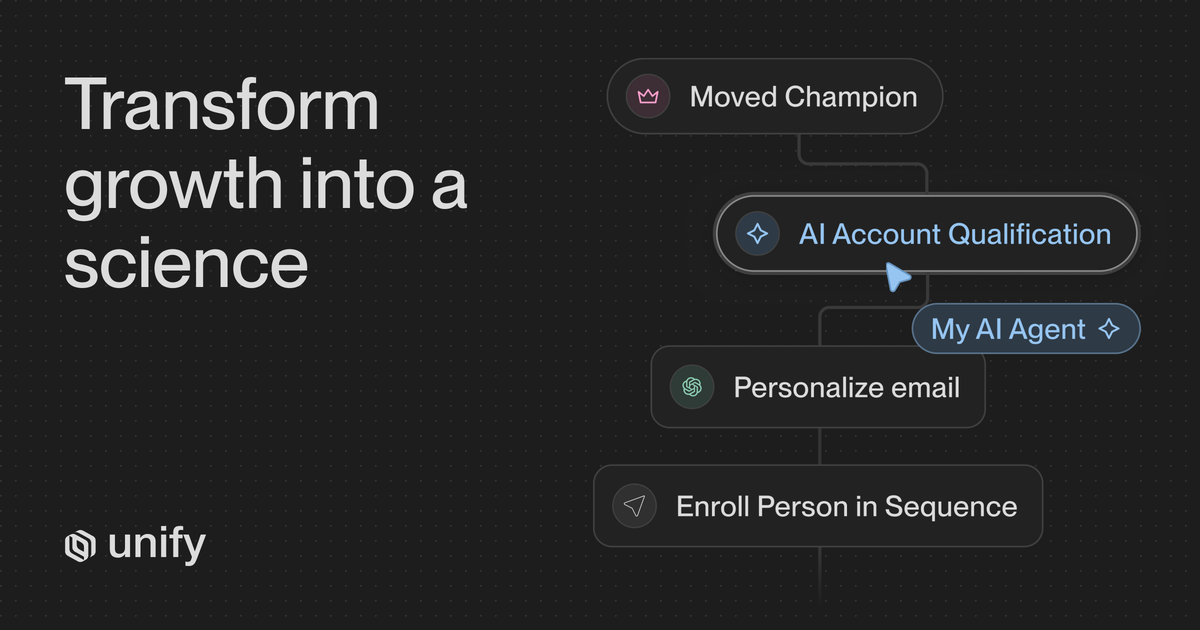 Unify turns intent signals into automated plays that enrich contacts and enroll them in AI-personalized sequences. Self-serve pricing starts free and runs to $60 per seat per month.
Unify vs Salesmotion at a Glance
| Unify | Salesmotion | |
|---|---|---|
| Starting price | Free forever (up to 3 seats) | $85/mo individual, self-serve |
| Paid self-serve | Base $20/seat/mo; Pro $60/seat/mo | $85/mo with no annual commitment |
| Free trial | 14 days on Pro, no credit card | Interactive demo |
| Consumption model | Credit-based (enrichment and AI actions) | No credits |
| Signal source | Website visitors and intent feeds | 1,000+ external public sources |
| Core capability | Automated warm outbound plays | Signals + deep account research + outreach drafting |
The two platforms solve different problems, and after Unify's repricing that difference is the whole comparison. Unify automates the play: a signal fires, contacts get enriched, and AI-personalized sequences go out from managed mailboxes. Its signal set is anchored to your own properties — who visited, who is showing intent, who moved. Salesmotion runs the other half with three AI agents: a Signal Agent monitoring 1,000+ external sources for compelling events, a Research Agent that builds deep account briefs, and an Outreach Agent that drafts messages reps review and send. One optimizes for automated volume against accounts already circling you; the other for informed conversations with accounts that changed for reasons you would otherwise never see.
See Salesmotion on a real account
Book a 15-minute demo and see how your team saves hours on account research.
Key Takeaways
- Unify's free forever plan covers up to 3 seats, which makes it one of the cheapest ways to test warm outbound in the category.
- Base costs $20 per seat per month and Pro $60 per seat per month. Business is quoted.
- Pro includes a 14-day free trial with no credit card required, so you can run a real play before paying anything.
- Credits sit on top of the seat price. Unify publishes email enrichment at 1 credit and a phone number at 4, so a fully enriched contact costs 5.
- G2 reviewers rate Unify 4.7/5 and consistently praise the play builder and deliverability infrastructure.
- The trade-off is coverage, not cost: Unify tells you which accounts are engaging with you, not what changed at the accounts that aren't. Compare account-based alternatives on what they can see, not on entry price.

“Salesmotion helps you spot signals from prospect accounts, news items / job hiring alerts etc that indicate that now is a good time to reach out with a well-crafted message.”
Rob Douglas
Director of Sales, icit business intelligence
Unify GTM Pricing Plans Overview
Unify publishes its self-serve pricing at unifygtm.com/pricing, which is more transparent than most competitors in the category. Only the Business tier is quote-only. Here's the structure as of August 2026:
| Plan | Price | Seats | Trial |
|---|---|---|---|
| Free | $0 forever | Up to 3 | — |
| Base | $20/seat/mo | Per seat | — |
| Pro | $60/seat/mo | Per seat | 14 days, no credit card |
| Business | Custom | Custom | — |
Three things follow from that table.
The Free Plan Is a Real Plan
Three seats, free, indefinitely. That is enough for a founder-led motion or a two-person SDR pod to run plays against their own website traffic without a purchase order. Most platforms in this category gate the equivalent behind a demo call.
Pricing Scales With Headcount, Not Commitment
Base and Pro are per-seat, month to month. There is no minimum term to sign and no annual commitment to negotiate down from, which removes the usual procurement cycle. The flip side of per-seat pricing is the familiar one: the better your adoption, the bigger your bill. We've written before about why per-seat pricing punishes growing teams.
The Trial Removes the Last Excuse
Pro's 14-day trial does not ask for a card. If you want to know whether automated plays work for your motion, you can find out in two weeks for nothing — a materially better evaluation path than any of the quote-only platforms in this comparison.
The Credit System: What Sits On Top of the Seat Price
The seat price is not the whole bill. Unify meters data and AI actions in credits, and those are consumed by plays running automatically in the background.
Unify's published credit rates:
| Action | Credit Cost |
|---|---|
| B2B email enrichment | 1 per email |
| Phone number | 4 per number |
A fully enriched contact — email plus phone — costs 5 credits. That is the arithmetic to run before you scale a play: multiply your expected monthly enrichment volume by 5, not by 1.
The unpredictability compounds because plays run automatically. A play that suddenly matches more accounts (a good thing) burns credits faster (a budgeting problem). Consumption pricing transfers volume risk from the vendor to the buyer: the vendor's revenue grows with your activity, so nothing in the model encourages efficiency. Someone on your team ends up watching a credit dashboard, which is operational overhead the pricing page never mentions.
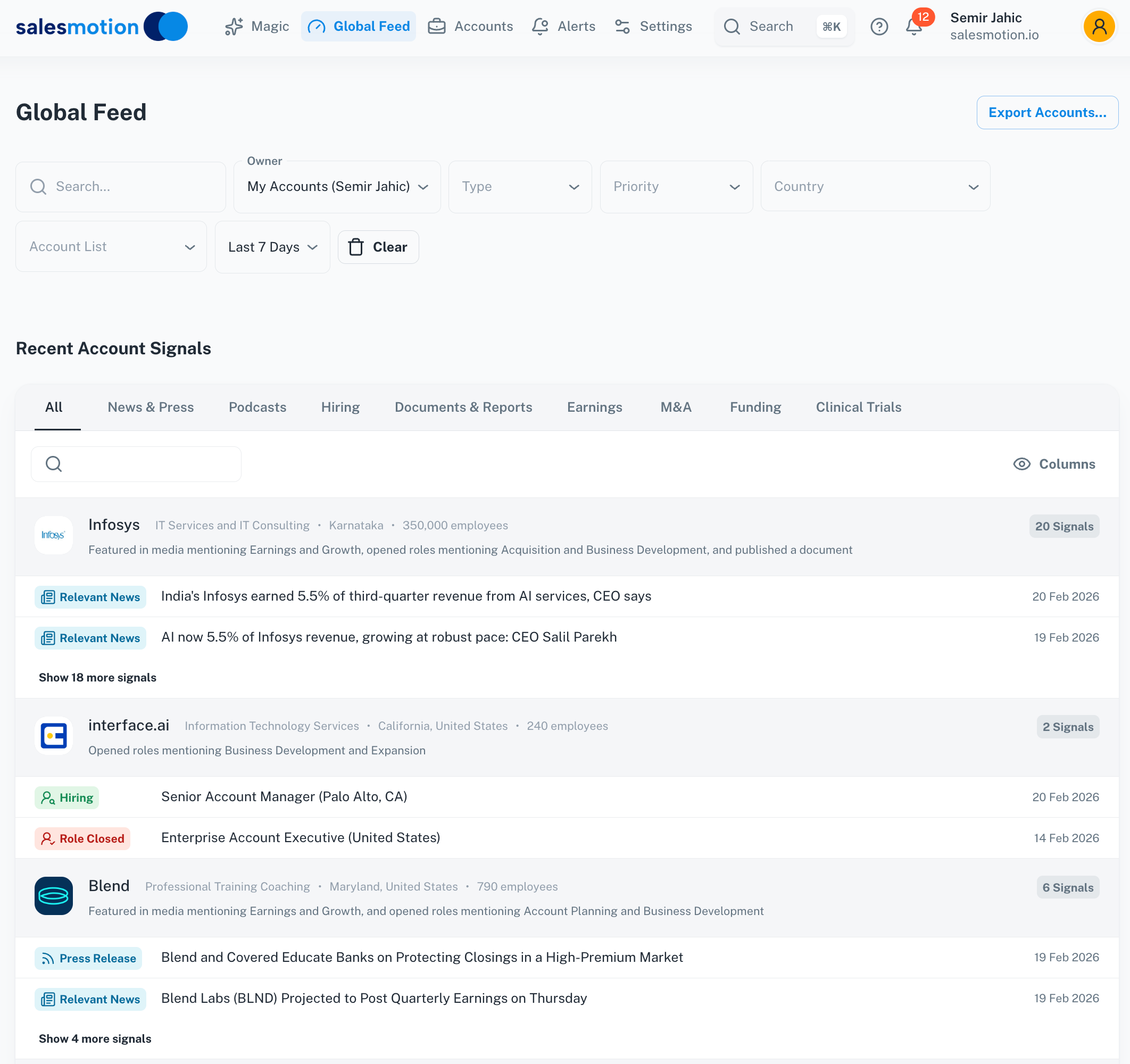 Salesmotion's Global Feed surfaces earnings, hiring, role changes, and news signals across every monitored account. No credit meter runs in the background: monitoring 1,000+ sources is included in the flat price.
This is the sharper contrast with Salesmotion's model than price is. Salesmotion is $85/month for an individual on a self-serve monthly plan with no annual commitment, and custom team pricing with unlimited users on team plans. There is no credit system. Signal monitoring across 50+ signal types, AI research briefs, and outreach drafting are all included, so the cost of using the platform more is zero. Per seat, Unify Base is cheaper. Per unit of usage, Unify's meter keeps running and ours doesn't.

“Automatic account profile detail I can use to manage my territory. Using Salesmotion AI to generate value statements per persona, account, etc. Using Salesmotion to give me a starting point based on new hires, or news alerts is critical.”
Adam Wainwright
Head of Revenue, Cacheflow
Is Unify GTM Worth It in 2026?
For a specific team profile, yes — and the free plan means you no longer have to take our word for it. If you run a product-led or high-velocity motion, want hands-off automated sequences from managed mailboxes, and have meaningful website traffic to work from, Unify is the most polished platform in warm outbound. The deliverability infrastructure is genuinely hard to replicate, and the play builder is the best in its category.
The honest caveats:
- The signals are inbound-shaped. Unify is strongest when the account is already engaging with you — a visit, an intent spike, a champion who moved. If your target list is enterprise accounts that have never touched your website, there is nothing for a play to trigger on.
- The intelligence layer is enrichment-deep. Unify tells you a signal fired and enriches the contact. It doesn't analyze earnings calls, map executive priorities, or build the account context a rep needs for a complex deal. For enterprise sales, a triggered sequence without research behind it is still a cold email.
- Costs scale with success. More matched accounts means more credit burn on top of seats. Budgeting requires modeling play volume, which most teams get wrong in year one.
- Automated sending isn't for everyone. If your buyers are senior executives, sequences from managed mailboxes carry brand risk that rep-reviewed outreach doesn't.
Compare that with the outcomes teams get from research-led, signal-based selling. Frontify grew sales velocity 42% year over year and grew self-sourced revenue 4x after putting account intelligence at the center of its outbound motion. Analytic Partners cut research time from 3 hours to 15 minutes per account and grew qualified pipeline 40% year over year. The lever in both cases wasn't more automated sends. It was reps walking into every conversation already informed.
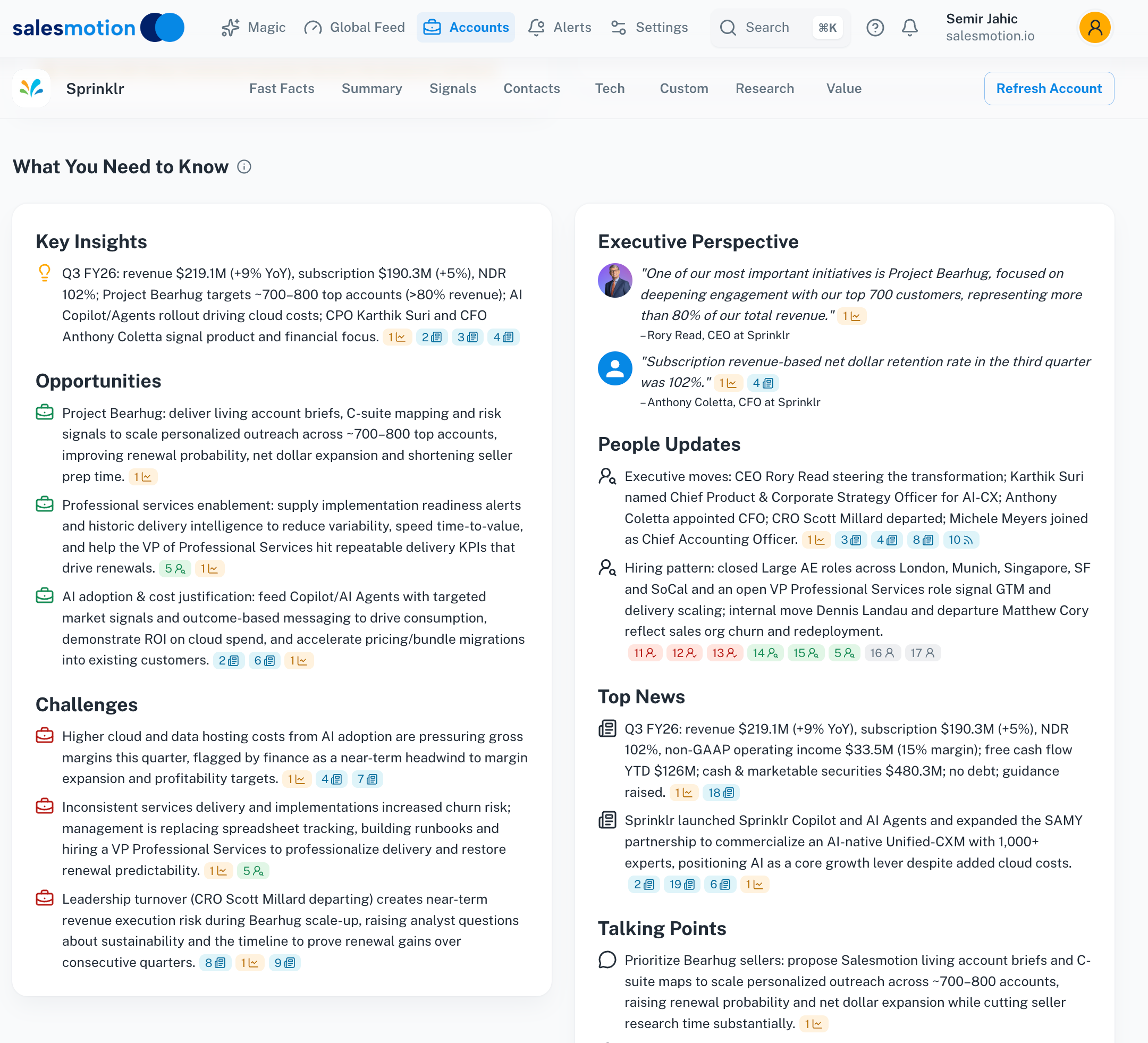 A Salesmotion account brief condenses earnings commentary, executive quotes, people moves, and talking points into one view. This is the research depth behind each touch, not just a trigger for a sequence.
Salesmotion's Take
Unify deserves its reputation, and the repricing was the right call — a free tier and a $20 seat make it easy to say yes to. That also means the interesting question is no longer what it costs. It's what it can see. Unify watches your properties and your intent feeds, which is exactly right when a buyer is already circling you. But most of an enterprise territory never visits your site, and the reason to call them this quarter is happening somewhere else: a new CFO, a restructuring on the earnings call, a hiring surge in the team you sell to. That's the layer we built Salesmotion around — 1,000+ external sources, deep research, and outreach drafting, with the rep making the final call instead of a mailbox farm. If your pipeline problem is converting known interest, buy Unify. If it's finding a reason to reach out at all, that's a different tool.

Semir Jahic
CEO & Co-Founder, Salesmotion
Unify Competitors and Alternatives to Consider
It's worth pricing the rest of the category, if only to see how unusual Unify's transparency now is. The warm-outbound space is also consolidating fast: Koala, one of Unify's closest competitors, was acquired by Cursor and shut down in 2025 (our Koala alternatives guide covers the migration options). That makes vendor diligence part of the pricing decision.
- Salesmotion ($85/mo individual, self-serve monthly; custom team pricing with unlimited users on team plans) runs the signal-to-conversation motion from outside-in: Signal Agent, Research Agent, and Outreach Agent, with reps in control of what goes out. Our full guide to the best Unify alternatives breaks down where it replaces Unify and where it doesn't.
- Clay (free tier; Launch $185/mo, Growth $495/mo) is the build-your-own option with 150+ data providers, though its usage-based pricing develops the same unpredictability at scale.
- Common Room (Essential $2,500/mo billed annually; no free tier) aggregates community and social signals. See our Common Room pricing breakdown and the best Common Room alternatives for that side of the category.
- UserGems and Champify are built around the highest-converting warm signal, job changes and champion movement. UserGems publishes Core at $3,000/mo, Advanced at $6,250/mo and Elite at $12,500/mo. We've compared UserGems pricing and the leading Champify alternatives if champion tracking is your priority.
- Apollo.io (free plan; Basic $49, Professional $79, Organization $119 per user/mo on annual billing) covers the budget end with a contact database plus built-in sequencing.
The pattern across the category: the platforms with published, self-serve pricing (Unify, Clay, Apollo, Salesmotion) meter usage in some form, while the ones with quoted annual contracts (Common Room, UserGems) charge more upfront for predictability. Decide which risk you'd rather hold.
Frequently Asked Questions
How much does Unify GTM cost?
Unify publishes self-serve pricing: a free forever plan for up to 3 seats, Base at $20 per seat per month, Pro at $60 per seat per month, and a custom Business tier. Credits are consumed on top of the seat price for enrichment and AI actions, so real monthly spend depends on how much volume your plays push through.
How do Unify credits work?
Credits are Unify's internal currency for data and actions. Its published rates are 1 credit per B2B email enrichment and 4 credits per phone number, so a contact enriched with both costs 5. Because plays consume credits automatically as they match accounts, monthly burn scales with how well your plays are working rather than with your headcount.
Does Unify have a free trial or free plan?
Both. Unify offers a free forever plan for up to 3 seats, and the Pro plan includes a 14-day free trial that does not require a credit card. That is a more open evaluation path than most platforms in the category, several of which gate everything behind a demo call.
Is Unify GTM worth it?
Unify is worth it for teams with meaningful website traffic and intent data who want fully automated warm outbound at volume — and with a free plan and a no-card trial, the cost of finding out is close to zero. Its managed mailbox infrastructure and play builder lead the category, reflected in a 4.7/5 G2 rating. It's a weaker fit for enterprise teams selling into accounts that never visit their site, for teams that need deep account research behind every touch, and for anyone uncomfortable with automated sequences going out without rep review.
What are the best Unify alternatives?
The best alternative depends on what you're optimizing for. Salesmotion is the strongest pick for teams that need buying signals from outside their own properties, plus deep research and rep-reviewed outreach — a complement to Unify as often as a replacement. Clay suits teams that want maximum workflow flexibility, UserGems and Champify own the job-change signal, Common Room covers community signals, and Apollo is the budget all-in-one. Our Unify alternatives guide compares all five in detail.