
Summer Promo: $39/mo $85 with code SUMMER26 · See pricing →

Alternatives

Top 5 Unify Alternatives in 2026

Compare the best alternatives to Unify (Unify GTM) for signal-based selling, warm outbound, and account intelligence — with honest pricing and fit notes for each.

Semir JahicBy Semir JahicCEO & Co-Founder, SalesmotionLast reviewed
At a glance

How Unify Alternatives Compare

Side-by-side comparison of the key capabilities that matter most.

FeatureSalesmotionClayCommon RoomUserGemsApollo.io
Core ApproachThree AI agents: signals, deep research, outreach draftingBuild-your-own enrichment & workflow automationCommunity & social signal aggregationJob change & champion trackingContact database + built-in sequencing
Signal Coverage1,000+ business & market signal sourcesSignals via 150+ data providers (assemble yourself)Community, social & digital channel signalsJob changes and champion movesJob changes, funding & basic intent
Account ResearchAI-generated briefs from 1,000+ sourcesAI research agent (requires workflow building)Community engagement profilesRelationship context around tracked contactsFirmographics and technographics
OutreachAI-drafted, research-backed messages reps sendVia campaigns and sequencer integrationsWorkflows and alerts into your stackAutomated plays into CRM and sequencerBuilt-in sequences, dialer & AI writing
Ease of SetupLive in minutesSteep learning curve (workflow building)Moderate (channel integrations needed)Moderate (CRM integration setup)Easy self-serve setup
Pricing ModelFlat per-seat, no creditsCredit-based, can spike at scaleFree tier + custom contractsCustom, based on tracked contactsPer-user freemium
Pricing$85/mo for individuals. Custom pricing for teams & enterprise.Free tier; paid from $149/monthFree tier + custom pricingCustom (mid-market to enterprise)Free plan; from $49/user/month
Rating (G2)4.8/54.9/54.5/54.7/54.8/5

Why teams switch from Unify

Unify (unifygtm.com) has quickly become the best-known name in warm outbound. The platform aggregates 25+ intent signal types — website visitors, job changes, G2 activity, champion tracking — and turns them into automated "plays" that enrich contacts and send AI-personalized email sequences from managed mailboxes. With customers like Perplexity, Cursor, and Justworks, it has real traction, and it holds a 4.7/5 rating on G2.

So why look for alternatives? Three reasons come up most often. First, price: Unify's Growth plan starts at $1,740/month billed annually (a $20,000+ yearly commitment), and the month-to-month option at $1,000/month includes just 2,500 credits and a two-play limit. Second, the credit system makes costs hard to predict — enrichment, signals, and AI actions all consume credits at different rates, and G2 reviewers regularly cite surprise burn. Third, depth: Unify automates the play, but its account intelligence is enrichment-level. Teams selling complex deals often need real account intelligence — research briefs, executive priorities, earnings context — not just a triggered sequence.

The category is also consolidating fast: Koala, one of Unify's closest competitors, was acquired by Cursor and shut down in 2025 (see our Koala alternatives guide), which has many teams re-evaluating what they actually need from signal-based selling. The best Unify alternative depends on whether you want automated volume, deeper research, or a specific signal type done exceptionally well.

Why Trust This Guide?

Semir Jahic, CEO & Co-Founder of Salesmotion

I'm Semir Jahic, CEO of Salesmotion. Before founding an account intelligence platform, I spent years in enterprise sales at Salesforce and led revenue teams at Clari. My team and I have evaluated dozens of sales tools firsthand — including the new wave of warm-outbound platforms like Unify. This guide is based on real experience and verified public information, not vendor marketing. We work with sales teams at companies like Analytic Partners, Frontify, and Cytel that run signal-based selling motions every day.

Semir Jahic — CEO & Co-Founder, Salesmotion

Detailed Breakdown

Best Unify Alternatives

An in-depth look at each platform, including features, pricing, and limitations.

1

Salesmotion

Our Pick
G2: 4.8/5 (25 reviews)

Salesmotion is the best Unify alternative for teams that want to run the full signal-based selling motion, not just automate plays. Unify's strength is the automated pipeline from signal to sequence. Salesmotion covers that ground with three AI agents working together: a Signal Agent that monitors 1,000+ sources for buying signals (leadership changes, funding, earnings, hiring, tech adoption), a Research Agent that generates deep account briefs with executive priorities and talking points, and an Outreach Agent that drafts messages anchored to that research — which reps review and send.

The philosophical difference matters: Unify optimizes for automated volume from managed mailboxes, while Salesmotion optimizes for informed, rep-driven conversations. For teams selling complex or enterprise deals, the depth of research behind each touch matters more than the number of automated sends.

The pricing difference is just as stark. Unify's annual Growth plan starts around $1,740/month with credit-based usage on top. Salesmotion is $85/month for individuals, self-serve monthly with no annual commitment, and custom team pricing with unlimited users on team plans — with no credit system to forecast.

Best for:Sales teams that want signals, deep account research, and outreach drafting in one platform — with reps in control of what goes out

Key Features

  • Signal Agent: 24/7 monitoring of 1,000+ business and market signal sources
  • Research Agent: AI-generated account briefs with executive priorities and talking points
  • Outreach Agent: research-backed message drafts with verified contact data
  • Flat per-seat pricing — no credits to manage or forecast
  • Salesforce and HubSpot integration (Enterprise plan)
  • Live in minutes with self-serve onboarding

Limitations

  • Does not send automated email sequences — drafts outreach for reps to review and send
  • No managed mailbox or deliverability infrastructure like Unify
  • No free tier available
Pricing: $85/mo for individuals — flexible monthly billing. Custom pricing for teams and enterprise on request.
2

Clay

G2: 4.9/5Visit site

Clay is the closest alternative to Unify in spirit — both automate outbound workflows triggered by data — but Clay takes a build-your-own approach. Instead of Unify's packaged plays, Clay gives you a spreadsheet-like canvas where you pull data from 150+ providers, waterfall enrichment across sources, run AI research agents, and push results into your sequencer or CRM with custom logic.

For RevOps and growth teams that found Unify's plays too rigid or its credits too opaque, Clay offers more control and a free tier to start. The trade-off is real: Clay has a steep learning curve, and at high volume its credit-based pricing develops the same unpredictability that frustrates Unify customers.

Best for:Growth teams and RevOps professionals who want Unify-style automation with maximum flexibility and control over data sources

Key Features

  • 150+ data enrichment providers in one platform
  • Waterfall enrichment across multiple sources for best coverage
  • Spreadsheet-like interface for custom workflow building
  • AI-powered research agent for personalized outreach
  • Integrations with Salesforce, HubSpot, and 100+ tools
  • Automated prospecting campaigns with custom logic

Limitations

  • Steeper learning curve than Unify's packaged plays — requires workflow building skills
  • Credit-based pricing can get very expensive at scale
  • No managed email deliverability infrastructure
Pricing: Free plan with limited credits. Starter at $149/month. Explorer at $349/month. Pro at $800/month
3

Common Room

G2: 4.5/5Visit site

Common Room overlaps with Unify on signal aggregation but draws from a different well: community and social channels. It tracks engagement across GitHub, Slack, Discord, LinkedIn, and X, identifies the people behind that activity, and routes warm leads to sales with workflows and alerts.

For developer-focused and community-driven companies, Common Room often surfaces higher-quality signals than website-intent platforms — someone actively discussing your product in a community is a stronger indicator than an anonymous page visit. It also has a free tier, making it far more accessible than Unify's entry price. What it doesn't do is run the outbound itself: there are no managed mailboxes or automated sequences.

Best for:Developer-focused and community-driven companies that want person-level signals from digital communities at an accessible price

Key Features

  • Signal aggregation from GitHub, Slack, Discord, Twitter/X, and more
  • Person-level identification from community activity
  • Automated workflows and alerts for sales teams
  • CRM and sales tool integrations
  • Custom engagement scoring across channels
  • Free tier available for smaller communities

Limitations

  • No native sequencing or managed email sending like Unify
  • Most valuable for companies with active digital communities
  • No deep account research or briefing capabilities
Pricing: Free tier for small communities. Paid plans with custom enterprise pricing based on signal volume
4

UserGems

G2: 4.7/5Visit site

UserGems is the specialist play: instead of Unify's 25+ signal types, it goes deep on the single highest-converting warm signal — job changes. It monitors when your customers, champions, and past buyers move to new companies, auto-creates CRM records, and triggers plays so reps reach out while the relationship is still warm.

Unify includes champion tracking as one signal among many; UserGems makes it the entire product, with deeper coverage and more automation around it. For teams with an established customer base, tracked champions routinely convert at multiples of cold outreach. It's a complement to broader intelligence platforms rather than a full replacement for Unify's outbound engine.

Best for:Sales teams with an established customer base that want to turn job changes and champion moves into warm pipeline automatically

Key Features

  • Automatic tracking of customer and prospect job changes
  • CRM auto-updates when tracked contacts move companies
  • Past customer identification at new target accounts
  • Champion tracking across your entire contact database
  • Salesforce and HubSpot native integration
  • Automated pipeline creation from job change signals

Limitations

  • Narrow focus on job changes — no website intent or broader signal coverage
  • Requires a meaningful existing customer base to maximize value
  • No account research or general intelligence capabilities
Pricing: Custom pricing based on number of tracked contacts. Typically mid-market to enterprise pricing
5

Apollo.io

G2: 4.8/5Visit site

Apollo.io is the budget-friendly alternative for teams that want Unify's core loop — find the right people, reach out across channels — without the five-figure annual commitment. It combines a 275M+ contact database with built-in email sequences, a dialer, job change alerts, funding signals, and basic intent data, all on transparent per-user pricing with a free tier.

Apollo's signals are shallower than Unify's (no person-level website intent, no managed deliverability infrastructure), and its AI personalization is more basic. But for SMB and mid-market teams testing signal-based outbound, it delivers most of the workflow at a tenth of the cost.

Best for:SMB and mid-market teams that need an affordable all-in-one platform to identify, contact, and engage target accounts

Key Features

  • 275M+ contact database with global coverage
  • Built-in email sequences, dialer, and meeting scheduler
  • Job change alerts and funding signals
  • AI email writing assistant
  • Free tier with generous credits
  • Chrome extension for LinkedIn prospecting

Limitations

  • No person-level website intent or signal orchestration like Unify
  • No managed mailbox infrastructure — deliverability is on you
  • Account intelligence limited to firmographics
Pricing: Free plan available. Basic from $49/user/month. Professional from $79/user/month. Organization from $119/user/month

Customer Story

How Analytic Partners increased pipeline 40% and accelerated Fortune 500 deals

40%

more qualified pipeline

$1M+

Fortune 500 pipeline

85%

less research time

We're no longer fishing. We know who the right customers are, and we can qualify them quickly. Salesmotion has had a direct impact on pipeline quality.

Andrew Giordano

Andrew Giordano

VP of Global Commercial Operations, Analytic Partners

Read the full case study

Founder's Take

Unify is the most polished of the warm-outbound platforms — the signal-to-play automation is genuinely impressive, and customers like Perplexity and Cursor prove it works at scale. But automating plays only answers half the question. A signal tells you when to reach out; it doesn't tell you what to say. The teams we see win consistently pair signals with deep account research, so every message lands with context — and they keep a rep in the loop instead of blasting automated sequences from managed mailboxes. That's the motion we built Salesmotion around: signals, research, and outreach drafting working together, with the rep making the final call.
Semir Jahic

Semir Jahic

CEO & Co-Founder, Salesmotion

Summary

Key Takeaways

  1. 1Unify excels at automated warm outbound: 25+ intent signal types trigger plays that enrich contacts and send AI-personalized sequences from managed mailboxes. If you want hands-off volume, it remains a strong choice.
  2. 2The most common reasons teams look elsewhere are cost (the annual Growth plan starts around $1,740/month billed annually) and unpredictable credit burn, which makes monthly spend hard to forecast.
  3. 3Salesmotion runs the full motion rather than just automating plays — a Signal Agent monitoring 1,000+ sources, a Research Agent generating deep account briefs, and an Outreach Agent drafting messages reps review and send. At $85/month self-serve, it's a fraction of Unify's entry price.
  4. 4Clay is the best alternative for teams that want Unify-style automation with more flexibility — 150+ data providers and custom workflows, at the cost of a steeper learning curve.
  5. 5UserGems is the strongest pick if your highest-value signal is job changes — it tracks champions and past customers moving to new accounts and turns them into warm pipeline automatically.
  6. 6Common Room and Apollo cover the budget-conscious end: Common Room for community and social signals with a free tier, Apollo for an affordable all-in-one database plus sequencing.
An honest take

Where Salesmotion isn't the right fit

We'd rather you pick the right tool than the wrong one. Salesmotion isn't for everyone — here's when another option on this page is the smarter call.

  • You need a built-in email sequencer or dialer. Salesmotion is account intelligence, not a sending tool — it's built to sit alongside Outreach, Salesloft, or Apollo, not replace them.
  • You're buying purely for raw contact volume. Dedicated data vendors like ZoomInfo and Apollo carry larger raw contact databases.
  • You want a free-forever tier. Salesmotion starts at $85/mo for individuals — there's no free plan.
  • Your motion is pure high-volume SMB outbound. The depth pays off most on considered, higher-ACV deals where understanding the account actually changes the conversation.

Ready to see a better way to sell?

Salesmotion replaces hours of manual research with real-time account intelligence your reps can use today.

Product

See Salesmotion in Action

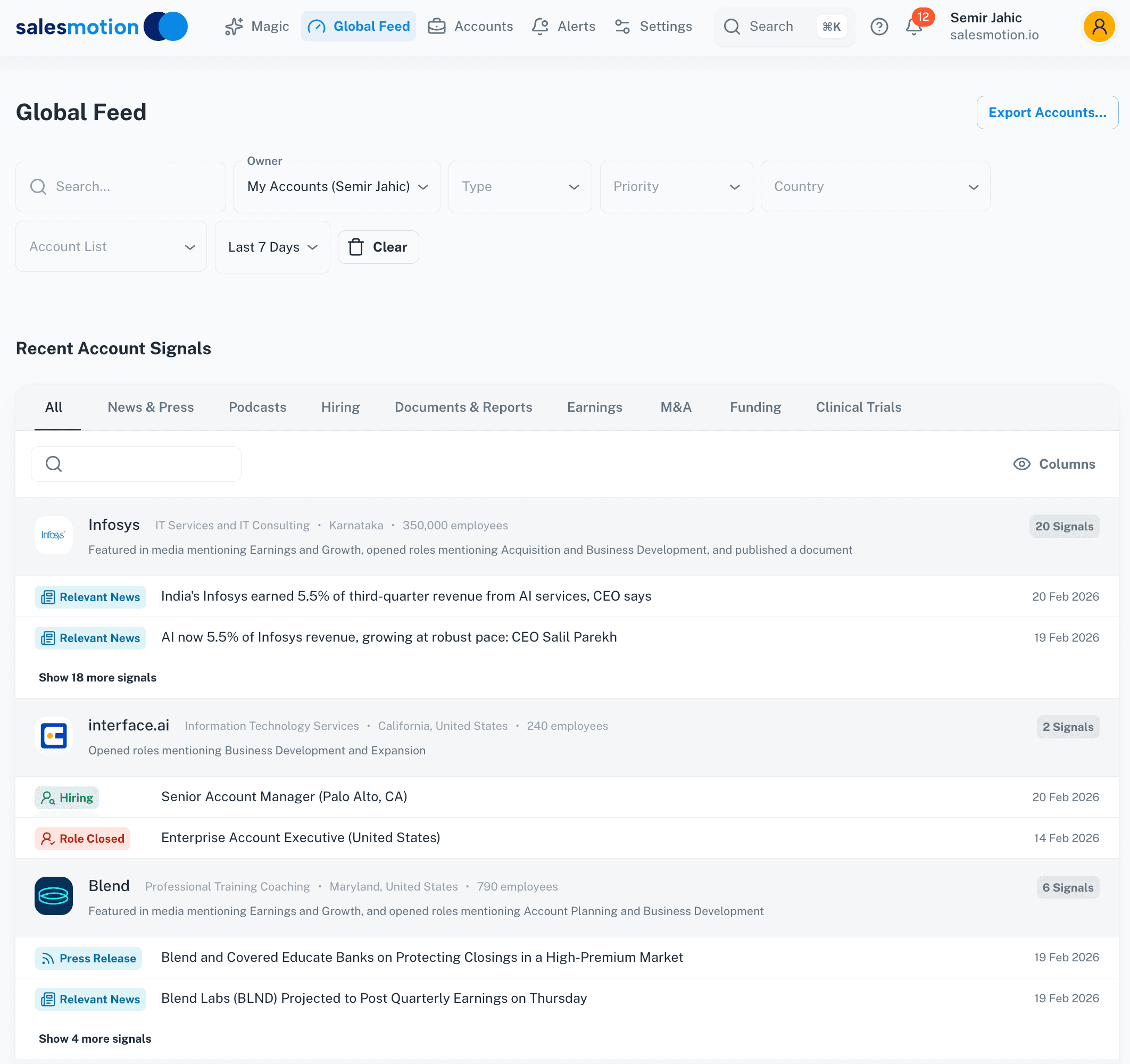
Salesmotion Signal Agent feed showing real-time buying signals across target accounts
The Signal Agent monitors 1,000+ sources so reps see every buying signal in one feed.
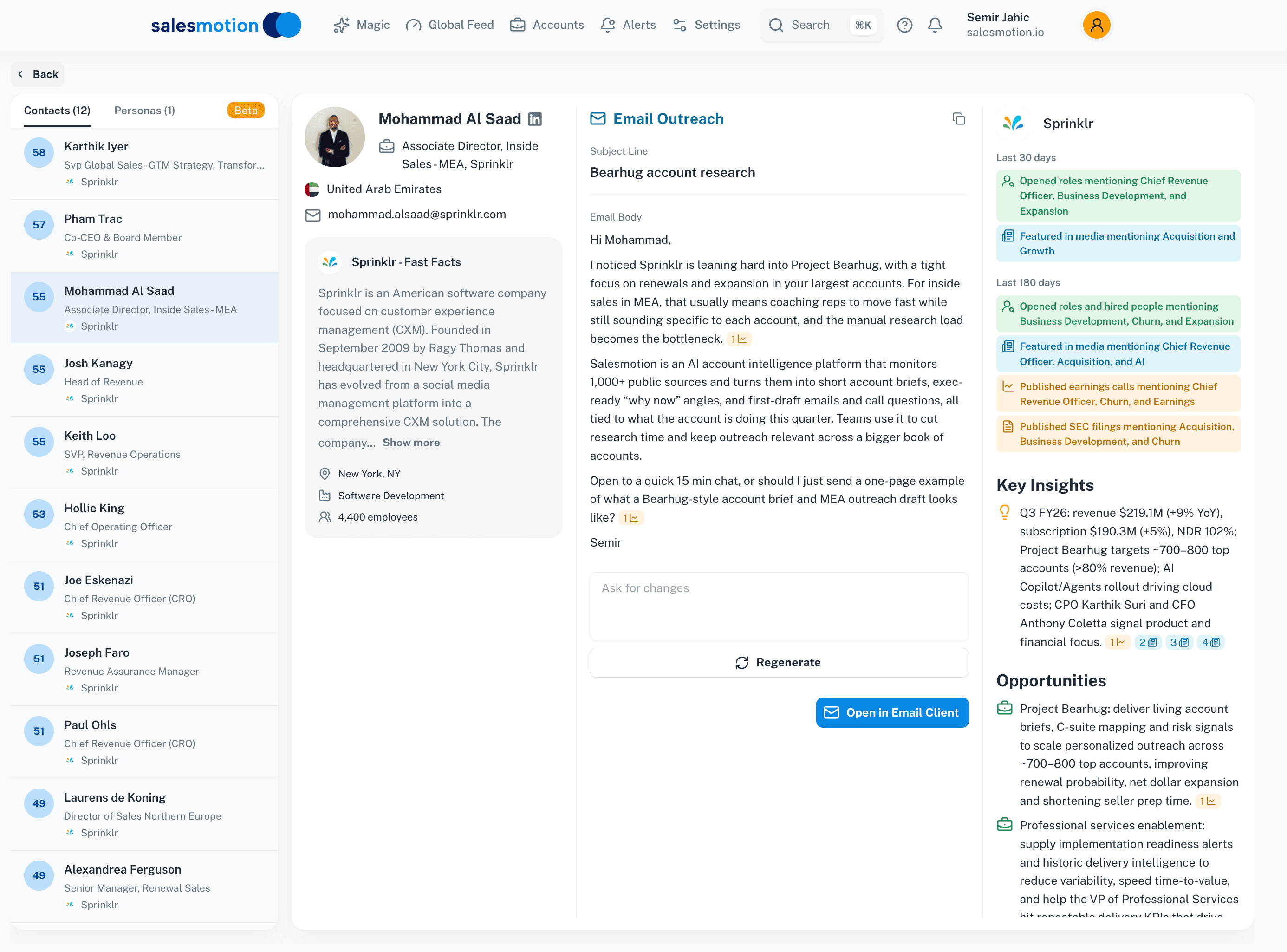
Salesmotion Outreach Agent drafting a research-backed email to a prospect
The Outreach Agent drafts messages grounded in account research — reps review and send.
FAQ

Frequently Asked Questions

How much does Unify cost?

Unify's published Growth plan starts at $1,740/month billed annually (a $20,880/year commitment) with 50,000 annual credits, 1 user, and 8 managed Gmail mailboxes. A month-to-month Growth option starts at $1,000/month but includes only 2,500 credits and a maximum of 2 active plays. Pro and Enterprise tiers are custom-priced. Additional users cost $100/seat/month on annual plans. Actual spend varies with credit consumption — enrichment, signals, and AI actions each burn credits at different rates — so buyer-reported totals are often higher than list price. Unify does not offer a free plan.

What is the best Unify alternative for signal-based selling?

Salesmotion is the best Unify alternative for signal-based selling when conversation quality matters as much as signal coverage. It pairs a Signal Agent monitoring 1,000+ sources with a Research Agent that builds deep account briefs and an Outreach Agent that drafts research-backed messages — at $85/month self-serve instead of a $20,000+ annual commitment. If your priority is fully automated sending at volume, Clay (flexible workflows) or Apollo (affordable all-in-one) are closer functional matches.

Can Salesmotion fully replace Unify?

It depends on which part of Unify you rely on. Salesmotion replaces — and goes deeper on — the intelligence layer: signal monitoring, account research, and outreach drafting. It does not replicate Unify's automated sending infrastructure (managed mailboxes, deliverability rotation, autonomous sequences). Teams that want a rep reviewing every message before it goes out usually find Salesmotion is the better fit; teams committed to hands-off automated volume may want to keep a sequencer alongside it.

What is the cheapest Unify alternative?

Apollo.io has a free plan and paid tiers from $49/user/month, making it the cheapest way to run signal-triggered outbound with a built-in database and sequencer. Common Room and Clay both offer free tiers for their core signal and enrichment features. Salesmotion is $85/month for individuals on a self-serve monthly plan with no annual commitment — significantly below Unify's $1,000+/month entry point — with custom team pricing and unlimited users on team plans.

What happened to Koala, and is Unify affected?

Koala, one of Unify's closest competitors in warm outbound and visitor identification, was acquired by Cursor in July 2025 and shut down its GTM platform — see our Koala alternatives guide for migration options. Unify itself is unaffected and continues to grow, but the consolidation is a reminder to weigh vendor stability and data portability when committing to an annual contract in this fast-moving category.

Related Comparisons

Explore more head-to-head comparisons and alternatives guides.

Give every rep three AI agents to build more pipeline.

A Signal Agent, Research Agent, and Outreach Agent — working 24/7 so your team spends less time researching and more time closing.