
Alternatives

Top 5 Pocus Alternatives in 2026

Compare the best alternatives to Pocus for product-led sales, signal-based selling, and pipeline prioritization.

At a glance

How Pocus Alternatives Compare

Side-by-side comparison of the key capabilities that matter most.

FeatureSalesmotionCommon Room6senseZoomInfoDemandbase
Signal Types1,000+ business & market signal sourcesCommunity, social & digital channel signalsAnonymous web intent + AI predictionsIntent data + company newsProprietary intent + Bombora + engagement
Product Usage DataNot focused on product analyticsLimited product data integrationThird-party intent (not product usage)Not focused on product analyticsNot focused on product analytics
Account IntelligenceAI-generated briefs from 1,000+ sourcesCommunity engagement profilesPredicted buying stagesFirmographics, org charts & technographicsAccount-level insights & intent data
Scoring & PrioritizationSignal-based prioritization with contextEngagement scoring across channelsAI buying stage predictionsIntent scoringEngagement minutes + intent scoring
Contact DataVerified contacts with account contextPerson identification from communityContact data included321M+ contactsContact data included
Ease of SetupLive in minutesModerate (channel integrations needed)Complex (weeks to months)Moderate setupComplex (weeks to months)
PricingFrom $85/mo (account-based, unlimited users on team plans)Free tier + custom pricing$60,000-$100,000+/yearFrom ~$15,000/year per user$50,000-$150,000+/year

Why teams switch from Pocus

Pocus carved out a valuable niche as the product-led sales (PLS) platform, helping sales teams prioritize accounts based on product usage signals. For companies with a freemium product or free trial, Pocus provides a critical bridge between product data and sales action, identifying which accounts are most likely to convert or expand based on how they actually use the product.

However, as organizations mature and expand beyond pure product-led growth, many teams find Pocus's focus on product signals too narrow. The most common reasons teams look for alternatives include needing buying signals beyond product usage (such as market events, leadership changes, or strategic initiatives), wanting deeper account intelligence to support outbound and enterprise selling, and scaling into markets where product-led motions are less relevant.

The best Pocus alternatives in 2026 provide broader signal coverage and deeper account context while maintaining the prioritization and scoring capabilities that made Pocus valuable. The right choice depends on whether your go-to-market is primarily product-led or increasingly sales-led and outbound.

Detailed Breakdown

Best Pocus Alternatives

An in-depth look at each platform, including features, pricing, and limitations.

1

Salesmotion

Our Pick
G2: 4.8/5 (25 reviews)

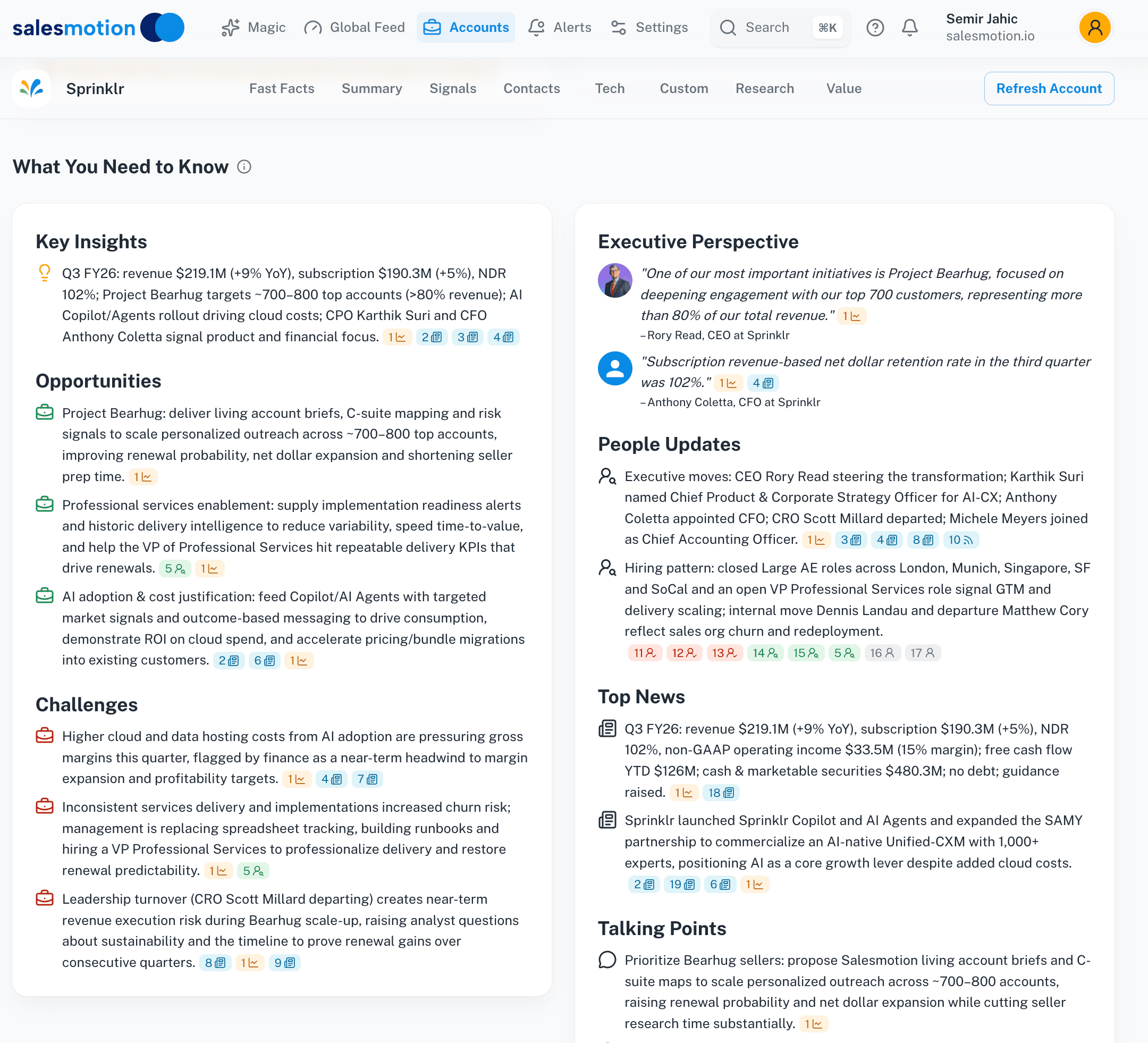
Salesmotion is the best Pocus alternative for teams that need buying signals and account intelligence beyond product usage data. While Pocus helps you understand what accounts are doing inside your product, Salesmotion helps you understand what accounts are doing in the broader market: what they are investing in, what their leadership is saying, what competitive changes they are navigating, and what business initiatives create an opening for your solution.

This makes Salesmotion particularly valuable as companies move beyond pure PLG into outbound and enterprise selling, where product usage data alone is not enough to drive conversations. The platform monitors over 1,000 sources and generates AI-powered research briefs with personalized talking points for every account.

For teams graduating from Pocus, Salesmotion provides the broader intelligence layer needed to sell effectively beyond your existing user base into net-new accounts.

Best for:Teams expanding beyond PLG that need broad account intelligence for outbound and enterprise selling

Key Features

  • AI-generated account briefs from 1,000+ sources
  • Real-time monitoring of leadership changes, funding, earnings, tech adoption, and hiring
  • Personalized talking points and outreach drafts for enterprise conversations
  • Salesforce and HubSpot integration (Enterprise plan)
  • Account-based pricing with no per-seat limits
  • Effective for both inbound prioritization and outbound prospecting

Limitations

  • Does not ingest product usage data for PLS scoring
  • Not designed for pure product-led sales motions
  • No free tier available
Pricing: From $85/mo — flexible account-based pricing, unlimited users on team plans
2

Common Room

G2: 4.5/5Visit site

Common Room is the most natural alternative to Pocus for teams that want to track engagement signals beyond product usage. While Pocus focuses on product analytics, Common Room aggregates signals from community channels (GitHub, Slack, Discord), social media (Twitter/X, LinkedIn), and other digital touchpoints. This provides a broader view of who is engaging with your brand and ecosystem.

For developer-focused and community-driven companies, Common Room often provides more diverse signal coverage than Pocus. The platform identifies individuals within target accounts based on their community engagement, making it useful for finding warm leads beyond your product user base.

Best for:Developer-focused and community-driven companies that want to aggregate engagement signals from digital communities

Key Features

  • Signal aggregation from GitHub, Slack, Discord, Twitter/X, and more
  • Person-level identification from community activity
  • Automated workflows and alerts for sales teams
  • CRM and sales tool integrations
  • Custom engagement scoring across channels
  • Free tier available for smaller communities

Limitations

  • Does not track product usage data like Pocus
  • Most valuable for companies with active digital communities
  • No traditional account research or contact data capabilities
Pricing: Free tier for small communities. Paid plans with custom enterprise pricing based on signal volume
3

6sense

G2: 4.3/5Visit site

6sense is the enterprise-grade alternative to Pocus for organizations that want AI-predicted buying intent across their entire addressable market. While Pocus scores based on your product data, 6sense uses anonymous web behavior, content consumption patterns, and AI to predict which accounts are in-market to buy, even if they have never tried your product.

For companies scaling beyond PLG into enterprise ABM motions, 6sense provides a comprehensive platform that includes advertising, web personalization, and predictive analytics. The trade-off is dramatically higher cost and implementation complexity.

Best for:Enterprise organizations transitioning from PLG to ABM that need predictive intent data and advertising capabilities

Key Features

  • AI-predicted buying stages for target accounts
  • Anonymous web intent detection across the broader internet
  • Account-based advertising and web personalization
  • Revenue AI for pipeline forecasting
  • Contact data and enrichment
  • Integration with CRMs, MAPs, and ad platforms

Limitations

  • Dramatically more expensive than Pocus
  • Complex multi-month implementation
  • Does not incorporate product usage data in its models
Pricing: Custom enterprise pricing. Typically $60,000-$100,000+/year depending on feature tier
4

ZoomInfo

G2: 4.5/5Visit site

ZoomInfo is the contact data-first alternative to Pocus, providing the largest B2B database alongside intent signals and engagement tools. For teams that used Pocus primarily for account prioritization and then needed to find and contact decision-makers, ZoomInfo solves the latter problem with 321M+ contacts, org charts, and direct dials.

ZoomInfo's intent data provides some account prioritization capability, though it is based on content consumption rather than product usage. For teams expanding from PLG into outbound sales, ZoomInfo provides the contact data foundation needed to reach accounts that are not yet in your product.

Best for:Teams expanding into outbound sales that need a comprehensive contact database to reach accounts beyond their product user base

Key Features

  • 321M+ contacts with direct dials, emails, and org charts
  • Intent data based on content consumption signals
  • Technographic data showing installed technologies
  • ZoomInfo Engage for sequencing and calling
  • Advanced search with hundreds of filter criteria
  • Website visitor identification (add-on)

Limitations

  • No product usage signal integration
  • Intent data is less actionable than Pocus's product-based signals
  • Expensive per-seat pricing not ideal for growing teams
Pricing: Custom pricing starting around $14,995/year per user. Enterprise plans $25,000-$60,000+/year
5

Demandbase

G2: 4.3/5Visit site

Demandbase is the full ABM platform alternative to Pocus for organizations ready to invest in enterprise-grade account-based marketing. It combines proprietary intent data, advertising, web personalization, and sales intelligence into a comprehensive suite. For companies that have outgrown PLG and want to run sophisticated ABM programs targeting enterprise accounts, Demandbase provides the full toolkit.

Demandbase's engagement minutes metric provides a different kind of account scoring than Pocus's product usage data, measuring how actively an account is engaging across all of your marketing and sales touchpoints. This can complement product signals for teams running hybrid PLG and sales-led motions.

Best for:Organizations that want a full ABM platform with advertising, intent data, and sales intelligence for enterprise go-to-market

Key Features

  • Account-based advertising with DSP capabilities
  • Proprietary intent data plus Bombora integration
  • Account identification and web personalization
  • Engagement minutes scoring across all touchpoints
  • Sales intelligence with account insights
  • Integration with Salesforce, HubSpot, and Marketo

Limitations

  • Very high cost compared to Pocus
  • Complex implementation requiring dedicated ABM operations
  • Does not incorporate product usage data natively
Pricing: Custom enterprise pricing. Typically $50,000-$150,000+/year depending on modules and account volume

Customer Story

How Cacheflow reduced prep time by 60% and tripled deal sizes

60%

less prep time

3x

deal sizes

Hours

saved per week

The moment we turned on Salesmotion, it became essential. No more hours on LinkedIn or Google to figure out who we're talking to. It's just there, served up to you, so it's always 'go time.'

Adam Wainwright

Adam Wainwright

Head of Revenue, Cacheflow

Read the full case study

Ready to see a better way to sell?

Salesmotion replaces hours of manual research with real-time account intelligence your reps can use today.

FAQ

Frequently Asked Questions

Do I still need Pocus if I am expanding beyond product-led growth?

It depends on how important product usage signals remain to your selling motion. If most of your pipeline still starts with free trial or freemium users, Pocus continues to provide value. However, if you are increasingly relying on outbound prospecting and enterprise sales, a broader platform like Salesmotion that provides intelligence across all accounts (not just product users) may be a better primary investment. Many teams in transition use both.

What is the best Pocus alternative for outbound sales?

Salesmotion is the best Pocus alternative for outbound sales because it provides deep account intelligence from 1,000+ sources, giving reps the context they need to craft relevant outreach to accounts that have never used your product. For teams that also need a large contact database, ZoomInfo or Apollo provide the contact data to pair with intelligence-driven outreach.

Can I replace Pocus with 6sense or Demandbase?

6sense and Demandbase offer account prioritization through intent data, which can partially replace Pocus's product usage scoring. However, neither platform ingests product usage data natively, so you would lose the granular product engagement signals that make Pocus unique. If your product data is critical, keep Pocus and add a broader tool. If you are moving to an ABM-first strategy, 6sense or Demandbase can replace the prioritization function.

Is Common Room a good complement to Pocus?

Yes, Common Room and Pocus are highly complementary. Pocus tracks product usage signals (feature adoption, usage frequency) while Common Room tracks community engagement signals (GitHub, Slack, social media). Together, they provide a comprehensive view of individual and account engagement for PLG companies with active communities. Many developer-focused companies run both platforms.

How does Salesmotion compare to Pocus for account scoring?

Pocus scores accounts based on product usage data and custom models from your data warehouse, making it ideal for conversion and expansion predictions within your existing user base. Salesmotion provides signal-based prioritization from 1,000+ external sources, making it effective for both existing accounts and net-new targets. Salesmotion's approach works regardless of whether an account has used your product.

Related Comparisons

Explore more head-to-head comparisons and alternatives guides.

Your reps are researching. They should be selling.

Join the top-performing sales teams using Salesmotion to build more pipeline and close more deals.

Book a demo