Most B2B marketing leaders know ABM works. 71% of organizations now run some form of account-based marketing program. But the question that stalls budget conversations isn't whether to invest in ABM. It's how much ABM platforms actually cost, and whether the price tag matches the value.
The answer is more complicated than a pricing page. The premium vendors publish no pricing at all, the mid-market ones publish partial pricing, and ad spend, implementation, and data subscriptions land on top of whatever you sign. And the sticker price rarely tells the full story.
TL;DR: Demandbase and 6sense sit at the premium end and publish no pricing; Vendr's marketplace data puts their median annual contracts at $68,591 and $62,220 respectively. AdRoll ABM (formerly RollWorks) and DemandScience (which Terminus merged into) serve the mid-market and do not publish ABM pricing either. Hidden costs like implementation, ad spend, and data enrichment can double your total investment. For teams that need the account intelligence layer without a full ABM stack, alternatives offer flexible account-based pricing starting at $85/month.
What You're Actually Paying For: ABM Platform Components
ABM platforms aren't monolithic products. They're bundles of capabilities, each with its own cost implications. Understanding the components helps you avoid paying for features you won't use.
Account identification and targeting is the foundation. This includes IP-to-account resolution, firmographic filtering, and account list management. Most platforms include this in their base tier.
Intent data is where costs climb. First-party intent (tracking your website visitors) is typically included. Third-party intent from providers like Bombora or TechTarget comes either bundled or as an add-on, and neither publishes a rate card, so it is a line item you have to negotiate for separately. This capability tells you which accounts are actively researching topics related to your solution.
Advertising and demand generation modules vary the most across vendors. Demandbase operates its own B2B DSP (demand-side platform), while others rely on integrations with LinkedIn, Google, and programmatic networks. Ad platform access can run $20,000 to $100,000+ depending on impressions and channels.
Sales intelligence and activation includes features like buying committee mapping, account research automation, CRM integrations, and rep-facing dashboards. This is the bridge between marketing-identified accounts and sales execution.
Analytics and attribution rounds out the stack. Multi-touch attribution, pipeline influence reporting, and ROI dashboards help justify the investment. These features are increasingly table stakes, but depth varies by tier.
The critical question isn't which vendor has the most features. It's which components actually drive revenue for your specific go-to-market motion.
ABM Platform Pricing Comparison: What to Budget for 2027
Here's what you can expect to pay across the major ABM platforms, based on third-party data from Vendr, G2, and verified user reports.
| Platform | Annual Cost Range | Pricing Model | Best For |
|---|---|---|---|
| Demandbase | Not published; Vendr median $68,591 | Platform fee + flat fee per user | Enterprise ABM with native B2B advertising |
| 6sense | Not published; Vendr median $62,220 | Custom, quote-only | Predictive analytics and intent-driven ABM |
| Terminus (now DemandScience) | Does not publish pricing | Quote only | Multi-channel ABM orchestration |
| AdRoll ABM (formerly RollWorks) | Does not publish pricing | ABM packages by demo; retargeting has no platform fee, you pay for media | Ad-led ABM for mid-market teams |
| HubSpot ABM | $43,200/yr (Marketing Hub Enterprise) | Included in suite | Teams already on HubSpot |
| Triblio | Contact vendor | Contact vendor | Content-led ABM programs |
| Salesmotion | From $85/mo | Account-based, unlimited users on team plans | Account intelligence and signal monitoring |
These ranges reflect typical mid-market deployments. Enterprise contracts with large account lists, premium intent data, and high ad volumes routinely exceed the upper bounds.

“We're no longer fishing. We know who the right customers are, and we can qualify them quickly. Salesmotion has had a direct impact on pipeline quality.”
Andrew Giordano
VP of Global Commercial Operations, Analytic Partners
Detailed Pricing Breakdown by Platform
Demandbase: Not Published; Vendr Median $68,591 Per Year
Demandbase does not publish pricing. Its pricing page describes the model as a platform fee plus a flat fee per user across the Demandbase One platform. Vendr reports a median annual contract of $68,591 across 187 purchases, with individual deals spanning $24,000 to $164,037.
What drives cost up: Demandbase operates the only B2B-native demand-side platform for advertising. If your ABM strategy is ad-heavy, this is a genuine differentiator, but it also means advertising budgets layer on top of platform fees. Companies spending $50,000+ on programmatic B2B ads annually will see meaningful value from Demandbase's targeting precision.
Strengths: Largest first-party intent dataset (2T+ signals/month), native advertising DSP, strong account identification.
Watch out for: Multi-year contract pressure, add-on costs for premium intent data, minimum ad spend requirements.
6sense: Not Published; Vendr Median $62,220 Per Year
6sense positions itself as the predictive analytics leader in ABM, using buying stage predictions and intent signals to identify which accounts are in-market. It does not publish pricing, and it retired its old Team/Growth/Enterprise tiers in May 2025 in favour of packages built around Sales Intelligence, data credits, and predictive AI.
Vendr reports a median annual contract of $62,220 across 386 purchases, with deals running from $11,234 to $176,511. A HockeyStack analysis noted that 6sense's full suite often prices above Demandbase for equivalent coverage.
Strengths: Industry-leading predictive analytics, buying stage scoring, granular intent signals.
Watch out for: Package structure that pushes you toward data credits you have to forecast, reliance on third-party DSPs for advertising, complex implementation.
Terminus (Now DemandScience): No Published Pricing
Terminus merged into DemandScience in November 2024, and the combined company operates under the DemandScience brand. The terminus.com site now redirects to DemandScience, which does not publish pricing, so the cost is whatever your quote says.
Strengths: Multi-channel ABM orchestration combined with DemandScience's buyer data and demand generation programs.
Ask about: Which former Terminus capabilities are included in the DemandScience package you are quoted, and how they are priced.
RollWorks (Now AdRoll ABM): No Published Pricing
RollWorks is now AdRoll ABM, sold under the AdRoll brand. AdRoll's pricing page lists its ABM packages (Account-Based Advertising, Account-Based Marketing, and the two combined) by demo request without dollar figures. Account-Based Retargeting has no fee to get started and you pay only for media.
Strengths: A retargeting entry point with no platform fee, self-serve advertising options, good for teams running their first ABM program.
Keep in mind: AdRoll ABM is built around account-based advertising. Teams that need account research and sales signals usually pair it with an intelligence layer.
HubSpot ABM: Included in Marketing Hub Enterprise ($43,200/Year)
HubSpot's ABM tools are bundled into Marketing Hub Enterprise at $3,600/month. For teams already invested in HubSpot's ecosystem, this eliminates the need for a standalone ABM platform. Features include target account dashboards, company scoring, buying role tracking, and account-level reporting.
Strengths: No incremental ABM cost for existing HubSpot Enterprise customers, native CRM integration, familiar interface.
Watch out for: Intent data requires third-party integrations, advertising capabilities limited to LinkedIn and Google Ads, less sophisticated predictive scoring than dedicated ABM platforms.
The Account Intelligence Alternative
Not every team needs a full ABM stack. Many organizations already have marketing automation, CRM, and advertising in place. What they lack is the account intelligence layer: knowing which accounts are worth pursuing, why they're worth pursuing right now, and what to say when you reach them.
Salesmotion fills this specific gap with flexible, account-based pricing starting at $85/month — scaling by accounts monitored, not headcount. Instead of replacing your entire MarTech stack, it sits alongside your existing tools and monitors 1,000+ sources for buying signals: leadership changes, earnings commentary, strategic initiatives, hiring patterns, funding rounds, and competitive moves. With unlimited users on team plans, every rep gets access without per-seat negotiations. Teams like Analytic Partners saw qualified pipeline increase 40% by adding this signal layer to their existing go-to-market motion.
This isn't a full ABM platform. It's the research and intelligence component that most ABM buyers actually need, at a fraction of the cost.
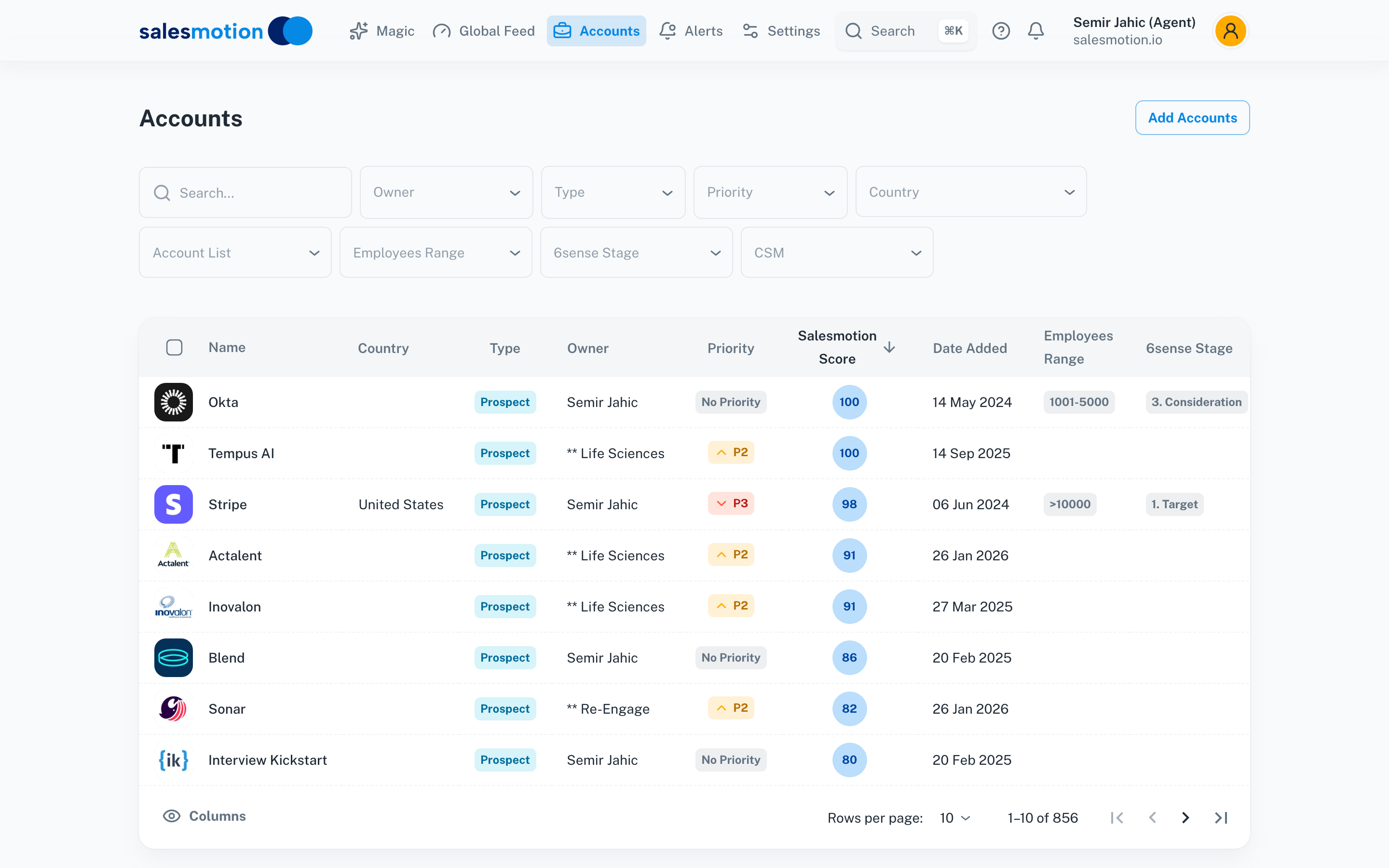 Salesmotion provides the account intelligence layer of ABM at $85/month — deep research, signal monitoring, and scoring without the six-figure platform cost.
Hidden Costs That Inflate Your ABM Budget
The platform subscription is typically 40-60% of your total ABM investment. Here's where the rest goes.
Implementation and onboarding ranges from $5,000 to $50,000 depending on platform complexity. Demandbase and 6sense implementations are guided onboardings, not self-serve. Advertising-led platforms like AdRoll ABM are lighter to stand up.
Ad spend is the silent budget killer. ABM advertising platforms require media budgets on top of software fees. Most effective programs allocate $3,000-$15,000/month in ad spend, adding $36,000-$180,000 annually. This is separate from your platform subscription.
Data enrichment and maintenance costs compound over time. Third-party intent data subscriptions, contact data providers, and list-building services add $10,000-$50,000 annually. According to Mailmodo, technology and data subscriptions average 24% of total ABM budgets.
Internal headcount is the cost most teams underestimate. Running an ABM program effectively requires dedicated resources: campaign managers, data analysts, content creators, and operations specialists. ITSMA research shows that companies spend 29% of their marketing budget on ABM, and a significant portion of that goes to people.
Opportunity cost matters too. An ABM platform that takes 6 months to implement and 12 months to show ROI carries a different total cost than a tool your team uses productively within a week.

“The moment we turned on Salesmotion, it became essential. No more hours on LinkedIn or Google to figure out who we're talking to. It's just there, served up to you, so it's always 'go time.'”
Adam Wainwright
Head of Revenue, Cacheflow
How to Calculate ABM ROI
ABM platforms justify their cost through three measurable outcomes: pipeline velocity, deal size, and win rates. Here's a framework for modeling ROI before you sign a contract.
Step 1: Establish your baseline. Document your current metrics: average deal size, win rate on target accounts, sales cycle length, and cost per opportunity. Without a baseline, you can't measure improvement.
Step 2: Model conservative improvements. Based on industry benchmarks, ABM programs typically deliver 38% higher win rates and 28% faster sales cycles on target accounts. Use conservative estimates (half the benchmark) for your model.
Step 3: Calculate the revenue delta. If you close 50 target-account deals per year at $80,000 ACV with a 20% win rate, a 10% improvement in win rate adds 5 deals, or $400,000 in new revenue. Compare that against your total ABM investment (platform + ads + headcount).
Step 4: Factor in time to value. Full ABM platforms require 3-6 months for implementation plus 2-3 quarters to generate statistically meaningful results. Your ROI calculation should account for 9-12 months before positive returns. Lighter-weight approaches that improve account research and signal monitoring can show results in weeks rather than quarters.
A practical benchmark: If your total ABM investment (platform + ads + people) equals 5-10% of the pipeline it influences, you're in healthy territory. Programs spending more than 15% of influenced pipeline on ABM technology alone should reassess their stack.
What to Evaluate Before Choosing an ABM Platform
Price is one variable. These five factors determine whether your investment generates returns.
Your current stack coverage. Map what you already have. If your CRM, marketing automation, and advertising platforms cover 70% of ABM functionality, you may only need to fill specific gaps like intent data or account intelligence rather than buying a full suite.
Account list size and complexity. Platforms like 6sense and Demandbase are built for enterprises running ABM across thousands of accounts with complex buying committees. If you're targeting 200-500 accounts, a lighter solution paired with strong account research delivers equivalent results at lower cost.
Ad-heavy vs. signal-heavy strategy. If programmatic B2B advertising is central to your ABM motion, Demandbase's native DSP justifies its premium. If your strategy is more sales-led, focusing on the right signals at the right time, signal-based tools provide better ROI per dollar spent.
Implementation capacity. Enterprise ABM platforms require dedicated RevOps resources for implementation and ongoing management. Teams without that capacity should lean toward tools that integrate quickly and deliver value without a multi-month rollout.
Contract flexibility. Most ABM platforms require annual or multi-year commitments. Some lock in minimum ad spend requirements. Before committing to a five- or six-figure annual contract, ensure you can pilot the platform's impact on a smaller account segment.
Frequently Asked Questions
How much should a mid-market company budget for ABM?
Budget for the platform fee, ad spend, data, and implementation as four separate lines, because vendors quote the first and assume the rest. On the platform line, the best public anchors are Vendr's medians: $68,591 for Demandbase and $62,220 for 6sense. According to WebFX, companies dedicate an average of 29% of their marketing budget to ABM, so calibrate against your total marketing spend.
Are free ABM tools worth considering?
HubSpot offers a free tier with basic account identification, and it is useful for teams experimenting with ABM before committing to a paid platform. The dedicated ABM vendors do not: 6sense's pricing page lists no free plan, and Demandbase offers free tools rather than a free version of the platform. Free tiers also lack the predictive scoring, advertising integration, and sales activation features that drive meaningful pipeline impact. Treat them as proof-of-concept tools, not production ABM solutions.
What's the biggest hidden cost in ABM platforms?
Ad spend. Most ABM platforms are designed to funnel accounts into advertising programs, and the media budget often exceeds the platform subscription. A $40,000 ABM platform with $10,000/month in ad spend costs $160,000 in year one. Always ask vendors to separate platform fees from recommended ad budgets during the evaluation process.
Can I build an effective ABM program without a dedicated ABM platform?
Yes. Only 15.3% of organizations use a dedicated ABM platform. The majority (56.1%) run ABM using a combination of CRM, marketing automation, intent data providers, and account intelligence tools. This modular approach gives you more control over costs and lets you invest in the specific capabilities your team actually uses.
How long before an ABM platform shows positive ROI?
Enterprise ABM platforms are implemented through guided onboarding and need a period of program maturity before ROI is measurable, so plan in quarters rather than weeks. Lighter account intelligence tools can show impact within 4-6 weeks because they enhance existing sales workflows rather than requiring new marketing programs. Frontify's team saw a 42% increase in sales velocity after adding signal-based intelligence to their existing process.
Key Takeaways
- Total program costs (including ads, data, and headcount) often run 2-3x the platform fee, whatever the platform fee turns out to be.
- Demandbase and 6sense sit at the premium end, publish no pricing, and carry Vendr median contracts of $68,591 and $62,220. Both are best suited for enterprise teams with dedicated RevOps resources and significant ad budgets.
- Hidden costs, particularly ad spend, data enrichment, and implementation, can double your first-year investment. Always model total cost of ownership, not just the subscription.
- Most organizations (56%) run ABM without a dedicated platform, using a combination of CRM, marketing automation, and specialized account intelligence tools.
- Before committing to a six-figure ABM platform, evaluate whether a targeted account intelligence layer like Salesmotion (flexible, account-based pricing from $85/month) covers the research and signal capabilities your sales team actually needs.
- Calculate ROI against a clear baseline: compare your current win rate, deal size, and cycle length against conservative improvement estimates, and ensure the platform pays for itself within 12 months.