An ideal customer profile (ICP) is supposed to be the foundation of every go-to-market decision: who you target, how you position, where you spend marketing budget, and which deals your reps prioritize. In practice, most ICPs are a paragraph written during a planning offsite that describes your customer in terms so broad they could apply to half the B2B market. "Mid-market SaaS companies with 100-500 employees in North America" is not an ICP. It's a description of roughly 40,000 companies with vastly different buying behaviors, technology stacks, and growth trajectories. A useful ICP is specific enough to say no to most companies and yes to the ones most likely to buy, expand, and renew.
TL;DR: A strong ICP combines firmographic criteria (industry, size, geography), technographic signals (tools they use), behavioral signals (hiring patterns, funding activity, growth indicators), and negative filters (attributes that predict churn or poor fit). Build it from your best 20 customers, validate with win/loss data, then activate through account scoring, territory design, and signal-triggered outreach. An ICP that isn't embedded in your CRM and outreach workflows is an ICP that doesn't exist.
How to Build an Ideal Customer Profile
Step 1: Analyze Your Best Customers
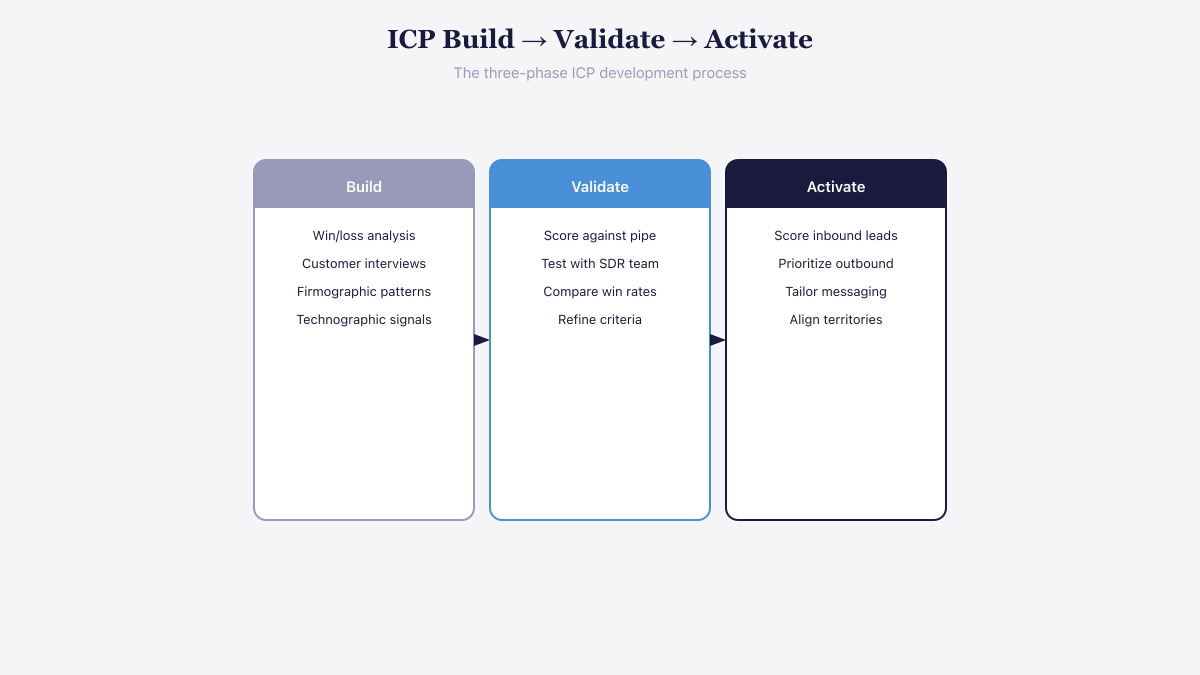 An effective ICP moves through build, validate, and activate phases before driving outbound.
Start with data, not assumptions. Pull your top 20 customers by these criteria:
- Shortest sales cycle (they bought quickly because they had clear need and fit)
- Highest expansion revenue (they grew because they got value)
- Lowest churn risk (they stay because the solution is embedded in their workflow)
- Strongest NPS or advocacy (they refer and participate in case studies)
For each customer, document:
| Attribute | What to Capture |
|---|---|
| Firmographic | Industry, sub-industry, employee count, revenue range, growth rate, headquarters location, number of offices |
| Technographic | CRM platform, marketing automation, sales engagement tools, data infrastructure, cloud provider |
| Organizational | Sales team size, presence of RevOps function, reporting structure (CRO vs. VP Sales) |
| Behavioral | How they found you (channel), what triggered the purchase (event), buying process length, stakeholders involved |
| Outcome | Time to value, expansion revenue, retention length, support ticket volume |
Step 2: Identify the Patterns
Look for clusters in the data. Typical patterns that define ICP segments include:
Industry concentration. If 12 of your top 20 customers are in financial services and healthcare, that's a signal worth weighting heavily.
Size threshold. There's usually a minimum company size below which customers don't get enough value to retain, and a maximum above which the sales cycle and customization requirements exceed your delivery capacity.
Technology stack. If your best customers all use Salesforce, that's both a technographic filter and an integration advantage worth encoding in the ICP.
Growth stage. Series B-D companies in hiring mode often have different buying urgency than established enterprises optimizing existing processes.
Organizational maturity. Companies with a dedicated RevOps function may adopt faster because they have the infrastructure to integrate your solution.
Step 3: Add Negative Filters
Equally important is defining who is NOT your ideal customer. Analyze your churned customers and lost deals for disqualifying patterns:
- Industry exclusions: Verticals where your solution doesn't deliver sufficient value
- Size floors: Companies below a threshold where the deal economics don't work
- Technology incompatibilities: Companies on platforms you don't integrate with
- Buying process red flags: Organizations that consistently take 12+ months to decide, require extensive customization, or have procurement processes that erode deal value
Negative filters save your team from pursuing accounts that look good on paper but consistently underperform as customers.
Step 4: Build the ICP Scorecard
Convert your findings into a weighted scoring model:
| Criteria | Weight | Score (1-5) | Example: 5 = Best Fit |
|---|---|---|---|
| Industry match | 25% | 1-5 | 5 = Financial services, Healthcare; 3 = Technology; 1 = Government, Education |
| Company size | 20% | 1-5 | 5 = 200-2,000 employees; 3 = 50-199 or 2,001-5,000; 1 = Under 50 or over 5,000 |
| Technology stack | 15% | 1-5 | 5 = Salesforce + Outreach; 3 = HubSpot; 1 = No CRM or custom-built |
| Growth signals | 15% | 1-5 | 5 = Series B-D, hiring 20%+ YoY; 3 = Stable growth; 1 = Flat or declining |
| Org maturity | 10% | 1-5 | 5 = Dedicated RevOps; 3 = Sales ops function; 1 = No dedicated ops |
| Geography | 10% | 1-5 | 5 = US/UK/DACH; 3 = Western Europe; 1 = Regions without local support |
| Negative filters | 5% | 1-5 | 5 = No disqualifiers; 1 = Multiple red flags present |
Score interpretation:
- 4.0-5.0: Tier 1 — Named accounts, fully personalized outreach, senior rep assignment
- 3.0-3.9: Tier 2 — Territory-based coverage, warm nurture with signal-triggered activation
- 2.0-2.9: Tier 3 — Automated sequences, content-led engagement
- Below 2.0: Do not pursue
See Salesmotion on a real account
Book a 15-minute demo and see how your team saves hours on account research.
How to Validate Your ICP
An ICP built from 20 customers is a hypothesis. Validation turns it into a strategy.
Win/Loss Analysis
Pull your last 50-100 closed-won and closed-lost deals. Score each retrospectively against your ICP criteria. The validation question: do high-ICP-score deals close at significantly higher rates than low-ICP-score deals?
If yes, the ICP is predictive. If the correlation is weak, revisit the criteria weights and consider whether you're missing a critical attribute.
Cohort Performance
Compare customer cohorts by ICP score:
| ICP Score | Avg Sales Cycle | Win Rate | 12-Month Retention | Expansion Revenue |
|---|---|---|---|---|
| 4.0-5.0 | ? days | ?% | ?% | $? |
| 3.0-3.9 | ? days | ?% | ?% | $? |
| 2.0-2.9 | ? days | ?% | ?% | $? |
Fill this table with your actual data. The gaps between tiers should be meaningful. If Tier 1 and Tier 3 accounts perform similarly, the ICP isn't differentiating effectively.
Market Feedback
Test ICP alignment with your sales team:
- Do the Tier 1 accounts feel right to experienced reps?
- Are there accounts the ICP scores low that reps believe should be higher (or vice versa)?
- Does the scoring miss an attribute that reps consistently mention as predictive?
Rep feedback often identifies qualitative factors the data doesn't capture, like the presence of a specific buyer persona or a cultural fit that predicts partnership success.
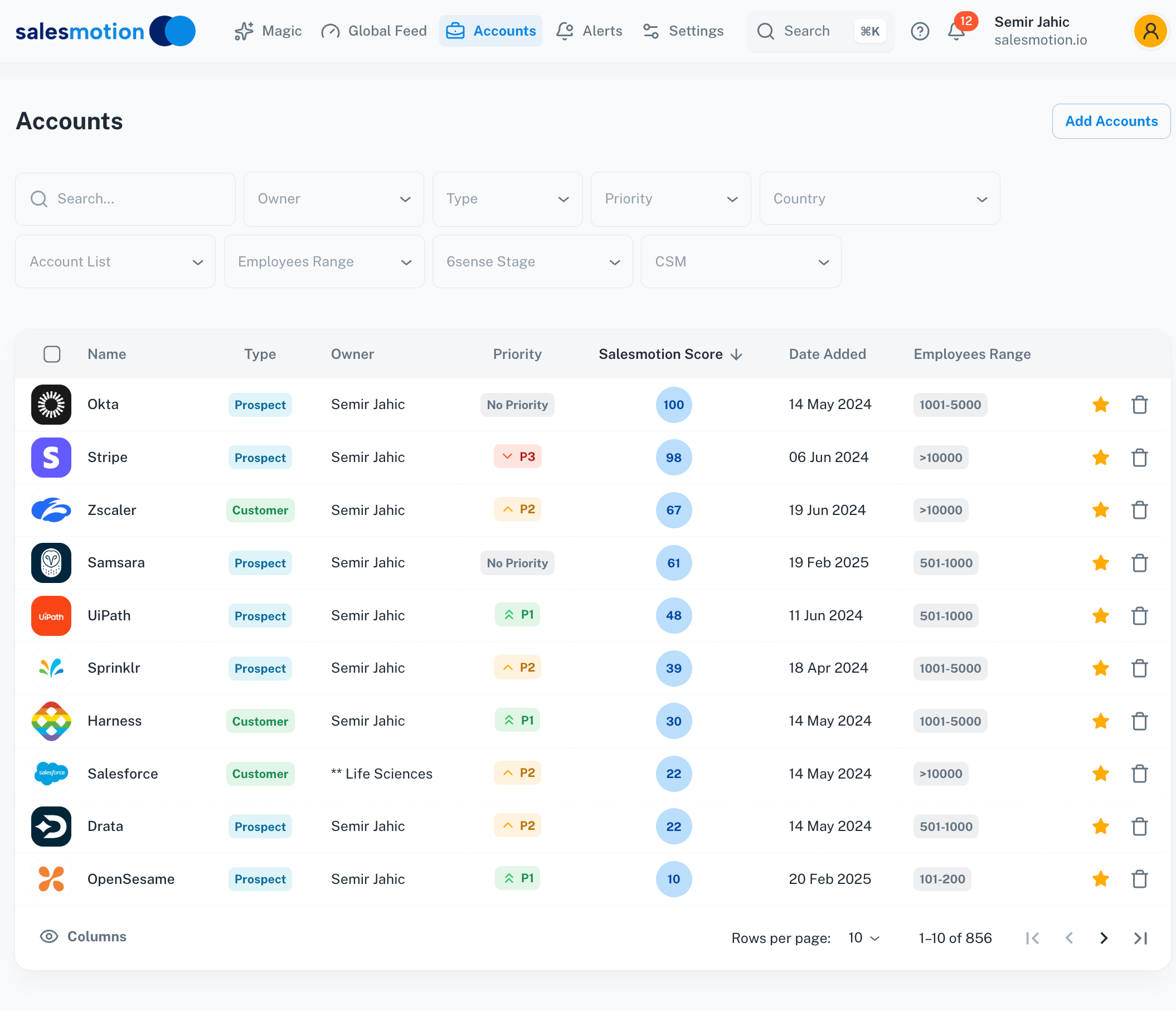 An ICP scoring dashboard ranks target accounts by fit and real-time signal activity, ensuring reps focus on accounts that match both profile criteria and current buying readiness.

“We're no longer fishing. We know who the right customers are, and we can qualify them quickly. Salesmotion has had a direct impact on pipeline quality.”
Andrew Giordano
VP of Global Commercial Operations, Analytic Partners
How to Activate Your ICP
Building an ICP is the easy part. Activation is where most teams fail. An ICP that sits in a strategy document while reps prospect whoever they want is theater, not strategy.
Embed in CRM
Every account in your CRM should have an ICP score. This means:
- Building ICP criteria as fields on the Account object (industry, employee count, tech stack, growth signals)
- Creating a calculated ICP score field that automatically weights the criteria
- Making ICP score visible on every account record and pipeline view
- Using ICP score in pipeline review conversations: "Why are we spending time on this Tier 3 account when we have 15 Tier 1 accounts untouched?"
Drive Territory Design
Assign accounts to reps based on ICP tier, not just geography or account size. Your best reps should own your best-fit accounts. See our GTM strategy framework for how tiering connects to resource allocation.
Trigger Signal-Based Outreach
A static ICP score tells you who to target. Buying signals tell you when to engage. Combine ICP scoring with signal monitoring to create a dynamic prioritization system:
- Tier 1 account + leadership change signal = immediate personalized outreach
- Tier 2 account + funding announcement = escalate to Tier 1 treatment
- Tier 3 account + multiple signals = re-evaluate ICP score with new data
Teams like Frontify improved sales velocity by 42% by combining ICP-based targeting with signal-triggered engagement that ensured reps contacted the right accounts at the moment of highest receptivity.
Align Marketing and Sales
Share the ICP with marketing so demand gen strategies, content strategy, and ABM campaigns target the same accounts and segments. Misalignment between marketing's target audience and sales' ICP creates pipeline that reps don't want to work.
Common ICP Mistakes
Too broad. If your ICP describes 50,000+ accounts, it's not filtering effectively. A useful ICP should narrow your total addressable market to 1,000-5,000 accounts for the primary tier.
Static. ICPs should be reviewed quarterly as you close more deals and gather more data. The ICP that launched your go-to-market should evolve as you learn which segments actually convert and retain.
Based on who you sell to, not who succeeds. Your current customer base includes accounts that were sold to but shouldn't have been. Build the ICP from your best customers, not all customers.
Ignoring negative signals. An ICP without disqualification criteria is incomplete. Knowing who not to sell to is as valuable as knowing who to pursue.
Not activated. The most common failure. A beautiful ICP document that isn't embedded in CRM scoring, territory design, and outreach prioritization changes nothing.

“Automatic account profile detail I can use to manage my territory. Using Salesmotion AI to generate value statements per persona, account, etc. Using Salesmotion to give me a starting point based on new hires, or news alerts is critical.”
Adam Wainwright
Head of Revenue, Cacheflow
Key Takeaways
- Build the ICP from your top 20 customers by retention, expansion, sales cycle speed, and advocacy — not from your entire customer base.
- Include firmographic, technographic, organizational, and behavioral attributes. Weight them based on correlation with customer success outcomes.
- Add negative filters that identify disqualifying attributes from churned customers and lost deals.
- Validate with win/loss analysis and cohort performance data. An ICP that doesn't correlate with higher win rates and better retention isn't working.
- Activate by embedding scores in CRM, driving territory design, and combining ICP fit with buying signals for dynamic prioritization.
- Review quarterly. Your ICP should evolve as you close more deals and learn which segments truly succeed.
Frequently Asked Questions
What is an ideal customer profile (ICP)?
An ideal customer profile defines the attributes of companies most likely to buy your solution, succeed with it, and become long-term customers. Unlike buyer personas (which describe individual people), an ICP describes the organizational characteristics that predict fit: industry, company size, technology stack, growth stage, and organizational maturity. A well-defined ICP includes both positive qualifiers and negative filters that disqualify poor-fit accounts.
How is an ICP different from a buyer persona?
An ICP defines the company-level attributes that predict fit (firmographic, technographic, and behavioral characteristics). A buyer persona defines the individual-level attributes of the people within those companies who participate in the buying decision (job title, responsibilities, goals, pain points, preferred communication channels). You need both: the ICP tells you which companies to target, and buyer personas tell you which individuals within those companies to engage and how.
How many accounts should an ICP cover?
A primary ICP tier should typically identify 500-5,000 accounts, depending on your sales capacity and market size. If your ICP produces 50,000 accounts, it's not specific enough to drive prioritization. If it produces fewer than 200, you may have over-filtered and limited your addressable market. The tiered approach works best: 500-1,000 Tier 1 accounts for fully personalized engagement, 2,000-5,000 Tier 2 for warm nurture, and a broader Tier 3 for automated coverage.
How often should you update your ICP?
Review the ICP quarterly with fresh win/loss data and customer performance metrics. Major updates (reweighting criteria, adding new attributes, or redefining tiers) should happen annually during strategic planning. Tactical updates (adjusting score thresholds, refining negative filters) can happen monthly as you learn from new closed deals and churn patterns.