Financial services accounts are among the most data-rich and most complex to research for B2B sales. Banks, insurance companies, asset managers, and fintech firms operate under intense regulatory scrutiny, and virtually everything they do generates a public record. The challenge is not finding information about a financial services prospect. The challenge is knowing which of the dozens of regulatory filings, earnings releases, and compliance disclosures actually signal a buying opportunity.
Account research for financial services sales requires fluency in the regulatory landscape, an understanding of how banks and fintechs make technology decisions, and the ability to translate financial data into a compelling sales conversation. The rep who references a prospect's recent consent order or their earnings call commentary about digital transformation will always outperform the one who leads with a generic feature demo.
TL;DR: Financial services account research relies on SEC and FDIC filings, earnings transcripts, regulatory announcements, and patent activity. Build a 10-minute framework that identifies regulatory pressures, technology investment signals, and leadership changes. The highest-intent buying signals in financial services are consent orders, new compliance requirements, earnings language about technology modernization, and executive hires in digital or technology functions.
Why Financial Services Research Is Fundamentally Different
Financial services is one of the most regulated sectors globally. This creates a unique research environment for sales professionals.
Regulatory filings are your best intelligence source. No other industry generates as much detailed, structured, public data. Call reports, stress test results, enforcement actions, examination findings, and annual reports provide granular insight into a financial institution's operational health, strategic priorities, and risk posture.
Compliance drives purchasing decisions. A significant portion of technology spending at financial institutions is compliance-driven. New regulations, enforcement actions, or audit findings create non-discretionary purchasing requirements. Understanding the regulatory calendar and your prospect's compliance posture gives you a timing advantage that feature-based selling cannot match.
Technology modernization is the dominant theme. Legacy infrastructure at large banks creates constant pressure to modernize. Earnings calls across the industry are filled with commentary about digital transformation, cloud migration, API-first architecture, and AI adoption. Each of these themes creates specific technology buying needs that you can research and anticipate.
Long procurement cycles with multiple approval layers. A technology purchase at a major bank might require sign-off from the business unit, IT, information security, compliance, procurement, and vendor management. Research that maps these stakeholders and their specific concerns dramatically improves your chances of navigating the buying process.
See Salesmotion on a real account
Book a 15-minute demo and see how your team saves hours on account research.
The Key Sources to Monitor for Financial Services Accounts
Effective account research in financial services means knowing where regulators, the companies themselves, and the industry publish data.
SEC Filings
Every publicly traded financial institution files 10-K, 10-Q, 8-K, and proxy statements with the SEC. These filings contain:
- Risk factor disclosures: Specific technology, cybersecurity, and operational risks the company has identified
- Management Discussion & Analysis (MD&A): Strategic commentary on investments, market positioning, and operational priorities
- Technology spending commentary: Often buried in the 10-K but increasingly highlighted as a strategic differentiator
FDIC and OCC Data
For banks and thrifts, the FDIC and OCC publish detailed financial and operational data:
- Call Reports: Quarterly financial snapshots filed by every insured depository institution
- Enforcement Actions: Consent orders, cease and desist orders, and civil money penalties reveal compliance gaps
- Community Reinvestment Act (CRA) Ratings: Performance evaluations that influence strategic decisions
- FDIC Bank Profiles: Summary of financial condition, branch data, and performance trends
Earnings Transcripts
Earnings calls for financial services companies are unusually rich in strategic intelligence. Analysts ask pointed questions about technology investments, operational efficiency, and competitive positioning. Pay special attention to:
- Technology investment amounts and year-over-year changes
- Commentary about specific platforms, vendors, or initiatives
- Guidance on expense growth (signals budget availability)
- Language about "digital transformation," "modernization," or "cloud migration"
Regulatory Announcements
Federal and state regulators publish proposed rules, final rules, guidance documents, and enforcement actions that directly create purchasing urgency. Key sources include the OCC, Federal Reserve, CFPB, state banking departments, and FINRA.
Patent Filings
Financial services companies increasingly file patents for AI, blockchain, risk analytics, and digital banking innovations. Patent activity on Google Patents or the USPTO reveals R&D investment priorities and technology direction that are rarely discussed publicly until product launch.

“My ultimate goal is to know more about the company than they know themselves. Before, that took hours across multiple tools. With Salesmotion, I can get there in 30 minutes or less and walk into a Fortune 500 conversation fully prepared.”
Jeff Dalo
Senior Director Business Development, Analytic Partners
The 10-Minute Research Framework for Financial Services
Minutes 1-3: Institution Profile and Financial Health Identify the institution type (commercial bank, investment bank, insurance, fintech), asset size, geographic footprint, and business mix. Pull the latest quarterly earnings summary. For banks, check the FDIC BankFind page for financial snapshots.
Minutes 3-5: Regulatory Posture and Compliance Events Search for recent enforcement actions, consent orders, or examination findings from the OCC, FDIC, Federal Reserve, or state regulators. Check if any new regulations affecting their business lines have been finalized or proposed in the last 6 months. Consent orders are the strongest compliance-driven buying signal in financial services.
Minutes 5-7: Strategic Priorities and Technology Investments Review the latest earnings call transcript. Note any commentary about technology spending, digital initiatives, or platform changes. Check press releases for partnerships, technology vendor announcements, or innovation lab launches.
Minutes 7-9: Leadership and Organizational Changes Check LinkedIn and recent press for C-suite changes, particularly in technology (CTO, CIO), compliance (CCO, Head of Risk), and digital banking roles. Look for new positions that signal emerging priorities (Head of AI, VP of Digital Experience, Chief Data Officer).
Minutes 9-10: Synthesize Your Angle Connect a regulatory or strategic signal to your solution. "Your Q3 earnings call mentioned a $200M technology modernization program over the next three years. Here is how we help banks operationalize that kind of initiative" is a conversation starter that works.
Salesmotion automates much of this research by aggregating earnings data, regulatory filings, leadership changes, and news into a single account brief. Analytic Partners, which sells into Fortune 500 companies including financial institutions, grew their qualified pipeline 40% year-over-year after adopting a signal-driven approach to account research.
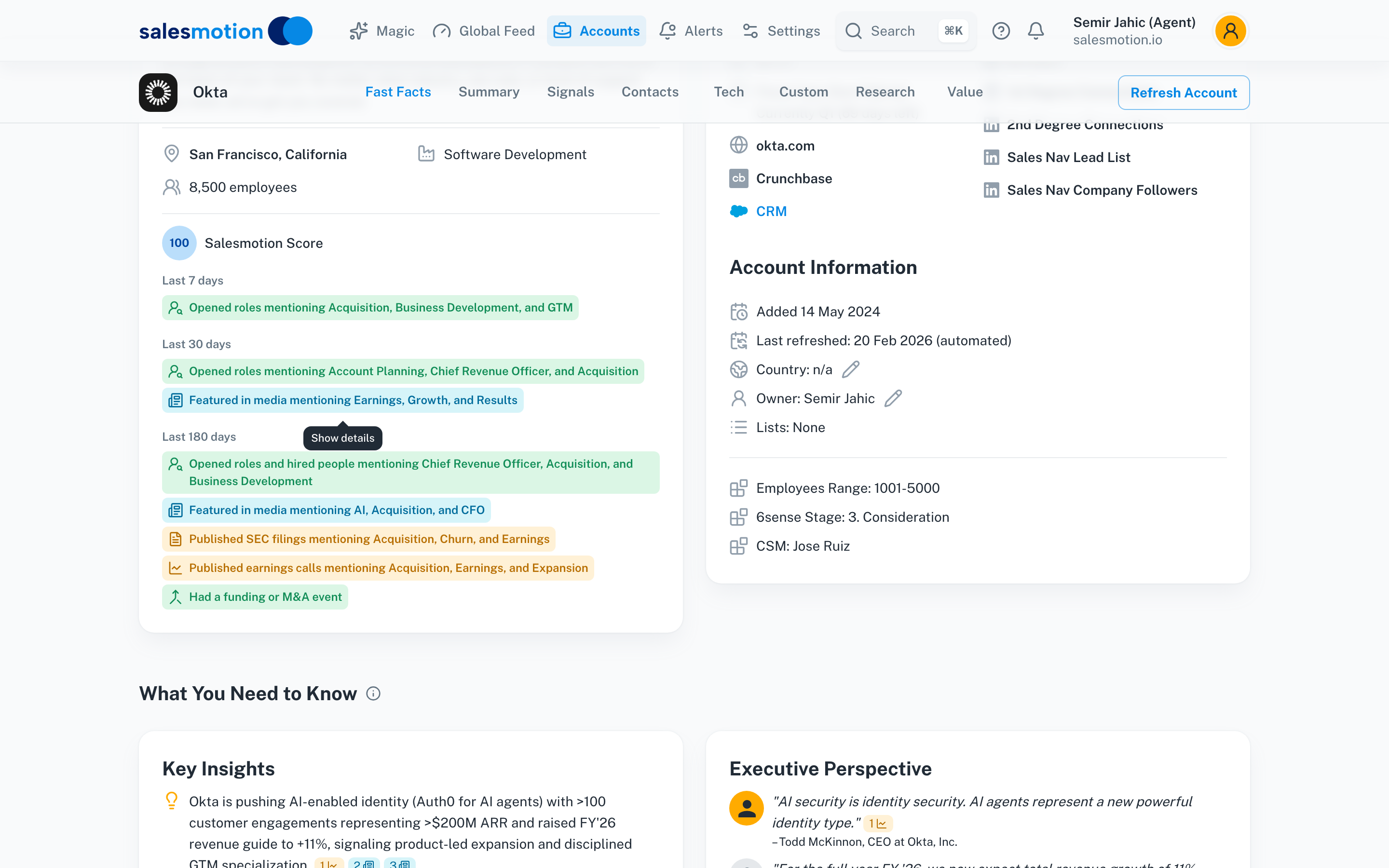 Salesmotion automates account research across 1,000+ sources — delivering key insights, executive commentary, opportunities, and competitive intelligence in a single brief.
Signals That Indicate Financial Services Purchase Readiness
The buying signals in financial services are often regulatory or strategic in nature, distinct from the signals that matter in other industries.
High-Intent Signals
- Consent order or enforcement action: Creates non-discretionary compliance spending. This is the single strongest buying signal in banking.
- Earnings call commitment to technology investment: When a CEO quantifies technology spend ("$500M over three years"), they have committed publicly and must deliver.
- New CTO, CIO, or Chief Digital Officer: Technology leadership changes trigger vendor evaluations within 90 days.
- New regulatory requirement with implementation deadline: Final rules with compliance dates create time-bound purchasing urgency.
Medium-Intent Signals
- M&A announcement: Bank mergers create massive technology integration and consolidation needs.
- Digital banking or fintech partnership announcement: Signals openness to new technology approaches.
- Workforce reduction in technology functions: Often precedes outsourcing or platform consolidation decisions.
- Patent filing activity in a new domain: Signals R&D investment and future technology needs.
Lower-Intent (Longer-Term) Signals
- CRA examination rating decline: May drive community banking technology investments.
- Branch closure announcements: Signals digital channel investment acceleration.
- Conference sponsorship or speaking in new technology areas: Indicates strategic exploration.

“The Business Development team gets 80 to 90 percent of what they need in 15 minutes. That is a complete shift in how our reps work.”
Andrew Giordano
VP of Global Commercial Operations, Analytic Partners
Tools Comparison: Researching Financial Services Accounts
| Approach | Coverage | Time per Account | Signal Freshness | FinServ Depth |
|---|---|---|---|---|
| Manual (SEC, FDIC, OCC, CFPB sites) | Very comprehensive | 60-120 minutes | Real-time but labor-intensive | Very high |
| General sales intelligence (ZoomInfo, LinkedIn) | Contact data, basic firmographics | 5-10 minutes | Daily | Low, misses regulatory data |
| Financial data platforms (S&P Capital IQ, Bloomberg) | Deep financial and regulatory data | 15-30 minutes | Daily | Very high, but expensive |
| Salesmotion | Earnings, leadership, news, strategic signals | Under 5 minutes | Continuous monitoring | High for public intelligence |
The best strategy for financial services sales combines automated monitoring for earnings commentary, leadership changes, and news with periodic deep research into regulatory filings and call reports for your highest-priority accounts.
For the complete guide to sales intelligence for fintech and financial services, including workflows for banking, insurance, and wealth management sales, explore our industry page.
Key Takeaways
- Financial services accounts generate more public data than almost any other sector. SEC filings, FDIC reports, enforcement actions, and earnings transcripts are your primary intelligence sources.
- Regulatory events drive technology purchases in financial services more than in any other industry. Track consent orders, new regulations, and compliance deadlines.
- Earnings call transcripts reveal technology investment commitments, digital transformation priorities, and budget guidance that are not available from any other source.
- The highest-intent buying signals are enforcement actions, public technology spend commitments, CTO/CIO hires, and regulatory compliance deadlines.
- Build a 10-minute framework that covers financial health, regulatory posture, strategic priorities, leadership changes, and a synthesized outreach angle.
- Combine automated account intelligence for territory-wide monitoring with targeted regulatory research on active pipeline accounts.
Frequently Asked Questions
What are the best free sources for researching bank accounts before a sales call?
The FDIC BankFind tool provides financial summaries, branch data, and enforcement history for every insured bank. SEC EDGAR has 10-K, 10-Q, and earnings call transcripts for public institutions. The OCC, Federal Reserve, and CFPB publish enforcement actions, proposed rules, and examination findings. Together, these free sources provide a comprehensive view of a bank's financial health, regulatory posture, and strategic direction.
How do regulatory enforcement actions create buying opportunities in financial services?
Consent orders and cease and desist actions require financial institutions to remediate specific deficiencies within defined timelines. These remediation programs almost always involve technology purchases: new compliance monitoring systems, risk analytics platforms, data governance tools, or reporting infrastructure. The enforcement action itself is public, so you can identify the specific areas requiring improvement and tailor your outreach to the remediation requirements.
How long are sales cycles in financial services?
Enterprise technology sales cycles at large banks and insurance companies typically range from 9 to 18 months. Compliance-driven purchases can move faster (6 to 12 months) because of regulatory deadlines. Fintech companies tend to have shorter cycles (3 to 9 months) because of leaner procurement processes. Understanding whether your deal is compliance-driven versus discretionary helps you forecast timeline and identify the right stakeholders to accelerate.
What leadership changes signal technology buying in financial services?
New CTO, CIO, or Chief Digital Officer appointments are the strongest signals, as these leaders evaluate and often replace technology vendors in their first two quarters. Chief Data Officer and Chief Risk Officer hires signal specific investment in data infrastructure and compliance technology. At fintechs, VP of Engineering and VP of Product hires often precede platform decisions. Track these appointments on LinkedIn and through industry publications like American Banker and Financial Times.