Your best rep just missed a deal because nobody noticed the prospect's CEO changed two weeks ago. Not because the data wasn't available. Because no one thought to ask.
That's the core problem with reactive account intelligence. Proactive account intelligence alerts solve it by pushing signals to reps automatically. But most teams are still stuck in the old model, and when you're managing 200, 300, or 500 accounts, "remembering to look" is not a strategy.
Why Does "Just Prompt It" Fail at Scale?
The pitch sounds reasonable: give every rep access to ChatGPT, let them research accounts on demand. It's cheap, it's flexible, and any rep can start immediately.
Here's what actually happens.
Monday morning. A rep opens ChatGPT and types: "Summarize recent news for Acme Corp and identify potential buying triggers." The response is decent. It pulls some recent articles, maybe an earnings mention. The rep spends five minutes refining the prompt, another five verifying the output. Ten minutes per account.
Now multiply that by a territory of 300 accounts. That's 50 hours of prompting and verification, assuming nothing changes between research sessions. But things always change. Leadership turns over, competitors announce products, earnings disappoint, and hiring surges signal expansion. By the time a rep circles back to an account they researched last month, the intelligence is stale.
This is the fundamental limitation of reactive tools: they answer questions, but they don't watch for changes. Salesforce's State of Sales research found that reps spend 70% of their time on non-selling activities, with research consuming roughly 14% of every week. That's an entire workday lost to looking things up.
The reactive model also creates a consistency problem. Ask five reps to research the same account with ChatGPT, and you'll get five different summaries. One rep asks about leadership changes. Another focuses on financials. A third forgets to check for hiring signals entirely. There's no standard coverage, no guaranteed signal detection, and no way for a manager to know what was missed.
As research from Bizzuka and Medium's analysis of AI consistency confirms, generative AI models are probabilistic by design. The same prompt entered twice can produce materially different outputs. For a sales team that needs reliable, repeatable intelligence across hundreds of accounts, this variability is a liability.
The Proactive Model: Intelligence That Comes to You
Proactive account intelligence flips the workflow. Instead of reps searching for signals, signals find the reps.
Here's the same Monday morning under a proactive model:
Monday morning. A rep opens their CRM or inbox. Three alerts are already waiting: Acme Corp's VP of Sales left last week. Beta Industries just posted 12 new engineering roles (expansion signal). Gamma Tech's Q4 earnings missed estimates by 15%, and the CEO mentioned "operational efficiency" on the call. Each alert includes a summary, suggested talking points, and a recommended next step.
The rep didn't prompt anything. They didn't remember to check these accounts. The system monitored all 300 accounts overnight and surfaced only the ones that require attention.
This is the difference between a search engine and a radar system. One waits for you to type. The other scans continuously and tells you when something matters.
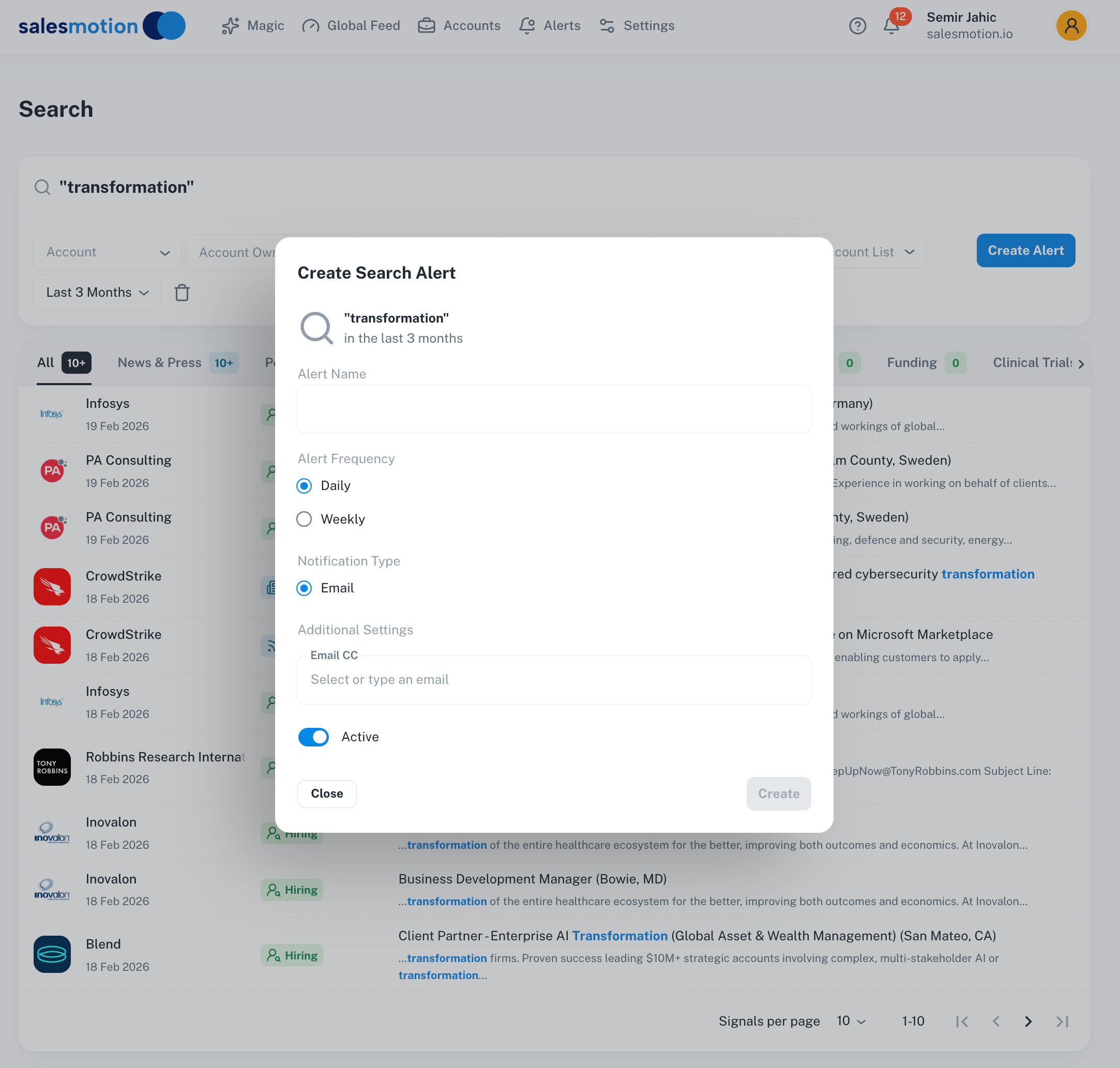 Setting up proactive alerts takes minutes. Once configured, your territory is monitored 24/7 without any manual effort.
The operational impact is significant. Account intelligence platforms that use continuous monitoring report 50-85% reductions in per-account research time. Gartner predicts that by 2026, B2B organizations using AI-driven intelligence will reduce prospecting and meeting-prep time by over 50%. That's not a marginal improvement. It's a structural shift in how reps spend their days.

“Automatic account profile detail I can use to manage my territory. Using Salesmotion AI to generate value statements per persona, account, etc. Using Salesmotion to give me a starting point based on new hires, or news alerts is critical.”
Adam Wainwright
Head of Revenue, Cacheflow
Side-by-Side: Reactive Prompting vs. Proactive Alerts
To make this concrete, here's what a single account workflow looks like under each model:
Reactive workflow (rep prompts for intelligence)
- Rep decides to research Account X (or a manager reminds them).
- Rep opens ChatGPT, writes a prompt asking for recent news, leadership changes, and financial updates.
- ChatGPT returns a summary. Rep spends 3-5 minutes reading and verifying links.
- Rep manually checks LinkedIn for personnel changes. Another 3-5 minutes.
- Rep drafts outreach based on what they found. Maybe they missed the earnings call. Maybe the news article was from last quarter.
- Total time: 15-25 minutes per account. Coverage: incomplete. Frequency: whenever the rep remembers.
Proactive workflow (alerts push intelligence to rep)
- Platform monitors Account X continuously across news, SEC filings, job postings, earnings calls, LinkedIn, and 1,000+ other sources.
- A material change is detected: new CTO hired from a competitor.
- Alert fires within hours. Rep receives a notification with a summary, the signal's relevance score, and suggested talking points.
- Rep reviews the alert in 2 minutes and sends a personalized message referencing the leadership change.
- Total time: 2-5 minutes per account. Coverage: comprehensive. Frequency: continuous.
The math scales in one direction. At 50 accounts, reactive prompting costs roughly 12-20 hours per month in research time alone. At 300 accounts, it's functionally impossible to maintain without a team of analysts. Proactive alerts scale linearly with no additional rep effort, because the monitoring runs whether the rep is awake or not.
Why Does Consistency Matter More Than Cleverness in Account Intelligence?
One of the underappreciated advantages of proactive intelligence is consistency. When alerts are system-generated, every account gets the same coverage. Every leadership change triggers a notification. Every earnings miss gets flagged. Every hiring surge above a defined threshold fires an alert.
With reactive prompting, coverage depends entirely on the individual rep's skill, memory, and discipline. The best prompt engineer on the team might catch signals that five other reps miss entirely. And even that top rep can't maintain perfect recall across a full territory week after week.
This creates a management blind spot. A sales leader reviewing pipeline can't see which accounts were thoroughly researched and which were skimmed or skipped entirely. Proactive systems produce an auditable record of every signal detected and every alert delivered, giving managers visibility into coverage quality.
Research from Everstage shows that top-performing reps spend 35-40% of their time selling compared to the 28% average. The gap isn't explained by talent alone. It's explained by systems that eliminate low-value research loops and keep reps focused on high-value conversations.
See Salesmotion on a real account
Book a 15-minute demo and see how your team saves hours on account research.
The Speed Factor: Intent Signals Don't Wait
Buyer intent signals have a short shelf life. A prospect who just reorganized their sales team is thinking about new tools now, not in three weeks when a rep gets around to reviewing the account. A company that missed earnings is fielding vendor calls within days, not months.
Organizations using multi-signal intent data see 25-35% higher conversion rates and 30-40% shorter sales cycles compared to those using single-source data. But those numbers only hold if reps act quickly. A signal detected and delivered in hours has dramatically more value than the same signal discovered during a quarterly territory review.
This is where the reactive model fails most visibly. Even a rep who diligently prompts ChatGPT every Monday is operating on a weekly cycle at best. Signals that fire on Tuesday sit unnoticed until the following week. By then, a faster competitor may have already reached out.
Proactive platforms like Salesmotion's Signal Agent collapse this gap. Signals are detected, enriched with context, and delivered to reps within hours of the triggering event. The competitive advantage isn't just knowing more. It's knowing sooner.
ChatGPT Is Not the Enemy. Latency Is.
None of this is an argument against ChatGPT or generative AI broadly. ChatGPT is an exceptional tool for drafting outreach, brainstorming positioning, and answering ad-hoc questions. The detailed comparison between Salesmotion and ChatGPT covers the full feature-by-feature breakdown.
The argument is against latency. Any workflow that requires a human to initiate a search, formulate the right question, and manually route the answer into action introduces delay. That delay compounds across a territory, a quarter, and a fiscal year.
The teams closing deals faster in 2026 aren't the ones with better prompts. They're the ones whose intelligence infrastructure eliminates the gap between "something changed" and "a rep knows about it."
Sales intelligence market projections bear this out. The market is expected to grow from $4.85 billion in 2025 to over $10 billion by 2032, with the fastest growth in platforms offering real-time monitoring and automated alerting. The reactive tools aren't shrinking, but they're being layered under proactive systems that handle the monitoring and leave reps to handle the conversations.
How to Evaluate Your Current Approach
If you're unsure whether your team is running a reactive or proactive intelligence workflow, ask these questions:
- Signal detection: Do reps discover account changes through their own research, or does a system surface changes automatically?
- Coverage breadth: Are all accounts in a rep's territory monitored continuously, or only the ones the rep remembers to check?
- Consistency: Would two reps researching the same account produce the same list of recent signals?
- Speed: How many hours or days pass between a material account change and the first rep outreach?
- Manager visibility: Can a sales leader see which accounts have been researched and which haven't?
If any answer points to a manual, rep-initiated process, you're running a reactive model. That works at 20 accounts. It breaks at 200.
Key Takeaways
- Reactive intelligence (prompting ChatGPT, manual research) depends on reps knowing what to ask, when to ask, and for which accounts. At territory scale, this breaks down.
- Proactive intelligence (automated alerts and signals) monitors accounts continuously and pushes relevant changes to reps before they have to search.
- Sales reps spend only 28-30% of their time selling. Eliminating manual research loops reclaims hours every week.
- Prompt-based tools produce inconsistent outputs across a team. Ten reps prompting the same AI get ten different results.
- Alert-driven workflows reduce response time from days to minutes, which matters because buyer intent signals have a short shelf life.
Frequently Asked Questions
Can ChatGPT be configured to send proactive alerts?
No. ChatGPT is a conversational interface that responds to prompts. It doesn't monitor external data sources, track account changes over time, or push notifications. Some teams build custom GPTs with scheduled workflows, but these still require manual configuration, lack real-time signal detection from sources like SEC filings or earnings calls, and don't integrate with CRM systems for alert routing.
How many accounts can a rep realistically monitor with reactive prompting?
Based on the time investment of 15-25 minutes per account for thorough research, a rep can realistically maintain coverage on 20-40 accounts through manual prompting before research quality degrades. Beyond that threshold, reps either spend their entire week on research or start skipping accounts. Proactive alert systems scale to hundreds of accounts per rep because the monitoring is automated.
Does proactive intelligence replace the need for reps to do their own research?
It shifts the type of research reps do. Instead of spending time discovering what changed at an account, reps spend time deciding how to act on changes the system already surfaced. The research moves from "find the signal" to "craft the response," which is a higher-value use of a rep's judgment and relationship skills.
What types of signals does proactive monitoring typically cover?
Comprehensive platforms monitor leadership changes, earnings reports, hiring surges, layoffs, product launches, competitor mentions, M&A activity, regulatory filings, funding rounds, strategic partnerships, and executive statements from earnings calls or conference appearances. The breadth matters because a single signal source misses the full picture of an account's buying readiness.