
Professional services firms, from management consulting to law firms to accounting practices, are among the most relationship-driven buyers in B2B. They also generate a surprisingly rich set of public signals if you know where to look. Practice expansions, lateral partner hires, client win announcements, and thought leadership publications all reveal strategic direction and purchasing intent. Most reps miss these signals because they are looking in the wrong places. A signal-based selling approach shifts the focus from cold outreach to timely engagement triggered by these public events.
Account research for professional services sales requires understanding how these firms operate: revenue comes from billable hours, growth comes from practice expansion and lateral hires, and technology decisions are driven by partner consensus rather than top-down mandates. The research framework that works for SaaS or manufacturing does not translate directly.
TL;DR: Professional services account research depends on lateral hire announcements, practice expansion signals, industry rankings, client win press releases, and thought leadership patterns. Build a 10-minute framework that identifies growth practices, strategic hires, and technology investment signals. The strongest buying signals are new practice launches, lateral partner hires, office openings, and firm rankings changes that create competitive pressure.
Why Professional Services Accounts Require a Different Research Approach
Professional services firms operate under a fundamentally different business model than product companies. This shapes how they buy technology.
Partner-driven decision making. At most law firms, consulting firms, and accounting practices, technology purchases require partner buy-in. The managing partner or practice group leader has outsized influence. Your research needs to identify not just the firm's needs but the specific partner or practice leader who owns the problem your solution addresses.
Revenue is human-capital dependent. Professional services revenue scales with headcount and utilization rates. A firm that just hired 30 associates or opened a new office is in growth mode and needs supporting infrastructure. A firm that just laid off staff is in cost-cutting mode and may be rethinking expensive technology platforms.
Lateral hires signal strategic direction. When a law firm hires a lateral partner from a competitor, it signals expansion into that partner's practice area. When a consulting firm recruits a new practice leader, it signals investment in that capability. These hires are heavily publicized because they are a form of market signaling.
Rankings and reputation drive competition. Chambers, Vault, Am Law 100, and other industry rankings create competitive pressure. A firm that dropped in rankings may invest in operational efficiency or business development technology to regain position. A firm climbing in rankings is validating its strategy and may scale it further.
See Salesmotion on a real account
Book a 15-minute demo and see how your team saves hours on account research.
The Key Sources to Monitor for Professional Services Accounts
Effective account research for professional services relies on industry-specific publications and signals that general sales tools rarely capture.
Law Firm Rankings and Industry Directories
For legal sector accounts:
- Chambers and Partners: Practice area and individual lawyer rankings that drive competitive positioning
- Am Law 100/200: Revenue, profits per partner, and financial performance rankings
- Legal 500: Global practice area rankings and editorial commentary
- NALP Directory: Hiring data, office locations, and firm demographics
Rankings changes create both celebration (opportunity to reinforce strategy) and concern (urgency to invest in areas of decline). Both create buying windows.
Consulting Firm Reports and Announcements
For consulting and advisory firms:
- Firm-published reports and whitepapers: Reveal practice area focus and thought leadership strategy
- Press releases about new practices or capabilities: Signal organizational investment
- Partner and principal promotions: Internal promotions indicate growing practices
- Acquisition announcements: Consulting firms acquire to add capabilities quickly
Lateral Hire Announcements
Lateral hires are the most reliable leading indicator in professional services. Track them through:
- The American Lawyer and Law360 for law firm laterals
- Consulting industry publications for practice leader moves
- LinkedIn for real-time tracking of senior moves across firms
- Firm press releases, which typically announce laterals within days of the move
A lateral partner hire signals: budget availability (they negotiated a compensation package), practice expansion (the firm is investing in that area), and technology needs (the new partner brings clients who need to be onboarded).
Thought Leadership and Content Patterns
Professional services firms use thought leadership as a business development tool. Their publishing patterns reveal strategic priorities:
- A sudden increase in AI-related publications signals an AI practice or offering launch
- Industry-specific whitepapers indicate sector focus areas
- Event sponsorships and speaking engagements show where they are investing brand visibility
- Podcast appearances by firm leaders reveal current strategic thinking
Job Postings
Professional services job postings reveal operational and technology priorities:
- Associate hiring in specific practice areas signals growth
- Business development and marketing technology roles indicate GTM investment
- CRM administrator or knowledge management roles confirm technology platform decisions
- Innovation or digital roles signal transformation initiatives

“The talking points are gold. If they're in Salesmotion, I know they're being discussed inside that business. That makes it easy to spark a real conversation, which is 90 percent of the battle.”
Andrew Giordano
VP of Global Commercial Operations, Analytic Partners
The 10-Minute Research Framework for Professional Services
Minutes 1-3: Firm Profile and Market Position Identify the firm type (law, consulting, accounting, advisory), size (headcount, revenue, office count), and core practice areas. Check industry rankings for their position and recent trajectory. Note the managing partner or CEO.
Minutes 3-5: Growth Signals and Practice Expansion Search for recent lateral hires, new practice launches, and office openings in the last 12 months. Check firm press releases and industry publications. Note which practice areas are expanding versus stable.
Minutes 5-7: Financial and Operational Context For public companies (rare in professional services), check earnings data. For private firms, use industry rankings for directional financials (Am Law for law firms, ALM for consulting). Review industry coverage for commentary about firm strategy, utilization rates, or market positioning.
Minutes 7-9: Technology and Operational Signals Check job postings for CRM, business development, or technology roles. Look for press releases about technology partnerships or platform investments. Check conference sponsorships and industry event participation for digital transformation signals.
Minutes 9-10: Synthesize Your Angle Connect a growth signal or lateral hire to your solution. "You just opened a Dallas office and hired three partners from Baker McKenzie for your private equity practice. Here is how we help growing practices scale client development without scaling headcount proportionally" shows you understand their business.
Salesmotion aggregates leadership changes, news, earnings data, and strategic signals into a single account brief. For professional services sales, the leadership change monitoring is particularly valuable because lateral hires and partner appointments happen frequently and signal purchasing intent within 60 to 90 days.
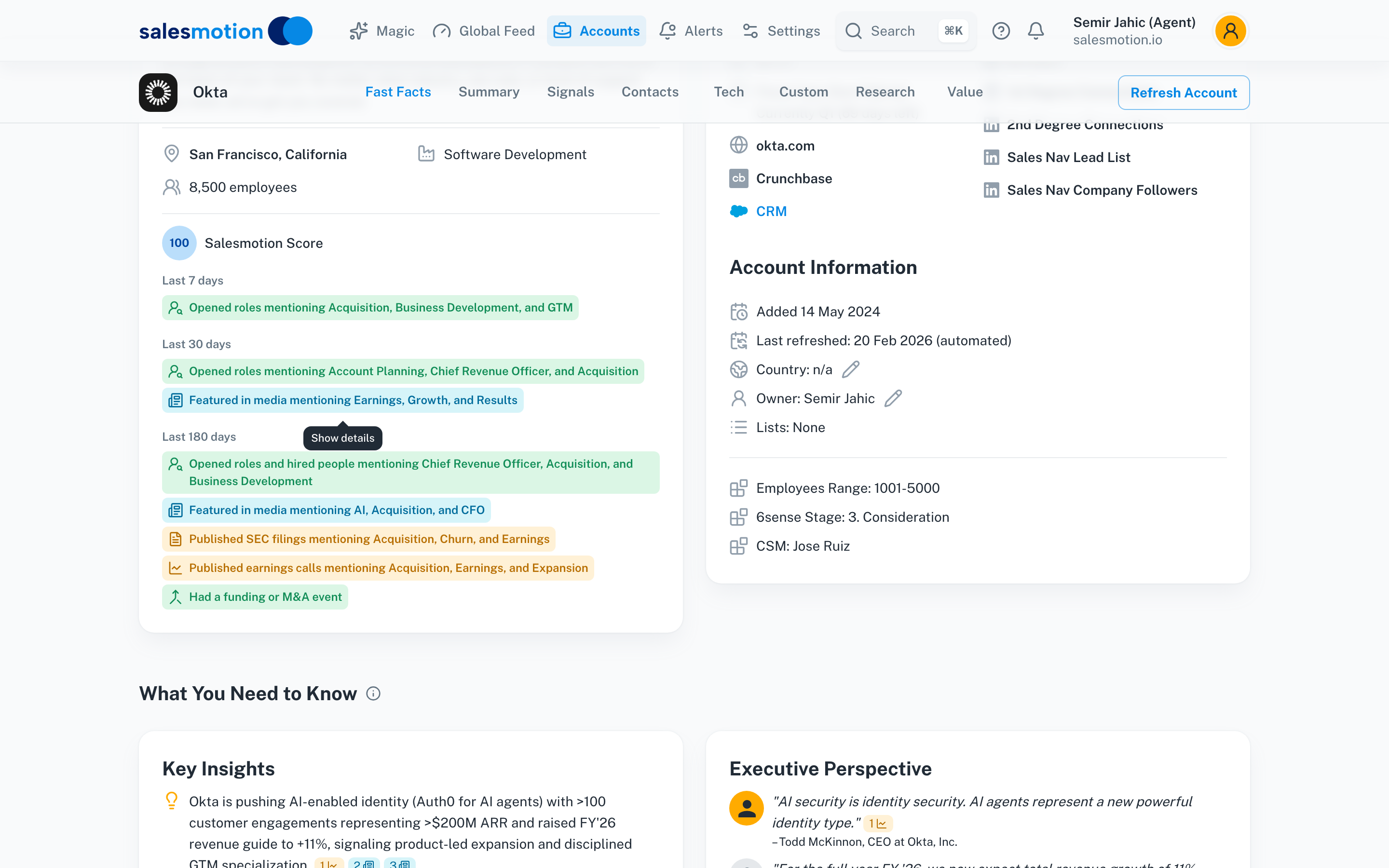 Salesmotion automates account research across 1,000+ sources — delivering key insights, executive commentary, opportunities, and competitive intelligence in a single brief.
Signals That Indicate Professional Services Purchase Readiness
The buying signals in professional services are driven by growth events, competitive dynamics, and organizational maturity.
High-Intent Signals
- Lateral partner or practice leader hire: The strongest signal. Creates immediate technology needs for client onboarding, business development, and practice management.
- New office opening: Geographic expansion requires CRM, communication, knowledge management, and business development infrastructure.
- New practice area launch: Signals investment and creates needs for industry-specific tools, research capabilities, and client development technology.
- Managing partner or CEO transition: Firm-wide leadership changes trigger strategic reviews that include technology evaluations.
Medium-Intent Signals
- Rankings improvement or decline: Improvement validates strategy (scale it). Decline creates urgency (fix it). Both create technology buying windows.
- Merger or acquisition announcement: Firm combinations create technology consolidation needs.
- Business development or marketing team expansion: Signals investment in go-to-market capabilities.
Lower-Intent (Longer-Term) Signals
- Thought leadership pivot to a new topic area: Signals strategic exploration 6-12 months ahead of hiring and investment.
- Industry conference sponsorship in new categories: Indicates market expansion intent.
- Innovation lab or digital transformation announcement: Signals technology evaluation appetite.

“This is massive and saves me hours of searching Google and reading annual reports. Using Salesmotion as my very first place to go when I'm doing anything account-related now.”
Derek Rosen
Director, Strategic Accounts, Guild Education
Tools Comparison: Researching Professional Services Accounts
| Approach | Coverage | Time per Account | Signal Freshness | Professional Services Depth |
|---|---|---|---|---|
| Manual (rankings, press releases, LinkedIn, trade pubs) | Good with industry expertise | 30-60 minutes | Varies | High |
| General sales intelligence (ZoomInfo, LinkedIn) | Contact data, firmographics | 5-10 minutes | Daily | Low, misses lateral hires and rankings |
| Legal/consulting databases (ALM Intelligence, Chambers) | Rankings, financial data, practice data | 10-20 minutes | Quarterly/annual | Very high for covered firms |
| Salesmotion | Leadership changes, news, strategic signals | Under 5 minutes | Continuous | High for event-driven signals |
The most effective approach for professional services sales combines automated signal monitoring for leadership changes and firm news with targeted industry database research for accounts in your active pipeline.
For the complete guide to sales intelligence for consulting and professional services, including workflows for law firm, consulting, and advisory firm sales, explore our industry resource.
Key Takeaways
- Professional services account research requires industry-specific sources: lateral hire announcements, industry rankings, practice expansion signals, and thought leadership patterns that general sales tools miss.
- Lateral partner hires are the single most reliable buying signal. They indicate practice investment, budget availability, and immediate technology needs for client onboarding and business development.
- Rankings changes create competitive pressure that drives technology investment. Track Chambers, Am Law, and sector-specific rankings for your target accounts.
- Partner-driven decision making means your research must identify the specific practice leader or managing partner who owns the problem you solve.
- Build a 10-minute framework covering firm profile, growth signals, financial context, technology signals, and a specific outreach angle tied to a lateral hire or practice expansion.
- Layer automated account intelligence for territory monitoring with targeted industry database research on active pipeline accounts.
- For research frameworks in other verticals, see our guides to account research for manufacturing and healthcare.
Frequently Asked Questions
What are the best sources for researching law firms before a sales call?
Chambers and Partners rankings, Am Law 100/200 financial data, and The American Lawyer coverage provide the foundation. Lateral hire announcements on Law360 and Am Law Daily reveal practice expansion signals. LinkedIn tracking of partner moves provides real-time intelligence. Job postings on the firm's careers page reveal technology platform decisions and operational priorities. Combining these sources gives you a comprehensive view of a law firm's strategic direction and technology needs.
How do lateral hires create buying opportunities at professional services firms?
When a firm hires a lateral partner, they are investing in practice growth. The new partner brings clients who need to be onboarded into the firm's systems. They bring practice expertise that may require new research tools, industry databases, or business development technology. They negotiate a compensation package that includes business development support. And they often have technology preferences from their prior firm that they push to adopt. The 60 to 90 days after a lateral hire is the highest-intent window for technology sales.
How do you research private professional services firms with limited public data?
Most professional services firms are private partnerships. Focus on industry rankings (Am Law, Vault, Chambers, Management Consulted) for directional financial data. Track lateral hires through trade publications and LinkedIn. Monitor job postings for technology and growth signals. Review the firm's published thought leadership for strategic priorities. Conference sponsorships and speaking engagements reveal investment areas. Industry awards and client testimonials (often published on firm websites) indicate active practice areas.
What makes professional services buying cycles different from other B2B sales?
Professional services firms use consensus-based purchasing, requiring partner approval for significant technology investments. Buying cycles are typically 6 to 12 months, but can compress when tied to a lateral hire, office opening, or competitive ranking change. Budget authority is often distributed across practice groups rather than centralized in IT. Building relationships with practice leaders and managing partners, rather than only procurement, is essential. Technology decisions are heavily influenced by what peer firms use, making case studies and referrals particularly effective.