B2B sales prospecting is all about finding, researching, and connecting with potential business customers who are a perfect fit for what you sell. It’s the engine room of the sales process, where you create new opportunities instead of just waiting for them to show up.
What B2B Sales Prospecting Means Today

Think of old-school prospecting like panning for gold in a random river. You'd sift through tons of dirt, hoping to find a few tiny nuggets. Modern B2B prospecting is more like using a map that tells you exactly where the gold is before you even pick up a shovel. For a breakdown of specific approaches, see our guide to sales prospecting techniques that build pipeline.
It’s no longer a volume game of generic cold calls and mass emails. Today, it's all about relevance. The question has shifted from "Who can I contact?" to something much sharper: "Why should I contact this specific company, right now?"
This is a huge shift. The best sales teams now focus their energy on accounts actively showing buying signals—clear signs that a company has a problem you can fix or is going through a change that opens a door for you.
The Difference Between Leads and Prospects
Many people use "lead" and "prospect" interchangeably, but they represent two different stages. Getting this right clarifies what prospecting is really about.
- A Lead is anyone who has shown some interest, like downloading an ebook. Think of them as a broad pool of potential customers.
- A Prospect is a lead who has been qualified and confirmed to be a strong fit for your solution. They match your Ideal Customer Profile (ICP) and are worth a salesperson's direct, personal attention.
Lead generation, usually handled by marketing, casts a wide net. B2B sales prospecting is a focused, proactive effort by sales reps to turn qualified leads (or entirely new contacts) into real sales conversations. For a great deep dive on using specific platforms for this, check out this guide on LinkedIn for B2B lead generation.
Why Modern Prospecting Is So Challenging
Let's be direct: effective prospecting is the biggest bottleneck for most revenue teams. A shocking 66.7% of sales reps only reach out to 250 prospects or fewer in an entire year, while just 15% manage to contact over 1,000.
This gap explains why so many teams struggle to build a consistent pipeline, especially in complex industries like biotech, SaaS, and fintech where buying cycles are long.
The goal of modern B2B sales prospecting isn't just to book a meeting, but to start a relevant conversation. It’s about positioning your reps as valuable partners who understand the buyer’s context from the first interaction.
This modern approach respects the buyer’s time, which naturally increases engagement and lays the foundation for a predictable pipeline. It’s about quality over quantity, precision over volume, and intelligence over brute force.
See Salesmotion in action
Take a self-guided interactive tour — no signup required.
Use Buying Signals as Your Secret Weapon
Imagine knowing the exact moment a target account is ready to have a conversation. That’s the power of buying signals. These are observable events, actions, or changes that point to a potential need for your product, giving you the perfect reason to reach out.
Effective B2B prospecting isn’t about interrupting someone's day; it’s about joining a conversation that’s already happening inside their company. Buying signals are your invitation. They turn cold outreach into a warm, relevant touchpoint by giving you a compelling "why now?"
Instead of prospecting in the dark, you use these triggers to connect your solution directly to a timely business challenge or opportunity. This instantly positions you as a well-informed advisor, not just another salesperson.
Hard Signals vs. Soft Signals
Not all signals carry the same weight. Knowing the difference helps you prioritize your efforts and tailor your message for maximum impact. Think of it as the difference between a company shouting its plans with a megaphone versus whispering them in a hallway.
Hard signals are clear, public, and often indicate a major strategic shift or budget allocation. They are high-impact triggers that suggest a company is actively evaluating a change or has a pressing need.
- Funding Announcements: New capital almost always means new projects and increased spending.
- Mergers and Acquisitions (M&A): Combining two companies creates operational complexity and opens the door for new systems.
- Executive Hires: A new C-level exec, especially a CRO or CMO, often has a mandate to shake things up and bring in new tools within their first 90 days.
- New Office or Territory Expansion: Growth into new markets requires new infrastructure, staff, and technology.
These signals are factual and point to major business initiatives where your solution could be critical.
A hard signal is an undeniable event that forces a company to re-evaluate its current state. It’s the closest you can get to an invitation to start a sales conversation.
Soft signals, on the other hand, are more subtle. They suggest a growing interest or a potential future need, making them excellent for nurturing relationships and getting ahead of the curve. While less direct, they provide valuable context about a company's focus.
- Spikes in LinkedIn Engagement: Key decision-makers suddenly engaging with content related to a problem you solve.
- Job Postings: A company hiring a team of data scientists suggests a new focus on analytics.
- Conference Attendance or Sponsorship: A company investing in a specific industry event signals its strategic focus.
- Mention in a Podcast or Interview: An executive publicly discussing a specific business challenge.
Combining both types gives you a complete picture of an account’s journey.
Connecting Signals to Business Challenges
The real skill is translating an event into a business problem. A signal is the "what"; your job is to connect it to the "so what" for your prospect.
For example, a SaaS company hiring a new Chief Revenue Officer (a hard signal) is a golden opportunity. That new CRO is almost certainly reviewing their entire sales tech stack. This is your chance to reach out and offer a solution that helps them hit their new targets faster.
Similarly, a biotech firm announcing a new clinical trial phase (another hard signal) has a cascade of needs, from data management software to patient recruitment services.
This is where intent data becomes a powerful asset. Teams using it have cut customer acquisition costs by 35% and boosted close rates by 28%. In the U.S. B2B sector, where ad spend hits $18.5 billion, AI-powered platforms can track digital footprints—like competitor site visits or report downloads—to show precisely when a prospect is in-market. You can learn more about interpreting these digital breadcrumbs in our guide on what is intent data.

“The moment we turned on Salesmotion, it became essential. No more hours on LinkedIn or Google to figure out who we're talking to. It's just there, served up to you, so it's always 'go time.'”
Adam Wainwright
Head of Revenue, Cacheflow
A Practical Framework for Signal-Driven Prospecting
Knowing that buying signals exist is one thing; building a system to act on them is another. If you want to turn signal intelligence into a healthy pipeline, you need a repeatable framework.
This simple, four-stage approach can transform B2B sales prospecting from a chaotic mess into a structured, scalable operation. The core idea is to move beyond just finding signals and start managing them. It’s a blueprint for making signal-driven selling a core part of your team's DNA.
This flow diagram breaks down how signals should feed directly into a structured outreach process.
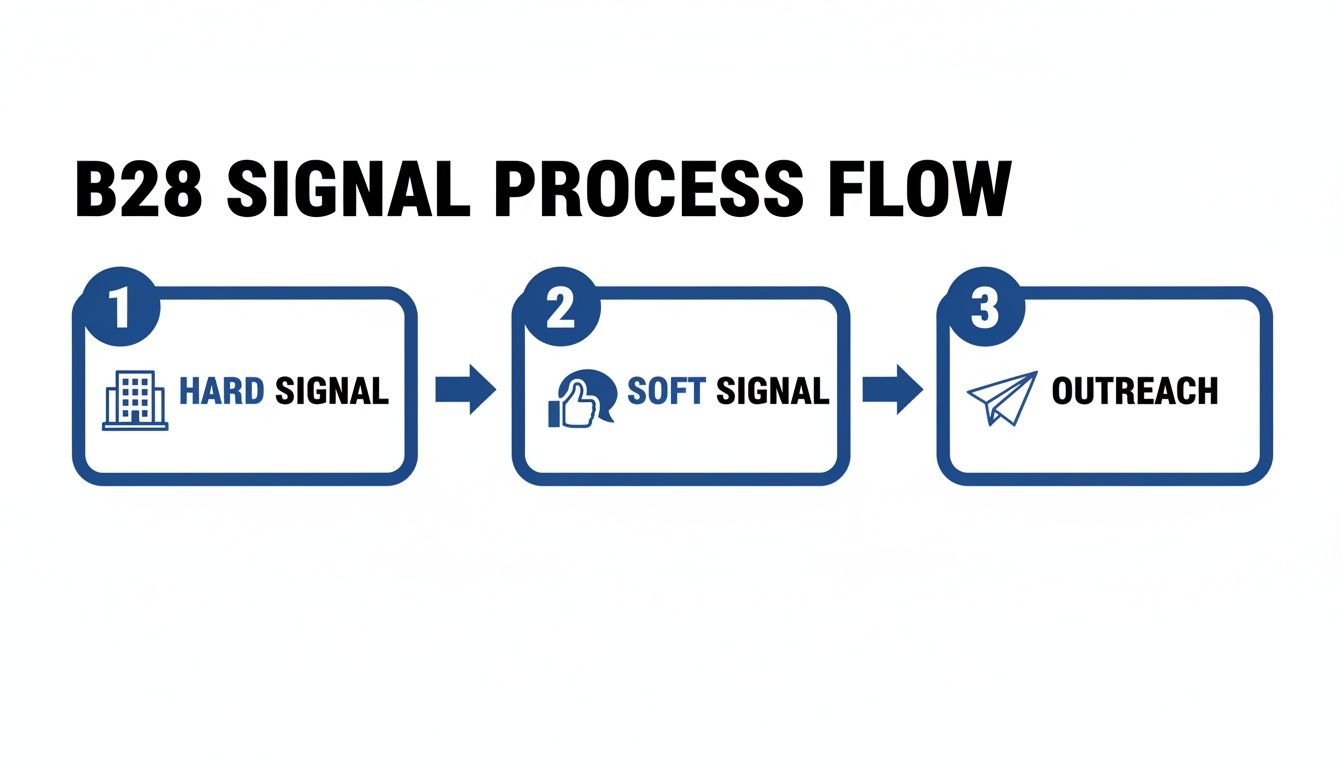
As you can see, both hard and soft signals are valuable. The key is that they should always lead to timely and personalized engagement.
Stage 1: Monitor Your Target Accounts
The foundation is an always-on monitoring system. Your goal is to automate the discovery of buying signals across your Ideal Customer Profile (ICP) accounts so you never miss a critical trigger. Relying on manual Google searches or random LinkedIn scrolling just isn't scalable.
You need a system that actively listens for you. This could start with simple tools like Google Alerts, but to do this effectively across an entire territory, you need technology that tracks a wide range of sources—from funding news and press releases to podcast interviews—and delivers curated alerts into your workflow.
Stage 2: Prioritize Based on Signal Quality
Once signals start rolling in, you’ll realize not all are created equal. Signal overload can be just as paralyzing as having no signals at all. The second stage, Prioritize, is about separating the noise from the high-potential opportunities. This is where you score accounts based on the quality and urgency of their signals.
A hard signal, like a $50 million funding round, should immediately send an account to the top of your list. A softer signal, like a new director-level hire, is still valuable but might be weighted differently.
The key is to create a simple scoring system:
- Tier 1 (High Priority): Accounts showing multiple hard signals or a cluster of related soft signals. These require immediate, personalized outreach.
- Tier 2 (Nurture): Accounts showing isolated soft signals. Add them to a watch-list and look for more triggers before engaging.
- Tier 3 (Monitor): ICP accounts with no current signals. Keep them in your monitoring system for future changes.
This tiered approach ensures your team focuses its time on the accounts most likely to be in a buying cycle right now.
Stage 3: Engage with Context and Relevance
With a prioritized list, you can move to the Engage stage. This is where you turn intelligence into a real conversation. Every piece of outreach must be anchored to the specific signal you identified. This is the difference between a generic pitch and a compelling message that gets a reply.
For example, instead of saying, "I'd love to show you our platform," you can say, "Saw you just hired a new VP of Operations—as you build out the team, leaders in your position often focus on streamlining workflows."
The goal of signal-based engagement isn't just to reference the trigger, but to form a hypothesis about what that trigger means for the business and connect it to a problem you solve.
This stage also involves multi-threading—using the signal to identify and engage multiple stakeholders at the account. A new product launch signal isn't just relevant to the Head of Product; it also matters to leaders in marketing, sales, and operations.
Stage 4: Prepare for Every Conversation
Finally, the Prepare stage ensures the intelligence you gathered doesn't get lost once a meeting is booked. The signals that earned you the meeting are the same signals that will help you win the deal. Before any call, review all the triggers and context you've collected.
Use this information to formulate insightful questions and anticipate their objectives. This transforms your meeting prep from a quick glance at their website into a truly strategic session.
To learn more about how this works in practice, explore the core concepts of signal-based selling in our detailed guide. By following this four-part framework, you create a powerful, repeatable process for B2B sales prospecting that drives predictable results.
Crafting Outreach That Actually Gets Replies
Let's be honest: all the account intelligence in the world is useless if your outreach falls flat. In B2B sales prospecting, generic templates are the fastest way to get your message deleted. If you want to break through the noise, your outreach needs to be anchored in a specific, timely buying signal.
This is about moving beyond, "I saw your post on LinkedIn." True personalization connects a real business trigger to a potential pain point you can solve. It positions your message as a helpful insight, not just another sales pitch. Every email or message should clearly answer the prospect’s unspoken question: “Why are you contacting me, and why now?”
The Anatomy of a Signal-Based Message
Effective outreach isn't about clever wordplay. It's about a logical structure that builds a compelling case for a conversation. A message that consistently gets replies has four key components.
- The Hook: Start by referencing the specific buying signal you identified. This immediately establishes context and shows you’ve done your homework.
- The Point of View (POV): Connect that signal to a common business challenge or opportunity. This is where you make a hypothesis about what the signal means for their company.
- The Value Proposition: Briefly explain how your solution helps companies navigate the exact challenge you just described. This is your "so what?"—the tangible value you offer.
- The Call to Action (CTA): End with a clear, low-friction next step. Ditch the "30-minute demo" ask. Instead, suggest sharing a relevant resource or ask a simple question to start a dialogue.
The most effective B2B prospecting messages don't feel like a sales pitch. They read like well-researched, helpful advice from a peer who understands the recipient’s world.
Real-World Examples Tied to Triggers
Putting this structure into practice is where the magic happens. The table below shows how you can frame your outreach based on common buying signals.
Signal-Based Outreach Template Examples
| Signal Type | Subject Line or Hook | Core Message Angle | Call to Action |
|---|---|---|---|
| New Funding Round | Congrats on the Series B! | "Companies scaling post-funding often face [X challenge]." | "Is improving [X] a focus for you this quarter?" |
| New Executive Hire | Your new role at [Company] | "New leaders often evaluate [Y] in their first 90 days." | "Curious if a signal-based approach to [Y] is on your radar?" |
| Technology Stack Change | Saw you're implementing [Tech] | "We help teams get more ROI from [Tech] by solving [Z]." | "Open to seeing a 2-min video on how it works?" |
| Company Expansion | Heard about the new office in [City] | "Expanding teams often struggle with [A] as they grow." | "Worth a quick chat to see if we can help you avoid those growing pains?" |
These examples are frameworks for thinking. The goal is to connect a specific event to a relevant problem, making your outreach timely and valuable from the first sentence.
Let's break down a couple of these into full emails.
Signal: A target company announces a $50M Series B funding round.
- Subject: Congrats on the Series B!
- Hook: "Hi [Name], just saw the news about your Series B funding—congratulations to the team. That's a huge milestone."
- POV: "Typically, after a significant funding round, the pressure is on to scale the GTM team quickly to meet investor targets, which often exposes gaps in onboarding and training."
- Value Prop: "We help CROs at recently funded companies like [Similar Company] cut ramp time by 40% with a platform designed for rapid, scalable sales enablement."
- CTA: "Is improving new hire productivity a focus for you in the next quarter?"
Signal: A company hires a new Chief Revenue Officer.
- Subject: Your new role at [Company Name]
- Hook: "Hi [Name], saw you recently joined [Company Name] as the new CRO. Congrats on the new role!"
- POV: "Leaders in your position are often tasked with evaluating the entire revenue tech stack in the first 90 days to find quick wins for pipeline generation."
- Value Prop: "Our account intelligence platform helps new sales leaders identify in-market accounts showing real buying signals, so they can redirect their team's efforts toward high-probability deals."
- CTA: "Curious if a signal-based approach to pipeline is on your radar?"
Multi-Touch Sequences That Build Momentum
A single email, no matter how good, is rarely enough. Real success in B2B sales prospecting comes from multi-touch, multi-channel sequences that maintain context across email, LinkedIn, and phone calls. Proactive outreach remains a powerhouse tactic, with 82% of buyers open to meetings from such efforts. In fact, 57% of C-level execs prefer the phone over other channels.
And while a single email might not get a reply, response rates can surge by 160% when it’s part of a well-orchestrated sequence.
This is where your intelligence really shines. A follow-up LinkedIn message can reference your initial email. A phone call can start with the same buying signal you used as your hook. This creates a cohesive narrative and turns your prospecting from isolated shots in the dark into a compelling, ongoing conversation. You can find more powerful ways to begin these discussions in our guide to effective sales conversation starters.
“Automatic account profile detail I can use to manage my territory. Using Salesmotion AI to generate value statements per persona, account, etc. Using Salesmotion to give me a starting point based on new hires, or news alerts is critical.”
Adam Wainwright
Head of Revenue, Cacheflow
How to Scale Your Prospecting with Account Intelligence

Signal-driven prospecting is incredibly effective, but how do you do it for hundreds of accounts? Manually tracking every signal for every target is a recipe for burnout.
The short answer is technology. This is where account intelligence platforms come in. They are built to automate the signal-driven framework, making sophisticated B2B sales prospecting a scalable reality for your entire team.
These platforms act as an always-on monitoring system for your target accounts. They eliminate the enormous “manual research tax” that bogs down reps, freeing them from the daily grind of scrolling through news sites and social media feeds.
Automating the "Why Now"
Instead of spending hours just looking for a reason to reach out, reps get a curated feed of real-time, actionable alerts. Think of it as having a dedicated intelligence analyst for every one of your accounts.
This technology constantly scans a massive range of sources—from funding announcements and executive changes to podcast interviews and product launches—and surfaces the triggers that matter.
The core job of account intelligence is to turn a chaotic flood of information into a clear, prioritized list of opportunities. It systematically solves the "why now" problem at scale.
This automated approach ensures your team’s actions are consistently driven by real business triggers, not guesswork.
From Signal Overload to Actionable Insight
One of the biggest headaches with manual signal tracking is figuring out what to do with the information. A news headline is just noise until you connect it to a business problem your solution can fix. Account intelligence platforms are designed to make that connection for you.
They don't just show you what happened; they give you the context to understand why it matters. This transforms raw data into actionable insights you can use immediately in your outreach.
Here’s how this changes the prospecting workflow:
- Consistent Account Planning: Intelligence is centralized and always up-to-date, making account plans living documents, not static spreadsheets.
- Prioritized Territories: RevOps and sales leaders can use signal-based scoring to see which accounts across a territory are showing the most intent, focusing the team's effort where it will have the biggest impact.
- Scalable Personalization: Reps can personalize outreach for dozens of accounts in the time it used to take to research just one, using platform-generated insights.
By automating the monitoring and interpretation of buying signals, these platforms empower every rep to operate like a top performer. If you're looking to explore this category further, you can learn more about what a modern B2B sales intelligence platform can do for your team. It makes a high-relevance, signal-driven approach to B2B sales prospecting a scalable system for everyone.
Measuring What Matters in Your Prospecting Efforts
You can't improve what you don't measure. It’s an old saying, but it’s especially true in B2B sales prospecting. It’s easy to get caught up tracking vanity metrics like call volume or emails sent. While activity is part of the puzzle, it doesn’t tell you if your reps are effective.
To build a healthy, predictable pipeline, you need to shift your focus from "how busy are we?" to "how effective are we?" It’s about measuring the quality of your engagement, not just the quantity of your attempts.
Key Metrics for Prospecting Success
A modern prospecting dashboard goes beyond simple activity logs. It should give you a clear picture of how well your team is engaging the right accounts and creating real opportunities. A great place to start is by tracking a handful of outcome-focused metrics.
Here are the essential KPIs for any signal-driven prospecting team:
- Meetings Booked with ICP Accounts: This is the ultimate leading indicator of pipeline health. It’s not just about booking any meeting; it’s about booking meetings with companies that perfectly fit your Ideal Customer Profile.
- Positive Reply Rate: Forget open rates—they’re notoriously unreliable. A positive reply, even a "not now, but check back next quarter," is a powerful signal that your messaging is resonating.
- Conversation Rate: This tracks how many initial connections (like a reply or a quick call) turn into a substantive conversation or a qualified meeting. This metric reflects your reps' ability to turn a flicker of interest into a real opportunity.
From Activities to Outcomes
The most advanced teams take measurement a step further by connecting their buying signals directly to results. This is where you can truly see the ROI of your intelligence-gathering.
The gold-standard metric for a signal-driven team is the signal-to-meeting conversion rate. This KPI tracks how many of your identified buying signals successfully lead to a booked meeting, tying your prospecting activities directly to pipeline creation.
This specific measurement proves that your team isn't just finding triggers—they're effectively using them to start valuable conversations.
Using Signals to Score Territory Health
Beyond individual rep performance, buying signals can also give you a high-level view of territory health. By assigning scores to accounts based on the quality and quantity of buying signals they’re showing, you can quickly see which territories are hot and which are cold.
This signal-based scoring helps sales leaders proactively allocate resources, coach reps on where to focus their energy, and build more accurate forecasts. It transforms territory management from a reactive, gut-feel exercise into a strategic, data-informed process.
Key Takeaways
- Modern B2B sales prospecting is no longer about volume -- it is about using buying signals to reach the right accounts at the right moment with a compelling reason to engage.
- Buying signals (leadership changes, funding rounds, technology shifts, hiring surges) are your invitation to start a warm, relevant conversation instead of a cold interruption.
- A structured signal-driven framework -- Detect, Qualify, Engage, Measure -- turns prospecting from a reactive scramble into a repeatable, systematic process.
- Personalized outreach that references a specific trigger event dramatically outperforms generic messaging; the key is connecting your solution directly to the prospect's current situation.
- Account intelligence platforms let you scale signal-driven prospecting across your entire territory, ensuring no high-value opportunity slips through the cracks.
- The gold-standard metric is the signal-to-meeting conversion rate, which ties your prospecting activities directly to pipeline creation and proves the ROI of your approach.
Frequently Asked Questions
What is B2B sales prospecting?
B2B sales prospecting is the proactive process of finding, researching, and connecting with potential business customers who are a strong fit for your solution. Unlike lead generation, which casts a wide net through marketing, prospecting is a targeted, one-to-one sales activity where reps identify specific companies and contacts that match their Ideal Customer Profile. Modern prospecting is driven by relevance and buying signals rather than volume and cold outreach.
What is the difference between a lead and a prospect?
A lead is anyone who has shown some initial interest, like downloading an ebook, and represents a broad pool of potential customers. A prospect is a lead that has been qualified and confirmed to be a strong fit for your solution, matching your Ideal Customer Profile and warranting a salesperson's direct, personal attention. Lead generation is typically a marketing function that casts a wide net, while prospecting is a focused sales effort that turns qualified leads into real conversations.
What are buying signals and how do they help with prospecting?
Buying signals are observable events, actions, or changes that point to a potential need for your product, giving you a compelling reason to reach out. Hard signals include funding announcements, executive hires, and M&A activity that indicate major strategic shifts. Soft signals include LinkedIn engagement spikes, job postings, and conference attendance that suggest growing interest. Together, they transform cold outreach into warm, relevant touchpoints by providing the "why now" context.
How many touchpoints does it take to book a B2B meeting?
Industry benchmarks say 8 to 16 touchpoints, but that number can be misleading because the quality and relevance of your outreach matters infinitely more than the raw quantity. A well-timed, multi-channel sequence triggered by a powerful buying signal like a new funding round or executive hire can land a meeting in just 2 to 3 hyper-relevant touches. The goal is not to hammer prospects with more messages but to use a mix of channels where every touchpoint adds value.
What is a signal-driven prospecting framework?
A signal-driven framework is a structured, four-stage approach: Monitor your target accounts with an always-on system that tracks buying signals, Prioritize accounts based on signal quality using a tiered scoring system, Engage with context-rich outreach anchored to the specific signal you identified, and Prepare for every conversation by reviewing all triggers and intelligence collected. This framework turns prospecting from a chaotic scramble into a repeatable, systematic process.
How do you measure the effectiveness of B2B prospecting?
Move beyond vanity metrics like call volume or emails sent and focus on outcome-based KPIs. Track meetings booked with ICP accounts (leading indicator of pipeline health), positive reply rate (proof your messaging resonates), and conversation rate (how many initial connections turn into qualified meetings). The gold-standard metric is the signal-to-meeting conversion rate, which directly ties your prospecting activities to pipeline creation and proves the ROI of your approach.
Got Questions? We've Got Answers.
Even with the best framework, theory and practice are two different things. Once you start putting a signal-driven prospecting strategy into motion, real-world questions pop up. Let's tackle a few of the most common ones.
What's the Real Difference Between Lead Generation and Sales Prospecting?
It’s easy to use these terms interchangeably, but they're fundamentally different jobs.
Lead generation is a marketing play. It’s about casting a wide net with things like ebooks or webinars to pull in a high volume of inbound interest. Think of it as a one-to-many broadcast to fill the very top of your funnel.
Sales prospecting is a targeted, one-to-one sales activity. Reps proactively hunt for specific accounts that perfectly match their Ideal Customer Profile (ICP). Great prospecting means you're creating opportunities with the right companies, often before they’ve even raised their hand. You aren't waiting for leads to fall into your lap; you're making them happen.
Seriously, How Many Touchpoints Does It Take to Book a Meeting?
Industry benchmarks say it takes anywhere from 8 to 16 touchpoints to get a prospect's attention. But honestly, that number can be misleading. The quality and relevance of your outreach matter infinitely more than the raw quantity.
A well-timed, multi-channel sequence triggered by a powerful buying signal—like a new funding round or an executive hire—can land a meeting in just 2-3 hyper-relevant touches.
The goal isn't to hammer prospects with more messages. It's to use a mix of channels where every touchpoint adds value and connects back to a real event at their company. This flips the script from a numbers game to a relevance game.
How Can I Do This Signal-Based Thing on a Shoestring Budget?
You don't need a huge budget to get started. The biggest change is a shift in mindset, and you can start building that muscle manually without spending a dime. It's all about training yourself to look for triggers and weave them into your outreach.
Here’s a simple, no-cost way to get started:
- Pick Your VIPs: Hand-select your top 10-15 target accounts.
- Set Up Watchdogs: Create free Google Alerts for each company's name. This is your baseline for news and press releases.
- Follow Them on LinkedIn: Follow their company pages and, more importantly, the key decision-makers within those accounts.
- Flip on the Notifications: Use LinkedIn’s notification bell for those key contacts so you see when they post or engage with content in real-time.
Sure, this is a manual grind. But it forces you to think like a signal-driven seller. The small wins from this process will build a business case for investing in an account intelligence platform later to automate and scale what you've proven works.
Ready to ditch the manual research and scale your B2B sales prospecting? Salesmotion is an AI-powered account intelligence platform that turns real-world buying signals into actionable opportunities for your revenue team.
Learn how Salesmotion can help you win more timely conversations