
The 10 sales prospecting techniques worth building into a 2027 pipeline plan are cold calling, email prospecting, LinkedIn outreach, account-based marketing, referrals, content marketing, social selling, event-based prospecting, vertical prospecting and intent data. What they share is relevance: timing and context matter more than the number of touches.
TL;DR: No single technique wins on its own, so combine them. Most B2B prospects need five to eight touches across email, phone and LinkedIn over two to three weeks, and each touch should reference something specific and timely. Referrals start with trust already in place, and ABM fits high-value enterprise deals: start with a pilot of 10 to 20 target accounts.
Tired of prospecting with little to show for it? Generic outreach is dead. In a world saturated with noise, success hinges on relevance. But manually researching every account to find that perfect, timely angle can consume your entire day, leaving little time for actually selling. The result is a weak pipeline and missed quotas. Effective prospecting isn't about working harder—it's about working smarter.
This guide cuts straight to what works. For a comprehensive primer on modern B2B sales prospecting, start there. Below, we break down 10 proven B2B sales prospecting techniques that consistently generate high-quality leads. For each technique, you'll get a clear explanation, actionable steps, and specific examples you can use immediately. We cover everything from refining cold calls and emails to mastering account-based marketing and leveraging intent data.
More importantly, we'll show you how to supercharge each method with AI-driven account intelligence. You'll learn how to turn hours of manual research into seconds of actionable insight, helping you craft hyper-relevant messages that resonate with your ideal customers. It’s time to stop being busy and start strategically building a pipeline that closes. Let’s dive in.
1. Cold Calling
Cold calling means contacting potential customers by phone who have had no prior interaction with your company. It's a direct outreach aimed at starting a conversation, qualifying the prospect, and setting up a more in-depth meeting. While challenging, a well-executed cold call can cut through digital noise and create an immediate, human connection.

How to Implement This Technique
- Build a Targeted List: Identify prospects who fit your Ideal Customer Profile (ICP). Focus on quality over quantity; a list of 50 highly relevant contacts is more valuable than 500 random ones.
- Do Pre-Call Research: Before dialing, spend 3-5 minutes researching the prospect and their company. Look for recent company news, a relevant LinkedIn post, or mutual connections. This effort turns a "cold" call into a "warm" one.
- Develop a Clear Opener: Your first 15 seconds are critical. State your name, your company, and a concise reason for your call that connects directly to their potential needs.
- Execute and Track: Make your calls, focusing on asking open-ended questions rather than delivering a monologue. Log every call and its outcome in your CRM to spot patterns and refine your approach. For deeper insights, learn the best times to cold call for higher connection rates.
Pro-Tip: Don't try to sell your product on the first call. Your main goal is to secure a discovery meeting for a more detailed conversation.
How Salesmotion Accelerates Cold Calling
Salesmotion transforms this classic technique by arming reps with crucial intelligence before they pick up the phone.
- Account Signals: Get real-time alerts when a target account shows buying intent, like visiting your pricing page. This gives you the perfect trigger and a compelling reason to call now.
- Automated Briefs & POVs: Instead of manual research, Salesmotion automatically generates a concise brief on each prospect, including their business priorities and potential pain points. It also creates a Point of View (POV) that frames how your solution solves their specific challenges, giving you a powerful, personalized opening line every time.
See Salesmotion in action
Take a self-guided interactive tour — no signup required.
2. Email Prospecting
Email prospecting is a scalable way to send targeted messages to potential customers. Unlike phone calls, it’s asynchronous, allowing prospects to engage on their own schedule. A well-crafted email campaign can efficiently reach a broad, relevant audience, making it a cornerstone of modern sales prospecting.
How to Implement This Technique
- Segment Your Prospect List: Group your contacts by industry, job role, or company size. This allows for more relevant and personalized messaging at scale.
- Craft a Compelling Subject Line: Your subject line is the gatekeeper. Make it personal, intriguing, and brief. A/B test different options to see what resonates.
- Write a Concise, Value-Driven Message: Keep your email short (3-5 sentences) and focused on the prospect's benefit. Start with a personalized opening line, present a core problem you solve, and end with a clear call-to-action (e.g., "Are you open to a 15-minute call next week?").
- Automate a Follow-Up Sequence: Most responses come after multiple touchpoints. Use a sales engagement platform to build a sequence of 3-5 follow-up emails that add value with each message. Understanding how to incentivize your team can be optimized with the right compensation—learn how to design the best sales commission structure.
Pro-Tip: Stick to one clear call-to-action (CTA) per email. Offering too many choices leads to decision paralysis and lower response rates.
How Salesmotion Accelerates Email Prospecting
Salesmotion ensures your emails are sent at the perfect time with the most relevant message, dramatically increasing open and reply rates.
- Account Signals: Get notified the moment a target account shows intent, such as a surge in hiring for a relevant department. These signals provide the ideal trigger for a timely email sequence.
- Automated Briefs & POVs: Salesmotion generates prospect briefs and a unique Point of View (POV) automatically. This gives you hyper-personalized opening lines and value propositions for every email, turning a cold outreach into a relevant, can't-ignore message.

“The talking points are gold. If they're in Salesmotion, I know they're being discussed inside that business. That makes it easy to spark a real conversation, which is 90 percent of the battle.”
Andrew Giordano
VP of Global Commercial Operations, Analytic Partners
3. LinkedIn Outreach
LinkedIn outreach uses the world's largest professional network to identify, connect with, and engage potential customers. It goes beyond cold outreach by using shared connections and content engagement to build rapport before the sales conversation begins. This method is highly effective for B2B sales, allowing reps to pinpoint decision-makers with precision. For a deeper look at why LinkedIn outreach rewards relevance over volume, see our dedicated guide.

How to Implement This Technique
- Optimize Your Profile: Your LinkedIn profile is your digital storefront. Make sure it has a professional headshot and a headline that highlights the value you provide (e.g., "Helping SaaS CFOs Automate Revenue Recognition").
- Identify and Research Prospects: Use LinkedIn Sales Navigator to build targeted lists. Before connecting, spend a few minutes reviewing their profile for common connections, recent posts, or shared interests.
- Engage Before Connecting: Like or comment thoughtfully on a prospect's post before sending a connection request. This simple step makes your name familiar when your request arrives.
- Send a Personalized Request: When you connect, always add a note. Reference your prior engagement, a mutual connection, or something specific from their profile. "Hi [Name], I saw your recent post on [Topic] and wanted to connect" is far more effective than a generic request.
Pro-Tip: Provide value first. Share a relevant article, offer a helpful insight, or congratulate them on a recent company achievement. The goal is to start a conversation, not to pitch immediately.
How Salesmotion Accelerates LinkedIn Outreach
Salesmotion makes every LinkedIn interaction smarter and more timely, turning a manual process into a data-driven strategy.
- Account Signals: Get notified when a target executive posts on LinkedIn or when their company announces new funding. These signals provide a natural entry point for a conversation.
- Automated Briefs & POVs: Salesmotion instantly generates a brief on the prospect's company priorities. It also crafts a unique Point of View (POV) that you can adapt into a powerful InMail or connection request, showing you've done your homework.
4. Account-Based Marketing (ABM)
Account-Based Marketing (ABM) is a strategic approach that flips the traditional sales funnel. Instead of casting a wide net, ABM focuses marketing and sales resources on a predefined set of high-value accounts, treating each company as its own market. This collaborative approach ensures outreach is highly personalized and coordinated.

How to Implement This Technique
- Define Your ICP and Select Accounts: Work with marketing to establish your Ideal Customer Profile (ICP). Use firmographic, technographic, and intent data to build a focused list of target accounts.
- Map Key Stakeholders: Within each target account, identify the key players in the buying committee. Research their roles and priorities to understand how to best engage them.
- Create Personalized Campaigns: Develop messaging and content tailored to the specific needs of each account. This could include account-specific landing pages, ads, or direct mail.
- Execute and Measure: Launch your coordinated multi-channel campaigns with sales and marketing working in lockstep. Track engagement at the account level, not just the individual lead level. For a deeper look, discover the essential account-based marketing metrics to monitor.
Pro-Tip: ABM success relies on tight alignment between sales and marketing. Hold regular sync-ups to review account progress, share insights, and adjust your strategy.
How Salesmotion Accelerates ABM
Salesmotion supercharges your ABM strategy by turning broad account targets into precise, actionable opportunities.
- Account Signals: Go beyond static lists with real-time alerts. Salesmotion notifies you when a target account shows buying intent, telling you exactly which account to prioritize now.
- Automated Briefs & POVs: Salesmotion eliminates the manual research bottleneck by automatically generating detailed briefs for every target account and its key stakeholders. This equips your entire revenue team with the perfect personalized message to break through the noise.

“All of the vendors that I've worked with, all of the onboarding that I have had to deal with, I will say, hands down, Salesmotion was the easiest that I have had.”
Lyndsay Thomson
Head of Sales Operations, Cytel
5. Referral Prospecting
Referral prospecting uses your existing network of satisfied customers and partners to get warm introductions to new clients. Instead of starting from scratch, you begin with a layer of trust already established by the referrer. This approach significantly boosts response rates and shortens sales cycles.
How to Implement This Technique
- Identify Your Advocates: Systematically identify your happiest customers—those who have achieved significant results with your solution and are most likely to advocate for you.
- Choose the Right Time: The best time to ask for a referral is right after a positive experience, like a successful quarterly business review (QBR) or when they express satisfaction with your service.
- Make the Ask Easy and Specific: Don't just ask, "Do you know anyone who could use our service?" Instead, be specific: "We're looking to connect with VPs of Marketing at other SaaS companies. Does anyone in your network come to mind?"
- Show Gratitude and Follow Up: Always thank your referrer, regardless of the outcome. Offer a meaningful incentive, like a gift card or a discount, and keep them in the loop on the referral's progress.
Pro-Tip: Create a formal referral program. A structured process with clear incentives encourages more customers to participate and makes it easier to track success.
How Salesmotion Accelerates Referral Prospecting
Salesmotion helps you identify the perfect moment to ask for a referral, turning a reactive process into a proactive one.
- Account Signals: Receive alerts when a customer shows high engagement or achieves a key success metric, signaling they're a prime candidate to become an advocate.
- Automated Briefs & POVs: When you get a referral, Salesmotion instantly generates a brief on the new prospect. It also crafts a tailored Point of View (POV) that connects the success of your referring customer to the challenges of the new prospect, giving you a powerful and relevant opening message.
6. Content Marketing and Thought Leadership
Content marketing is a strategic approach focused on creating and distributing valuable content to attract and engage a target audience. By positioning your company as a thought leader through blogs, webinars, and whitepapers, you draw prospects in organically, building credibility and trust long before a sales conversation begins.
How to Implement This Technique
- Identify Core Prospect Problems: Brainstorm the biggest challenges and questions your Ideal Customer Profile (ICP) faces. Your content strategy should be built around providing answers.
- Create Pillar and Cluster Content: Develop a comprehensive "pillar" piece of content on a broad topic. Then, create smaller "cluster" pieces (blog posts, videos) that address specific subtopics and link back to the main pillar.
- Optimize and Distribute: Ensure all content is optimized for search engines to attract organic traffic. Promote it on channels where your prospects are active, like LinkedIn and industry forums.
- Gate High-Value Assets: Offer your most in-depth content, like research reports or templates, in exchange for an email address. This turns anonymous visitors into qualified leads. Part of this is building a strong personal brand to attract prospects effectively.
Pro-Tip: Consistency is more important than frequency. A high-quality blog post published twice a month is more effective than five shallow articles. Focus on delivering real value.
How Salesmotion Accelerates Content Marketing
Salesmotion connects your content marketing efforts directly to sales action by identifying which accounts are actively engaged and ready for outreach.
- Account Signals: Get real-time alerts when a target account downloads a whitepaper or registers for a webinar. This intent data transforms a passive reader into a high-priority, warm lead.
- Automated Briefs & POVs: When a prospect engages, Salesmotion automatically generates a brief detailing their company's needs. It also creates a tailored Point of View (POV) so reps can initiate a conversation based on the exact topic the prospect was researching.
7. Social Selling
Social selling involves using social media platforms like LinkedIn and Twitter to find, connect with, and nurture prospects. Instead of a direct pitch, it focuses on building relationships by sharing valuable content and engaging in relevant industry conversations. This approach helps you become a trusted advisor, making prospects more receptive to a sales conversation.
How to Implement This Technique
- Optimize Your Social Profile: Treat your LinkedIn or Twitter profile as a landing page. It should clearly state who you help and the problems you solve.
- Share Valuable Content Consistently: Post relevant articles and industry insights 3-5 times per week. The goal is to provide value to your target audience, not just promote your product.
- Engage with Prospects Strategically: Before reaching out, interact with your prospect's content. Like, share, and leave thoughtful comments on their posts to build familiarity.
- Join and Participate in Groups: Identify relevant LinkedIn Groups or Twitter hashtags. Actively participate in discussions and answer questions to position yourself as a knowledgeable resource.
Pro-Tip: The goal of social selling isn't to close a deal in the DMs. It's to build a relationship and earn the right to take the conversation offline for a formal discovery call.
How Salesmotion Accelerates Social Selling
Salesmotion provides the "why" and "when" for your social outreach, turning passive scrolling into a strategic activity.
- Account Signals: Get notified when a key decision-maker at a target account posts about a relevant challenge. This signal provides the perfect, timely reason to engage with their post.
- Automated Briefs & POVs: When a signal alerts you to a prospect's activity, Salesmotion instantly provides an automated brief on their company. This allows you to craft a relevant and insightful comment that goes far beyond a generic "Great post!"
8. Event-Based Prospecting
Event-based prospecting involves engaging with potential customers at industry conferences, trade shows, and webinars. This method leverages in-person or focused virtual environments to build rapport and generate qualified leads in a concentrated setting. You meet prospects where they are actively seeking solutions.
How to Implement This Technique
- Pre-Event Planning: Identify key events where your Ideal Customer Profile (ICP) will be present. If possible, get the attendee list in advance to pinpoint high-value prospects and request meetings.
- Define Clear Objectives: Set specific, measurable goals. Aim to book a certain number of meetings or start conversations with key accounts like those attending the Adobe Summit or SaaStr Annual.
- Engage and Qualify: During the event, focus on asking insightful questions rather than just pitching. Train your team to quickly qualify leads to ensure you're spending time with the right people.
- Execute a Rapid Follow-Up: Follow up within 24-48 hours while the conversation is still fresh. Reference your specific discussion to personalize the outreach and propose a clear next step.
Pro-Tip: Don't just stay at your booth. Walk the floor, attend sessions, and participate in networking receptions to maximize your interactions.
How Salesmotion Accelerates Event-Based Prospecting
Salesmotion helps you capitalize on every event opportunity by connecting digital intent signals with in-person engagement.
- Account Signals: Get alerts when key stakeholders from a target account register for the same event as you. This intelligence helps you prioritize outreach and schedule meetings with interested prospects.
- Automated Briefs & POVs: Before a meeting, Salesmotion generates an automated brief on the prospect's company and a tailored Point of View (POV). This equips you with the talking points needed to make your conversation highly relevant and impactful.
9. Vertical/Niche Prospecting
Vertical prospecting is a highly focused technique where you concentrate on a specific industry or niche market. Instead of a broad approach, this strategy positions you as a specialist, enabling you to deliver customized messaging that resonates with a particular segment like life sciences or financial services.
How to Implement This Technique
- Select Your Vertical: Choose an industry where your product has a strong use case. Analyze your existing customer base for successful patterns or identify emerging markets.
- Become an Expert: Immerse yourself in the vertical. Understand its unique challenges, regulations, and jargon. Join industry associations and read trade publications.
- Create Vertical-Specific Content: Develop case studies and white papers that speak directly to the pain points of your chosen niche. This positions you as a trusted advisor, not just a vendor.
- Tailor Your Outreach: Customize all your messaging, from email templates to demo scripts, to reflect the industry's language and priorities. A generic pitch won't work.
Pro-Tip: Partner with industry influencers and complementary vendors within your chosen vertical. Their endorsements and referrals can dramatically accelerate your access to key accounts.
How Salesmotion Accelerates Vertical Prospecting
Salesmotion provides the deep, industry-specific intelligence needed to execute a vertical strategy at scale.
- Account Signals: Monitor your target vertical for intent signals unique to that industry, such as regulatory changes or M&A activity. These triggers provide the perfect context for timely outreach.
- Automated Briefs & POVs: Salesmotion automatically generates briefs that highlight vertical-specific challenges for each account. It then crafts a Point of View (POV) that articulates how your solution solves those niche problems, ensuring every interaction is laser-focused.
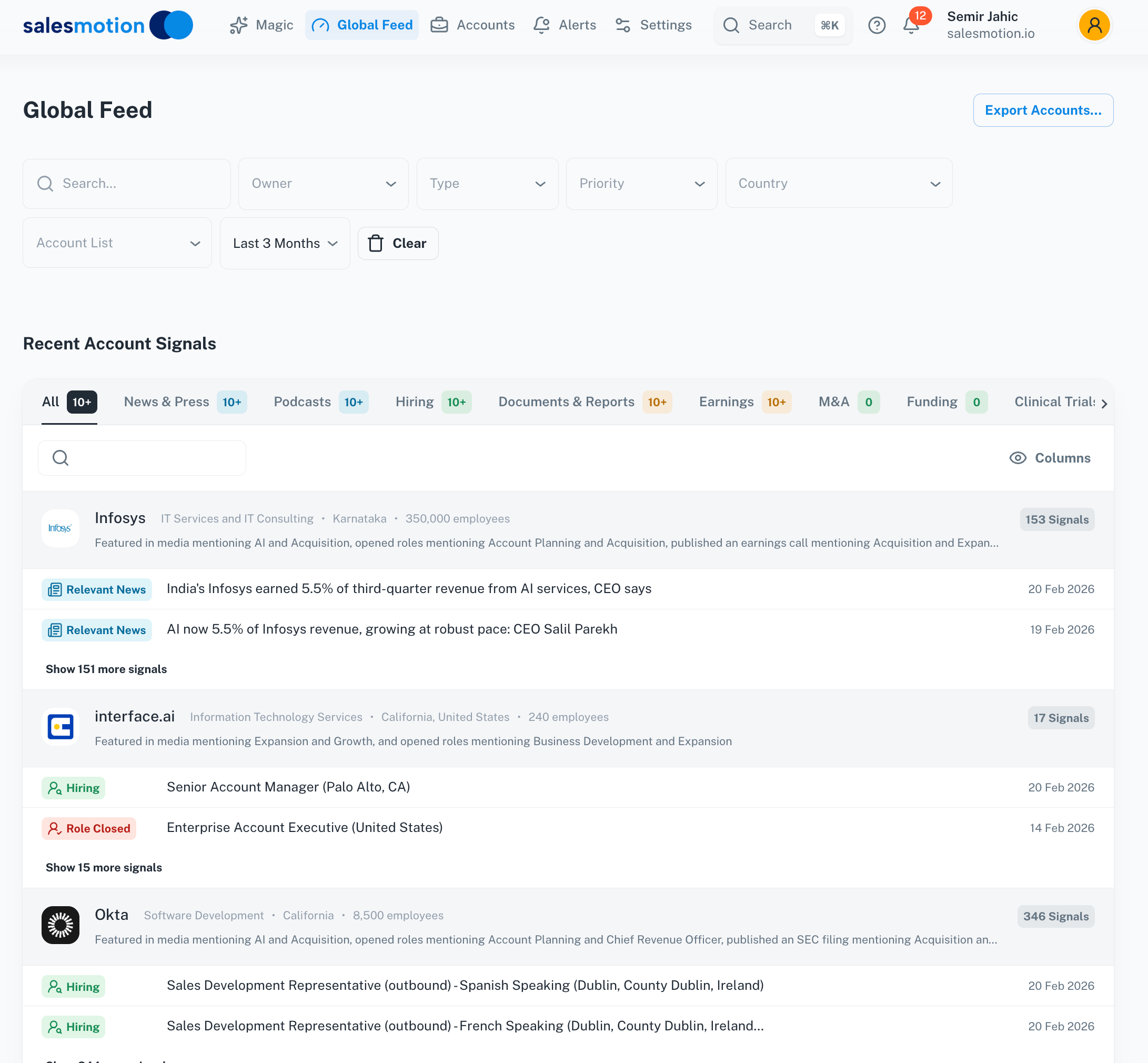 Filtering signals by type and priority turns a data firehose into an actionable list of accounts showing real intent to buy.
10. Intent Data and Predictive Prospecting
Intent data and predictive prospecting is a data-driven technique that uses AI to identify prospects actively researching solutions like yours. It tracks online activities and content consumption to predict which accounts are most likely to be in-market, allowing sales teams to engage at the perfect moment.
How to Implement This Technique
- Define Your Intent Topics: Work with an intent data provider (like 6sense or Demandbase) to select keywords and topics relevant to the problems your product solves.
- Combine with ICP: Layer intent data over your Ideal Customer Profile (ICP) criteria. This combination filters interested companies down to a manageable list of qualified accounts.
- Establish Signal Thresholds: Determine what level of intent activity constitutes a "hot" lead worthy of immediate outreach.
- Create a Fast-Follow Process: When an account crosses your intent threshold, you must act quickly. Create a specific outreach sequence for these high-priority prospects. Learn more by reading our guide on what is intent data.
Pro-Tip: Use intent data to re-engage a prospect via email. A spike in research activity from a past prospect is a powerful signal that the timing may now be right.
How Salesmotion Accelerates Intent Data Prospecting
Salesmotion makes intent data instantly actionable, closing the gap between a signal and your outreach.
- Account Signals: Our platform consolidates third-party intent data with first-party signals (your website visitors) and market signals (job changes, funding news). This creates a single, prioritized feed of accounts showing the strongest buying intent right now.
- Automated Briefs & POVs: When an account shows intent, Salesmotion automatically generates a sales brief and a customized Point of View (POV). This instantly equips your reps with the "why you, why now" messaging needed to convert a data point into a conversation.
Top 10 Sales Prospecting Techniques Comparison
| Method | Implementation complexity | Resource requirements | Expected outcomes | Ideal use cases | Key advantages |
|---|---|---|---|---|---|
| Cold Calling | Low–Medium (scripts, training) | Sales reps, phone system, contact lists | Immediate conversations; low overall conversion | High-touch B2B, decision-maker outreach | Real-time qualification; personal connection |
| Email Prospecting | Low (templates, sequences) | Email platform, lists, content creation | Scalable outreach; moderate response rates | Broad B2B/B2C outreach, launches, nurturing | Cost-effective, measurable, easy to scale |
| LinkedIn Outreach | Medium (profile + targeted messaging) | LinkedIn tools, time for engagement, CRM | Higher trust and engagement; moderate conversion | Executive outreach, professional B2B prospecting | Rich profile data; professional context lowers friction |
| Account-Based Marketing (ABM) | High (cross-team coordination) | CRM, ABM tools, research, personalized content | Higher win rates and deal sizes | Enterprise accounts and strategic targets | Personalized multi‑channel approach; aligned sales+marketing |
| Referral Prospecting | Low–Medium (program setup) | CRM, referral incentives, happy customers | Very high conversion; shorter sales cycles | Service firms, customer-driven growth, SMBs | Highest trust and conversion; lower CAC |
| Content Marketing & Thought Leadership | Medium–High (strategy + production) | Content team, SEO, distribution channels | Long-term inbound leads; brand authority growth | Market education, long sales cycles, lead nurturing | Compounding value; high-quality inbound leads |
| Social Selling | Medium (consistent engagement) | Social profiles, content, time investment | Gradual relationship building; measurable engagement | Personal-brand driven sales; B2B and B2C influence | Authentic relationships; market intelligence |
| Event-Based Prospecting | Medium–High (planning & logistics) | Travel, sponsorship, staff, booth materials | High-quality interactions; variable ROI | Conferences, trade shows, industry networking | Face-to-face engagement; pre-qualified audiences |
| Vertical / Niche Prospecting | Medium (industry research) | Industry expertise, tailored content, networks | Higher relevance and conversion within niche | Industry-specific solutions, specialist SaaS | Deep credibility; stronger product-market fit |
| Intent Data & Predictive Prospecting | High (data integration & models) | Intent platforms, AI, IT resources, data feeds | Higher-quality, ready-to-buy leads; faster cycles | Data-driven sales teams, ABM prioritization | Real-time prioritization; improved outreach efficiency |
Turn Prospecting from a Grind into a Science
We've covered ten B2B sales prospecting techniques, from classic cold calling to data-driven intent outreach. Each method offers a unique pathway to engaging high-value accounts. The journey from a simple list of names to a robust, predictable pipeline isn't about choosing just one tactic—it's about building an integrated strategy that meets buyers where they are.
The golden thread through every successful prospecting effort is relevance at scale. Prospects are overwhelmed with generic messages. The only way to cut through the noise is by showing you understand their specific challenges and priorities before you reach out. This is the fundamental shift from prospecting as a numbers game to a strategic science.
Key Takeaways
- Effective prospecting in B2B has shifted from volume-based outreach to relevance-driven engagement, where timing and context matter more than the number of touches.
- Cold calling and email prospecting remain effective when backed by pre-call research and real-time buying signals that provide a compelling reason to reach out.
- Account-Based Marketing (ABM) treats high-value accounts as individual markets, requiring tight sales and marketing alignment and personalized multi-channel campaigns.
- Referral prospecting delivers the highest conversion rates and shortest sales cycles because trust is built in from the start through a mutual connection.
- Intent data and predictive prospecting use AI to identify accounts actively researching solutions like yours, enabling reps to engage at the moment of highest buying probability.
- The strongest prospecting strategies combine multiple techniques into an integrated, multi-channel approach where insights from one method inform and improve the others.
Your Blueprint for Elevated Prospecting
Mastering these sales prospecting techniques requires a new mindset. It's about moving away from manual research and embracing a system that empowers you to act on intelligence. Here are the core principles to guide you:
-
Synthesize, Don't Silo: The most effective prospectors don't just cold call or just use LinkedIn. They use insights from social selling to warm up a cold call. Your goal is to create a seamless, multi-channel experience for your prospect, where each touchpoint builds upon the last.
-
Intelligence is the Accelerator: Each technique we discussed becomes exponentially more powerful when fueled by deep account intelligence. An ABM campaign without specific insights is just a generic ad. A cold email without a relevant trigger is just spam. The quality of your data directly dictates the quality of your results.
-
Operationalize Your Approach: Don't leave success to chance. For each technique, define the process, establish clear KPIs, and implement the right tools. This structure ensures consistency and makes it possible to measure what's working. To modernize your approach, platforms like AI-powered booking solutions can automate tedious scheduling, allowing reps to focus more on selling.
Ultimately, the goal is to transform your sales organization into a highly efficient engine where every action is purposeful. By mastering these diverse sales prospecting techniques and underpinning them with a powerful intelligence layer, you equip your team to not just hit their quota but to build a predictable, scalable revenue machine. The era of brute-force prospecting is over. The future belongs to the informed and the relevant.
Frequently Asked Questions
What is the most effective sales prospecting technique for B2B?
There is no single best technique because effectiveness depends on your market, deal size, and buyer profile. However, combining methods tends to outperform relying on any one approach. For example, pairing intent data with email prospecting allows you to reach the right accounts at the right time with a relevant message, which consistently produces higher response rates.
How many prospecting touches does it take to book a meeting?
Most B2B prospects require between five and eight touches across multiple channels before they engage. A mix of email, phone, and LinkedIn outreach spread over two to three weeks tends to work best. The key is that each touchpoint should add value rather than just checking in.
How can I make cold outreach feel less cold?
Research is the key differentiator. Spend a few minutes before each call or email looking for a recent trigger event, such as a funding round, new hire, or product launch. Referencing something specific and timely in your opening line transforms generic outreach into a relevant conversation starter that prospects are far more likely to respond to.
When should a B2B team invest in Account-Based Marketing?
ABM is most effective when you sell high-value solutions to a defined set of enterprise accounts. If your average deal size justifies the investment of personalized campaigns and your sales cycle involves multiple stakeholders, ABM can significantly improve win rates and deal sizes. Start with a small pilot of 10 to 20 target accounts before scaling.
Ready to stop the endless research and start having more meaningful sales conversations? Salesmotion automates the account intelligence that fuels every effective prospecting technique in this article. Get real-time account signals, dynamic briefs, and strategic POVs delivered directly into your workflow, so your team can focus on what they do best: selling.