Your sales team's contact database is decaying right now. Every day, professionals change jobs, companies restructure, email addresses are deactivated, and phone numbers are reassigned. By most estimates, B2B contact data degrades at 25-35% per year, which means a database of 100,000 contacts loses 25,000-35,000 valid records annually without any action. B2B contact data quality is not a one-time project. It is an ongoing operational challenge that directly affects pipeline generation, sales productivity, and revenue.
TL;DR: B2B data quality problems are systemic, not incidental. Static databases decay 25-35% per year. The most effective approach combines regular verification, automated enrichment, and real-time signal monitoring to maintain data accuracy without requiring manual upkeep. Investing in data quality directly improves pipeline conversion and rep productivity.
The True Cost of Bad B2B Data
Data quality problems cost more than most sales leaders realize. The impact shows up in four areas.
Wasted rep time. Reps spend an estimated 20-30% of their time managing data quality issues: researching bounced contacts, finding updated information, deduplicating records, and cleaning up after failed outreach. A Salesforce study found that sales reps spend only 28% of their time actually selling. Bad data makes this already small percentage even smaller.
Damaged sender reputation. High email bounce rates damage your domain's sender reputation. Once your domain is flagged by email providers, even your valid emails end up in spam folders. The threshold is typically 2-3% bounce rates. A database with 10% stale email addresses will cross that threshold quickly.
Missed pipeline. Every bad contact record is a missed opportunity. If 30% of your target account contacts are outdated, you are systematically missing 30% of your addressable market. The accounts with the freshest data get the most outreach, not necessarily the accounts with the best fit.
Poor forecasting. CRM data contaminated with duplicate records, outdated contacts, and inaccurate firmographics produces unreliable pipeline reports. Sales leaders cannot accurately forecast when the data underneath is unreliable.
See Salesmotion on a real account
Book a 15-minute demo and see how your team saves hours on account research.
How B2B Data Decays
Understanding the decay mechanisms helps you build a prevention strategy.
Contact-Level Decay
People change jobs, get promoted, move to different departments, or leave the workforce entirely. Email addresses are deactivated, phone numbers change, and LinkedIn profiles update. The average B2B professional changes roles every 2-3 years, which means your contact database turns over significantly within a typical enterprise sales cycle.
Operations teams know the gap between the goal and the reality. A sales-operations lead at a life-sciences services firm told us: "we always want to have everything to be fresh in the system with names, with titles. ... Unfortunately, this is, this is the wish. It does not happen."
Company-Level Decay
Companies merge, get acquired, change names, restructure divisions, and pivot business models. Firmographic data like revenue, employee count, industry classification, and technology stack changes regularly. A company that was a 200-person Series B startup when you added them to your CRM may now be a 50-person post-layoff company or a 2,000-person post-acquisition enterprise.
Relationship Decay
Even when contact information is technically accurate, the relevance of the contact may have changed. A champion who was excited about your product may have lost budget authority. A technical evaluator who ran your POC may have moved to a different project. The contact record looks fine, but the relationship it represents has decayed.

“We're no longer fishing. We know who the right customers are, and we can qualify them quickly. Salesmotion has had a direct impact on pipeline quality.”
Andrew Giordano
VP of Global Commercial Operations, Analytic Partners
How to Measure B2B Data Quality
You cannot improve what you do not measure. Track these metrics to understand the health of your contact database.
Email Deliverability Rate
The percentage of emails that successfully reach inboxes. Industry benchmark: 95%+ for a healthy database. Below 90% indicates significant data quality problems. Monitor this monthly through your email platform (HubSpot, Outreach, Salesloft).
Phone Connect Rate
The percentage of calls that reach a live person (not a wrong number, disconnected number, or generic voicemail). Benchmark: 15-25% for a well-maintained database. Below 10% suggests widespread phone number decay.
Duplicate Rate
The percentage of records that are duplicates (same person, multiple records). Benchmark: under 5%. Many CRMs accumulate duplicates as contacts are imported from multiple sources. Duplicates waste outreach budget and create confusion about engagement history.
Field Completeness Rate
The percentage of records with all critical fields populated (name, email, title, company, phone). Benchmark: 80%+ for active prospect lists. Records with missing critical fields cannot be effectively segmented or personalized.
Data Freshness Score
The percentage of records verified or updated within the last 90 days. Benchmark: 60%+. Records that have not been verified in 6+ months should be flagged for re-verification before outreach.
Verification Methods and Tools
Several approaches help maintain data accuracy, each with different trade-offs.
Email Verification Services
Tools like ZeroBounce, NeverBounce, and Hunter.io verify email addresses without sending actual emails. They check MX records, SMTP responses, and domain validity. Run verification before every outbound campaign and quarterly on your full database. Cost: $0.001-$0.01 per verification.
Phone Verification
Phone numbers are harder to verify than emails. Services like Cognism provide phone-verified mobile numbers. Manual verification (calling to confirm the number reaches the right person) is the gold standard but does not scale. Focus phone verification on high-priority contacts only.
CRM Enrichment Integrations
Platforms like ZoomInfo, Apollo, and Clearbit offer CRM integrations that automatically update contact records with fresh data. These catch some changes but rely on the provider's own data freshness, which varies. No single enrichment provider catches all changes in real time.
Signal-Based Real-Time Updates
The most effective approach to data freshness is not periodic verification but continuous signal monitoring. When a contact changes jobs, gets promoted, or leaves a company, the change is detected through job posting signals, LinkedIn activity, and corporate announcements. Salesmotion monitors these signals across your territory, updating account intelligence in real time rather than waiting for quarterly database refreshes.
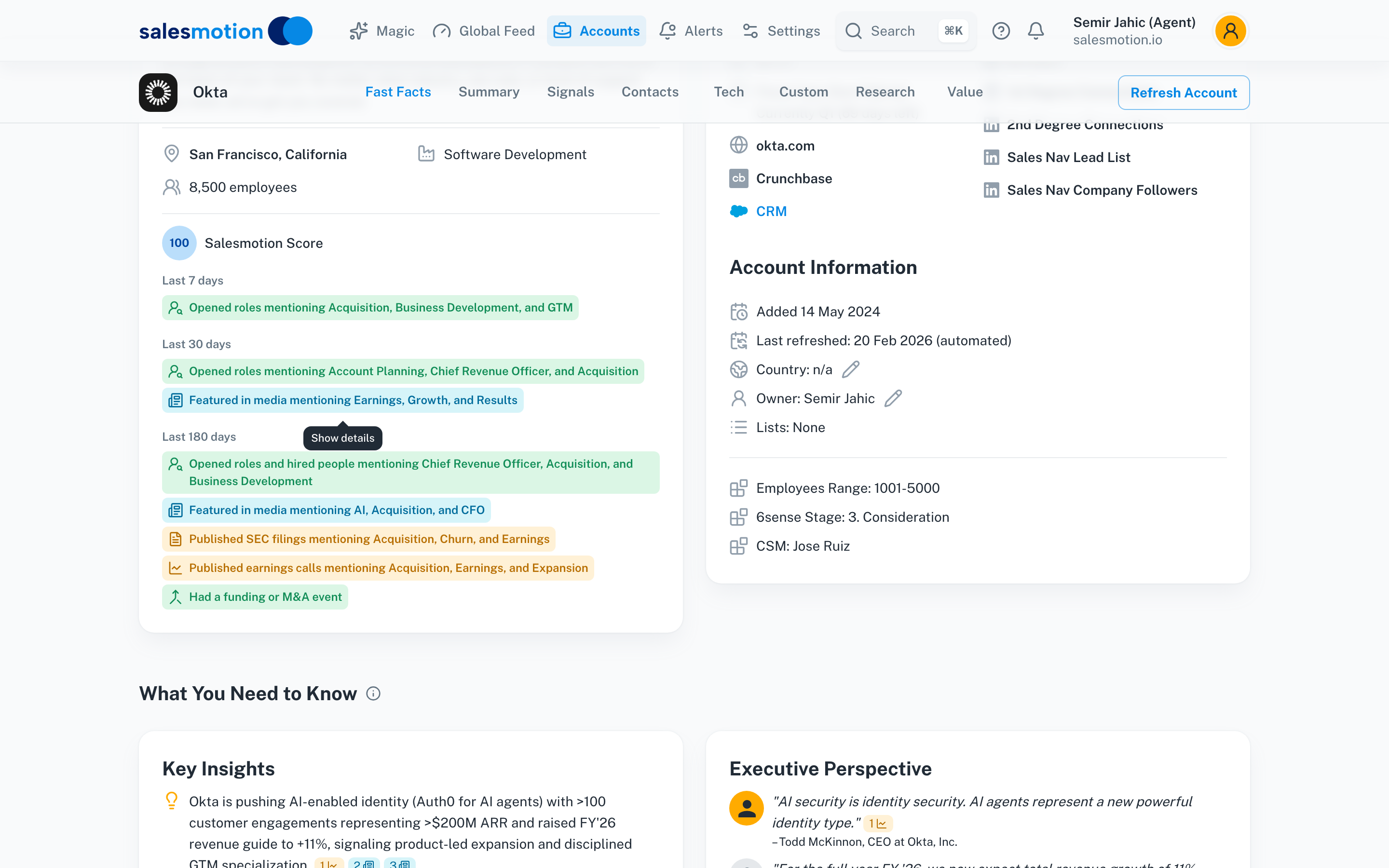 Salesmotion solves the data quality problem by synthesizing intelligence from 1,000+ sources with full source attribution — every insight is verifiable, not a black box.

“All of the vendors that I've worked with, all of the onboarding that I have had to deal with, I will say, hands down, Salesmotion was the easiest that I have had.”
Lyndsay Thomson
Head of Sales Operations, Cytel
Data Enrichment Strategies
Enrichment goes beyond verification. It adds missing fields, corrects outdated information, and provides context that makes contacts more actionable.
Waterfall Enrichment
Use multiple data sources in sequence. Start with your primary provider (e.g., ZoomInfo). For contacts where the primary provider has missing or stale data, fall back to a secondary provider (e.g., Apollo, Lusha). For still-missing data, use specialized sources (industry databases, LinkedIn, signal platforms). This "waterfall" approach maximizes coverage without overpaying for redundant data.
Technographic Enrichment
Add technology stack data to your accounts. Knowing that a target company uses Salesforce, Snowflake, and HubSpot helps you tailor outreach and identify competitive displacement opportunities. Providers like BuiltWith and Wappalyzer crawl websites to identify technology usage.
Signal Enrichment
Add buying signal data to your contacts and accounts. This includes leadership changes, hiring patterns, funding rounds, and strategic initiatives. Signal enrichment transforms a static contact record into a dynamic intelligence profile. It answers not just "who is this person?" but "what is happening at their company right now?"
Building a Data Quality Program
Sustainable data quality requires a program, not a one-time cleanup. A marketing director at a telecoms firm told us the same thing in fewer words: "Data is always building. It's never a job that's finished."
Monthly: Email Verification
Verify all email addresses in your active prospect list monthly. Remove hard bounces immediately. Flag soft bounces for re-verification next cycle. Cost is minimal ($50-200/month for most teams) and prevents sender reputation damage.
Quarterly: Full Database Audit
Run a comprehensive audit of your CRM database quarterly. Check duplicate rates, field completeness, and record freshness. Enrich contacts that have not been updated in 90+ days. Flag accounts where firmographic data may have changed (post-acquisition, post-restructuring).
Continuous: Signal Monitoring
Deploy real-time signal monitoring to catch changes as they happen rather than discovering them during quarterly audits. Salesmotion tracks leadership changes, hiring patterns, and account intelligence signals continuously, ensuring your data reflects current reality.
Annual: Data Strategy Review
Review your data provider stack annually. Are you getting value from every subscription? Are there coverage gaps? Are new providers offering better freshness or accuracy? The B2B data market evolves quickly, and last year's best provider may not be this year's.
For a comparison of data providers and intelligence platforms, see our B2B contact data provider guide. For more on why static databases fall short, see our post on sales intelligence platforms.
Key Takeaways
- B2B contact data decays 25-35% annually, making data quality an ongoing operational challenge, not a one-time project
- Bad data costs sales teams through wasted rep time (20-30% of their day), damaged sender reputation, missed pipeline, and unreliable forecasting
- Measure data quality through email deliverability rate, phone connect rate, duplicate rate, field completeness, and data freshness score
- Use waterfall enrichment (multiple providers in sequence) to maximize coverage without overpaying for redundant data
- Real-time signal monitoring catches contact and company changes as they happen, replacing periodic verification with continuous freshness
- Build a data quality program with monthly verification, quarterly audits, continuous signal monitoring, and annual strategy reviews
Frequently Asked Questions
How fast does B2B data decay?
B2B contact data decays at approximately 25-35% per year under normal conditions. During periods of high market disruption (mass layoffs, rapid hiring, M&A waves), decay can exceed 40%. The primary drivers are job changes (average tenure of 2-3 years), company restructuring, email domain changes, and phone number reassignment. Signal-based monitoring catches most changes within days rather than months.
What is the most cost-effective way to maintain B2B data quality?
The most cost-effective approach is a three-tier system: monthly email verification ($50-200/month), quarterly enrichment through your primary data provider (included in most subscriptions), and continuous signal monitoring for high-priority accounts. This combination keeps your active prospect list at 90%+ accuracy without requiring manual research or expensive full-database refreshes.
How do I fix duplicate records in my CRM?
Start with your CRM's built-in deduplication tools (Salesforce and HubSpot both offer native merge capabilities). For larger databases, use dedicated dedup tools like RingLead or Cloudingo. Establish merge rules (which record wins when data conflicts), and set up automation to prevent future duplicates at the point of import. Target a duplicate rate under 5%.
Is real-time data better than periodic database refreshes?
Real-time signal monitoring and periodic database refreshes serve different purposes. Database refreshes update bulk records with corrected firmographic and contact data. Signal monitoring catches specific events (job changes, promotions, company changes) as they happen. The ideal approach uses both: quarterly database refreshes for baseline accuracy and continuous signal monitoring for time-sensitive changes that create selling opportunities.