The best B2B contact databases and data providers are ZoomInfo for the broadest database with an AI layer on top, Apollo.io for contact data and outreach in one product with a permanent free plan, and Cognism for phone-verified mobile numbers in Europe. Lusha, RocketReach, SalesIntel, UpLead, Lead411, Seamless.AI and Hunter.io each win a narrower job, from quick self-serve lookups to email finding and verification. Six of the ten publish their prices, and nine offer a free plan, a free trial or free credits.
TL;DR: Pick ZoomInfo if you want the broadest platform on this list (500M+ contacts, org charts, intent and AI agents) and you can buy on an annual, consumption-based contract. Pick Apollo.io if you want a 240M-contact database, sequencing and a dialer in one product, starting free. Pick Cognism if your team calls into Europe and needs phone-verified mobiles with Do-Not-Call coverage. A contact database tells you who to reach; it works best next to something that tells you which accounts to work this week.
| Top pick | Best for | Starting price |
|---|---|---|
| ZoomInfo | Larger teams that want data, intent and AI agents in one platform | Custom, consumption-based (ZoomInfo Lite is free) |
| Apollo.io | Teams that want contact data and outreach in one product | Free; $49–$119/user/mo (annual) |
| Cognism | Teams prospecting into Europe by phone | Custom, quote-only |
Shopping for contact data providers?
Contact data is necessary but not enough. Salesmotion bundles verified contacts with the why-now context.
Email + phone + signals + research briefs + AI outreach in one tool. From $85/mo, monthly contract.
Why Trust This Guide?
Every price and product fact in this guide was checked against the vendor's own website on 10 October 2026, and the published prices for Apollo.io, Lusha, RocketReach and UpLead were re-checked on 24 October 2026. Where a vendor publishes no price, the guide says so and does not estimate. Where a figure comes from a third party, the third party is named in the same sentence. Accuracy percentages and database sizes are the vendors' own published claims and are labelled that way.
Salesmotion publishes this guide. Contact data is not Salesmotion's category, so it has no numbered slot in the list. It appears once, in "Where Salesmotion Fits" after the ten reviews, with a plain description of what it adds alongside a contact database.
The first-party angle comes from our own conversations. We sat in 55 sales and customer calls between August and October 2026. In 22 of them the question was not who to contact but which accounts to work this week, and when.
"I just feel like we have a lack of visibility into ... what accounts are actually hot" Sales leader, healthcare technology
That shapes how this guide is organized. The list covers the tools that find and verify people. The section after it covers the layer that tells you which accounts are worth the call.
The order of the list is based on fit for a B2B sales team choosing its primary contact database. Platforms that combine a large database with signals and workflow come first. More specialized tools follow, ordered by how much of a team's contact needs each one covers.
What to Look for in a B2B Contact Data Provider
Not all contact databases are equal. Before comparing individual providers, establish the criteria that matter most for your team. If you are still deciding whether you need a database at all, start with do I still need a contact database?
Data Accuracy and Verification
The single most important factor. A database of hundreds of millions of contacts means little if the emails you export bounce. Look at how each provider verifies its data and what it commits to in writing. Lusha states 98% email accuracy across its database. RocketReach says contacts are verified on demand and in real time with 98% accuracy. UpLead backs a 95%+ accuracy guarantee and says it refunds bounces. SalesIntel describes its contacts as AI and human-verified with 95% accuracy on a 90-day refresh cycle. These are vendor claims, so test each one on a sample of your own target accounts before you sign. Records also age as people change jobs; our B2B data decay strategy covers how to keep a database current after you buy it.
Coverage and Depth
Coverage means different things for different teams. If you sell into EMEA, check coverage there specifically. If you target mid-market, a large total record count tells you little about your segment. Evaluate coverage by your actual ICP, not total record counts. Key questions: Does the provider cover your target geographies? Industries? Company sizes? Does it include direct phone numbers, or only company lines?
Compliance and Data Sourcing
GDPR, CCPA, and evolving privacy regulations have made data sourcing a board-level concern. Ask each provider how it collects data, how it handles Do-Not-Call lists, and which certifications it holds. Cognism describes a compliance-first posture with extensive Do-Not-Call coverage across Europe. Lusha lists ISO 27701, ISO/IEC 42001 and SOC 2 Type II, and says it is GDPR certified by ePrivacyseal. Hunter.io says the data it distributes has disclosed public sources. If you sell into Europe, compliance is not optional.
Enrichment and Signals
Static contacts go stale. Most providers on this list now layer something on top of the contact record: technographic data, intent signals, job change alerts, and firmographic updates. Contact data tells you WHO to call. Enrichment and signals tell you WHEN and WHY. This distinction separates basic databases from sales intelligence platforms, and the comparison table below shows what each provider includes.
CRM Integration and Workflow
A contact database that lives in a separate tab creates friction. Look for providers that push data directly into Salesforce, HubSpot, or your sequencing tool. Check for native CRM sync, a browser extension for prospecting, and API or MCP access if your team builds its own workflows or works inside an AI assistant.

“Salesmotion has been a game-changer for me. I used to spend 12 hours a week on prospect research, now it's down to 4. Plus I'm finding stuff I was totally missing - podcasts, news mentions, the good bits.”
George Treschi
Account Executive, FY25 President's Club, Sigma
The 10 Best B2B Contact Data Providers Compared
Here is a side-by-side comparison of the ten providers, followed by detailed reviews.
| Provider | Best for | Standout capability | Signals included | Pricing | Free plan or trial |
|---|---|---|---|---|---|
| ZoomInfo | Larger teams that want one platform | 500M+ contacts with org charts and Copilot | Buyer signals in Copilot; Streaming Intent is an add-on | Custom, consumption-based | ZoomInfo Lite, 10 credits a month |
| Apollo.io | Data and outreach in one product | 240M contacts with sequences and a dialer | Intent topics on every plan | Free; $49–$119/user/mo (annual) | Free plan; 14-day trial on Basic and Professional |
| Cognism | Phone prospecting into Europe | Phone-verified mobile numbers | Hiring, funding and M&A, job changes; Bombora intent on Pro | Custom, quote-only | Free data sample |
| Lusha | Self-serve lookups for reps and small teams | 515M+ contacts with published per-reveal costs | 26 buying signals, refreshed weekly | Free (40 credits/mo); Starter $37.45/mo, Professional $52.45/mo (annual) | Free plan, 40 credits a month |
| RocketReach | Email and phone lookup at volume | 700 million professional profiles | Intent data on Ultimate | Essentials $27/mo, Pro $69/mo, Ultimate $142/mo (annual) | 5 free lookups |
| SalesIntel | Teams that want human-verified data | Research on Demand for missing contacts | 60,000+ intent topics | Does not publish pricing | Free trial |
| UpLead | Verified exports with a guarantee | 95%+ accuracy guarantee with bounce refunds | Buyer intent data on Professional | 7-day free trial; Essentials $99/mo or $74/mo (annual) | 7-day trial, 5 credits |
| Lead411 | Export-based pricing | 1,000 exports a month on the entry plan | Buyer intent on annual Spark | Spark $49/mo or $490/year | 7 days, 50 exports |
| Seamless.AI | High-volume prospecting | 1.8B+ emails and 414M+ phone numbers | Buyer Intent and Job Changes | Free (50 credits); paid plans quote-only | 50 free credits |
| Hunter.io | Email finding and verification | Emails returned with their public sources | Signals product | Free (50 credits/mo); Starter 49€/mo or 34€/mo (yearly), as shown on its pricing page | Free plan, 50 credits a month |
Clearbit, which earlier editions of this list reviewed, is now part of HubSpot and its enrichment ships as HubSpot data enrichment inside paid HubSpot plans, so it no longer has a slot as a standalone provider. Teams that used it on its own can read our Clearbit alternatives guide.
Detailed Provider Reviews
1. ZoomInfo
ZoomInfo is the broadest platform on this list. Its site states verified data on 500M+ contacts and 100M+ companies, backed by 300+ human researchers. On top of the data sit ZoomInfo Copilot, which it calls an AI sales agent, GTM Workspace agents for account research and meeting prep, and API and MCP access through GTM.AI.
Best for: Larger sales teams that want contact data, org charts, intent and AI assistance from one vendor and can buy on an annual contract.
What it is strong at: Breadth. Copilot assembles contacts, org charts, account history and company updates, and connects to Salesforce, HubSpot, Outreach, Salesloft and Gong. ZoomInfo also offers a permanent free tier, ZoomInfo Lite, with no credit card required.
Pricing: ZoomInfo does not publish list pricing; contracts are quoted per organization; its own pricing page states that no specific dollar amounts are published because pricing is consumption-based. Vendr reports a median contract of $33,500 a year based on 1,576 purchases, with a range of $7,233–$156,053. ZoomInfo Lite is a permanent free tier with 10 credits a month.
Choose it if: you want the widest coverage and an AI layer in one contract. Plan your budget around the packaging: ZoomInfo's pricing page lists Streaming Intent, international data, sales engagement, extra seats, and API and MCP access as add-ons to base plans, and paid plans are annual subscriptions. For a full breakdown, see our ZoomInfo pricing review.
2. Apollo.io
Apollo.io combines a database of 240M contacts and 30M companies with built-in sales engagement: email sequences, a dialer, enrichment and workflow automation. Its free plan stays free with no time limit and includes 900 credits per seat per year, which makes it the most accessible entry point on this list.
Best for: Startups and growing teams that want prospecting data and outreach in a single product on a published, self-serve rate card.
What it is strong at: One product for the whole outbound motion. Intent topics and AI research appear on every plan, including Free, and the Basic plan adds unlimited sequences, CRM integrations and waterfall enrichment.
Pricing: Apollo publishes its pricing: a free tier, then Basic at $49, Professional at $79 and Organization at $119 per seat per month on annual billing (3-seat minimum on Organization). Monthly billing is $65 and $99 on Basic and Professional; Organization is annual only. Basic and Professional start with a 14-day trial.
Choose it if: you want data and sending in one place and are comfortable with credit metering. Apollo's pricing page prices an email at 1 credit and a phone number at 8 credits, and says unused credits expire at the end of each billing cycle. See our Apollo.io pricing analysis and Apollo alternatives for more context.
3. Cognism
Cognism positions itself as "Europe's most trusted B2B data". It offers phone-verified mobile numbers that Cognism says deliver up to 3x higher connect rates, with decision-maker data refreshed every 30 days.
Best for: B2B teams targeting European buyers who need verified direct dials and a compliance-first data supplier.
What it is strong at: Phone-verified mobiles and compliance. Cognism offers extensive Do-Not-Call coverage across Europe, on-demand mobile verification on its Pro package, and completed a SOC 2 Type II audit for 2026. It is more than a contact list: its pricing page lists hiring, funding and M&A, and job-change signals, AI account research, and MCP and API access, and the Pro package adds Bombora intent data.
Pricing: Cognism does not publish list pricing; contracts are quoted per organization; it sells Standard and Pro packages, each listed with 5 seats included, on a credit system where one credit reveals one contact. A free data sample is available on request.
Choose it if: phone outreach into Europe is central to your pipeline and you are ready to start with a sales conversation. Cognism is built for Europe first, so teams with North American territories should test coverage there on the data sample. Review our Cognism pricing breakdown for details.
4. Lusha
Lusha is a self-serve contact data platform with one of the largest databases on this list by its own count: 515M+ verified contacts and 29M+ companies, including 165M+ emails and 117M+ direct dials.
Best for: Individual reps and small teams that want quick, reliable contact lookups on a published price, without a sales call.
What it is strong at: Transparent self-serve buying and a deep compliance stack. Lusha prices an email reveal at 1 credit and a phone number at 5 credits, lists ISO 27701, ISO/IEC 42001 and SOC 2 Type II, and says it is GDPR certified by ePrivacyseal. It also includes 26 buying signals refreshed weekly, such as funding events, hiring surges and leadership changes, and makes its data available through an API, an MCP server, Claude and ChatGPT.
Pricing: Lusha publishes its pricing: a free plan with 40 credits a month, then Starter at $37.45, Professional at $52.45 and Premium at $299.95 per month on annual billing ($49.90, $69.90 and $399.90 billed monthly). Scale is quote-only.
Choose it if: you want to start free and pay by card as you grow. Confirm which features sit on which plan before you buy. See our Lusha pricing review.
5. RocketReach
RocketReach lets reps search 700 million professionals and 60 million companies with 50+ filters, and says contacts are verified on demand and in real time with 98% accuracy.
Best for: Recruiters and sales teams that need email and phone lookups across a very broad set of professional profiles.
What it is strong at: Scale and a fair metering rule. A lookup is used only if RocketReach finds and verifies an email or phone; otherwise it is refunded. MCP and API access is listed on all three plans.
Pricing: RocketReach publishes its pricing: Essentials at $329/year ($27/month), Pro at $829/year ($69/month) and Ultimate at $1,699/year ($142/month). Monthly billing runs $49/$99/$209. Annual plans include unlimited lookups; the 1,200/3,600/20,000 figures are export caps. Team plans start at $6K annually, and a free account includes 5 lookups.
Choose it if: breadth of profiles matters more to you than a built-in outreach suite. Match the plan to the data you need: Essentials is email only, phone data, CRM integrations and org charts start on Pro, and intent data is on Ultimate.
6. SalesIntel
SalesIntel builds its offer around human verification. Its site describes contacts as AI and human-verified with 95% accuracy on a 90-day refresh cycle, checked by a team of more than 2,000 researchers, and lists 200M+ verified B2B contacts and 54M+ verified mobile numbers.
Best for: Teams that want human-verified contacts and a research team that will find the people a database is missing.
What it is strong at: Research on Demand, which covers any contact or account not already in the database, plus 60,000+ intent topics and 42,000+ tracked technologies. Its pricing page describes unlimited data and enrichment at a single price.
Pricing: SalesIntel does not publish pricing; its pricing page is a request form. Its homepage links a free trial.
Choose it if: verified mobile numbers and on-request research matter more to you than a self-serve checkout.
7. UpLead
UpLead sells real-time verified B2B emails, mobile numbers and intent data. It verifies emails at the moment of export, backs a 95%+ accuracy guarantee, and says it refunds bounces and poor data.
Best for: Individual users and small teams that want verified exports on a published monthly price.
What it is strong at: Verification at export and a written guarantee. One credit buys one contact with email and mobile direct dial. UpLead connects to Salesforce, HubSpot, Pipedrive, Outreach, Salesloft, lemlist and other tools, and tracks 16,000+ technologies.
Pricing: UpLead publishes its pricing: a 7-day free trial with 5 credits, then Essentials at $99 a month (170 credits) or $74 a month billed annually, and Plus at $199 a month (400 credits) or $149 a month billed annually. Professional is annual only and quoted.
Choose it if: you run targeted prospecting and want a guarantee on what you export. Essentials and Plus are single-user plans with a monthly credit allowance, and extra credits can be bought; technographics start on Plus, and buyer intent data and team seats are on Professional.
8. Lead411
Lead411 sells B2B contact data by export volume, with buyer intent data included on its annual entry plan.
Best for: Teams that want a simple export allowance at a low published entry price.
What it is strong at: Straightforward packaging. The Spark plan includes 1,000 exports a month, the annual version adds buyer intent, and the higher plans support multiple users.
Pricing: Lead411 publishes its pricing: Spark at $49 a month (1,000 exports a month) or $490 a year (12,000 exports a year), Ignite starting at $150 a month or $1,500 a year, and Blaze by quote with unlimited exports. The Pilot Light trial is free for 7 days with 50 exports.
Choose it if: you think in exports per month and want intent data without a separate contract.
9. Seamless.AI
Seamless.AI states 1.8B+ verified business emails and 414M+ phone numbers. Its product is organized around a Prospector, Buyer Intent, Job Changes and CRM enrichment, with an AI Assistant and six named AI agents on top.
Best for: High-volume prospecting teams that want a large pool of emails and phone numbers with AI help built in.
What it is strong at: Scale and reach into the rest of the stack. Seamless.AI says it syncs with 6,000+ tools, and it offers a Chrome extension, an API and MCP access.
Pricing: Seamless.AI does not publish list pricing; contracts are quoted per organization; its pricing page is a demo request form. Its site says Seamless.AI is free for up to 50 credits.
Choose it if: volume is the priority and you are happy to get a quote for paid plans. For teams exploring options, see our Seamless.AI alternatives guide.
10. Hunter.io
Hunter.io is built around email: finding and verifying professional email addresses, then sending outreach through its Sequences product. Enter a domain, and Hunter's Domain Search returns the email addresses it has found for that company.
Best for: Marketers and SDRs focused on email outreach who need reliable email finding and bulk verification.
What it is strong at: Email verification with disclosed sources. Hunter says it analyzes millions of websites daily, auto-verifies its lead data on all plans, and returns email addresses with information about where and when it found them. Every plan includes unlimited team members.
Pricing: Hunter publishes its pricing, shown in euros on its pricing page: a free plan with 50 credits a month, then Starter at 49€, Growth at 149€ and Scale at 299€ a month (34€, 104€ and 209€ a month on yearly billing), with unlimited team members on every plan.
Choose it if: email is your main channel. Hunter is built around email, and many teams run it alongside one of the databases above.

“Automatic account profile detail I can use to manage my territory. Using Salesmotion AI to generate value statements per persona, account, etc. Using Salesmotion to give me a starting point based on new hires, or news alerts is critical.”
Adam Wainwright
Head of Revenue, Cacheflow
Where Salesmotion Fits
Salesmotion is not a contact database, and it does not have a numbered slot above. It is the account-intelligence layer that sits alongside one. The ten providers in this guide answer "who works there and how do I reach them". Salesmotion answers "which of my accounts changed this week, what happened, and what should I say".
Three AI agents do the work. The Signal Agent monitors 1,000+ public sources for 50+ signal types, including leadership changes, earnings commentary, hiring, funding rounds and product launches. The Research Agent turns those into cited account briefs. The Outreach Agent drafts messages a rep reviews, and drafts can be pushed to lemlist. It connects through a native Salesforce integration, a HubSpot integration, a REST API and an MCP server for Claude, ChatGPT and other assistants.
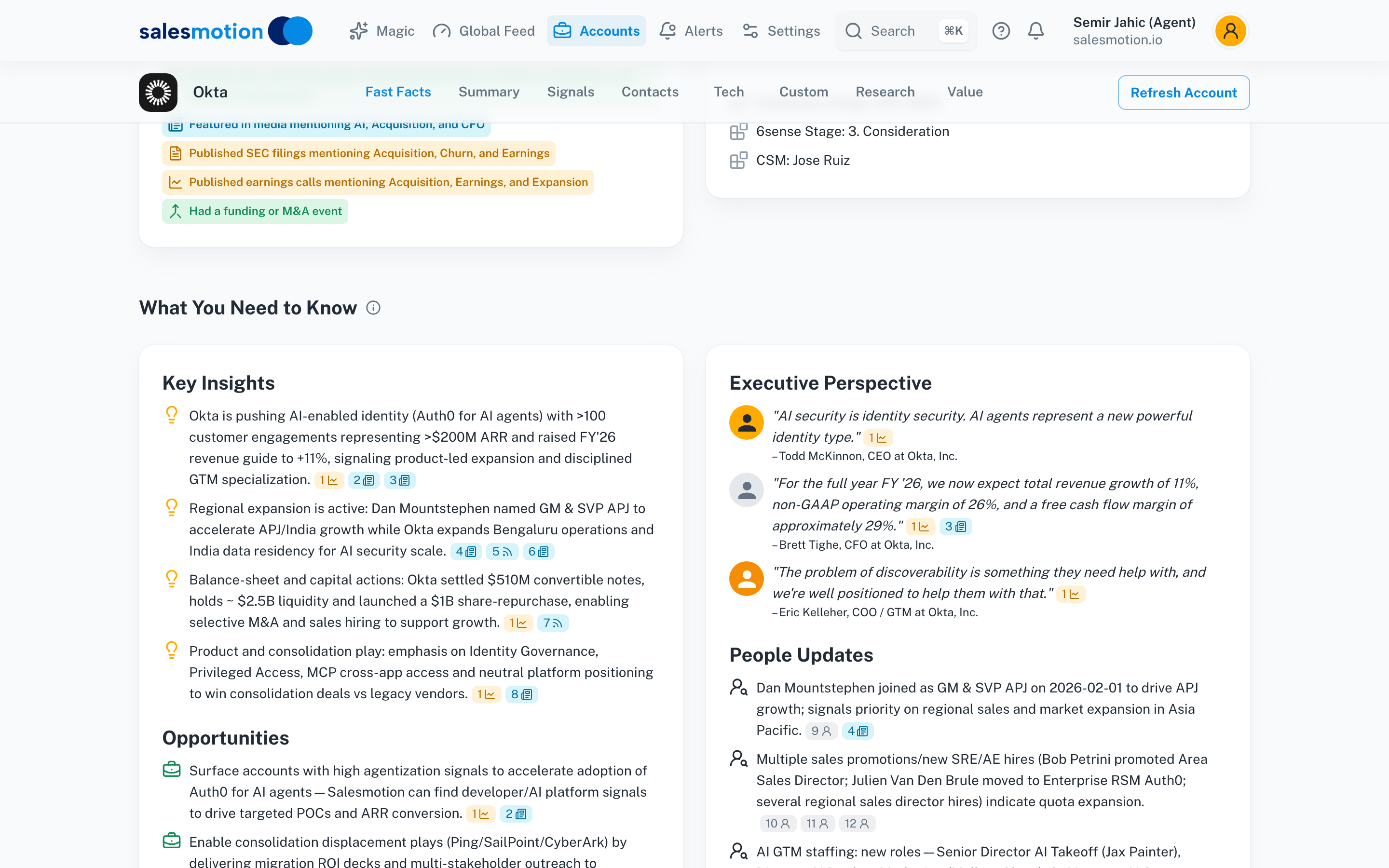 Salesmotion surfaces key insights, executive perspectives, people moves, and talking points, giving reps the context behind every contact.
Salesmotion does include some contact data, sized for working a focused account list. The Individual plan is $85/mo, tracks up to 100 accounts, and includes 200 contact credits a month for verified emails and phone numbers, on a monthly contract. Teams and enterprises get custom pricing with a credit volume sized to the team. You can try the interactive demo before talking to anyone.
Salesmotion's Take
A contact record tells you who. It never tells you why now. After years watching reps drown in databases, I'm convinced most teams already have enough contacts and nowhere near enough context. That's the layer we built Salesmotion for: verified contacts enriched with live account signals, such as a leadership change, an earnings priority or a hiring surge, so reps know which of those contacts is actually worth a call this week. We're not trying to out-database ZoomInfo or Apollo; we're the enrichment and timing layer that sits on top of the contacts you already have.

Semir Jahic
CEO & Co-Founder, Salesmotion
In practice the two work together. Keep the database that covers your market for reach and volume. Add Salesmotion when the bottleneck is knowing which accounts to prioritize and what to say. Analytic Partners, for example, grew qualified pipeline 40% and cut research time by 85% with this signal-driven approach.
Contact Data vs. Contact Intelligence: Why Context Matters More Than Volume
The traditional approach to B2B contact data is straightforward: buy a database, export contacts, run sequences. It works, but people change jobs and records age, so a team that relies on volume alone is always replacing contacts it has already paid for.
The shift is from static contact lists toward contextual contact intelligence. Several providers on this list have moved that way themselves, adding intent topics, job-change alerts and buying signals to the contact record. The idea is the same everywhere: pair the contact with three layers a list of names does not carry.
Timing signals. When a target account posts a VP of Sales role, reports earnings mentioning "digital transformation," or announces a new product launch, those signals tell reps WHEN to reach out, not just WHO to call.
Account context. Knowing a prospect's email and title is table stakes. Knowing their company just lost its biggest customer, hired a new CRO, and increased R&D spending is what makes outreach land.
Prioritization. Reps cannot work 500 accounts equally. Signal-based platforms continuously monitor account activity to surface which accounts are entering a buying window, so reps focus their energy where it matters most.
When you compare providers, ask where each of these layers will come from: the database itself, an add-on, or a separate account intelligence tool that sits beside it.
How to Choose the Right Provider for Your Team
The best provider depends on your team size, budget, geography, and how you use contact data.
If you need volume on a budget, start with Apollo.io. The free plan and published paid plans give growing teams a 240M-contact database plus sequencing. If email is the main channel, Hunter.io adds email finding and verification from a free plan upward.
If you sell into Europe, start with Cognism. Phone-verified mobiles and Do-Not-Call coverage across Europe are what it is built around.
If you are a larger team with budget, ZoomInfo offers the broadest single platform on this list for contact data, org charts, intent and AI agents, on an annual contract.
If you want to pay by card and start today, Lusha, RocketReach, UpLead and Lead411 all publish their prices and offer a free plan, free lookups or a short trial.
If human verification matters most, look at SalesIntel, which pairs a researcher-verified database with research on request.
If contacts are not your bottleneck, the real question might not be "which database should I buy?" but "how do I turn the contacts I already have into qualified meetings?" That is where account intelligence and signal-based prioritization change the equation. Book a walkthrough to see how it works with your existing data.
Choosing a Contact Database by Region
Most "best provider for [country]" questions have the same honest answer: none of the ten providers publishes a country-by-country coverage table on its pricing or product pages, so your own sample is the only reliable test. Here is what the vendors do publish, and where to start.
| If you sell into | What the vendors publish | Shortlist to test first |
|---|---|---|
| Europe (UK, DACH, France, Benelux, Nordics, Spain, Italy) | Cognism calls itself "Europe's most trusted B2B data" and lists Do-Not-Call coverage across Europe. Lusha lists GDPR certification by ePrivacyseal. ZoomInfo sells international data as an add-on to base plans. | Cognism, Lusha, ZoomInfo |
| US and Canada | Lusha states 132M US contacts and 85% US phone accuracy. ZoomInfo states 500M+ contacts overall, Apollo.io 240M and RocketReach 700 million professionals, without a country split. | ZoomInfo, Apollo.io, Lusha, RocketReach |
| APAC, India, Japan, Latin America and the Middle East | No provider on this list publishes regional counts for these markets. | Two or three global databases tested side by side on your own list |
The test takes an afternoon. Pick 50 target accounts in the country you care about. Run them through each shortlisted provider and count how many of your target roles come back, how many have a direct dial or mobile rather than a switchboard number, and how many emails bounce when verified. In Europe, also ask how the provider screens against national Do-Not-Call lists. The provider that wins on your 50 accounts beats any published record count.
For a market-by-market view of what the data costs, see our breakdown of B2B contact data cost. If Europe is your main market, the Cognism alternatives and Lusha alternatives pages compare the options in more depth.
Key Takeaways
- ZoomInfo leads on breadth (no published price; Vendr reports a median of $33,500 a year across 1,576 purchases), Apollo.io leads for data plus outreach (free to $119 per user per month on annual billing), and Cognism leads for phone-verified European data (no published price).
- Six of the ten providers publish prices: Apollo.io, Lusha, RocketReach, UpLead, Lead411 and Hunter.io. ZoomInfo, Cognism, SalesIntel and Seamless.AI quote on request.
- Nine of the ten offer a free plan, a free trial or free credits. Cognism offers a free data sample.
- Every provider on this list now includes some form of signal or intent data. Check which plan it sits on before you compare prices.
- Accuracy figures are vendor claims. Test a sample against your own ICP, and evaluate coverage in your market, not total record counts.
- The most common gap in a sales stack is not contacts but context. Pairing contact data with account intelligence and buying signals helps reps prioritize the right accounts at the right time.
Frequently Asked Questions
What is the best B2B contact data provider?
It depends on the job. ZoomInfo is the broadest platform, with 500M+ contacts, org charts and AI agents on a custom annual contract. Apollo.io is the best fit for teams that want data and outreach in one product, with a permanent free plan and paid plans from $49 per seat per month on annual billing. Cognism is the best fit for phone prospecting into Europe, with phone-verified mobiles and Do-Not-Call coverage.
How accurate are B2B contact data providers?
Accuracy varies, and the published figures are the vendors' own. Lusha states 98% email accuracy and 85% US and 86% global phone accuracy across its database. RocketReach states 98% accuracy on contacts verified on demand. UpLead backs a 95%+ accuracy guarantee and says it refunds bounces. SalesIntel states 95% accuracy on a 90-day refresh cycle. Run a sample of your own target accounts through any provider before you commit.
How fast does B2B contact data decay?
Fast enough that refresh cadence belongs in your evaluation. Contact records go out of date whenever someone changes role or company, so ask each provider how often it re-verifies. The published answers differ: Cognism says its decision-maker data is refreshed every 30 days, SalesIntel works on a 90-day refresh cycle, Lusha refreshes its buying signals weekly, UpLead verifies emails at the moment of export, and Hunter.io says it removes contact information that no longer has a public source after six months.
How much does a B2B contact database cost?
Several providers start free. Among those that publish dollar prices, entry plans on annual billing are $27 a month at RocketReach, $37.45 a month at Lusha, $49 per seat per month at Apollo.io and $74 a month at UpLead, and Lead411's Spark plan is $49 a month. Hunter.io publishes its prices in euros, from 49€ a month. ZoomInfo, Cognism, SalesIntel and Seamless.AI do not publish list prices. For ZoomInfo, Vendr reports a median contract of $33,500 a year based on 1,576 purchases.
Is there a free B2B contact database?
Yes, several, and they are worth using as a starting point. Apollo.io's free plan includes 900 credits per seat per year with no time limit. Lusha offers 40 free credits a month, Hunter.io 50 credits a month, ZoomInfo Lite 10 credits a month, and Seamless.AI is free for up to 50 credits. RocketReach gives a free account 5 lookups, and UpLead and Lead411 offer 7-day trials. The limits are on volume and features, so teams running outbound at scale usually move to a paid plan.
What is the best B2B contact data provider for Europe?
Cognism is the provider on this list built around Europe: it calls itself "Europe's most trusted B2B data", offers phone-verified mobile numbers, and lists Do-Not-Call coverage across Europe. Lusha, which lists GDPR certification by ePrivacyseal, and ZoomInfo, which sells international data as an add-on, are the usual comparisons. Test all three on 50 accounts in your target countries before you sign.
Where does B2B contact data come from?
Each provider combines a few methods, and they describe them differently. ZoomInfo cites 300+ human researchers behind its data. SalesIntel says a team of more than 2,000 researchers verifies its contacts on a 90-day cycle. Hunter.io says it analyzes millions of websites daily and returns each email with where and when it was found. UpLead says it licenses data from third parties and verifies emails at the moment of download. Cognism phone-verifies mobile numbers. Ask any provider you shortlist how its records are sourced and how often they are re-verified.
How can I test a contact database's accuracy before buying?
Run your own sample. Take 50 accounts from your real target list, request the same roles from each provider on its free plan, trial or data sample, then count matches, direct dials versus switchboard numbers, and email bounces after verification. Published accuracy figures are vendor claims; your sample shows how a provider performs on the accounts you will actually work.
What is the difference between a contact database and contact intelligence?
A contact database provides names, emails, phone numbers, and basic firmographic data. We cover the distinction in depth in contact database vs account intelligence. Contact intelligence adds layers of context: buying signals, account research, leadership changes, and suggested talking points for outreach. The database tells you WHO to contact. Intelligence tells you WHY and WHEN to reach out, which contacts are most likely to be in a buying window, and what to say when you do.
Can I use multiple B2B data providers together?
Yes, and many teams do. A common stack is a primary database such as ZoomInfo or Apollo.io for coverage, an email tool such as Hunter.io for finding and verifying addresses, and an account intelligence layer for timing and context. The key is avoiding duplicate spend on overlapping capabilities. Decide which provider fills which gap in your workflow before stacking costs.
Does Salesmotion replace a contact database?
No. Salesmotion is the account-intelligence layer that sits alongside a contact database. It monitors accounts for buying signals, writes cited account briefs and drafts outreach. Its Individual plan includes 200 contact credits a month for verified emails and phone numbers, which suits a focused list of up to 100 accounts. Teams that need high-volume contact export keep a database such as ZoomInfo or Apollo.io next to it.