A massive contact list sounds impressive until you realize that only 13% of leads become opportunities and roughly 6% of those close. The math is simple: list quality determines pipeline quality. Building a prospect list of 10,000 unverified contacts produces worse results than a list building effort that delivers 2,000 verified, ICP-matched contacts with current data.
TL;DR: B2B prospect list building in 2026 is about accuracy, not volume. Contact data decays faster than most teams realize, with people changing roles and companies evolving constantly. The best list building approaches combine firmographic filtering with technographic data, intent signals, and real-time verification. Leading data providers maintain 91-95% email accuracy rates. Focus on five criteria when building or buying lists: ICP alignment, data freshness, verification method, compliance (GDPR/CCPA), and CRM integration depth.
Why List Quality Beats List Size
Every sales team has experienced the false confidence of a large prospect list. Ten thousand names look like ten thousand opportunities until reps start working them and discover outdated emails, wrong titles, and companies that do not match your ICP.
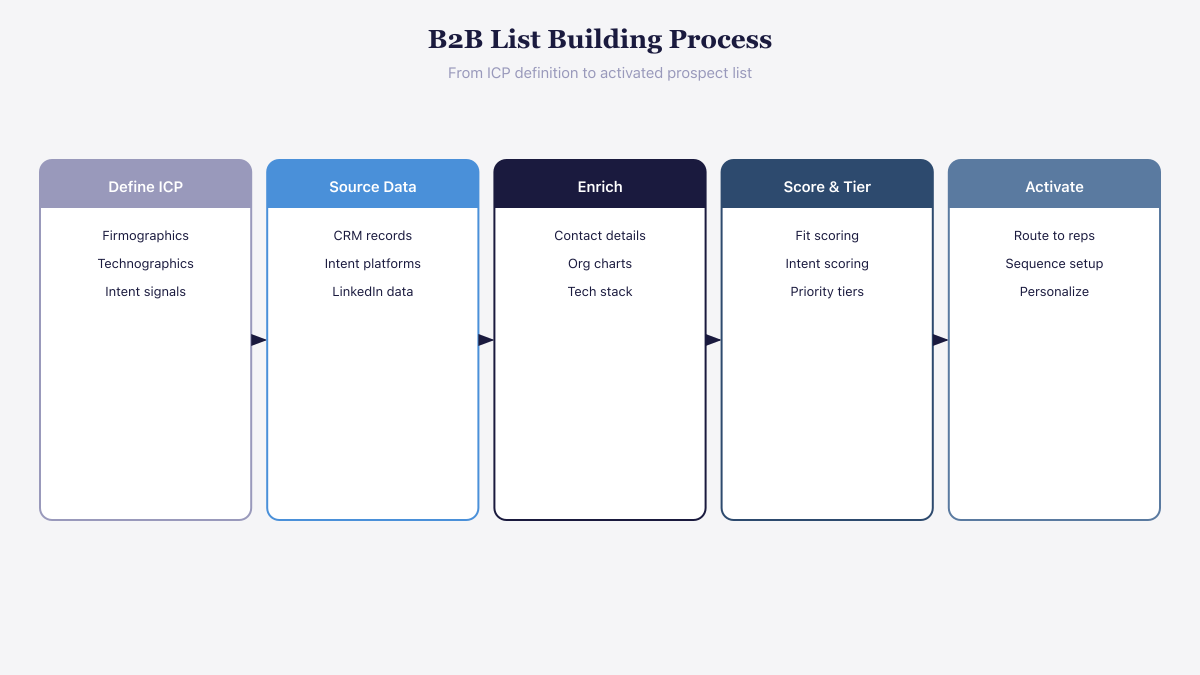 Effective list building follows a structured process from ICP definition to activation.
B2B data decays fast. People change jobs, companies merge, departments restructure. A contact list that was 95% accurate six months ago might be 80% accurate today. And 80% accuracy means one in five outreach attempts bounces, goes to the wrong person, or reaches someone who left the company.
The downstream effects compound. High bounce rates damage your sender reputation, which affects deliverability for every email your domain sends. Reps waste hours researching contacts that turn out to be dead ends. Pipeline reports inflate coverage with accounts that were never real opportunities. All of this traces back to list quality.
The teams generating the most pipeline per rep are not building bigger lists. They are building more accurate, better-targeted lists and refreshing them continuously.
Five Criteria for Building Effective Prospect Lists
1. ICP Alignment
A prospect list is only as good as the targeting criteria behind it. Start with your ideal customer profile: industry, company size, revenue range, tech stack, and geographic coverage.
But firmographic fit is not enough. Layer behavioral buying signals on top of static criteria. Is the company hiring for roles your product serves? Did they recently raise funding? Are they showing buying signals like researching your category on review sites or visiting competitor pages?
A list of 500 accounts that match your ICP and show active buying signals will outperform a list of 5,000 accounts that only match on firmographics. The signal layer is what separates a cold list from a warm one.
2. Data Freshness and Verification
How the data gets verified matters as much as the data itself. Three verification approaches exist:
Automated verification uses algorithms to check email syntax, domain validity, and SMTP response. Fast and scalable, but misses context: a correctly formatted email address can still belong to someone who left the company last month.
Human verification uses researchers to manually confirm contacts against LinkedIn profiles, company websites, and other sources. More accurate but slower and more expensive.
Hybrid verification combines automated checks with human review for high-value contacts. This is the approach most leading providers use, refreshing data every 90 days to maintain 91-95% accuracy rates.
When evaluating a data provider, ask: how often is data refreshed? What verification methods are used? Is there an accuracy guarantee or credit refund for bounced contacts? Providers that cannot answer these questions clearly are selling you stale data.
3. Contact Depth Beyond Email
Email addresses are the baseline. Effective list building includes direct phone numbers, mobile numbers, and organizational context that helps reps navigate the buying committee.
The typical B2B buying committee now includes 11 to 13 stakeholders. Building a list with one contact per account means missing most of the people who influence the purchase decision. Effective lists include multiple contacts per target account mapped to their roles: the day-to-day user, the budget holder, the technical evaluator, and the executive sponsor.
4. Compliance and Data Sourcing
GDPR, CCPA, and evolving privacy regulations make data sourcing methods a business risk, not just a feature. Ask every provider:
- Where does the data originate?
- Is there a documented consent chain?
- How are opt-outs and suppression lists managed?
- Does the provider check against global Do-Not-Call registries?
The compliance risk is not hypothetical. European regulations carry significant penalties for non-compliant outreach. Even in less regulated markets, prospects who receive unsolicited contact from data they never shared will mark your emails as spam, damaging deliverability for your entire domain.
5. CRM Integration
A prospect list that lives in a spreadsheet or standalone platform creates friction that reduces its value. Every manual step between the list and your outreach workflow introduces delay, errors, and data loss.
Evaluate whether your list building tool or provider offers native CRM integration with Salesforce, HubSpot, or whatever system your team uses. The list should sync directly into your CRM as accounts and contacts, with deduplication rules that prevent creating duplicate records from overlapping data sources.
Beyond basic sync, look for enrichment capabilities that keep records current. As contacts change roles or companies, the integration should update existing records automatically rather than requiring manual cleanup.

“The moment we turned on Salesmotion, it became essential. No more hours on LinkedIn or Google to figure out who we're talking to. It's just there, served up to you, so it's always 'go time.'”
Adam Wainwright
Head of Revenue, Cacheflow
Building Lists In-House vs. Buying Lists
Both approaches have trade-offs. The right choice depends on your team's resources and deal volume.
Building in-house means using data platforms to filter and export contacts based on your criteria. You control the targeting, can iterate quickly, and build institutional knowledge about which segments perform best. The trade-off is time: someone on your team must manage the process, maintain data quality, and handle ongoing enrichment.
Buying from a service means outsourcing list creation to a provider that delivers finished lists based on your ICP criteria. This saves time but reduces control and creates dependency on the provider's data quality. Bought lists also carry higher compliance risk if you cannot verify how the data was sourced.
The hybrid approach most teams use: maintain an account intelligence platform for ongoing list building and enrichment, supplemented by purchased lists for specific campaigns or new market segments where you lack internal data.
Maintaining List Quality Over Time
Building a list is not a one-time event. Without maintenance, list quality degrades continuously.
Set a refresh cadence. Review and re-verify your active prospect lists quarterly at minimum. Remove contacts who have bounced, changed companies, or opted out. Add new contacts at companies where your original contact has left.
Track engagement as a quality signal. Contacts that never open emails after multiple touches are either wrong, disengaged, or a bad fit. Remove persistent non-engagers from active sequences to protect deliverability and focus rep time on responsive prospects.
Enrich on an ongoing basis. When contacts engage (reply, click, attend a meeting), update their records with the latest information. When accounts show new buying signals, add additional stakeholders to the list. For a deeper look at maintaining data quality in your sales stack, see our guide on CRM data enrichment. Treat your prospect list as a living dataset, not a static file.

“We have very limited bandwidth, but Salesmotion was up and running in days. The template made it easy to load our accounts and embedding it in Salesforce was simple. It was one of the easiest rollouts we've done.”
Andrew Giordano
VP of Global Commercial Operations, Analytic Partners
Key Takeaways
- List quality determines pipeline quality. A smaller, accurate list outperforms a large, unverified list every time.
- B2B contact data decays fast. Refresh and re-verify quarterly at minimum to maintain 90%+ accuracy.
- Layer behavioral signals on top of firmographic criteria. Intent data transforms a cold list into a prioritized, warm target list.
- Map multiple contacts per account to cover the buying committee (11-13 stakeholders on average).
- Verify data sourcing and compliance before using any list. GDPR and CCPA violations carry real financial risk.
- Integrate lists directly into your CRM to eliminate manual data transfer, deduplication headaches, and record staleness.
Frequently Asked Questions
How often should we refresh our prospect lists?
Quarterly at minimum for active outreach lists. For high-priority target accounts, monthly enrichment catches job changes and new stakeholders faster. The refresh cadence should match your sales cycle: if deals take six months, contacts from your initial list may have changed roles before you close. Automated enrichment through your data provider or CRM integration is more sustainable than manual quarterly reviews.
How many contacts per account should our prospect list include?
Three to five contacts per target account is a practical starting point: at least one champion (day-to-day user), one economic buyer (budget authority), and one executive sponsor. For enterprise deals with large buying committees, expand to seven to ten contacts covering different functional areas that influence the decision. Single-threaded lists (one contact per account) are the most common cause of deals stalling when your sole contact changes priorities or leaves the company.
Is it better to build lists in-house or buy them from a provider?
In-house list building gives you more control over targeting and data quality but requires dedicated time and tooling. Purchasing lists saves time but introduces compliance risk and quality uncertainty. Most successful teams use a hybrid approach: maintain a data platform for core list building and enrichment, and purchase supplemental lists for specific campaigns targeting new segments or geographies. Whichever approach you choose, always verify a sample of contacts before running outreach at scale.