75% of sales leaders logged into their enablement platform fewer than five times last quarter (Highspot, 2025). That's not a rep adoption problem — it's a product-fit problem. Most enablement tools don't survive contact with how reps actually work.
TL;DR: The enablement market just consolidated. Seismic completed its merger with Highspot in August 2026. Showpad merged with Bigtincan. Gong entered the category with Gong Enable. The strongest 2026 stacks pair a content/coaching tool with an account intelligence layer that reps will actually open — because it answers "what's happening at this account today?", not "where's the slide?". Start with the gap costing you the most deals.
Comparing 10 sales enablement platforms?
Most enablement tools sit unused. Salesmotion gets used because reps see the value in 30 seconds.
Account briefs, signals, and AI-drafted outreach in one place. From $85/mo, live in an hour, no annual contract.
Our pick for the account-intelligence layer of your enablement stack is Salesmotion — the real-time "what's happening at this account today?" that reps actually open, from $85/mo. It isn't a content or coaching platform: pair it with a system of record like Highspot or Seismic for content management, training, and call coaching.
I've spent a decade in this market — first selling, now building. The pattern that keeps showing up: a sales ops leader at a 2,000-person life sciences company once told me their pain wasn't any single tool. It was the variety. Five different research tabs to prep one account meeting. The platforms below all promise to fix this. Here's where each actually delivers, and where each falls short.
2026 Industry Shakeup: The Merger Wave
Before diving into individual platforms, it is worth understanding the seismic consolidation reshaping this market:
- Seismic + Highspot (announced Feb 2026, completed Aug 2026): The two biggest content enablement platforms are now one company under the Seismic name, with Highspot sold as "Highspot by Seismic". It consolidates the top two content management platforms into one.
- Showpad + Bigtincan (announced Aug 2025): Vector Capital acquired Showpad and combined it with Bigtincan under the Showpad brand, bringing Showpad's content and coaching platform together with Bigtincan's Brainshark training tools.
- Gartner's inaugural Magic Quadrant for Revenue Enablement Platforms (Nov 2025): The analyst firm finally created a standalone MQ for enablement, with Highspot, Seismic, Allego, SalesHood, Showpad, and Bigtincan named as Leaders.
- Gong enters enablement (early 2026): Gong Enable brings AI-powered methodology coaching and call review into the enablement category, blurring the line between conversation intelligence and enablement.
What this means for buyers: The market is consolidating from ~10 viable options to a few major platforms. If you are mid-contract with Highspot, your platform now belongs to Seismic. If you use Brainshark, it is now sold as Showpad Brainshark. Evaluate renewal terms carefully and pressure vendors for clarity on roadmap integration timelines.
See the product in action
Take a self-guided tour of the Salesmotion platform — no signup required.
What Sales Enablement Actually Means in 2026
Sales enablement used to mean "give reps the right slide deck." That definition is dead.
Gartner now frames enablement as "revenue enablement," spanning every customer-facing role, not just sellers. Forrester reports that 60-70% of marketing-created content goes unused because reps cannot find it. And a Gartner study predicts that by 2026, 65% of B2B sales organizations will shift from intuition-based to data-driven decision making.
Modern enablement covers four pillars:
- Content management: The right materials, findable and trackable
- Coaching and readiness: Onboarding, skill development, call reviews
- Conversation intelligence: Recording, transcribing, and analyzing sales calls
- Account intelligence: Research, buying signals, competitive context, and meeting prep
Most platforms excel at one or two of these pillars. None covers all four well. That gap is where deals stall, because a rep with perfect pitch decks but zero context about a prospect's strategic priorities will lose to a competitor who did the research.

“The Business Development team gets 80 to 90 percent of what they need in 15 minutes. That is a complete shift in how our reps work.”
Andrew Giordano
VP of Global Commercial Operations, Analytic Partners
The 12 Best Sales Enablement Platforms Compared
| Platform | Primary Strength | Best For | Starting Price |
|---|---|---|---|
| Salesmotion | Account intelligence + signals | Reps who need meeting prep and buying signals | From $85/mo |
| Highspot (now Seismic) | Content management + analytics | Enterprise teams managing large content libraries | Does not publish pricing; Vendr reports a median of $60,005/yr across 351 purchases |
| Seismic (+ Highspot) | Enterprise content + enablement | Large orgs with mature enablement programs | Does not publish pricing; Vendr reports a median of $31,950/yr across 415 purchases |
| Mutiny | AI content generation + GTM automation | GTM teams who want reps to self-serve personalized assets | Free; Business $50/mo; Enterprise from $40,000/yr |
| Spekit | Governed GTM knowledge + in-workflow enablement | Revenue teams wanting content, learning, coaching, and deal rooms in one platform | Not published; custom quote |
| Showpad (+ Bigtincan) | Content + coaching | Mid-market teams wanting content and training in one tool | Does not publish pricing |
| Gong | Conversation intelligence | Teams optimizing call performance and deal execution | Not published |
| Mindtickle | Readiness + coaching | Orgs focused on onboarding and ongoing skill development | Does not publish pricing |
| Allego | Learning + content | Distributed teams needing async coaching and content sharing | Custom pricing |
| Brainshark (Showpad) | Training + coaching | Teams prioritizing sales readiness assessments | Does not publish pricing |
| Mediafly | Content + value selling | Orgs building ROI-driven sales presentations | Custom pricing |
| Guru | Knowledge management | Cross-functional teams needing a single source of truth | Free tier; paid from $15/user/mo |
Detailed Platform Reviews
1. Salesmotion: Account Intelligence for Sales Enablement
Salesmotion fills the gap that content and coaching platforms leave open: what does the rep actually know about the account before they walk into a meeting?
The platform monitors over 1,000 sources to deliver one-click account briefs covering executive changes, earnings commentary, hiring patterns, competitive moves, funding events, and strategic initiatives. It replaces the 3-hour manual research process that most reps either skip or do poorly.
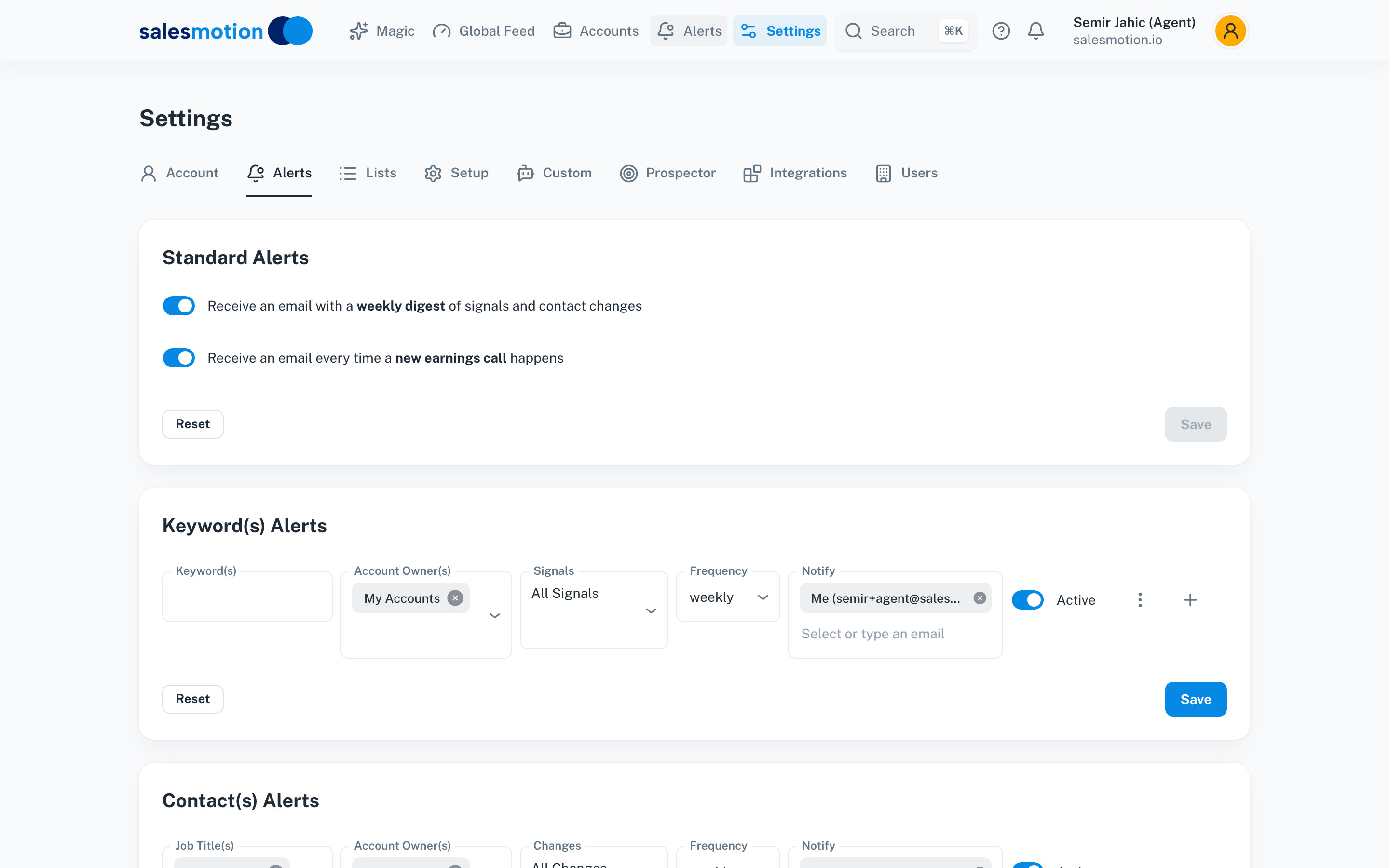 Salesmotion delivers proactive alerts — weekly signal digests, earnings call notifications, and keyword-based triggers — so reps never miss a buying window.
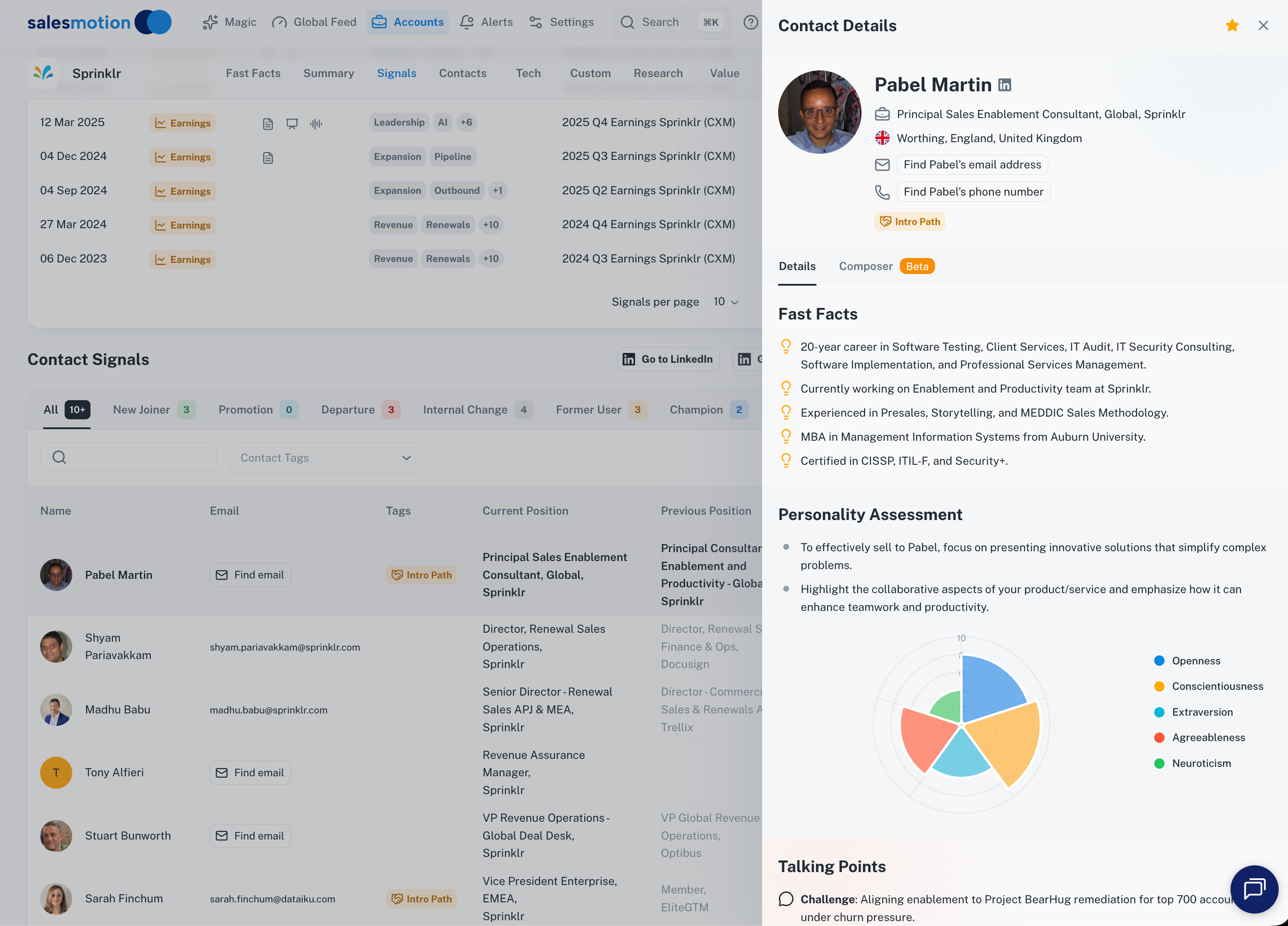 On-demand contact intelligence — verified emails, phone numbers, and role context for every account, enriched with AI personality assessments and talking points.
What it does best: Automated account research and real-time buying signal detection. Reps get alerts when target accounts show activity, such as a new VP of Sales hire, an earnings call mentioning "digital transformation," or a competitor contract expiring.
On-demand contact data: Beyond account intelligence, the platform provides on-demand enriched contacts for every monitored account. Reps get verified emails, direct phone numbers, current and previous positions, and AI-generated personality assessments — all without needing a separate contact data provider. Unlike static databases that decay at 3% per month, contacts are enriched in real time when reps need them, ensuring accuracy at the moment of outreach.
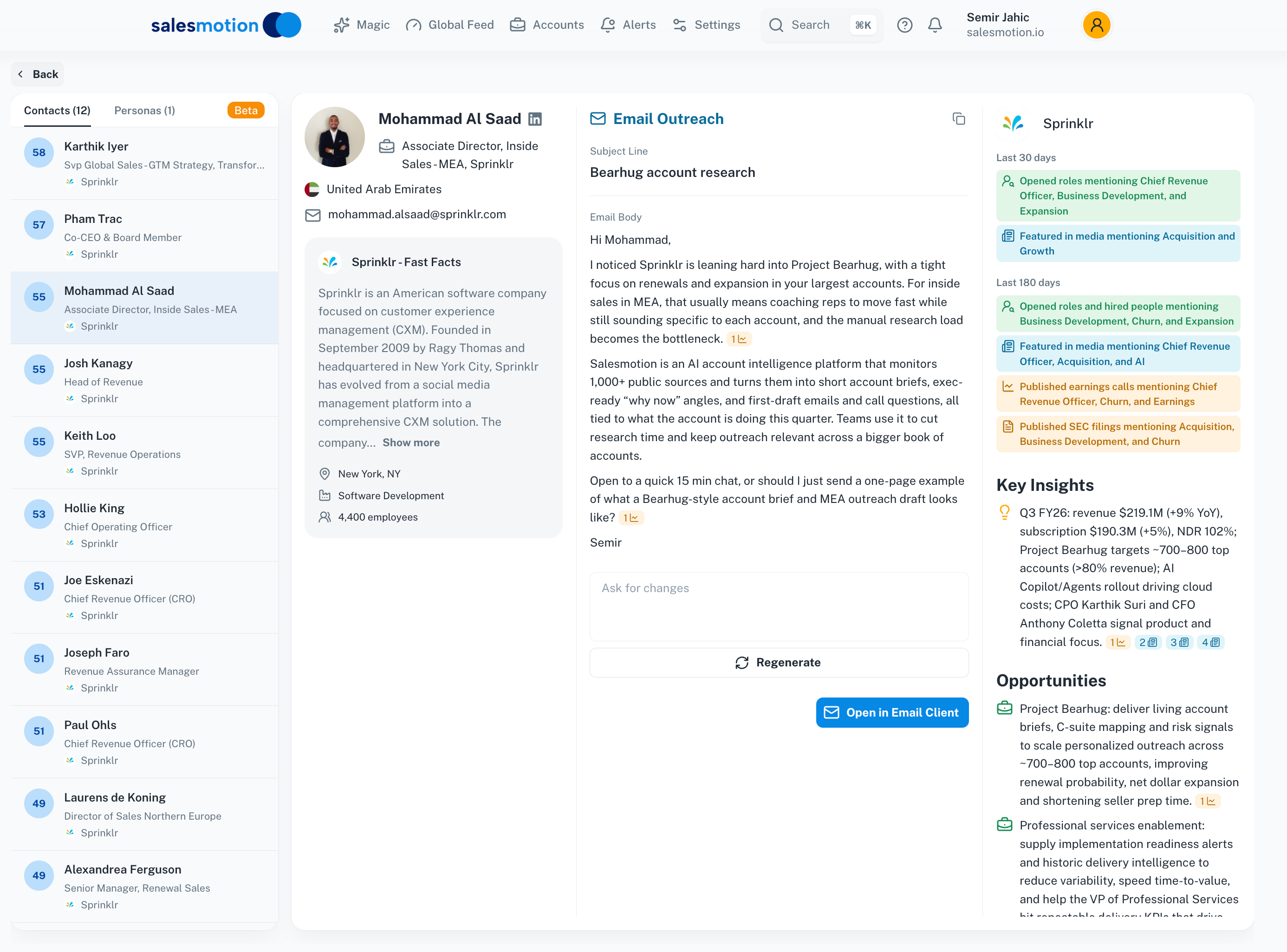 Salesmotion's AI Prospector generates hyper-personalized outreach for each contact, referencing real account signals and strategic context.
Who it's for: B2B sales teams at mid-market and enterprise companies where deal prep quality directly impacts win rates. Particularly strong for teams selling complex, multi-stakeholder deals.
Key differentiator: While content platforms help reps find the right deck, this platform ensures they know why the account is worth pursuing and what to say when they get there. Analytic Partners saw an 85% reduction in research time and a 40% increase in qualified pipeline after adopting it.
Pricing: Flexible account-based pricing starting at $85/month. Much more cost-effective than per-seat enablement vendors, with unlimited users on team plans. See full pricing.
Limitation: Not a content management or coaching tool. Best deployed alongside a content platform for full-stack enablement.
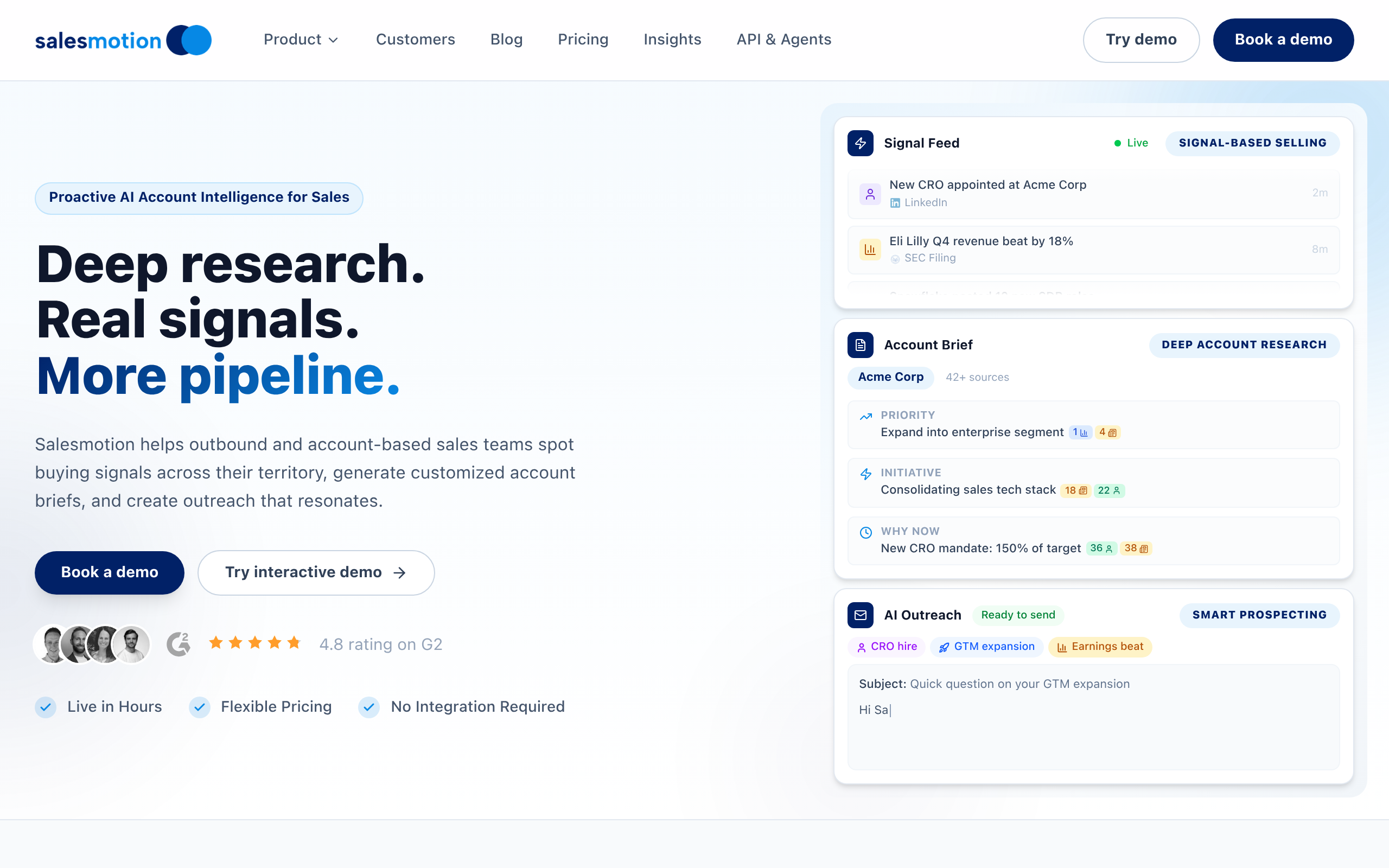 Salesmotion — the account intelligence layer that most enablement stacks are missing.
2. Highspot (Now Part of Seismic): Content Management Leader
Major update (August 2026): Seismic and Highspot completed their merger in August 2026, six months after announcing it. The two are now one company under the Seismic name, and the product is sold as Highspot by Seismic. Highspot says there is no immediate change to how customers use the product and no migration plan for Highspot customers.
Highspot was a market leader in sales content management and analytics before the merger. If your sales team has hundreds of pitch decks, battle cards, case studies, and one-pagers scattered across SharePoint and Google Drive, Highspot organizes, distributes, and tracks them.
What it does best: Content governance and engagement analytics. Highspot tracks which content reps actually use, how prospects engage with shared materials, and which assets correlate with closed deals.
Who it's for: Enterprise organizations with large content libraries and dedicated enablement teams. Companies spending $91K+ per year (the enterprise average, per Vendr) need a mature enablement program to justify the investment.
Key differentiator: AI-powered content recommendations surface the right assets for each deal stage and buyer persona. Highspot's Copilot assists with content creation and personalization. Highspot's pricing page now also lists AI agents alongside content, training, and coaching.
Pricing: Highspot does not publish pricing. Its three plans (Good, Better, Best) are all quoted through sales. Vendr reports a median of $60,005 per year across 351 purchases.
Limitation: The merger creates short-term uncertainty around product roadmap and packaging. Evaluate whether you need to commit to a multi-year contract while the integration is underway.
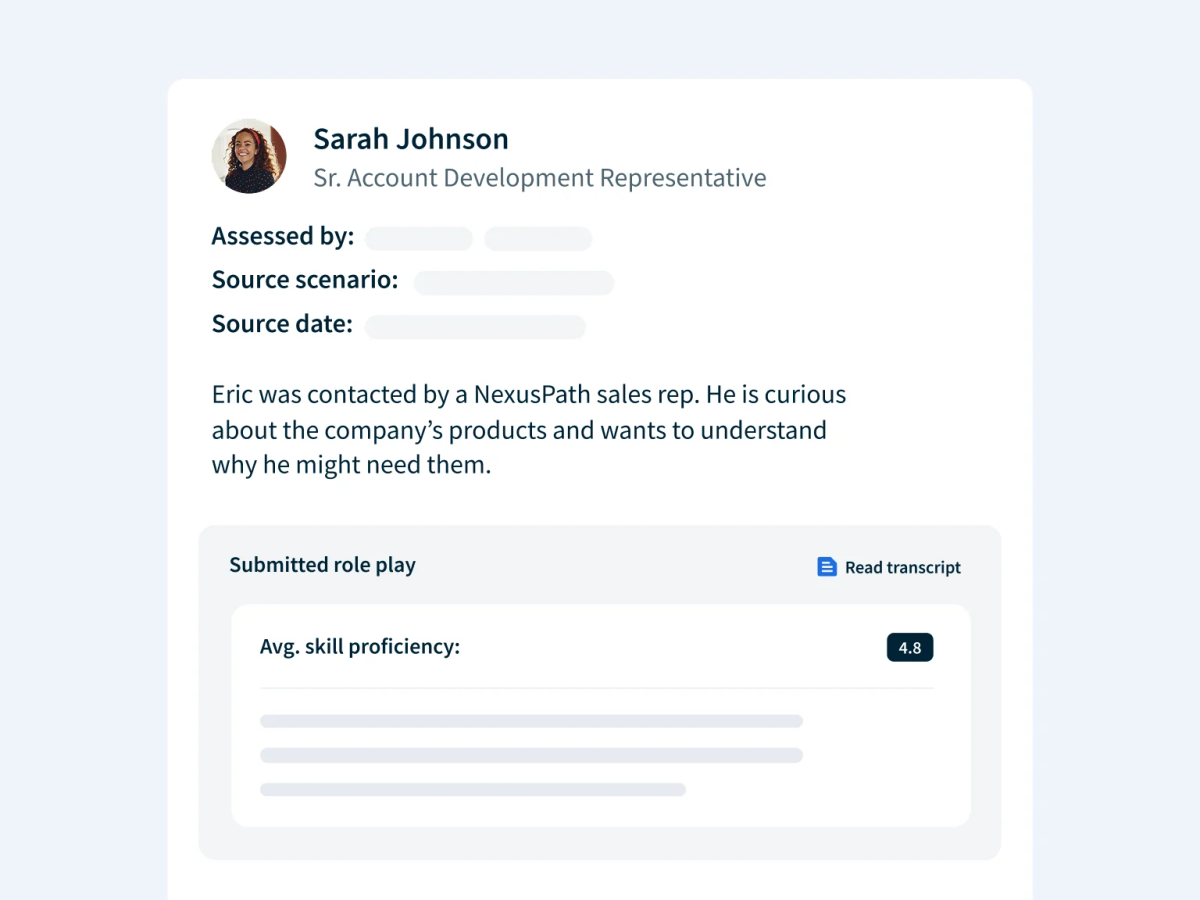 Highspot — now part of Seismic and sold as Highspot by Seismic.
3. Seismic: Enterprise Content and Enablement Suite (+ Highspot)
Seismic combines content management, buyer engagement, training (Seismic Learning), and analytics into a comprehensive enablement suite built for enterprise scale. Following the Highspot merger, completed in August 2026, Seismic is the largest company in the category, a position reinforced by its recognition as a Leader in Gartner's inaugural Magic Quadrant for Revenue Enablement Platforms (November 2025).
What it does best: Dynamic content assembly and personalization. Seismic pulls data from CRM fields to automatically generate customized presentations, proposals, and one-pagers without manual formatting. Seismic and Highspot by Seismic now sit in one company, putting Seismic's LiveDocs and Highspot's content analytics under one roof.
Who it's for: Large enterprises with 200+ reps, dedicated enablement teams, and the budget for a full-suite solution. Per Vendr, enterprise deployments commonly exceed $100,000/year.
Key differentiator: LiveDocs technology auto-populates content with real-time CRM data. The Aura Copilot AI layer assists with content generation and coaching recommendations.
Pricing: Seismic does not publish pricing. Vendr reports a median of $31,950 per year across 415 purchases, with a range from $8,993 to $179,008.
Limitation: Built for enterprise scale, so plan for a structured rollout. Ask which Seismic and Highspot by Seismic features are included in your contract.
 Seismic — now the undisputed category leader after acquiring Highspot, combining dynamic content assembly with best-in-class analytics.
4. Mutiny: AI-Native GTM Automation and Content Creation
Mutiny is AI built for GTM that does two things at once: it generates customer-ready selling assets on demand, and it lets reps build their own agents to automate the repetitive work around every deal. Rebuilt agent-first in its April 2026 relaunch, Mutiny now positions itself as the fastest AI for end-to-end GTM automation.
Mutiny flips the sales enablement model on its head. Where legacy enablement is built on retrieval (reps dig through a static library to find the closest existing asset), Mutiny is built on generation: the agent creates the exact deck, business case, or deal room a given deal needs, in minutes.
If your reps are waiting on marketing or design to turn out personalized decks, business cases, and deal rooms one at a time, Mutiny lets any rep produce that same caliber of asset in minutes and wire the surrounding workflow into a repeatable routine.
What it does best: Self-serve, personalized asset creation and GTM automation. Mutiny comes pre-loaded with the skills, routines, and playbooks revenue teams actually run, generates customer-facing assets (ABM campaigns, business cases, deal rooms, pricing proposals, meeting recaps, competitive comparisons, pitch decks), and lets sellers automate the work between meetings so they spend more time with customers.
Who it's for: B2B sales and marketing teams with 10+ people in GTM who feel the dependency problem, where reps wait on marketing, design, or RevOps to get personalized work out the door. Any rep can run it on day one, with no GTM engineer required — structurally different from tools that gate personalization behind a queue.
Key differentiator: Content generation over retrieval. Legacy enablement organizes and surfaces what already exists; Mutiny generates net-new, deal-specific content.
Pricing: Free at $0, Business at $50 per month with monthly credits, and Enterprise starting at $40,000 per year, per Mutiny's pricing page.
Limitation: Most organizations are still wired for the old enablement model, where content lives in a library and reps go find it. Shifting to a generation-first approach is a change in how teams think about and operate their GTM motion, so expect an adjustment period as reps and marketers get comfortable trusting the agent to create assets on the fly rather than reaching for an existing template.
 Mutiny — agent-first GTM platform that generates deal-specific assets on demand instead of retrieving them from a static library.
5. Spekit: Governed GTM Knowledge and In-Workflow Enablement
Spekit is an AI-first revenue enablement platform that combines governed GTM knowledge, content creation and management, learning, coaching, and digital sales rooms. Its Knowledge Engine keeps information approved and current, while AI Sidekick surfaces answers, relevant content, coaching, and recommended actions inside tools such as Salesforce, Gmail, Gong, and Slack. G2 currently lists Spekit at 4.7 out of 5 across more than 300 reviews.
What it does best: Connecting governed content with in-workflow execution. AI Sidekick uses deal context from CRM, calls, and email to make its recommendations relevant to each opportunity. AI Content Builder turns approved knowledge and live deal context into playbooks, decks, and buyer-ready assets, while Brand Studio automatically applies defined visual standards.
Who it's for: High-growth, mid-market, and enterprise B2B revenue teams managing frequent product releases, changing competitive information, or complex sales processes. It is particularly relevant to teams seeking content, learning, coaching, and buyer engagement in one platform.
Key differentiator: The same governed Knowledge Engine powers AI Sidekick, Learning Paths, AI Content Builder, and personalized Deal Rooms. Spekit MCP also makes approved knowledge available to external AI assistants and agents.
Pricing: Spekit does not publish standard pricing. Prospective customers can contact the company for a custom quote.
Limitation: Spekit may be broader than necessary for teams seeking only conversation intelligence, a basic content repository, or a project-management-focused client portal.
 Spekit delivers governed GTM knowledge, content, and coaching inside the tools reps already use.
6. Showpad (Merged with Bigtincan): Content and Coaching
Showpad bridges the gap between content management and sales coaching. It combines a content hub with training modules, practice scenarios, and coaching scorecards. Vector Capital acquired Showpad and merged it with Bigtincan (which had already acquired Brainshark) in a deal announced in August 2025. The combined company operates under the Showpad brand. Also named a Leader in Gartner's inaugural Magic Quadrant for Revenue Enablement Platforms (November 2025).
What it does best: Connecting content usage to coaching outcomes. Managers can see which reps are using approved content and where skill gaps correlate with content adoption gaps.
Who it's for: Mid-market B2B teams that want content management and coaching without buying two separate platforms. The Bigtincan merger adds Brainshark's training content creation tools, now listed as Showpad Brainshark.
Key differentiator: Showpad's Shared Spaces create branded, interactive deal rooms where buyers can access relevant content throughout the sales cycle. This gives reps visibility into buyer engagement.
Pricing: Showpad does not publish pricing. Its Professional, Advanced, and Expert plans are quoted on request and licensed per user.
Limitation: Showpad now lists Bigtincan Hub, Brainshark, Zunos, and ClearSlide as additional tools. Confirm which of them are included in the plan you are quoted.
 Showpad — merged with Bigtincan under Vector Capital, combining content management with coaching and training content creation.
7. Gong: Conversation Intelligence, Deal Execution, and Now Enablement
Gong records, transcribes, and analyzes every sales conversation to surface what top performers do differently. Named a Leader in Gartner's 2025 Magic Quadrant for Revenue Action Orchestration, Gong has expanded from call analytics into a full Revenue AI Operating System.
2026 update: Mission Andromeda. In early 2026, Gong launched Mission Andromeda, directly entering the enablement space with Gong Enable — an AI-powered revenue enablement product. The new AI Call Reviewer grades completed calls against your organization's own methodology, while the Account Console brings deal intelligence, risk signals, and recommended next steps into one unified view. Gong also added MCP (Model Context Protocol) support for connecting with other AI systems.
What it does best: Identifying patterns in winning deals through conversation analysis. Gong tracks talk-to-listen ratios, competitor mentions, pricing discussions, and next-step commitment rates across thousands of calls.
Who it's for: Sales teams that run a high volume of calls and want data-driven coaching. Particularly effective for organizations with 20+ reps where manager coaching time is limited.
Key differentiator: With Gong Enable, teams no longer need a separate enablement platform for call coaching and methodology adherence. The AI Call Reviewer closes the loop between training and live performance.
Pricing: Gong does not publish pricing. Its pricing page states that licences are priced per user with a platform fee based on the number of users supported, and that integrations are included.
Limitation: Gong is built around your own customer interactions. Teams pairing it with an account intelligence layer for external research see the strongest results because reps enter calls better prepared.
 Gong records, transcribes, and analyzes every sales conversation for data-driven coaching.
8. Mindtickle: Readiness and Coaching Platform
Mindtickle focuses on the "readiness" side of enablement: onboarding new reps, building skills, certifying competencies, and delivering ongoing coaching at scale.
What it does best: Structured onboarding programs and skill assessments. Mindtickle's "ideal rep profile" benchmarks individual performance against top-performer patterns, highlighting specific skill gaps.
Who it's for: Organizations with high rep turnover, rapid hiring, or complex products requiring ongoing certification. Strong in regulated industries where compliance training matters.
Key differentiator: AI-powered role plays let reps practice pitches and objection handling with automated feedback before live calls. Digital Sales Rooms extend readiness into buyer interactions.
Pricing: Mindtickle does not publish pricing. Book a demo for a quote.
Limitation: Built first for coaching and readiness. Teams whose main need is content management usually evaluate Highspot or Seismic.
 Mindtickle focuses on sales readiness with AI-powered role plays and ideal rep profiling.
9. Allego: Learning and Content for Distributed Teams
Allego emphasizes peer-to-peer learning and async coaching, making it particularly effective for distributed sales teams that cannot gather for in-person training.
What it does best: Video-based coaching and knowledge sharing. Reps record practice pitches, managers provide async feedback, and top-performer recordings become reusable training assets.
Who it's for: Remote-first or geographically distributed sales organizations. Also strong for financial services and life sciences where compliance-approved content sharing is critical.
Key differentiator: Conversation intelligence integrated directly into the learning platform. Reps can review their own calls alongside training content, connecting coaching to real deal behavior.
Pricing: Custom quotes. Platform licensing with user-based tiers.
Limitation: Less suited for large-scale content management. Organizations with 500+ assets may outgrow Allego's content features.
 Allego emphasizes peer-to-peer learning and async coaching for distributed sales teams.
10. Brainshark (Now Part of Showpad): Training and Coaching
Brainshark, originally acquired by Bigtincan and now sold as Showpad Brainshark following the Showpad and Bigtincan merger, focuses on sales training content creation, readiness scorecards, and coaching assessments.
What it does best: Enabling non-technical users to create training content quickly. Brainshark's presentation authoring tools turn slide decks into narrated, interactive training modules without video production.
Who it's for: Teams that need to produce high volumes of training content with limited resources. Mid-market companies that want readiness features.
Key differentiator: Readiness scorecards track rep preparedness across products, skills, and competitive knowledge. Managers get a dashboard view of who is ready to sell and who needs more coaching.
Pricing: Showpad does not publish pricing for Brainshark.
Limitation: Now one of several tools in the combined Showpad and Bigtincan lineup. Confirm how it is packaged with the Showpad plan you are quoted.
 Brainshark enables non-technical users to create interactive training content from slide decks.
11. Mediafly: Content and Value Selling
Mediafly differentiates through ROI calculators, interactive presentations, and value-selling tools that help reps build financial business cases during the sales cycle.
What it does best: Value-based selling enablement. Mediafly's interactive content lets reps build real-time ROI models with prospects, turning vague "we can save you money" claims into specific financial projections.
Who it's for: B2B teams selling high-ACV solutions where the buyer needs a quantified business case to justify the purchase internally. Strong in manufacturing, technology, and professional services.
Key differentiator: Buyer engagement analytics show not just whether a prospect opened a document, but which specific slides, pages, and calculator inputs they focused on.
Pricing: Custom enterprise quotes. Pricing varies based on modules selected.
Limitation: Narrower than Highspot or Seismic as a general-purpose enablement platform. Best as a specialized tool for value-selling motions.
 Mediafly differentiates through ROI calculators and interactive value-selling presentations.
12. Guru: Knowledge Management for Revenue Teams
Guru takes a different approach to enablement by focusing on knowledge management. Instead of managing content libraries or coaching programs, Guru ensures reps can find answers to questions instantly, wherever they work.
What it does best: Surfacing verified, up-to-date knowledge inside the tools reps already use. Guru integrates with Slack, Salesforce, Zendesk, and browsers to deliver answers without context-switching.
Who it's for: Cross-functional teams where sales, support, and customer success all need access to the same knowledge base. Particularly effective for companies with fast-changing products, pricing, or competitive landscapes.
Key differentiator: Knowledge verification workflows ensure content stays accurate. Subject matter experts receive automated reminders to review and update their cards, reducing stale information.
Pricing: Free tier for small teams. Paid plans start at $15/user/month. Enterprise pricing available.
Limitation: Not a traditional sales enablement platform. Guru handles knowledge, not coaching, content analytics, or conversation intelligence.
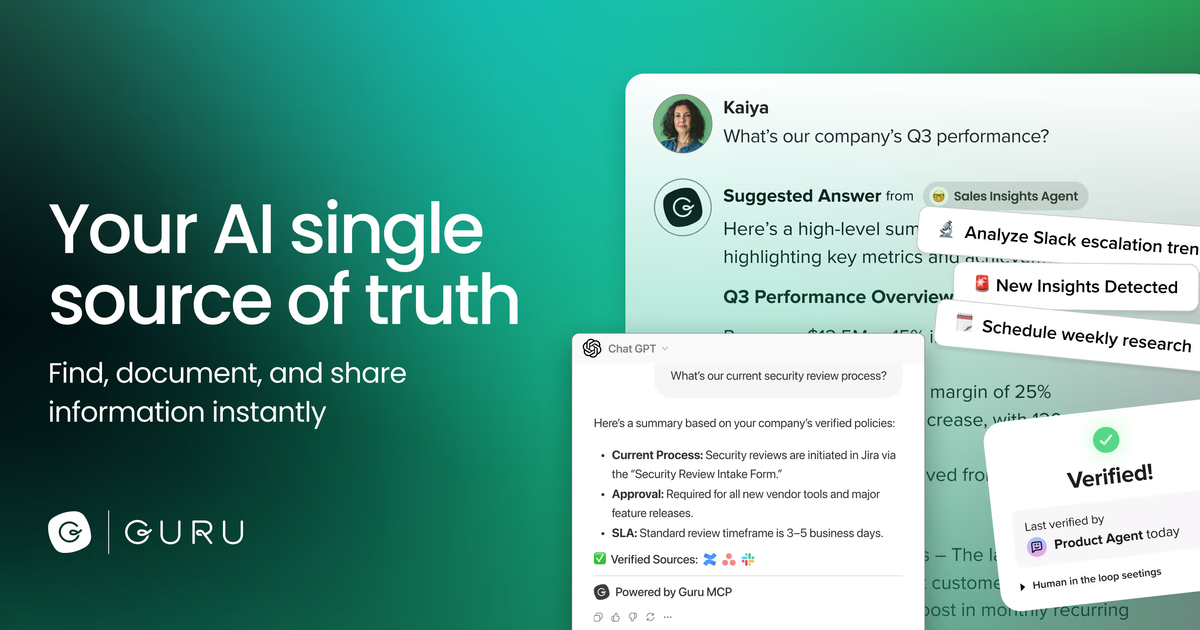 Guru surfaces verified knowledge inside the tools reps already use, from Slack to Salesforce.
See Salesmotion on a real account
Book a 15-minute demo and see how your team saves hours on account research.
How to Build a Sales Enablement Stack That Actually Works
Buying a single platform and expecting it to solve enablement is the same mistake that led to the 75% non-engagement stat. Instead, think in layers.
Layer 1: Account intelligence and research. Before a rep touches a slide deck or joins a coaching session, they need to understand the account. What are the prospect's strategic priorities? Who just joined the leadership team? What did the CEO say on the last earnings call? This layer feeds everything downstream. An account intelligence platform automates this research across 1,000+ sources, reducing prep time from hours to minutes. Frontify's sales team saw a 42% increase in sales velocity after adding this layer to their stack.
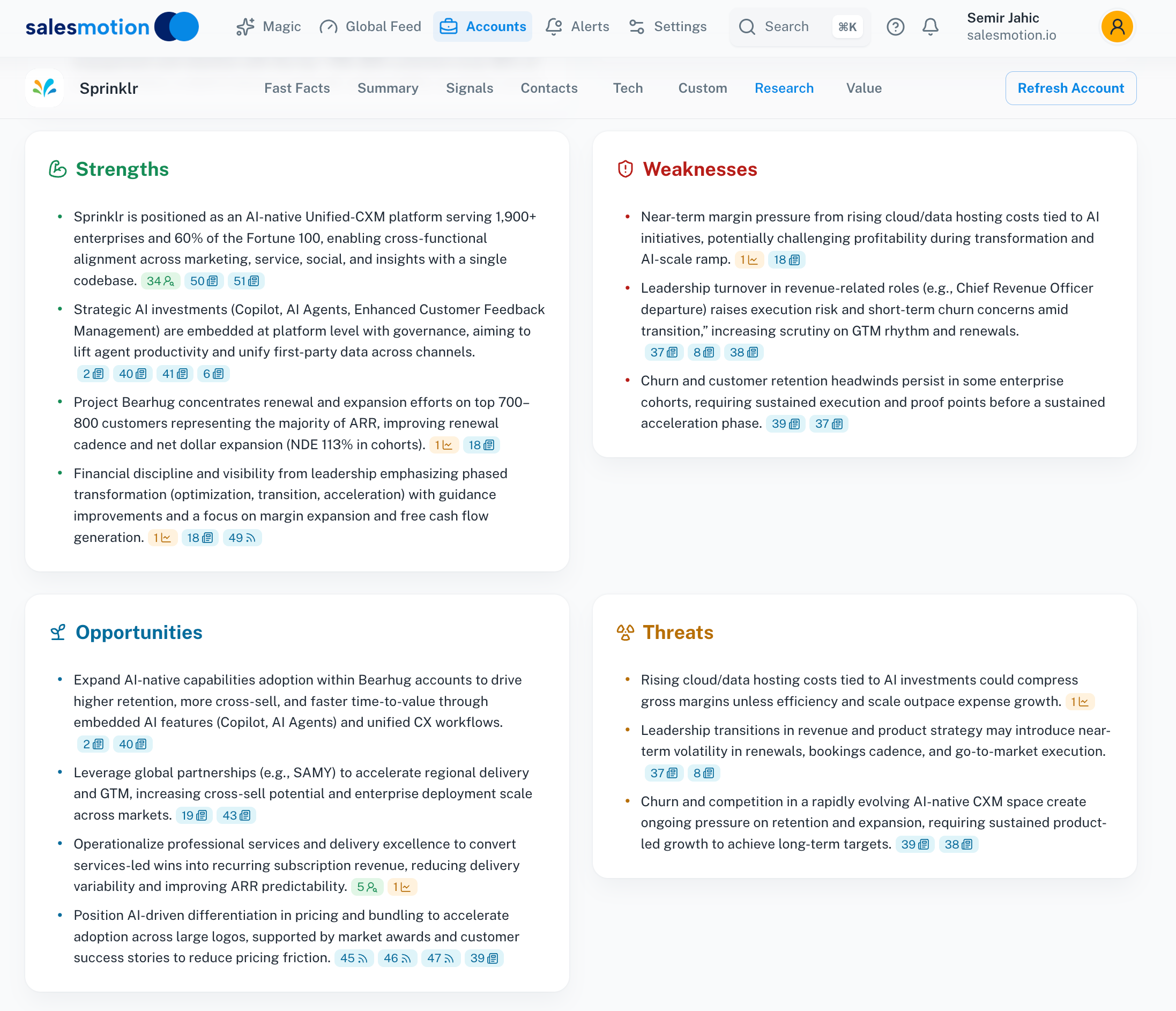 Layer 1 in action: Salesmotion generates AI-powered SWOT analyses with strategic context and source-backed insights — the research foundation that makes every other enablement layer more effective.
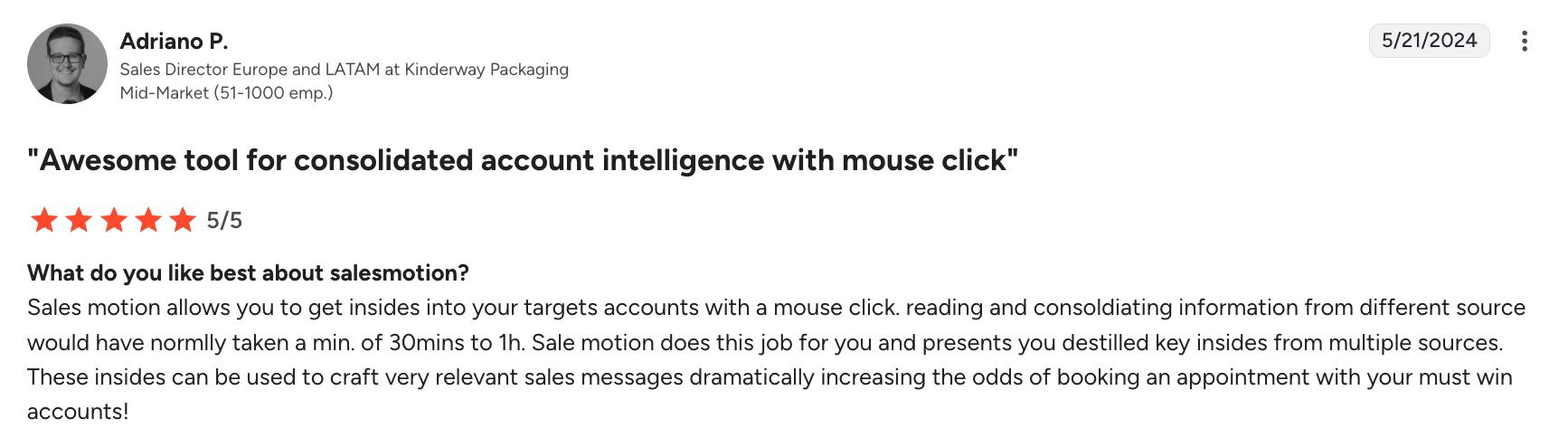 Real G2 review from a Sales Director on Salesmotion's account intelligence.
Layer 2: Content management. Once reps know the context, they need the right materials. Highspot, Seismic, or Showpad handle this, ensuring reps find approved, tracked, and personalized content.
Layer 3: Coaching and readiness. Mindtickle, Allego, or Brainshark develop skills over time. Onboarding, certification, and ongoing practice keep the team sharp.
Layer 4: Conversation intelligence. Gong or similar tools analyze actual call performance, closing the loop between coaching and execution.
Layer 5: Knowledge access. Guru or similar tools ensure reps can find quick answers during live conversations without leaving their workflow.
The adoption gap that plagues most enablement tools — 75% of sales leaders logging in fewer than five times per quarter, per Highspot's own data — often comes down to workflow fit. A Head of Sales Tools at a global telecom told us their previous intelligence tools "got low adoption because reps had to go to yet another tab." The platforms that stick are the ones that bring insights to where reps already work: the CRM, Slack, or the meeting prep flow.
The mistake most teams make is over-investing in Layers 2 and 3 while completely ignoring Layer 1. Reps end up with polished decks and solid talk tracks, but they walk into meetings knowing nothing about the account's current situation. That is the gap where deals die.
Here is what this looks like in practice: a signal fires when a target account posts a VP of Revenue Operations role. The account intelligence layer flags the account and surfaces context, including an earnings call mention of "sales transformation initiative" and three recent competitive wins in the account's industry. The rep enters discovery already knowing the likely pain, the key stakeholders, and the timing. Instead of a generic intro call, the first meeting is consultative. Deal velocity increases because half the discovery work happened before the call started.
Frequently Asked Questions
What is a sales enablement platform?
A sales enablement platform is software that equips revenue teams with the content, training, intelligence, and tools they need to engage buyers effectively. Modern platforms span content management, coaching, conversation analytics, and account research. The market reached over $6 billion in 2025 and is growing at 16-19% annually, according to Grand View Research and Mordor Intelligence.
How do I choose between sales enablement platforms?
Start with your biggest gap. If reps cannot find content, evaluate Highspot or Seismic. If onboarding takes too long, look at Mindtickle or Allego. If reps walk into meetings unprepared because research takes too long, an account intelligence platform addresses that directly. Most mature teams need two to three tools working together rather than one platform trying to do everything.
What is the difference between sales enablement and revenue enablement?
Revenue enablement expands the scope beyond sellers to include all customer-facing roles: marketing, customer success, partners, and presales. Gartner advocates this broader approach because buying decisions now involve more stakeholders and touchpoints than ever. The shift reflects a recognition that enablement is not just a sales support function but a strategic lever for the entire revenue organization.
How much do sales enablement platforms cost?
Costs range widely, and most of the category quotes rather than publishes. Guru starts with a free tier and paid plans at $15/user/month. Account intelligence platforms start as low as $85/month with account-based pricing. Showpad, Mediafly, Mindtickle, Allego and Brainshark are all quote-only. Highspot and Seismic do not publish pricing either: Vendr reports a median of $60,005 per year across 351 purchases for Highspot, and Vendr reports a median of $31,950 per year across 415 purchases for Seismic. Factor in implementation costs of $5,000-50,000 depending on complexity.
Can AI replace sales enablement platforms?
AI enhances enablement but does not replace it. The strongest results come from AI embedded within purpose-built platforms, such as content recommendations, automated research, conversation analysis, and coaching feedback, rather than generic AI tools used ad hoc.
Key Takeaways
- The market is consolidating fast. Seismic completed its merger with Highspot (Aug 2026), Vector Capital merged Showpad with Bigtincan, and Gong entered enablement with Gong Enable. If you are mid-contract with any of these vendors, review your renewal terms.
- Sales enablement in 2026 covers four pillars: content management, coaching, conversation intelligence, and account intelligence. No single platform excels at all four.
- Gartner's inaugural Magic Quadrant for Revenue Enablement Platforms (Nov 2025) validates enablement as a standalone category — not just a feature of CRM or sales engagement tools.
- Build your stack in layers. Start with account intelligence (the context reps need before meetings), then add content, coaching, and analytics on top.
- Enterprise content platforms like Seismic (now including Highspot) publish no pricing; Vendr reports medians of $31,950 per year for Seismic across 415 purchases and $60,005 for Highspot across 351 purchases.
- The biggest enablement gap is not content or coaching. It is that reps walk into meetings without understanding the account's current strategic priorities, leadership changes, and buying signals.
- Evaluate platforms based on your specific gap, not feature checklists. A mid-market team may get more ROI from account intelligence tools plus a lightweight content solution than from an enterprise suite they will underuse.