The best AI prospecting tool depends on which part of prospecting is slow. Apollo.io is the best starting point for most B2B teams because it puts 240M contacts, sequences and a dialer in one product with a permanent free plan. Salesmotion is the pick when reps already have contacts but need to know which accounts to work and what to say, and Clay is the pick for teams with RevOps support that want to build their own enrichment workflows.
Comparing AI prospecting tools?
Most AI prospecting tools spit out generic emails. Salesmotion drafts outreach anchored to real signals.
Verified contacts + 24/7 signal monitoring + AI-drafted emails grounded in actual account research. $85/mo.
Sales reps spend just 28% of their time actually selling, according to Salesforce. The rest goes to manual research, data entry, and toggling between tabs. AI prospecting tools promise to give that time back, but the category now covers very different products. Some find contacts. Some write and send email. Some run a dialer. A few watch accounts for buying signals and build outreach around what is actually happening there. This guide compares 10 of them on what each vendor sells today, what it costs, and which team it suits.
TL;DR: Three picks cover most teams. Apollo.io for teams that need contact data, sequences and calling in one tool, starting on a free plan. Salesmotion for teams selling into complex accounts that need signal-led research and drafted outreach a rep reviews, from $85/month. Clay for RevOps and GTM engineering teams that want custom enrichment across 150+ data providers. The other seven tools on this list are specialists: cold email volume, email coaching, multichannel outbound, enterprise sales engagement, and autonomous AI SDRs.
Top picks
| Tool | Best for | Starting price |
|---|---|---|
| Apollo.io | Contacts, sequences and calling in one tool | Free; $49–$119/user/mo (annual) |
| Salesmotion | Signal-led account research with drafted outreach | $85/mo for individuals |
| Clay | Custom enrichment and GTM workflows | Free; Launch $185/mo, Growth $495/mo |
Start with Apollo.io if you are building outbound and need contacts plus a way to reach them. Add Salesmotion when the bottleneck is relevance: it shows which accounts have something happening and why now, then drafts outreach grounded in that event for a rep to review, from $85/mo on a monthly contract.
Why Trust This Guide?
I'm Semir Jahic, CEO of Salesmotion. Before building an account intelligence platform, I spent years in enterprise sales at Salesforce and led revenue teams at Clari. Salesmotion publishes this guide, and Salesmotion is on the list at number 2. It is not number 1 because prospecting is wider than our lane: Salesmotion is research, signals and drafted outreach, and several tools here are built around contact databases, sending and dialing.
Three things keep the guide honest:
- Every price and product fact was checked against the vendor's own site on 10 October 2026. Where a vendor does not publish a price, we say so instead of estimating.
- Third-party figures are named. When a number comes from Salesforce, Gartner, Sopro or a vendor's own benchmark report, the sentence says so and links to it.
- The buyer view comes from our own calls. We sat in 55 sales and customer calls between August and October 2026. In 22 of them the question was not who to contact but which accounts to work this week, and when.
Two things buyers said in those calls shaped how this list is organized:
"I'm looking more for surveillance on my accounts to pick up the stuff that I might miss." (Regional sales manager, cybersecurity)
"the rate of responses is really, really low if they don't know you before." (Business development rep, CRO)
Our own customers show what the research-led approach can do. Analytic Partners grew qualified pipeline 40%. Frontify saw 42% faster sales velocity.
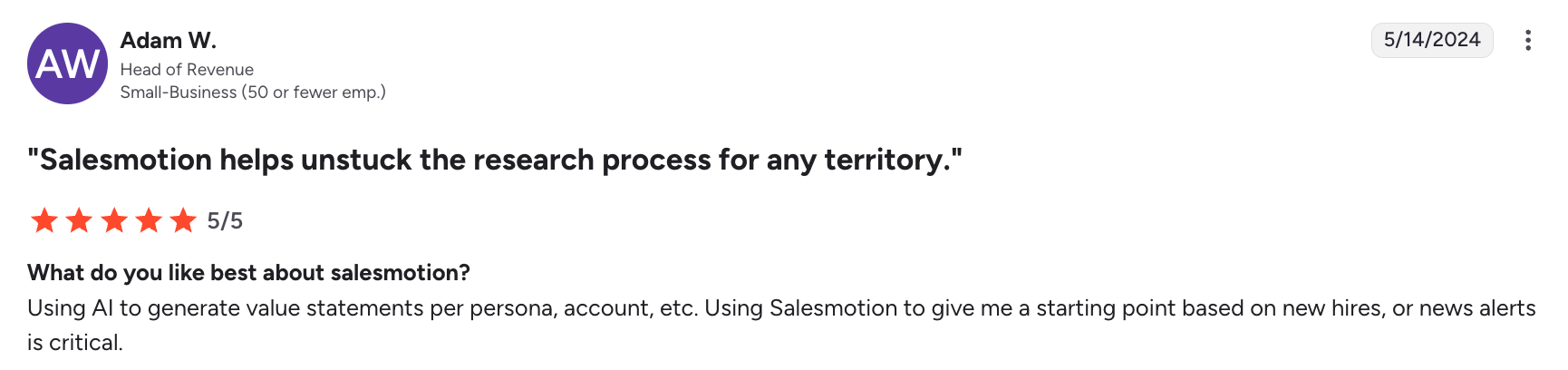 Real G2 review. Salesmotion is rated 4.8/5 on G2 across 26 reviews (reviews on G2).
See Salesmotion on a real account
Book a 15-minute demo and see how your team saves hours on account research.
Why AI Prospecting Tools Matter More Now
AI adoption in sales has surged from 39% to 81% in just two years, according to Sopro's 2026 analysis. The same analysis reports that teams using AI see 83% revenue growth rates compared to 66% for non-AI teams, a 17-point gap.
But adoption alone is not the differentiator. The gap is now between teams that use AI to send more emails and teams that use AI to send more relevant ones. Instantly's 2026 benchmark report found that only 5% of senders fully personalize their cold emails, yet that 5% sees 2-3x the reply rates. The tools worth paying for are the ones that make that level of personalization possible without asking reps to spend an hour researching each account.
Three forces are driving this shift:
- Buyers reject generic outreach. Gartner reports 73% of B2B buyers avoid suppliers that send irrelevant messages. Untargeted volume is a deliverability and reputation risk, not just a conversion problem.
- Research time eats selling time. Account research done by hand is slow, and it is the first thing reps skip when the quarter gets busy. AI can compress it to minutes.
- Signal timing wins deals. A leadership change, an earnings call mention, or a new strategic initiative creates a narrow window. Tools that detect these events and help reps act on them reach buyers while the event is still news.
The comparison table below shows how each tool approaches these three challenges.

“The moment we turned on Salesmotion, it became essential. No more hours on LinkedIn or Google to figure out who we're talking to. It's just there, served up to you, so it's always 'go time.'”
Adam Wainwright
Head of Revenue, Cacheflow
AI Prospecting Tools Comparison Table: Features, Pricing, and Free Plans
Tools with a published price come first, quote-only platforms after. Every pricing cell is the vendor's own published figure as of 10 October 2026.
| Tool | Best for | Standout capability | Pricing | Free plan or trial |
|---|---|---|---|---|
| Apollo.io | Contacts, sequences and calling in one tool | Database of 240M contacts and 30M companies | Free; $49–$119/user/mo (annual) | Free plan |
| Salesmotion | Signal-led account research with drafted outreach | 50+ signal types from 1,000+ public sources | $85/mo for individuals; custom for teams | Interactive demo |
| Clay | Custom enrichment and GTM workflows | Waterfall enrichment across 150+ providers | Free; Launch $185/mo, Growth $495/mo | Free plan |
| Regie.ai (RegieGO) | Self-serve outbound with calling | Power dialer in every paid plan | Free; Pro $49/mo; Team $150/seat/mo | Free plan |
| Instantly | Cold email at volume | Unlimited email accounts with warmup | Growth $47/mo; Hypergrowth $97/mo; Light Speed $358/mo | "Start free", no credit card |
| Lavender | Email coaching | Scores emails inside Gmail and Outlook 365 | Free; Starter $29/mo; Individual Pro $49/mo; Team $99/seat/mo | Free plan |
| Amplemarket | Multichannel outbound in one platform | Sequences, parallel dialer and social automation | Startup from $600/mo (2 users) | Free trial |
| Outreach | Enterprise sales engagement | AI agents for research, deals and personalization | Custom (per-seat + AI credits) | None listed on pricing page |
| Salesloft | Engagement with coaching and forecasting | Cadence, Conversation Intelligence and Clari Forecast | Custom, quote-only | None listed on pricing page |
| 11x | Autonomous outbound | Alice, an AI SDR that runs on autopilot | Custom, quote-only | None listed on site |
The 10 Best AI Prospecting Tools for B2B Sales Teams
How the list is ordered. Tools a team can start on at a published price come first (1 to 7). Within that group the broadest all-in-one tool leads, the research and signal layer most teams add next is second, and builders and specialists follow. Platforms sold by quote come after (8 to 10). The order is our editorial judgment, not a score, and every entry says who should pick that tool over the ones above it.
1. Apollo.io
Apollo.io combines a database of 240M contacts and 30M companies with sequencing, a dialer, enrichment and AI research in one product. Reps can find contacts, build lists, and launch email sequences without leaving the platform. It is the most complete single purchase on this list for a team that is building outbound and has no tools yet.
Best for: SMB and mid-market teams that need prospecting data and outreach in one platform at a published per-seat price. Especially useful for teams building outbound from scratch.
What it is strong at:
- A free plan that does real work. Apollo's free plan stays free with no time limit and includes 900 credits per seat per year, two sequences, AI Research and API access.
- Breadth from the entry tier. Basic adds unlimited sequences, CRM integrations, waterfall enrichment and a US dialer.
- Intent and signals on every tier. One intent topic on Free, six on Basic and Professional, twelve on Organization, plus signal filters, AI scores and agents.
- Integrations. Apollo lists Salesforce, HubSpot, Outreach, Salesloft, Marketo and all major email providers, and offers an MCP server.
Pricing: Apollo publishes its pricing: a free tier, then Basic at $49, Professional at $79 and Organization at $119 per seat per month on annual billing (3-seat minimum on Organization). Monthly billing is $65 and $99 on Basic and Professional; Organization is annual only. Usage is metered in credits (an email costs 1 credit, a phone number 8), and unused credits expire at the end of each billing cycle. Basic and Professional start with a 14-day trial.
Choose it if: you need contacts and a way to sequence them today, want to see the price before talking to anyone, and would rather run one tool than three. Teams selling large, complex deals often add an account intelligence layer on top for research from earnings calls, filings and news.
For deeper comparisons, see our full breakdown.
2. Salesmotion
Salesmotion is an account intelligence platform: research and signals, with drafted outreach a rep reviews before it goes out. Three AI agents do the work. The Signal Agent monitors 1,000+ public sources for 50+ types of buying signals, including leadership changes, earnings call commentary, strategic initiatives, hiring surges, M&A activity, and product launches. The Research Agent turns those into cited account briefs. The Outreach Agent drafts messages that reference the specific event, so the email reads like the rep did the research.
Most prospecting tools start with a contact list and generate copy. Salesmotion starts with what is happening at the account. That is why it sits at number 2 on a prospecting list and not number 1: it is the research and signal layer, and most teams run it alongside a contact database or a sequencer.
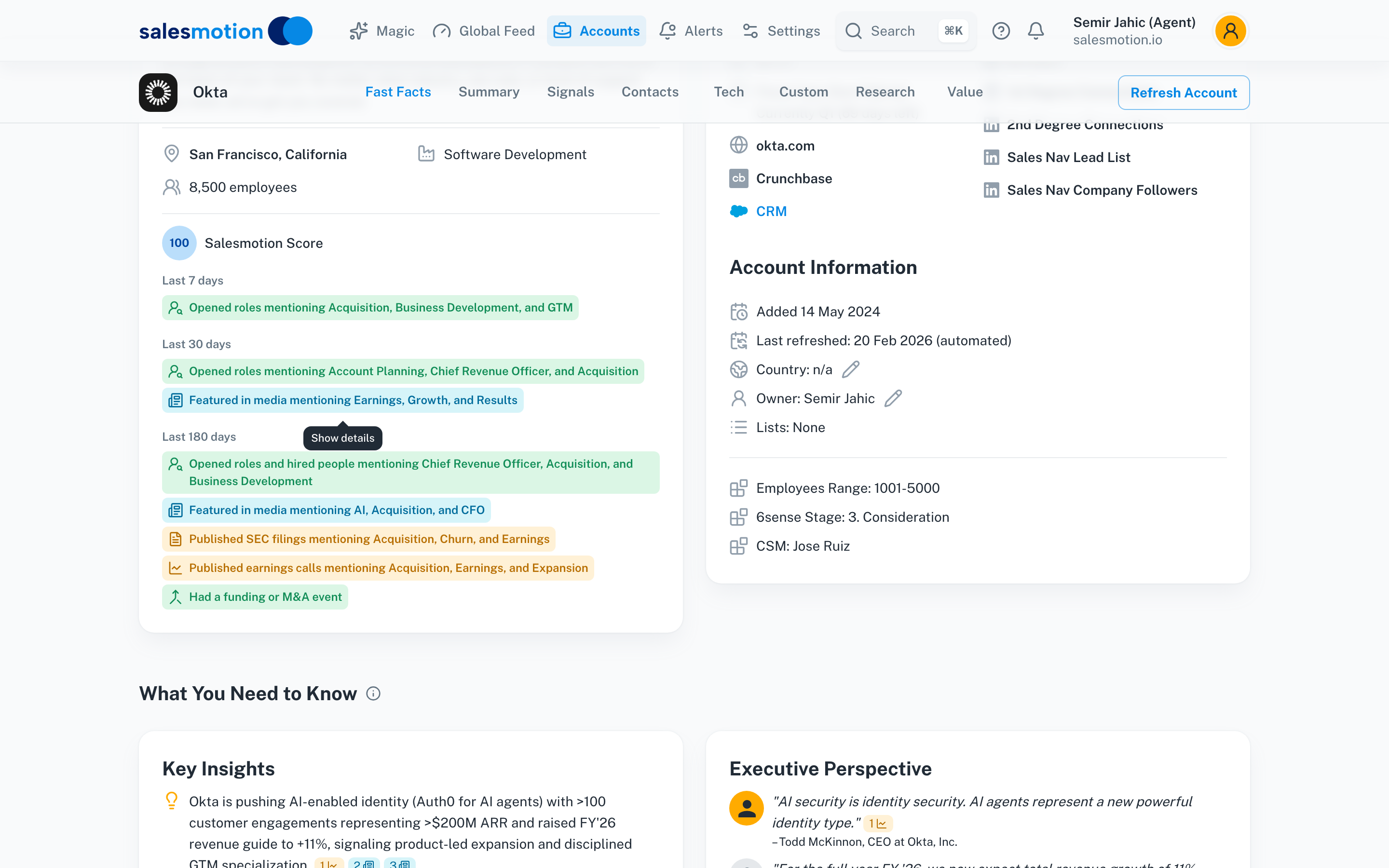 A Salesmotion account brief: key insights, executive perspective and talking points, each tied to a source.
Best for: Mid-market and enterprise B2B teams selling into complex accounts where generic outreach gets ignored and account research is the slow step.
What it is strong at:
- Signal monitoring. 50+ signal types across 1,000+ public sources, so reps hear about a new executive or a strategy shift without going to look.
- Cited account briefs. Every insight links to its source, so a rep can check a claim before repeating it to a buyer.
- Outreach drafts tied to the signal. The Outreach Agent drafts the message from the event and the research. The rep reviews, edits and sends, and drafts can be pushed to lemlist.
- Fits the stack you have. Native Salesforce integration, HubSpot integration, a REST API, and an MCP server for Claude, ChatGPT and other assistants.
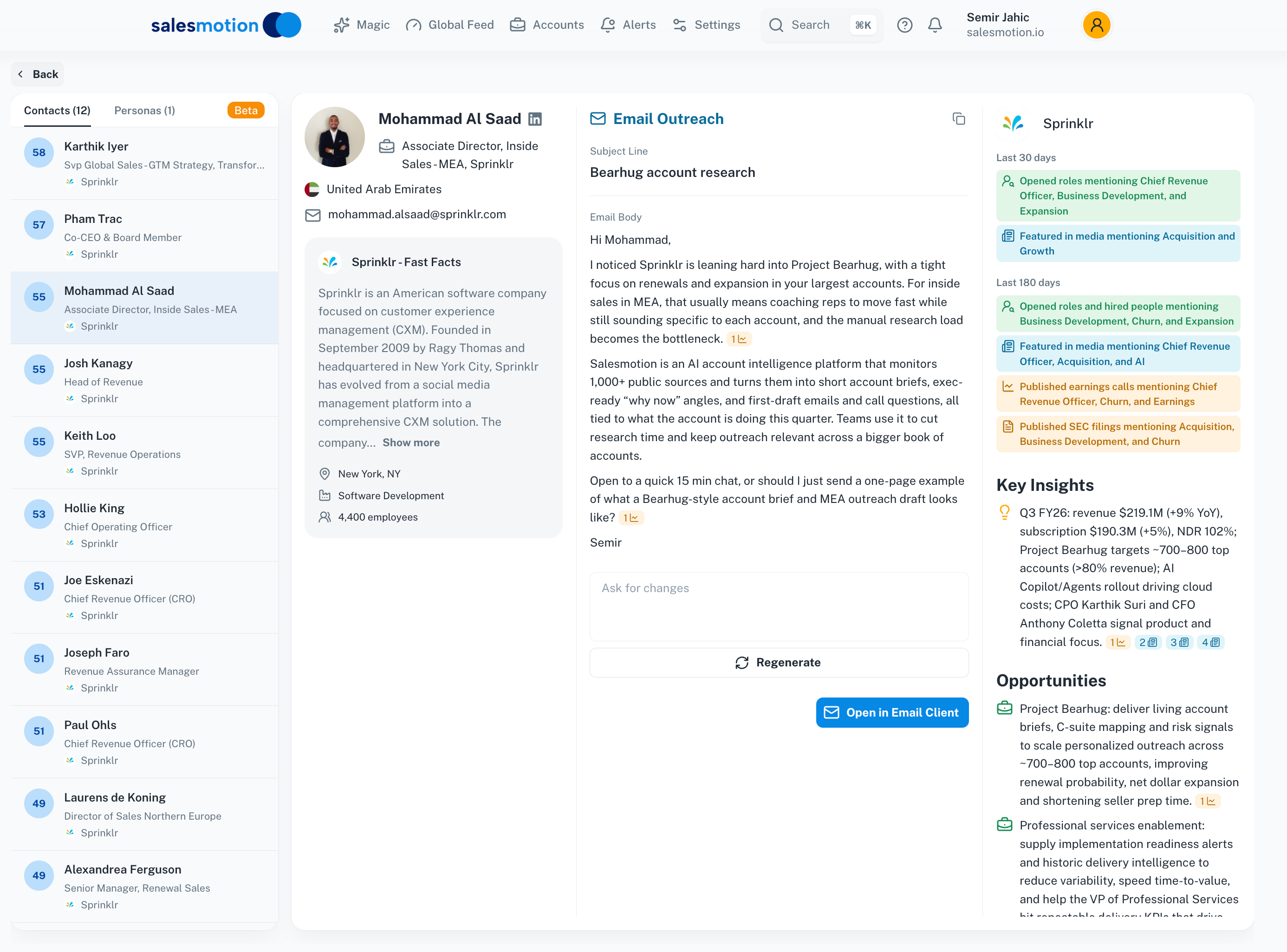 An outreach draft built from live account signals, ready for the rep to review.
Pricing: $85/month for individuals on a monthly contract with no annual commitment. The Individual plan tracks up to 100 accounts and includes 200 contact credits a month for verified emails and phone numbers. Teams and enterprise are custom-priced. The interactive demo shows the product without a call.
Customer results: Frontify reports 4x self-sourced revenue and 31% shorter sales cycles.
Choose it if: your reps have a list of target accounts and enough contacts, but spend too long working out which account to call this week and what to say when they do.
Salesmotion's Take
We built Salesmotion for one part of prospecting: knowing which accounts to work and what to say. It starts with the signal, builds the research, then drafts outreach anchored to what is actually happening at the account, and the rep decides what gets sent. If your gap is contacts or sending volume, Apollo or Instantly is the right first purchase. If your gap is relevance with enterprise buyers, this is the layer I would add.

Semir Jahic
CEO & Co-Founder, Salesmotion
3. Clay
Clay is a data enrichment and GTM workflow platform. Its "waterfall" approach checks multiple data providers in sequence until one returns a result, and its AI agents, called Claygents, carry out research tasks on your behalf. Clay has grown well past enrichment: it now has its own company and people database, native signals, a sequencer, and Account Agents that monitor a book of business.
Best for: RevOps teams, GTM engineers and technical sellers who want granular control over their enrichment and outbound pipeline.
What it is strong at:
- Multi-provider enrichment on one bill. Clay says it finds and enriches data from 150+ providers, and that you are not charged when an enrichment returns no result.
- Native signals. Job change, company news and social listening signals on Launch and above; web intent signals on Growth and above.
- A build surface that now reaches reps. Functions, Workflows and Account Agents, plus a Clay MCP that lets reps prompt ChatGPT, Claude or Codex against Ops-defined rules.
- CRM and warehouse sync. Native CRM integrations with auto-sync, and warehouse connectors, on Growth and above.
Pricing: Clay publishes its pricing: a free tier, Launch from $185/month and Growth from $495/month (about $167 and $446 on annual billing), then custom Enterprise on an annual commitment. Paid plans start with a 14-day trial, include unlimited seats, and meter usage in Actions and Data Credits. Clay introduced these plans in spring 2026; customers on the legacy Starter, Explorer and Pro plans can stay on them. See our Clay pricing breakdown for full details.
Choose it if: you have someone who enjoys building workflows and you want to control every step of how a lead is found, enriched and scored. Clay is a build surface for GTM engineers and Ops.
4. Regie.ai (RegieGO)
Regie.ai now sells RegieGO, a self-serve outbound workspace that it describes as "the fastest path from ICP to pipeline". RegieGO combines AI agents, relevant messaging, channel orchestration and a power dialer in one product, and surfaces why-now signals such as funding rounds, leadership changes and hiring. It is built for prospecting reps and founders, with a free plan and no contract on the paid plans.
Best for: Prospecting reps, founders, and small teams that want research, messaging, sequencing, and dialing in one self-serve workspace.
What it is strong at:
- Calling included. Regie.ai states that calling is part of every paid plan, with parallel dialing and the research already done.
- Why-now signals. Funding, leadership changes and hiring surface as triggers for outreach.
- Direct CRM sync. Syncs with Salesforce, HubSpot and Monday CRM, and connects to Gmail, Outlook, Gong, Attention and Seismic.
- Easy to try. A free plan with no credit card, and Pro and Team plans with no contract.
Pricing: Regie.ai publishes its RegieGO pricing: a free plan for up to 10 people sharing one credit pool, Pro at $49 per month for one person ($41 on annual billing), Team at $150 per seat per month ($125 on annual billing) with a two-seat minimum, then custom Enterprise. Paid credits reset each period, and extra credits cannot be bought on their own.
Choose it if: you are a single rep or a small team that wants one login for research, messaging and calls, and you want to start free. RegieGO is built around the rep's outbound workflow; Salesmotion is built around deep account research from filings, earnings calls and news.
5. Instantly
Instantly is cold email software for scaling outreach campaigns. It describes itself as built for unlimited email accounts and AI-powered lead generation, and its outreach plans cover both sending and warmup. A separate lead database of 450M+ B2B leads is sold as credits.
Best for: Early-stage startups, agencies, and SDR teams running high-volume cold email where deliverability is the main constraint.
What it is strong at:
- Sending infrastructure. Unlimited email accounts with warmup, so volume can be spread across many inboxes.
- A lead database in the same product. 450M+ B2B leads, bought through credit plans.
- Low published entry price. Outreach plans start at $47 a month on monthly billing.
- Exports. Instantly lists exports to major CRMs and outreach providers.
Pricing: Instantly publishes its pricing. Outreach plans: Growth at $47/month ($37.60 on annual billing), Hypergrowth at $97/month ($77.60), and Light Speed at $358/month ($286.30), then custom Enterprise. Lead database credits are sold as separate plans from $47/month, and bundles of the two start at $94/month.
Choose it if: you already know who you want to email and what you want to say, and the hard part is getting a lot of well-warmed email delivered. Pair it with a research or signal tool if the message itself is the weak point.
6. Lavender
Lavender is an AI email coach. It scores and improves sales emails as the rep writes them, inside Gmail and Outlook 365. Lavender has also launched Ora, which it describes as an AI sales agent that "writes emails like a top seller".
Best for: Individual reps and small teams focused on improving email quality more than email volume. Useful for teams with inconsistent messaging across reps.
What it is strong at:
- Coaching at the moment of writing. Emails are scored and improved in the composer, before they are sent.
- Works where reps already work. Gmail and Outlook 365, with integrations on the Individual Pro and Team plans.
- A manager view. The Team plan adds a Coaching Dashboard.
- A free tier to test it. The Basic plan is free forever and analyzes and personalizes 5 emails a month.
Pricing: Lavender publishes pricing for its Email Coach: Basic is free forever for 5 emails a month. Starter is $29/month. Individual Pro at $49/month includes integrations. The Team plan at $99 per seat per month includes integrations and the Coaching Dashboard. Annual billing lowers these to $27, $45 and $89.
Choose it if: your reps write their own emails and the quality varies. Lavender coaches what the rep writes, so it pairs well with a signal or research tool that supplies what to write about.
7. Amplemarket
Amplemarket calls itself an AI sales copilot and an all-in-one AI platform. It groups its product into intelligence (Duo Copilot, Duo Copywriter, Duo Inbox, Duo Voice), lead generation and signals (Searcher, Intent Signals, Job Change Alerts, Competitive Intelligence, Social Prospecting), multichannel engagement (sequences, a parallel dialer, social automation, a unified inbox), and deliverability.
Best for: Mid-market teams that want a single platform to replace several point solutions for multichannel outbound.
What it is strong at:
- Multichannel in one product. Sequences, a parallel dialer, social automation and a unified inbox.
- People and engagement signals. Job changes, funding, news, hiring, website visits, competitor engagement and social activity.
- Deliverability as a product group. Domain Health Center, Deliverability Booster, Mailbox Recommendation and an Email Spam Checker.
- A copilot for reps. Duo Copilot is included from the Startup plan.
Pricing: Amplemarket publishes a Startup tier at $600/month on an annual term (2 users, 27,000 contacts); Growth and Elite are quote-only. All plans include a free trial.
Choose it if: you run email, phone and LinkedIn together and want one vendor for all three, with signals about people and engagement built in. Teams that want research from earnings calls and filings add an account intelligence layer.
8. Outreach
Outreach describes itself as an agentic AI platform for revenue teams. It covers sales engagement, conversation intelligence (Kaia), deal management, forecasting and mutual action plans, and has added a broad line-up of AI agents: Research Agent, Revenue Agent, Deal Agent, Personalization Agent, Meeting Prep Agent, Omni and Agent Studio.
Best for: Enterprise sales teams that need one platform for sequences, coaching, deals and forecasting, and want outbound execution standardized across a large team.
What it is strong at:
- Sales execution at scale. Sequences, conversation intelligence, deal management and forecasting on one platform.
- Research and personalization agents. The Research Agent combines conversation data from Outreach with first-party engagement data and third-party public data.
- Open to other AI systems. Outreach MCP and Agent Studio are part of its agent line-up.
- Growing AI use. Outreach reported 12x growth in AI credit consumption in the first half of 2026.
Pricing: Outreach does not publish list pricing; contracts are quoted per organization. It sells four tiers (Amplify Essentials, Core, Plus and Pro) differentiated by AI credit allotments, described as per-user pricing with no platform fees.
Choose it if: you manage a large team, already have data and research covered, and need every rep running the same plays with manager visibility. Evaluation starts with a sales conversation.
9. Salesloft
Salesloft describes itself as a predictive revenue system. Its products include Cadence for engagement, Conversation Intelligence, Deals, Rhythm for prioritizing a rep's day, Signals, and, since the merger with Clari completed in December 2025, Clari Forecast. Its AI agents work inside that workflow: Account Research, Person Research, Buyer Identification and AI Email Steps for Cadence among them.
Best for: Mid-market and enterprise teams that want engagement, coaching and forecasting from one vendor.
What it is strong at:
- Engagement with coaching. Cadence, Conversation Intelligence, Deals and Analytics in one platform.
- A wide in-workflow agent suite. Account and person research, buyer identification, AI email generation and deal summaries.
- Forecasting. Clari Forecast is now sold as part of Salesloft.
- MCP server. The Salesloft MCP Server works with AI applications that support MCP, including Claude, ChatGPT and Copilot.
Pricing: Salesloft does not publish list pricing; contracts are quoted per organization. Its pricing page lists products without dollar figures, contract terms or seat minimums.
Choose it if: call coaching and forecast accuracy matter as much to you as outbound, and you want them in the same system as your cadences. Its agents work inside the Salesloft workflow, so the value grows with how much of the platform your team adopts.
10. 11x
11x sells autonomous "digital workers". Alice is an AI SDR for outbound: she engages buyers across email, calls and more, handles replies and books meetings, in over 105 languages. Julian is an AI phone agent for inbound, covering speed to lead and lead qualification. 11x markets Alice as autonomous prospecting that runs on autopilot.
Best for: Teams that want outbound to run without a rep driving each step, and are ready to hand the workflow to an agent.
What it is strong at:
- End-to-end autonomy. Alice prospects, sequences, handles replies and books meetings.
- Its own signal and research layer. Signals and Triggers, Deep Research, website visitor tracking and 50+ data sources.
- Inbound voice. Julian answers and qualifies inbound leads by phone.
- Integrations. CRM, Slack and G2 integrations and an API, with Salesforce and HubSpot named on its site.
Pricing: 11x does not publish list pricing; contracts are quoted per organization. Its site is demo-gated. Third-party estimates circulate but none is sourced to 11x.
Choose it if: your motion is high-volume and you want an agent to own outbound from first touch to booked meeting. If you want a rep to approve each message before it goes out, ask how approval works for your use case: 11x's site describes Alice as running on autopilot.

“The Business Development team gets 80 to 90 percent of what they need in 15 minutes. That is a complete shift in how our reps work.”
Andrew Giordano
VP of Global Commercial Operations, Analytic Partners
How Signal-Based AI Prospecting Differs from Template-Based Tools
AI prospecting tools take one of two starting points: the contact list or the account.
Template-based AI prospecting starts with a contact list, generates email copy using basic fields (name, title, company, industry), and optimizes for volume and deliverability. This approach works for high-volume, lower-ASP sales motions where the math favors quantity.
Signal-based AI prospecting starts with account intelligence. A leadership change fires. An earnings call reveals a new strategic initiative. A competitor loses a key executive. The AI uses these events to generate outreach that references a specific, relevant trigger. The math here favors relevance and timing over volume.
Here is how the difference plays out in practice:
Template approach: "Hi Sarah, I noticed you're the VP of Sales at Acme Corp. Companies like yours often struggle with pipeline coverage. Would you be open to a quick chat?"
Signal approach: "Hi Sarah, congrats on the VP of Sales role at Acme. I saw your CEO mentioned on the Q3 call that pipeline visibility is a top priority for the year ahead. We've worked with similar teams to surface buying signals that help reps focus on accounts actually in-market."
The signal-based message does not guess at the pain point. It references a real event that the buyer recognizes. Analytic Partners grew qualified pipeline 40% and cut research time by 85% with signal-driven account intelligence.
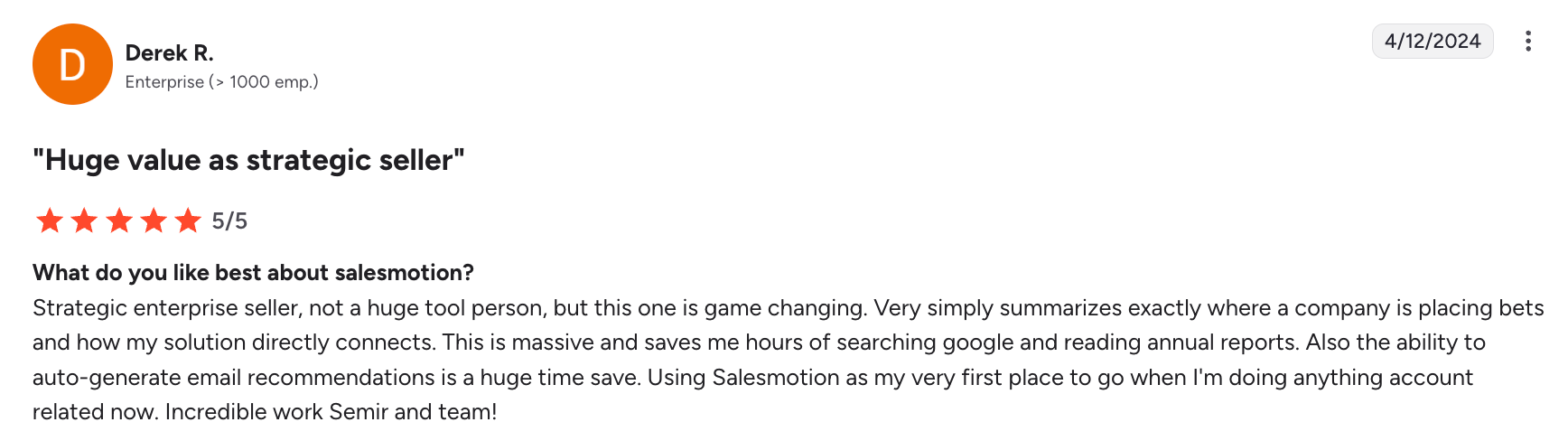 Real G2 review from an Enterprise Strategic Seller.
The line between the two is blurring. Several tools on this list that began with contacts and sending now ship signals of their own: Apollo.io has intent topics and signal filters, Clay has job change and company news signals, RegieGO surfaces funding and hiring, Amplemarket tracks job changes and website visits, and 11x lists signals and triggers. What still differs is the kind of signal and the depth of research behind it. For teams selling into enterprise accounts, where deal sizes justify the research, the signal-based approach is built for reply rate, meeting quality, and pipeline coverage more than for send volume. To learn more about how AI prospecting works in practice, see our complete guide.
CRM Integration Comparison: Which Tools Work With Your Stack?
A prospecting tool that creates more work than it saves does not last. CRM integration decides whether signals, research, and outreach flow into the workflow your team already has or sit in another tab.
Direct CRM sync, as each vendor describes it:
- Salesmotion: Native Salesforce integration (managed package, one-way or bi-directional sync) and a HubSpot integration
- Apollo.io: CRM integrations from the Basic plan; Salesforce and HubSpot are named
- Clay: Native CRM integrations with auto-sync on Growth and above
- Regie.ai: Syncs with Salesforce, HubSpot, and Monday CRM
- 11x: CRM integration and "Smart CRM Sync"; Salesforce and HubSpot are named on its site
- Amplemarket: An integrations hub; HubSpot is named on its site
Sales engagement platforms that sit beside the CRM:
- Outreach: Sold per user, with Connectors and Data Sharing listed as add-ons on its pricing page
- Salesloft: A revenue platform with its own Deals and forecasting products, plus an MCP server
Extension and export based:
- Lavender: Works inside Gmail and Outlook 365; integrations on Individual Pro and Team plans
- Instantly: Exports to major CRMs and outreach providers
The pattern we see is consistent: tools that write back into the CRM get used, and tools that live in a separate tab get abandoned. Ask each vendor for its current connector list and sync direction before you buy, because this is the part of a product page that changes most often. For deeper analysis of CRM integration strategies, see our Salesforce integration guide.
How to Choose the Right AI Prospecting Tool
Start with the situation you are in, not the feature list.
If you are building outbound from nothing: You need contacts and a way to reach them. Apollo.io's free plan covers both. RegieGO is the alternative if calling matters from day one: calling is part of every paid plan, from Pro at $49 a month.
If your reps have contacts but no reason to reach out: This is a research and timing problem. Salesmotion monitors target accounts for signals, writes the cited brief, and drafts the outreach for the rep to review. Run it alongside your contact database or sequencer.
If you have RevOps or GTM engineering support: Clay rewards teams that can build. You control every enrichment step and can wire in your own signals and scoring.
If deliverability is the constraint: Instantly is built for sending a lot of well-warmed cold email from many inboxes.
If email quality varies across reps: Lavender coaches each email as it is written and gives managers a dashboard on the Team plan.
If you run email, phone and LinkedIn together: Amplemarket puts all three in one platform with a parallel dialer and deliverability tooling.
If you have 20+ reps: Consistency across the team matters. Sales engagement platforms like Outreach or Salesloft standardize execution. Layer a signal intelligence tool on top so the messaging reflects what is happening at target accounts.
If you want outbound to run on its own: 11x is the autonomous option. Expect a demo and a quote before you see a price.
Two more questions settle most shortlists. First, deal size: for deals under $10K, the published-price volume tools match the unit economics; for deals of $25K and up, buyers expect informed outreach and research depth earns its cost. Second, time: if your reps spend hours every week on account research, that is the first thing to automate.
Key Takeaways
- AI prospecting tools range from contact databases and email senders to signal-driven account intelligence. Match the tool to your deal size and sales motion.
- Apollo.io is the broadest single purchase, with a permanent free plan. Salesmotion is the research and signal layer for complex accounts, from $85/month. Clay is the build surface for teams with RevOps support.
- Seven of the ten tools publish their prices. Outreach, Salesloft and 11x do not, so their cost is whatever your quote says.
- Four tools have a free plan: Apollo.io, Clay, RegieGO and Lavender. Instantly advertises "Start free" with no credit card, and Amplemarket includes a free trial on every plan.
- Only 5% of senders fully personalize cold outreach, yet they see 2-3x the reply rates, per Instantly's 2026 benchmark report. The best tools make that personalization possible without manual research.
- Signals are no longer rare: most tools here ship some. Compare the kind of signal (people and engagement versus company events from earnings calls, filings and news) and the research behind it.
- Start with your biggest bottleneck. If it is contact sourcing, start with Apollo.io or Clay. If it is research time and relevance, start with Salesmotion. If it is deliverability, start with Instantly.
Frequently Asked Questions
What is the difference between AI prospecting tools and traditional sales prospecting?
Traditional prospecting relies on manual research, static contact lists, and generic email templates. AI prospecting tools automate the research, personalize outreach at scale, and in some cases monitor signals to show when an account has a reason to talk. The practical difference is where the rep's time goes: less on finding and preparing, more on conversations. Salesforce reports that reps spend just 28% of their time selling, which is the gap these tools aim at.
How much do AI prospecting tools cost?
It ranges from free to a custom quote. Apollo.io, Clay, RegieGO and Lavender have free plans. Paid entry points are $29/month for Lavender, $47/month for Instantly, $49/month for RegieGO Pro (one user, monthly billing) and for Apollo.io Basic (per seat, annual billing), $85/month for Salesmotion, $185/month for Clay Launch, and $600/month for Amplemarket's Startup plan on an annual term. Outreach, Salesloft and 11x publish no dollar figures, so those three cost whatever your quote says.
Are there free AI prospecting tools?
Yes. Apollo.io's free plan has no time limit and includes 900 credits per seat per year and two sequences. Clay has a free tier with unlimited seats. RegieGO has a free plan for up to 10 people sharing one credit pool, with no credit card. Lavender's Basic plan is free forever for 5 emails a month. Free plans are a good way to test fit, and each one meters usage, so check the credit allowance against the volume you plan to run.
Can AI prospecting tools integrate with my CRM?
Yes, most do. Salesmotion has a native Salesforce integration and a HubSpot integration. Apollo.io includes CRM integrations from its Basic plan. Clay offers native CRM auto-sync on Growth and above. RegieGO syncs with Salesforce, HubSpot and Monday CRM. Lavender works as an extension inside Gmail and Outlook 365, and Instantly exports to major CRMs. Prioritize tools that write back into the CRM, because a tool that lives in a separate tab tends to get dropped.
How long does it take to implement an AI prospecting tool?
Vendors rarely publish implementation times, so treat any number you see as an estimate. A better guide is how the product is sold. Apollo.io, Clay, RegieGO and Lavender let you start on a free plan the same day, Instantly offers a "Start free" option, and Amplemarket includes a free trial. Outreach, Salesloft and 11x are sold through a sales conversation, and rollout depends on the size of the team and the scope you agree. Ask each vendor for a reference customer of your size and how long that rollout took.
Can AI prospecting tools replace SDRs?
Some are built to, and most are built to help. 11x markets Alice as an autonomous AI SDR that prospects, handles replies and books meetings. Others, Salesmotion among them, are built to keep the rep in the loop: the AI handles research, signal detection and first drafts, and the rep reviews the message and owns the conversation. For complex B2B sales, where buyers expect someone who understands their business, many teams prefer the second model. Think of AI as multiplying what each SDR can cover.
Which AI prospecting tool is best for small teams?
For teams under 10 reps, Apollo.io is the best starting point, with a free plan that includes contact credits and two sequences. Add Lavender ($29/month on Starter) if email quality is the gap, or use RegieGO if you want calling included from $49/month. As deal sizes grow above $25K, add a signal-intelligence layer like Salesmotion ($85/month for individuals on a monthly contract) so outreach reflects what is happening at the account today.
How do I measure ROI from an AI prospecting tool?
Track three metrics before and after adoption: time spent on account research per rep per week, reply rates on outbound sequences, and meetings booked per rep per month. Sopro's 2026 analysis found that 74% of companies achieve positive ROI within the first year of AI sales tool deployment. Calculate ROI as (time saved x fully-loaded cost per hour) + (incremental meetings x average deal value x close rate) minus tool cost.