Reps are 22% less likely to earn a next step with an executive than with a non-executive buyer. Yet executive engagement is exactly what separates deals that close from deals that stall in committee. Booking executive meetings requires a fundamentally different approach than booking meetings with individual contributors or managers.
TL;DR: C-suite executives are actually more responsive to outreach than most reps assume: they reply to cold emails at a 6.4% rate (higher than non-executives), and 57% prefer phone contact. The problem is not access. It is approach. Gong's analysis of over one million executive sales cycles reveals three keys: brief, credibility-building rapport (1-2 minutes adds 3.8% to next-meeting rates), fewer but better-prepared questions, and framing around cost of inaction rather than premature ROI claims. Multi-channel sequences combining email, phone, and LinkedIn produce 22% higher response rates than email alone.
Why Executive Meetings Are Different
Executives do not take meetings for the same reasons managers do. A VP of Sales might take a meeting to evaluate a tool that helps their team. A CRO takes a meeting because the topic connects to a strategic priority they are accountable for this quarter.
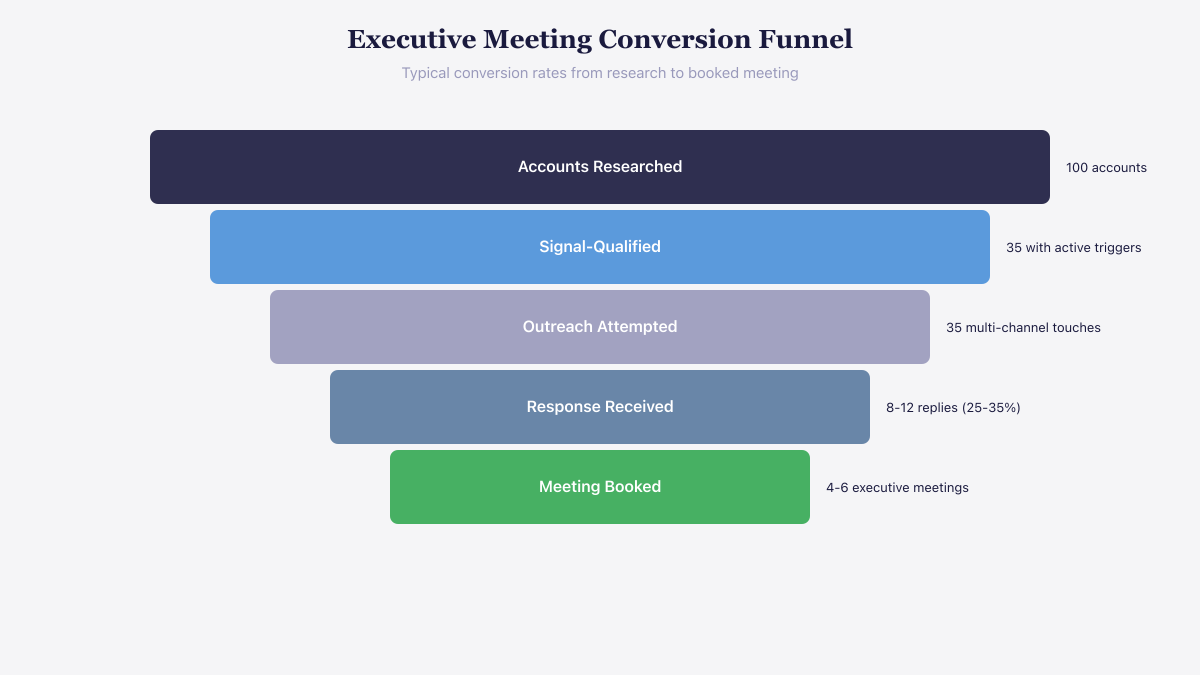 Signal-qualified outreach converts at 25-35%, turning 100 accounts into 4-6 executive meetings.
This means everything about the outreach must change: the reason for the meeting, the value proposition, the questions you ask, and how you spend the first two minutes.
Most reps fail at executive meetings because they run the same playbook they use for every other prospect. They open with small talk, ask basic discovery questions the prospect has answered a dozen times, and pitch features. Executives have heard it all before and decide within the first five minutes whether the conversation is worth continuing.
The data confirms this. After analyzing over one million executive sales cycles, Gong found that the specific behaviors reps exhibit during the first meeting determine whether they earn a second one.
See Salesmotion on a real account
Book a 15-minute demo and see how your team saves hours on account research.
Build Credibility in Two Minutes
Rapport is not optional. Skipping rapport entirely reduces your chance of a next meeting by up to 8.3%. But the type of rapport matters.
Executives do not want to discuss the weather or the local sports team. They want to know that you have done your homework and understand their business context. Effective executive rapport is credibility-building, not relationship-building. The relationship comes later, after you have demonstrated value.
The research-first framework: Share what you have learned about their company's situation through thorough account research: recent initiatives, market challenges, competitive dynamics, or organizational changes. Then ask: "What did I get right, and what did I miss?"
This approach accomplishes three things simultaneously. It demonstrates preparation. It shows you understand their world. And it gives the executive a natural entry point to correct your understanding, which creates a collaborative dynamic from the start.
One to two minutes of this type of rapport increases next-meeting rates by 3.8%. More than two minutes of rapport shows diminishing returns. Executives appreciate brevity.

“The talking points are gold. If they're in Salesmotion, I know they're being discussed inside that business. That makes it easy to spark a real conversation, which is 90 percent of the battle.”
Andrew Giordano
VP of Global Commercial Operations, Analytic Partners
Ask Fewer, Better Questions
Counter-intuitively, top-performing reps ask fewer questions during executive discovery calls than average reps. High question volume signals weak preparation. If you need to ask 15 questions to understand the prospect's situation, you have not done enough research beforehand.
Instead of asking "what are your biggest challenges?", which forces the executive to do all the work, lead with context and then inquire:
Generic: "What keeps you up at night regarding pipeline?"
Prepared: "We are hearing from other CROs in your space that buying signals are generating activity but not converting to qualified pipeline. Is that showing up for your team, and if so, where is the breakdown happening?"
The second approach demonstrates industry knowledge, creates a specific conversation thread, and makes it easy for the executive to respond with their unique perspective rather than reciting a generic answer.
Frame the Cost of Inaction, Not the ROI
This is the most counter-intuitive finding from the data: reps who discuss ROI during executive discovery calls are less likely to earn a next meeting. Early ROI discussion forces assumptions before alignment and often comes across as inflated or generic.
The alternative is framing around cost of inaction (COI). Instead of saying "our platform delivers 3x ROI," reference a peer outcome and let the executive assess the gap:
"One of the CROs we work with reduced their sales cycle by 27% after implementing account intelligence. What would that kind of improvement mean for your team's forecast this quarter?"
This approach works because it is specific (a real outcome, not a projection), relevant (a peer in a similar role), and collaborative (the executive calculates the value themselves). A number the executive arrives at independently is more credible than any ROI claim you present on a slide.

“We're saving about 6 hours per week per seller on account research alone. That's time they can reinvest in actually selling.”
Derek Rosen
Director, Strategic Accounts, Guild Education
The Multi-Channel Approach to Getting the Meeting
Before you can apply any of these conversation techniques, you need to get on the executive's calendar. Multi-channel sequences produce 22% higher response rates than email alone.
Email. Keep it under 100 words. Reference a specific trigger: a funding round, a new hire, a strategic announcement, or an industry shift. The best signals for enterprise sales make your outreach immediately relevant. Propose a specific meeting time rather than asking "are you available?" Subject lines between 36 and 50 characters generate the highest response rates.
Phone. Executives are more receptive to calls than most reps assume. According to research, 57% of C-level and VP-level buyers prefer phone contact. The key: have a specific reason for calling and deliver it in under 30 seconds. "I noticed you recently hired three new AEs. I work with CROs scaling outbound teams and wanted to share what is working for similar companies. Do you have 20 minutes this week?"
LinkedIn. Connect with a brief, no-pitch connection request. After connecting, share a relevant article or insight before requesting a meeting. Reps active on LinkedIn are 51% more likely to hit quota because social engagement warms the outreach before the ask.
Sequencing. Day 1: personalized email. Day 3: LinkedIn connection. Day 5: phone call. Day 8: follow-up email with new context. Day 12: LinkedIn message with a relevant case study. Each touchpoint adds context from the previous one, demonstrating coordinated intent rather than random pings.
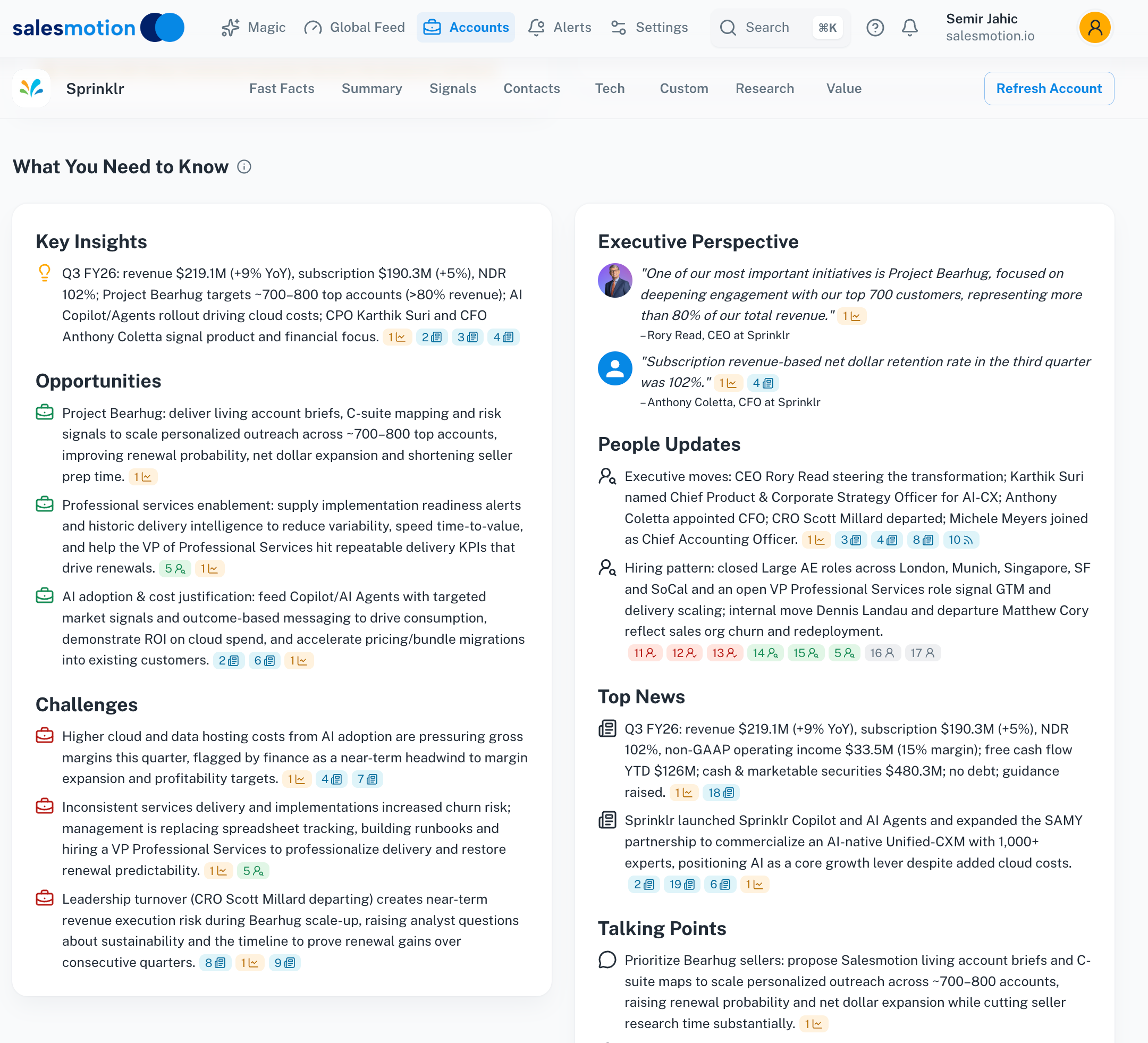 A pre-meeting account brief surfaces the executive's strategic priorities, recent company signals, and recommended talking points — so reps walk in prepared with hypotheses instead of generic questions.
Preparing for the Meeting You Booked
Earning the meeting is the first challenge. Making it productive enough to earn a second meeting is the real test.
Before the call: Map the buying committee. Identify who else should eventually be in the room. Research the executive's recent public statements, LinkedIn activity, and company news. Prepare three to five hypotheses about their priorities based on your research.
During the call: Spend the first two minutes on credibility-building rapport. Spend the next 10 minutes on problem alignment: confirm your hypotheses and discover what you missed. Spend the remaining time connecting their pain to a potential path forward without pitching a full solution.
Ending the call: Propose a specific next step that includes additional stakeholders. "Based on what we discussed, it would be valuable to include your VP of Sales and RevOps lead in the next conversation so we can map the full picture. How does Thursday at 2pm work?"
Key Takeaways
- Executives reply at 6.4% (higher than non-executives) and 57% prefer phone contact. Access is not the barrier. Approach is.
- One to two minutes of credibility-building rapport increases next-meeting rates by 3.8%. Skipping rapport drops rates by 8.3%.
- Ask fewer, better questions. Lead with context and hypotheses, not generic discovery prompts.
- Frame around cost of inaction, not ROI. Let executives calculate the value themselves using peer benchmarks.
- Use multi-channel sequences: email, phone, and LinkedIn together produce 22% higher response rates.
- Earn the second meeting by ending the first with a specific next step that expands the conversation to additional stakeholders.
Frequently Asked Questions
What is the best channel for reaching C-suite executives?
Phone is the most underutilized and effective channel. Research shows 57% of C-level buyers prefer phone contact, and 78% have taken a meeting from a cold call. However, multi-channel sequences outperform any single channel by 22%. The optimal approach combines email (for initial context), phone (for direct engagement), and LinkedIn (for social proof and relationship warming). Most successful executive outreach uses all three in a coordinated sequence rather than relying on one channel.
How many touchpoints does it take to book an executive meeting?
Plan for five to twelve touchpoints across multiple channels. Most deals require at least five touches before a prospect engages, yet 48% of reps stop after one follow-up attempt. For executives specifically, persistence with new value in each touchpoint is essential. Each follow-up should add context, not repeat the same ask. Share a relevant case study, reference new company news, or offer a specific insight. Following up with new information increases response rates by 50% or more compared to "just checking in" messages.
Should you go directly to executives or start with their team?
Start with the team in most cases. Build a champion who can provide internal context, validate your assumptions, and help position the executive meeting for success. Signal-based selling helps identify the right moment to move up to the executive level. Gong's data shows that win rates drop 6% when executives are the first touchpoint but rise 5% when introduced around the third touchpoint. The exception: if you have a warm introduction, a strong trigger event, or a previous relationship with the executive. In those cases, direct outreach is appropriate because you already have the context that would normally come from a champion.