Brendan Short coined the term "signal-based prospecting" in December 2023. Two years later, every sales tool claims to track "buying signals." But most are tracking data points -- website visits, content downloads, form fills -- and calling them signals. Real buying signals are compound events that indicate a company is likely to buy now, not just that someone at the company clicked something.
A website visit is not a buying signal. A new CRO getting hired at a target account that just posted 12 sales roles, expanded into your market, and mentioned your category in their earnings call? That convergence is what separates noise from opportunity. And that distinction is what most buying signals software gets wrong.
According to Cognism's research on signal-based selling, 75% of B2B sales engagements in 2025 originated from signal-based triggers. Signal-personalized emails achieve 18% response rates -- a 5.2x improvement over generic outreach. The teams winning right now aren't the ones with the most data. They're the ones who can distinguish a data point from a signal, and act on the difference.
TL;DR: Buying signals software monitors intent data, public events, and behavioral patterns to surface accounts showing genuine purchase intent. The best tools combine multiple signal types with context so reps know not just who to call, but why and when. This guide breaks down the signal landscape, compares platform categories, and explains why signal stacking -- not any single data source -- is the future of pipeline generation.
Best buying signal tools by signal type (2026):
| Signal Category | Best Tool | What It Detects | Starting Price |
|---|---|---|---|
| Account-level signals (50+ types) | Salesmotion | Earnings language, leadership changes, hiring, funding, M&A, strategic initiatives | $85/mo |
| Topic-level intent data | Bombora | Anonymous web browsing surges on 5,000+ B2B sites | Quote-only |
| Predictive buying stage | 6sense | AI-modeled awareness-to-purchase stage | Quote-only |
| Product evaluation intent | G2 | Profile visits, competitor comparisons, review reads | Mid-market |
| Job change signals | UserGems | Champion moves, buyer persona hires | $3,000/mo |
| First-party website signals | Clearbit Reveal | Anonymous website visitor identification | Included with HubSpot |
For a head-to-head comparison of these platforms by layer, pricing, and whether they act on signals or just report them, see our guide to the best signal-based selling tools.
What Buying Signals Software Actually Does
A buying signals tool watches for events and behaviors that indicate a company is moving toward a purchase decision. That includes everything from anonymous web research tracked across publisher networks to public events like leadership changes, earnings reports, and hiring surges.
The core job is simple: tell sales reps which accounts deserve attention right now, and give them enough context to have a relevant conversation.
But here's where most tools fall short. They'll tell you that Company X is showing "high intent" on a topic. They won't tell you why that matters for your specific value proposition, who inside the account is driving the initiative, or what angle to lead with. As Demandbase has noted, "Treating all signals the same -- e.g., a website visit carrying the same weight as a surge in third-party intent data -- is a big mistake." The answer, they argue, is "signal stacking."
According to Salesforce research, reps spend only 28% of their week actually selling. The rest goes to research, admin, and figuring out which accounts to prioritize. A good buying signals platform compresses that research time and puts reps in front of the right people faster.
That gap between raw signal and actionable intelligence is where deals are won or lost. And it's why Landbase draws a critical distinction: "Intent signals don't drive revenue -- activated signals do." Intent data identifies accounts in active evaluation. Signal-based selling identifies accounts entering that mode. The tools that help you detect the latter are the ones worth paying for.

“The account and contact signals are key for reaching out at important times, and the value-add messaging it creates unique to every contact helps save time and efficiency.”
Daniel Pitman
Mid-Market Account Executive, Black Swan Data
The Three Categories of B2B Buying Signals
Not all signals carry the same weight. Understanding the hierarchy helps you evaluate which buying signals software actually matters for your workflow.
1. Intent Data Signals
Intent data tracks anonymous research behavior across the web. When someone at a target account reads articles about "CRM migration" or "sales intelligence tools" on third-party publisher sites, intent data providers capture that activity and score it against the account's historical baseline.
The biggest player here is Bombora, whose Data Co-op aggregates content consumption across 5,000+ B2B publisher websites. 6sense combines Bombora's data with additional sources and layers on predictive AI to estimate buying stages. G2 Buyer Intent captures first-party signals from buyers actively comparing products on G2's review platform.
Intent data is powerful but has a fundamental limitation: it tells you what a company is researching, not why. A spike in "sales intelligence" research could mean they're evaluating new tools, writing a blog post, or doing competitive analysis for an existing vendor. As Short puts it: "Generic signals are getting commoditized. Niche signals are the new alpha." Everyone can track funding rounds -- few can extract strategic intent from earnings call commentary.
2. Behavioral and First-Party Signals
These are actions prospects take on your properties: website visits, pricing page views, content downloads, demo requests, email opens. Every B2B marketing stack captures some version of this data.
Website visitor identification tools like Warmly, Clearbit Reveal (now part of HubSpot's Breeze Intelligence), and RB2B de-anonymize website traffic at the company or individual level. Match rates vary widely, typically ranging from 5-20% for probabilistic tools to 30-40% for deterministic matching.
First-party signals are high-fidelity because the prospect is engaging directly with your brand. The challenge is volume. You're only seeing signals from accounts that already know you exist.
3. Public and Account-Level Signals
This is the category most B2B teams underestimate. Public signals include:
- Leadership changes: A new CRO or VP of Sales often brings new tool mandates and budget. UserGems research shows that new buyers spend 70% of their budget in the first 100 days, and reaching out based on new-hire signals produces 2.5x higher conversion rates.
- Earnings calls and financial reports: When a public company announces a strategic initiative, expansion into new markets, or cost-cutting measures, those are direct indicators of where budget is flowing.
- Hiring patterns: A company posting 15 SDR roles is scaling its outbound motion. That's a buying signal for sales tools, training, and enablement platforms.
- M&A activity: Acquisitions trigger tech stack consolidation, vendor reviews, and new budget allocation.
- News and press releases: Product launches, partnerships, and regulatory changes all create windows of relevance.
Public signals are undervalued because they're hard to aggregate and harder to make actionable. Monitoring 1,000+ sources manually isn't realistic. The platforms that solve this problem scan earnings calls, news, job postings, SEC filings, and LinkedIn activity across your entire book of business, then surface the signals that matter with AI-generated context and recommended angles of approach.
Salesmotion's Take
The term "buying signals" has been co-opted by every vendor with a product to sell. But there's a critical distinction most miss: a website visit is not a buying signal -- it's a data point. A real buying signal is when a new CRO is hired at a target account that just posted 12 sales roles, expanded into your market, and mentioned your category on their earnings call. That convergence is what separates noise from opportunity.

Semir Jahic
CEO & Co-Founder, Salesmotion
See Salesmotion on a real account
Book a 15-minute demo and see how your team saves hours on account research.
The Signal Landscape: Who Does What
The buying signals market has fragmented into distinct categories. Here's how to think about the landscape.
Intent Data Platforms
| Platform | Signal Source | Best For | What It Costs |
|---|---|---|---|
| Bombora | 5,000+ publisher co-op | Topic-level intent at scale | Not published; annual subscription quoted per organization |
| 6sense | Multi-source + predictive AI | Enterprise ABM with buying stage prediction | Not published; Vendr median $62,440/yr |
| G2 Buyer Intent | First-party G2 reviews/comparisons | SaaS companies tracking category buyers | Included with G2 seller plans |
| Demandbase | Multi-source + advertising | ABM programs combining intent with ad targeting | Not published; Vendr median $68,591/yr |
| TechTarget | Priority Engine publisher data | Tech buyers researching specific solutions | Varies by segment |
For a detailed breakdown of intent data vendors, see our guide to intent data providers.
Account Intelligence Platforms
These platforms go beyond raw intent data to provide contextual intelligence.
Salesmotion monitors 1,000+ public sources to detect leadership changes, earnings signals, hiring patterns, and news events, then generates AI-powered account briefs, talking points, and outreach angles. It's built for reps who need to know why to reach out, not just that they should.
UserGems specializes in job-change signals and relationship tracking. When a champion leaves a customer account for a new company, UserGems flags the opportunity. UserGems reports a median pipeline ROI of 47x for customers running champion-tracking plays.
CRM-Embedded Signal Tools
ZoomInfo pairs its massive contact database with intent signals. It publishes no dollar figures — its own pricing page explains that amounts are not listed because pricing is consumption-based — and Vendr's marketplace data shows an average contract value of $33,500 across 1,012 anonymized deals. Apollo offers a more accessible entry point at $49/user/month on annual billing, though its intent capabilities are more basic.
Both embed directly into CRM workflows, making them natural fits for teams that want signals alongside contact data in a single platform.
Website Visitor Identification
Warmly, Clearbit Reveal, and RB2B de-anonymize website visitors. These tools answer: "Who is on our site right now?" Warmly adds real-time chat and orchestration capabilities. RB2B focuses on individual-level identification with Slack notifications. Match rates and geographic coverage vary, so test before you commit.
What Makes a Signal Actionable
Here's the uncomfortable truth: most buying signals are noise. A Forrester study found that 69% of B2B buyers only engage with a salesperson after they've already made their decision. That means the window for signals to drive meaningful outreach is narrow, and timing is everything.
Four criteria separate actionable signals from background noise:
Timing. A signal that's 48 hours old is infinitely more valuable than one that's two weeks old. If a new VP of Revenue starts next Monday, the rep who reaches out that week has a conversation. The rep who reaches out next month has a cold call. According to Boomerang's research, first-mover vendors contacting funded firms within 48 hours see 400% higher conversion rates. 71% of funded companies finalize vendors within 90 days. Signal latency is one of the most underrated evaluation criteria for buying signals software.
Context. "Company X is showing high intent on sales tools" is a data point. "Company X's new CRO, previously at [customer], just posted three SDR roles, and their Q3 earnings call mentioned doubling outbound capacity" is a story. Context is what turns a signal into a conversation starter.
Relevance. Not every signal matters for every deal. A hiring surge in engineering means something different to a DevOps vendor than to a sales intelligence platform. The best tools let you filter and weight signals based on your ICP and value proposition.
Signal stacking. Individual signals are weak. A company visiting your pricing page once could be a competitor. That same company visiting your pricing page after their CRO changed, they posted five new sales roles, and their CEO mentioned "sales efficiency" on an earnings call? That's a buying committee mobilizing. Research from Cognism confirms that stacking multiple signals is the key to high-conversion outbound. RevGenius and Common Room's Signal School formalized this into a three-part framework: select signals, run signal plays, then stack signals for compound effect.
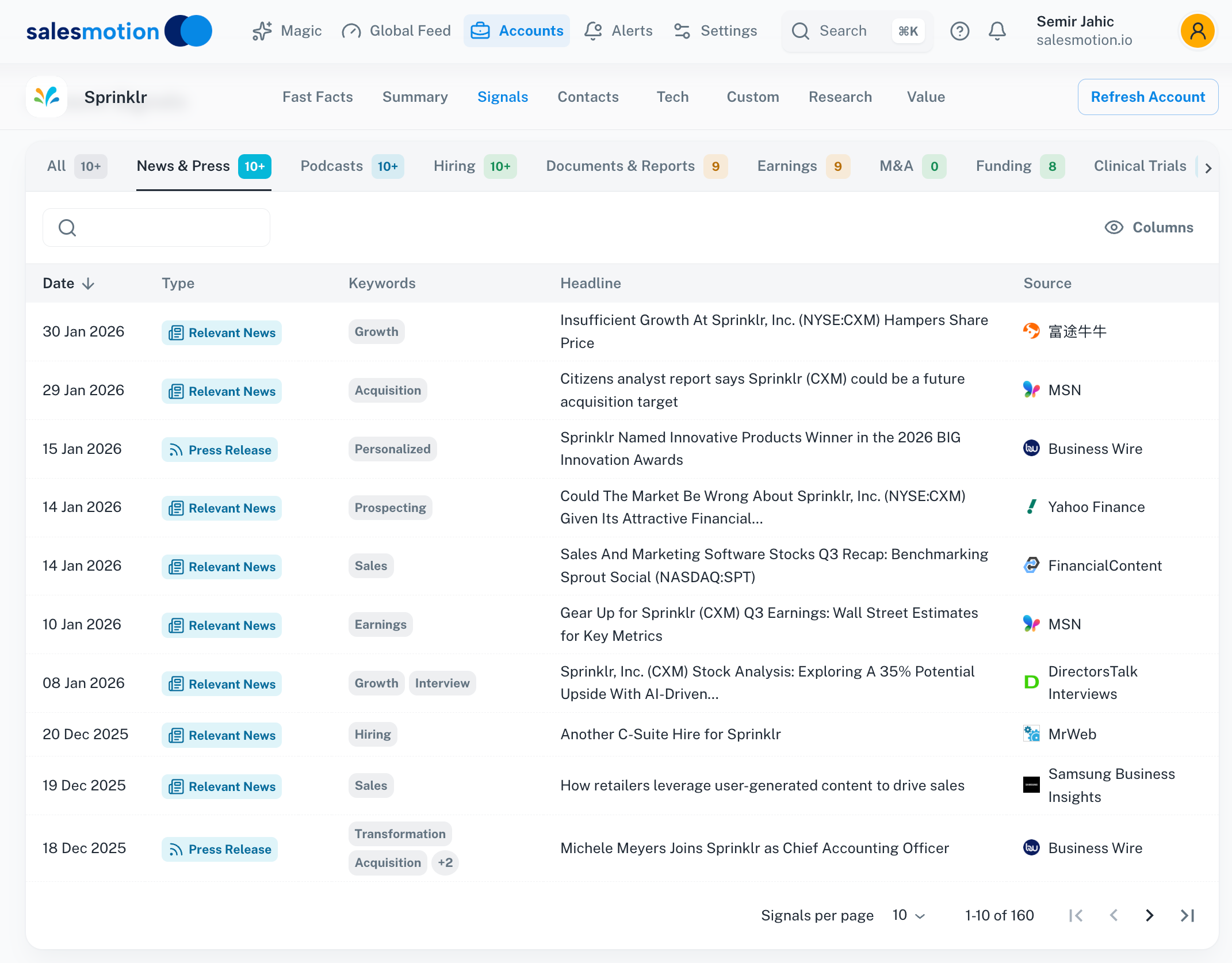 When multiple signals fire on the same account, an account intelligence platform stacks them with AI-generated context so reps can see the full picture.

“We're saving about 6 hours per week per seller on account research alone. That's time they can reinvest in actually selling.”
Derek Rosen
Director, Strategic Accounts, Guild Education
The Crawl-Walk-Run Framework for Signal-Based Selling
RevGenius Signal School, built in partnership with Common Room, offers a practical maturity model for teams adopting buying signals software. Their core thesis: "Signals are the unlock to efficient pipe generation -- detecting signals to know when people or accounts are in market, and using the context of the signal to convert."
Crawl: Select your signals. Start by identifying which signals matter most for your ICP. Not every signal is relevant. A company selling to healthcare isn't going to get value from tracking cryptocurrency funding rounds. Choose 2-3 signal types that directly correlate with your best past deals.
Walk: Run signal plays. Build repeatable plays around each signal type. When Signal X fires, Rep Y takes Action Z within 48 hours. Document the plays, measure conversion rates, and iterate. This is where most teams get stuck -- they have signals but no playbook for acting on them.
Run: Stack signals for compound effect. The highest-performing teams don't respond to individual signals. They wait for signal convergence -- multiple signals firing on the same account within a compressed timeframe. That convergence is what separates a timely, specific reason to call from a generic one.
For a deeper look at building these plays, read our signal-based selling playbook.
Building a Signal-Driven Sales Workflow
Theory is cheap. Here's what a signal-driven workflow looks like end to end, using a real scenario.
Step 1: Signal fires. Your account intelligence platform detects that Sprinklr's latest earnings call mentions a "major investment in enterprise sales capacity." The same week, three new VP-level sales roles appear on LinkedIn.
Step 2: Platform surfaces context. The account brief auto-updates with the earnings transcript highlights, links to the relevant SEC filing, the new hires' backgrounds, and AI-generated talking points connecting these events to your solution's value.
Step 3: Rep reviews and acts. Your enterprise AE opens the account in their morning workflow. Instead of spending 45 minutes researching Sprinklr across five tabs, everything is consolidated: the signals, the context, the contacts, and a recommended angle. Total prep time: under 5 minutes.
Step 4: Outreach lands. The rep sends a message referencing the specific earnings call quote about scaling enterprise sales, acknowledges the new VP hire, and positions the solution against that exact initiative. This isn't a generic "I saw you might be interested" email. It's evidence-based outreach that demonstrates you understand their business.
Step 5: Meeting booked. Signal-personalized emails achieve 18% response rates versus 3.4% for cold outreach. And that pipeline converts at higher rates because the timing and relevance were right from the start.
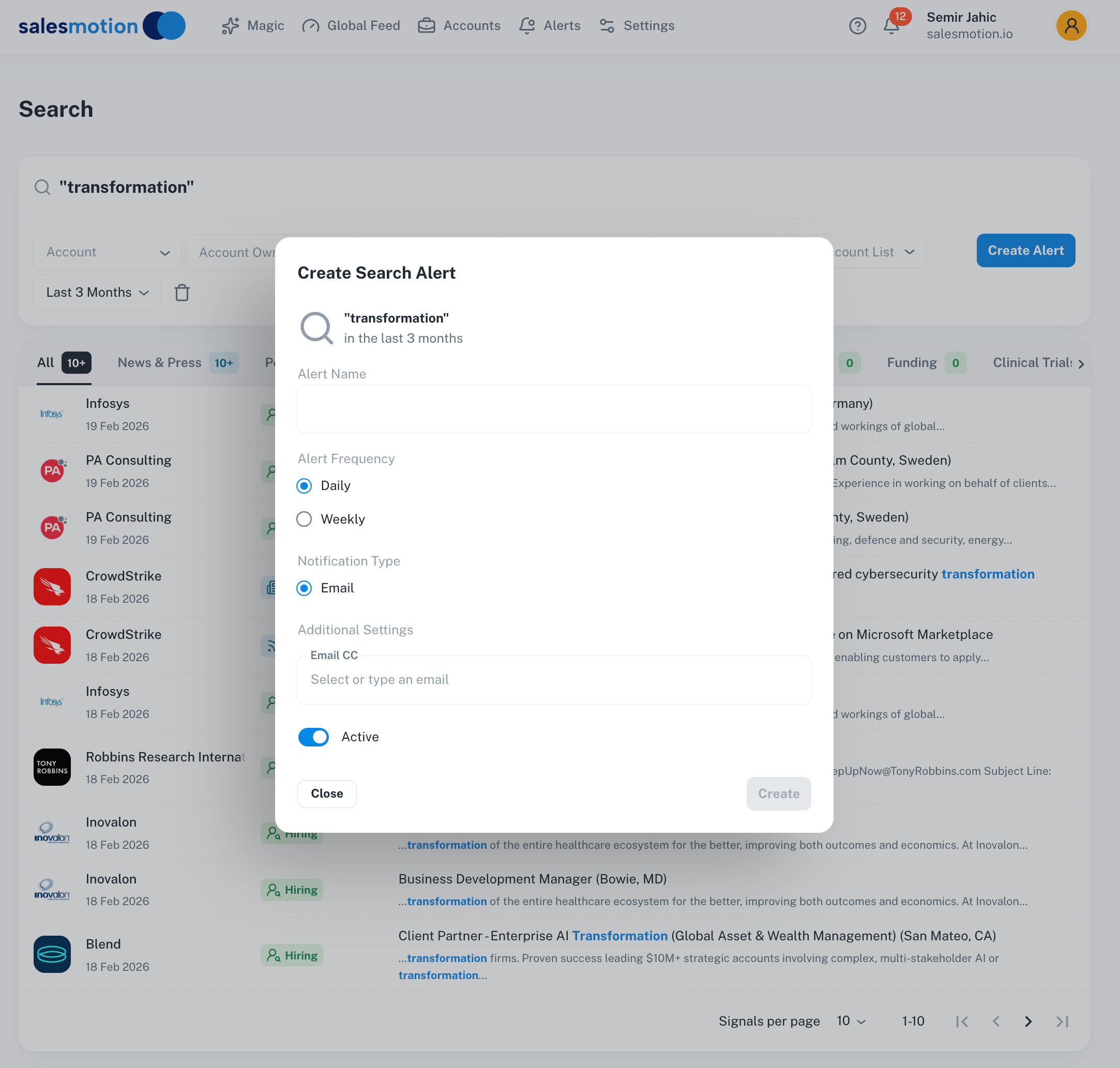 Setting up keyword-based alerts ensures reps are notified the moment a relevant signal fires across their territory, rather than manually checking dashboards.
Buying Signals Software Comparison: Top Platforms at a Glance
| Platform | Signal Types | AI Analysis | CRM Integration | Starting Price | Best For |
|---|---|---|---|---|---|
| Salesmotion | Earnings calls, SEC filings, leadership changes, hiring, news, funding, 1,000+ sources | AI account briefs, talking points, outreach drafts | Salesforce, HubSpot native | $85/mo (individual), custom pricing (team, unlimited users) | Enterprise sales teams needing deep account intelligence and signal-based outreach |
| Bombora | Anonymous web research across 5,000+ publisher co-op | Topic surge scoring | Via integrations | Quote-only | Large enterprises needing raw intent data feeds |
| 6sense | Multi-source intent + web + advertising | Predictive buying stage scoring | Salesforce, HubSpot, Marketo | Quote-only (Vendr median $62,440/yr) | Enterprise ABM teams with large budgets |
| ZoomInfo | Intent, contacts, technographics | Basic scoring and alerts | Salesforce, HubSpot, Outreach | Quote-only, consumption-based (Vendr average $33,500) | Teams that need contact data + intent signals in one platform |
| Apollo | Basic intent, job changes, funding events | AI email suggestions | Built-in engagement platform | $49/user/mo | SMB/mid-market teams wanting affordable all-in-one |
| Clay | Custom (via 150+ data providers) | Claygent AI research agent | Salesforce, HubSpot via API | Free; Launch $185/mo (credit-based) | RevOps teams building custom enrichment workflows |
| UserGems | Job changes, relationship tracking | Champion tracking, timing optimization | Salesforce, HubSpot native | Core $3,000/mo ($36k/yr) | Teams focused on past-customer and champion-change signals |
| Demandbase | Multi-source intent + advertising | Account scoring, buying groups | Salesforce, HubSpot, Marketo | Quote-only (Vendr median $68,591/yr) | Enterprise ABM programs combining intent with advertising |
For teams evaluating Salesmotion specifically: it is the only platform in this comparison that extracts management intent from earnings calls and executive commentary — signals that indicate strategic direction, not just anonymous web browsing. See our detailed comparison with ZoomInfo, 6sense, Clay, and Apollo.
Evaluating Buying Signals Software: What to Look For
When comparing tools, focus on these six dimensions:
Signal Coverage
How many signal types does the platform monitor? Pure intent data is one dimension. Public signals (earnings, hiring, news, leadership changes) are another. The platforms that combine both give reps the fullest picture. Ask: does this tool catch signals my team would miss entirely?
Signal Latency
How fast do signals reach your reps? Real-time matters. A platform that updates weekly is a reporting tool, not a selling tool. Ask for specifics: are signals surfaced within hours or days?
Noise Ratio
Every platform claims to surface "high-intent" accounts. The real question is: what's the false positive rate? If your reps get 50 "hot" accounts per day but only 5 are genuinely in-market, you've replaced one problem (no signals) with another (too many signals). Look for platforms that let you tune signal thresholds and filter by your ICP.
Context and Actionability
Raw signals aren't enough. Does the platform explain why the signal matters? Does it suggest who to contact and what to say? This is the difference between a data feed and a tool built for acting on buying signals. The fewer clicks between seeing a signal and sending outreach, the higher your team's follow-through rate.
Integration Depth
Signals that live in a standalone dashboard get ignored. The best tools push signals into Salesforce, HubSpot, Slack, or wherever your reps already work. Ask: does the integration create tasks, update records, or just send notifications?
ROI and Measurability
Can you trace pipeline and revenue back to specific signals? UserGems reports 47x median pipeline ROI across their customer base. Whatever platform you choose, make sure you can prove the math. If signal-driven pipeline doesn't convert at 2-3x the rate of cold outbound, either the signal quality is low or reps need better enablement on acting quickly.
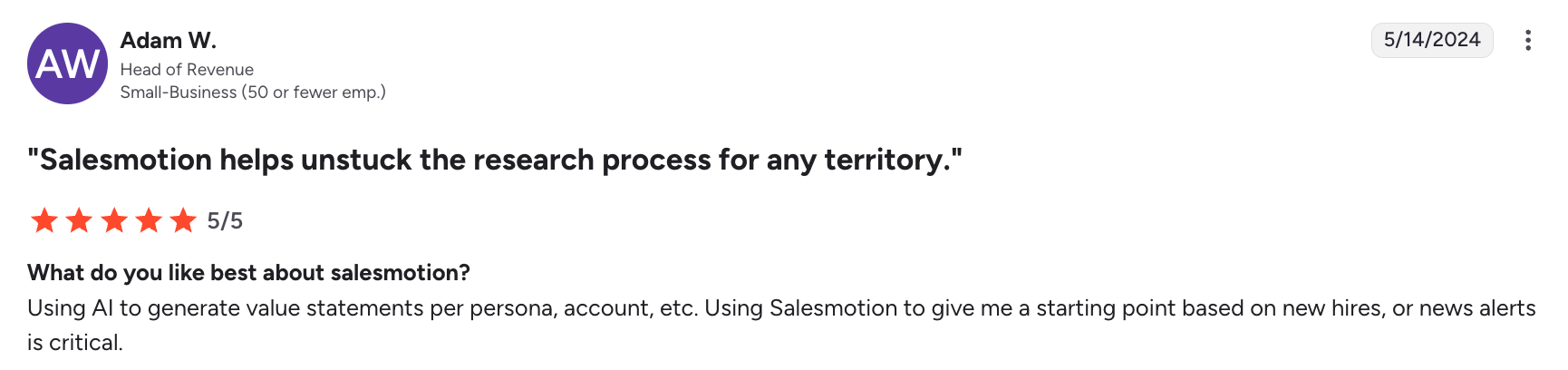 G2 review from a Head of Revenue describing how buying signals eliminated manual research time.
Key Takeaways
- Buying signals software monitors intent data, public events, and behavioral patterns to surface accounts with genuine purchase intent, replacing guesswork with evidence-based prioritization.
- Three signal categories matter: intent data (anonymous research behavior), first-party signals (engagement with your brand), and public signals (leadership changes, earnings, hiring, news). The best workflows stack all three.
- Context separates useful signals from noise. A "high intent" score without explanation is just a number. Look for platforms that tell reps why the signal matters and what to say.
- Speed determines value. Signal-personalized outreach hits 18% response rates versus 3.4% for generic messages, and first-movers within 48 hours see 4x higher conversion rates.
- Evaluate tools on coverage, latency, noise ratio, and integration depth. The best buying signals tool is one your reps actually use because it's embedded in their workflow and delivers clear ROI.
- Follow the crawl-walk-run model. Start with 2-3 high-value signal types, build repeatable plays around them, then stack signals for compound effect. See our guide on B2B buying triggers for the full taxonomy.
Frequently Asked Questions
What is the difference between buying signals and intent data?
Intent data is one type of buying signal. It specifically tracks anonymous web research behavior across publisher networks and review sites. Buying signals is the broader category that includes intent data plus public signals (leadership changes, earnings calls, hiring patterns, M&A activity), behavioral signals (website visits, content engagement), and first-party CRM data. The most effective buying signals strategies combine multiple signal types rather than relying on intent data alone.
How much does buying signals software cost?
It varies by category, and most of the enterprise vendors publish nothing. Bombora, 6sense, Demandbase and ZoomInfo all quote per organization. The closest public benchmarks come from Vendr's marketplace data: a $62,440 median annual contract for 6sense, $68,591 for Demandbase, and a $33,500 average for ZoomInfo. At the accessible end, prices are published: Apollo starts at $49/user/month on annual billing, Clay's Launch plan is $185/month, UserGems lists Core at $3,000/month, and Salesmotion starts at $85/month. Warmly publishes annual pricing from $10,000/year.
What is signal stacking and why does it matter?
Signal stacking means combining multiple buying signals on the same account to build a compound picture of purchase intent. A single signal -- like a website visit or a job posting -- is ambiguous on its own. But when a target account shows a new CRO hire, multiple SDR job postings, and earnings call mentions of your category within the same month, that convergence dramatically increases the probability they're in-market. Demandbase, Cognism, and the RevGenius Signal School all identify signal stacking as the key differentiator between teams that generate pipeline from signals and teams that drown in noise.
How do I measure ROI from buying signals software?
Track three metrics: signal-to-meeting conversion rate (what percentage of signal-driven outreach results in a booked meeting), pipeline sourced from signals (deals where the first touch was triggered by a signal), and time-to-first-meeting (how quickly reps convert new signals into conversations). Industry benchmarks suggest that signal-driven pipeline should convert at 2-3x the rate of cold outbound. If it doesn't, either your signal quality is low or your reps need better enablement on how to act on signals.
Can buying signals software replace my existing sales tools?
No. Buying signals software complements your CRM, sales engagement platform, and contact databases. It answers the "who and when" question that those tools can't. Your CRM tracks relationships. Your engagement platform runs sequences. Your contact database provides emails and phone numbers. Buying signals software tells your team which accounts from that database deserve attention right now and gives them the context to have a relevant conversation. The best implementations feed signals directly into existing workflows rather than creating a new tool reps need to check.
What is the best tool to track buying signals and management intent for outbound sales teams?
For outbound teams that need both buying signals and management intent (executive commentary, earnings call insights, strategic initiative tracking), Salesmotion is purpose-built for this use case. It monitors 1,000+ public sources including earnings calls, SEC filings, leadership changes, and hiring patterns, then generates AI-powered account briefs and signal-anchored outreach. For teams focused primarily on anonymous web intent data, Bombora and 6sense are the established leaders. For teams that want contact data alongside basic intent signals, ZoomInfo combines both. The best approach is often a combination: an intent data provider for research-behavior signals plus an account intelligence platform like Salesmotion for public and management intent signals.
How can I automate sales research for 500+ accounts without missing buying signals?
Manually researching 500+ accounts is not feasible — most reps can only deeply research 15-20 accounts per quarter. The solution is an always-on monitoring platform that continuously scans your entire book of business for buying signals. Salesmotion's Signal Agent monitors 1,000+ sources 24/7 across all your accounts, while the Research Agent compiles detected signals into cited account briefs. Customer Guild Education reported saving 6+ hours per AE per week on research after deploying this approach. For a step-by-step guide, see our post on account research at scale.