Every public company CEO stands in front of investors four times a year and tells the world exactly what keeps them up at night. They announce strategic priorities, flag competitive threats, reveal budget shifts, and outline where the business is headed. These statements are recorded, transcribed, and freely available within hours.
And yet, most sales reps never read them.
The ones who do have discovered something remarkable: when you open a cold email by quoting a prospect's own CEO, the response rate changes dramatically. Not because you are flattering anyone. Because you are demonstrating a level of preparation that fewer than 5% of sellers match. Prospects frequently have no idea what their own CEO said on the last earnings call. When you surface that context, you instantly shift from "another cold email" to "someone who understands our business."
TL;DR: CEO earnings call quotes are one of the most underused prospecting tools in B2B sales. Public company CEOs reveal strategic priorities, pain points, and budget shifts every quarter. Reps who reference these statements in outreach see 2-3x higher response rates because the specificity signals genuine research. This post walks through the complete workflow: finding the right quote, connecting it to your solution, drafting the email, and following up.
Why Are Earnings Call Quotes So Effective for Prospecting?
Earnings calls are the single richest source of executive intent data that nobody in sales is using. Every quarter, approximately 40,000 earnings call transcripts are published globally, covering every major public company. Each one contains 45-90 minutes of a CEO telling analysts exactly what the company is prioritizing.
Here is what makes these transcripts uniquely valuable for prospecting:
The CEO is speaking under legal obligation. Earnings calls are SEC-regulated events. CEOs cannot exaggerate, speculate wildly, or hide material information. When a CEO says "we are investing $50 million in digital transformation this year," that is a legally binding public statement. It carries weight that a LinkedIn post or press release does not.
The content reveals real priorities, not marketing spin. Press releases are written by PR teams to control narrative. Earnings calls include a Q&A section where analysts push CEOs on specifics. The answers reveal genuine strategic direction: which initiatives are getting funded, which are getting cut, and where the company sees its biggest risks and opportunities.
Almost nobody on the prospect's buying committee has read the transcript. This is the pattern that surprises sellers the most. VPs, directors, and even SVPs at public companies frequently have not read their own CEO's latest earnings call comments. When you reference a specific CEO quote in your outreach, the prospect's first reaction is often curiosity: "Where did you find that?" That curiosity opens conversations that generic personalization never could.
According to LinkedIn's Global State of Sales, 82% of top-performing sales reps say they "always" perform research before reaching out. But Instantly's 2026 Cold Email Benchmark shows that signal-personalized outreach achieves 18% response rates, 5.2x the average. The gap between "I looked at their LinkedIn" and "I read their CEO's earnings commentary" is the gap between average and exceptional.
How Do You Find the Right CEO Earnings Quote?
Finding a usable earnings call quote takes less time than most reps think. Here is the tactical workflow, from zero to a ready-to-use quote, in under 15 minutes.
Step 1: Locate the transcript
Start with the company's investor relations page (usually at [company].com/investors or [company].com/ir). Most companies post full transcripts within 24-48 hours of the call. If the transcript is not on the company site, check these free sources:
- The Motley Fool (fool.com/earnings-call-transcripts) publishes transcripts for thousands of public companies
- Seeking Alpha offers transcripts with a free account
- Investing.com (investing.com/news/transcripts) maintains a searchable transcript archive
For the freshest intelligence, focus on the most recent quarter. But do not ignore the prior quarter. Comparing two consecutive calls reveals what is accelerating, what has stalled, and what new priorities have emerged.
Step 2: Scan the prepared remarks for strategic language
Skip the financial results section (the CFO's portion). Focus on the CEO's prepared remarks, typically the first 10-15 minutes. Look for phrases that signal a strategic initiative your solution could support:
- "We are investing in..." or "We are accelerating..."
- "Our biggest priority this year is..."
- "We see significant opportunity in..."
- "One area where we need to improve is..."
- "We are transforming how we..." or "We are modernizing our..."
Highlight two to three statements that connect to a problem your product solves. You do not need a perfect match. You need a plausible bridge between their stated priority and your value proposition.
Step 3: Mine the Q&A for candid admissions
The Q&A section is gold. Analysts push CEOs past prepared talking points. Look for:
- Analyst challenges that the CEO acknowledges: "You are right, that is an area where we have more work to do." These admissions reveal pain points the CEO cannot hide.
- Forward-looking commitments: "By Q3, we expect to have..." These give you a timeline to reference in your outreach.
- Competitive mentions: When a CEO names a competitor or a market shift, it signals where internal attention is focused.
Step 4: Verify the quote is current and relevant
Before using a quote, confirm it has not been superseded by a more recent call or press release. A quote from two quarters ago about "expanding into EMEA" loses impact if the company already announced its London office. Check the company newsroom and the most recent 10-Q filing for any updates.
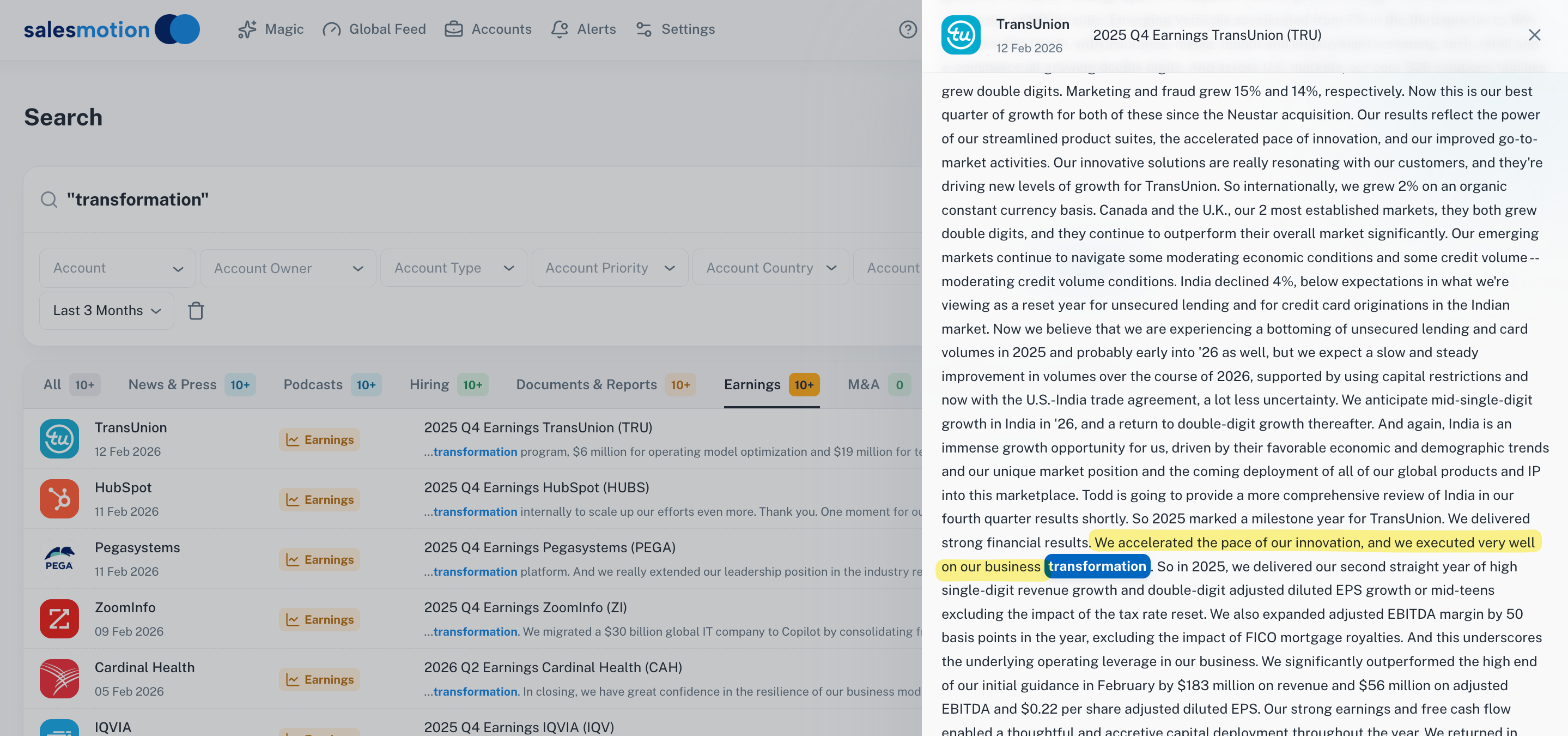 Search across earnings calls to find the exact CEO quote you need. No more reading full transcripts or scanning investor relations pages.

“My ultimate goal is to know more about the company than they know themselves. Before, that took hours across multiple tools. With Salesmotion, I can get there in 30 minutes or less and walk into a Fortune 500 conversation fully prepared.”
Jeff Dalo
Senior Director Business Development, Analytic Partners
Connecting the Quote to Your Solution
Having a great CEO quote is only half the work. The connection between the quote and your outreach must feel natural, not forced. Here is how to build that bridge.
Map the quote to a specific pain point your product addresses. If the CEO says "We are focused on improving sales productivity across the enterprise," and you sell sales enablement software, the connection is direct. If the CEO says "Our customer acquisition costs are increasing and we need to find more efficient channels," and you sell marketing automation, the connection is still clear but requires one more sentence to bridge.
Avoid stretching the connection too far. If you have to write three sentences explaining why the CEO's statement relates to your product, the fit is not strong enough. Pick a different quote or a different account. Forced connections feel manipulative and will hurt you more than a generic email would.
Identify the person on the buying committee most affected by the initiative. The CEO sets the priority, but someone else owns the execution. If the CEO says "We are investing heavily in data infrastructure," your outreach should go to the VP of Data Engineering or the CTO, not the CEO. Reference the CEO's statement as context, then speak to the recipient's specific role in delivering on that priority.
Here is how this looks in practice:
Before (generic cold email):
Subject: Quick question about [Company] sales team
Hi Sarah,
I help companies like yours improve sales productivity. We work with several enterprise SaaS companies and have helped them increase pipeline by 30%.
Would you be open to a 15-minute call next week?
After (earnings-informed cold email):
Subject: [CEO Name]'s Q4 comments on sales efficiency
Hi Sarah,
On [Company]'s Q4 call, [CEO Name] said the team is "focused on driving more revenue per rep without adding headcount." That usually means the pressure is landing on your team to find productivity gains.
We helped [similar company] increase meetings booked per rep by 40% by eliminating manual account research. Happy to share what worked in a 10-minute call.
The second email works for three reasons. It shows you did real research. It connects the CEO's public priority to Sarah's day-to-day reality. And it offers a specific, relevant outcome instead of a vague benefit.
Building a Repeatable Earnings Call Outreach System
One good earnings email is a nice trick. A repeatable system is a competitive advantage. Here is how to scale this approach across your entire book of accounts.
Batch your research by earnings season
Public companies cluster their earnings calls in specific windows: late January through mid-February (Q4 results), late April through mid-May (Q1), late July through mid-August (Q2), and late October through mid-November (Q3). Block two to three hours during each window to review transcripts for your top accounts. Research shows that 82% of top performers always research before outreach, and batching that research around earnings season makes it sustainable.
Create an earnings intelligence brief for each target account
For each account, capture:
- Two to three CEO quotes with the exact wording and the date of the call
- The strategic initiative each quote connects to
- The likely internal owner of that initiative (your outreach target)
- Your solution bridge in one sentence
This brief takes 10-15 minutes per account and gives you enough material for a full quarter of personalized outreach. Compare it to the 2-3 hours most reps spend on manual account research using five or more disconnected tools.
Layer in additional signals for multi-touch sequences
An earnings call quote is your opening move. For follow-up touches, layer in:
- Leadership changes announced after the earnings call ("I noticed [Company] just hired a new VP of Revenue Operations, which aligns with what [CEO] said about...")
- Hiring patterns that confirm the initiative is real (10 open data engineering roles after the CEO said "data infrastructure is our top priority")
- News mentions or analyst reports that expand on the earnings theme
This multi-signal approach is exactly how AI-powered research tools compress hours of manual work into minutes. Instead of spending an afternoon building an account brief from scratch, you can pull earnings commentary, leadership signals, and hiring patterns from a single platform and build your outreach sequence in a fraction of the time.
Time your outreach to the earnings calendar
The best window to send earnings-referenced outreach is 1-3 weeks after the call. The information is still fresh, but enough time has passed for internal discussions about the CEO's stated priorities to filter down through the organization. This is when your prospect is most likely thinking about how to execute on what the CEO announced, making your timing feel intentional rather than coincidental.
See Salesmotion on a real account
Book a 15-minute demo and see how your team saves hours on account research.
Common Mistakes and How to Avoid Them
Earnings call outreach is powerful, but it comes with specific pitfalls.
Quoting earnings from more than two quarters ago. Stale quotes make you look like you Googled the company five minutes before hitting send. Always use the most recent quarter available. If the last call was more than six months ago, lead with a different signal.
Leading with the quote instead of the implication. "Your CEO said X" is not an email opener. "Your CEO told analysts the company is prioritizing X, which usually means your team is dealing with Y" is. The quote provides credibility. The implication creates relevance.
Using earnings quotes for private companies. This only works for public companies with published transcripts. For private companies, use alternative intelligence sources like funding announcements, press releases, podcast appearances, and conference keynotes. The principle is the same: reference something the leadership team said publicly, then connect it to your value proposition.
Over-quoting or sounding like an analyst. You are a sales professional, not a stock picker. One quote per email is enough. Two at most. If your email reads like an investment memo, you have gone too far.
Sending the same quote to everyone at the company. If the CFO, VP of Sales, and Head of Engineering all receive the same earnings-call email with the same CEO quote, you look automated. Tailor the quote and the connection to each recipient's function. The CEO may have said five things on the call, and each statement is relevant to a different buyer.
Key Takeaways
- CEO earnings call transcripts are freely available and contain legally verified strategic priorities, pain points, and budget commitments that most prospects have not even read themselves.
- Referencing a specific CEO quote in outreach demonstrates research depth that separates you from 95% of cold emails and consistently drives 2-3x higher response rates.
- The tactical workflow (find transcript, scan CEO remarks, mine Q&A, connect to your solution) takes 10-15 minutes per account and yields a full quarter of relevant outreach material.
- Batch your earnings research around the four quarterly windows (January, April, July, October) and create intelligence briefs that pair CEO quotes with internal initiative owners.
- Avoid stale quotes, forced connections, and over-quoting. One specific, recent, relevant CEO statement connected to the prospect's role is worth more than five generic data points.
Frequently Asked Questions
Where can I find earnings call transcripts for free?
Most public companies publish transcripts on their investor relations page within 24-48 hours of the call. Free aggregators include The Motley Fool (fool.com/earnings-call-transcripts), Seeking Alpha (free account required), and Investing.com. For AI-summarized earnings intelligence that highlights the sales-relevant themes automatically, tools like Salesmotion surface CEO quotes alongside other account signals so you can skip the manual reading.
Does this strategy work for private companies?
Earnings call outreach specifically works for public companies since private companies do not hold regulated earnings calls. However, the underlying principle applies universally. Private company executives make public statements through podcast interviews, conference keynotes, press releases, and media appearances. The same framework works: find the executive statement, connect it to your solution, and reference it in your outreach.
How often should I refresh my earnings call research?
Refresh every quarter, ideally within one to three weeks of each earnings call. Public companies report quarterly, so your intelligence has a natural 90-day shelf life. Set calendar reminders for your top 20 accounts' earnings dates (available on any financial calendar site). Between earnings calls, supplement with news alerts and leadership change monitoring to keep your account intelligence current.
Can I use this approach for mid-funnel deals, not just cold outreach?
Absolutely. Earnings call quotes are even more powerful in active deals. Reference the CEO's stated priorities when building business cases, preparing for QBRs, or navigating procurement. Telling a champion "your CEO told Wall Street this initiative is a top-three priority" gives them internal ammunition to push the deal forward. It shows you understand the company's strategic context, not just the features you are trying to sell.