Cold email reply rates have halved since 2019, dropping from 8.5% to roughly 4%, according to Martal Group. The inbox is now a warzone of AI-generated noise. Salesforce's State of Sales 2026 found that 87% of sales organizations use some form of AI, which means your prospects are getting pelted with machine-written outreach from every direction.
And yet, signal-personalized emails still achieve 18% response rates, 5.2x the average, according to Instantly's Cold Email Benchmark 2026. The gap between the best and worst outreach has never been wider.
The difference is not AI versus human. It is relevant versus irrelevant. And relevance, at scale, comes from knowing what matters to your prospect right now, not what mattered six months ago when someone last updated their CRM notes.
TL;DR: Personalized outreach at scale requires signal-based context, not manual research or AI-generated fluff. The reps winning today stack three layers of personalization (individual, company, industry), anchor messages to real-time events, and write emails under 50 words. This post walks through the frameworks, anti-patterns, and a full end-to-end example.
Why Generic Outreach Is Dying
The volume play is over. Not declining. Over.
John Barrows put it bluntly on the OneShot.ai podcast: "We've turned SDRs into robots. Now they're being replaced by robots." The irony is painful. Sales leaders spent a decade training reps to follow rigid sequences with templated messaging. They optimized for activity metrics. Now AI can do the same thing faster and cheaper, and buyers can't tell the difference between a human-sent template and a machine-sent one.
The buyer backlash is measurable. Sopro found that 73% of B2B buyers actively avoid suppliers who send irrelevant outreach. Not ignore. Avoid. They mentally blacklist you. A separate Sopro study on AI in sales revealed that 57% of decision-makers say most outreach they receive feels impersonal.
Meanwhile, Gartner reports that 61% of B2B buyers now prefer a rep-free buying experience altogether. They would rather figure it out on their own than sit through another generic pitch. That is the legacy of years of mass outreach: buyers have been trained to distrust sellers.
The math tells the story. Instantly found that small, targeted campaigns of 50 recipients or fewer achieve 5.8% reply rates compared to 2.1% for large lists. Smaller is not just better. It is nearly three times better.
The lesson is straightforward: every email you send to the wrong person at the wrong time with the wrong message actively damages your ability to reach the right people later.

“Salesmotion empowers me to cultivate a great buyer experience. I'm able to challenge prospects' thinking and be a trusted consultative seller. A major part of this is Salesmotion insights.”
Austin Friesen
Account Executive, FY25 #1 President's Club, Clari
The SMYKM Principle: Show Me You Know Me
Sam McKenna's "Show Me You Know Me" framework, documented by ContentGrip, delivers a 43% open rate and 20% reply rate. That is 13x the average cold email reply rate.
The core principle is disarmingly simple: before you ask for anything, demonstrate that you've done your homework. Not with a flattery opener like "loved your LinkedIn post about leadership." With a specific, relevant observation that proves you understand the prospect's world.
McKenna's framework rests on three pillars:
1. Lead With Their Priority, Not Your Product
The first line of your email should reference something the prospect cares about, not something you sell. A recent strategic initiative. A public statement they made. A market shift affecting their industry. The reader should think "this person understands my situation" before they even know what you're offering.
2. Connect the Dots They Haven't Connected
Any rep can read a press release and reference it. The best reps connect a trigger event to a business implication the prospect may not have fully considered. That is the difference between "I saw you raised a Series C" (surface-level) and "Your Series C announcement mentioned expanding into EMEA. Most teams scaling internationally hit a wall when their sales team can't research accounts in unfamiliar markets fast enough" (insight-level).
3. Make the Ask Small and Specific
Don't request 30 minutes. Don't offer a demo. Ask a single question related to the observation you just made. "Is international expansion the priority for Q2, or is there something else driving hiring right now?" That kind of question proves curiosity, not quota pressure.
The challenge with SMYKM has always been scale. Doing this level of research for every prospect manually takes 30 to 60 minutes per account. That is fine for your top 10 dream accounts. It collapses at 200.
This is where signal-based selling changes the equation. Instead of researching from scratch, you start with a real-time event that tells you exactly what to reference. The research is half-done before you open the email.
See Salesmotion on a real account
Book a 15-minute demo and see how your team saves hours on account research.
Three Layers of Personalization That Actually Scale
Most teams think personalization is binary: either you send a generic template or you write a custom email from scratch. The reality is more nuanced. Effective personalization has three layers, and you don't need all three for every email. You need the right combination for the specific context.
Layer 1: Individual Personalization
This is the prospect as a person. Their role, their stated priorities, their career trajectory, their public statements.
Examples of strong individual hooks:
- A LinkedIn post where they shared a specific challenge
- A podcast appearance where they discussed their team's strategy
- A job change that signals new priorities in the first 90 days
- A conference talk or published article on a topic you can address
Individual personalization is the most powerful layer but the hardest to scale. Use it for decision-makers and high-value accounts. Skip it for initial outreach to mid-level contacts where company-level context is sufficient.
Layer 2: Company Personalization
This is the prospect's organization. What is happening at the company level that creates urgency or relevance for your solution?
Strong company-level signals include:
- Earnings calls mentioning specific strategic initiatives (e.g., "We're investing in go-to-market efficiency")
- Leadership changes in relevant departments
- Funding rounds or M&A activity
- New product launches or market expansions
- Job postings that reveal internal priorities (hiring 5 SDRs signals a scaling problem; hiring a RevOps lead signals a process problem)
Company personalization scales well because one signal often applies to multiple contacts at the same account. Research the company once, personalize the message for each contact's role.
Layer 3: Industry Personalization
This is the market context. What trends, regulatory changes, or competitive dynamics affect everyone in the prospect's industry?
Industry personalization is the most scalable layer. A regulatory change in healthcare affects every healthcare company in your territory. A new competitor entering a market raises strategic questions for every incumbent. You write the insight once and adapt it per account.
The mistake most teams make: they stop at industry personalization and call it "personalized." Saying "I know SaaS companies face long sales cycles" is not personalization. It is a statement of the obvious. Industry context only works when stacked with company or individual context.
The winning formula is Layer 3 + Layer 2 at minimum, with Layer 1 added for high-priority targets. This is how you personalize outreach at scale without spending 45 minutes per email.
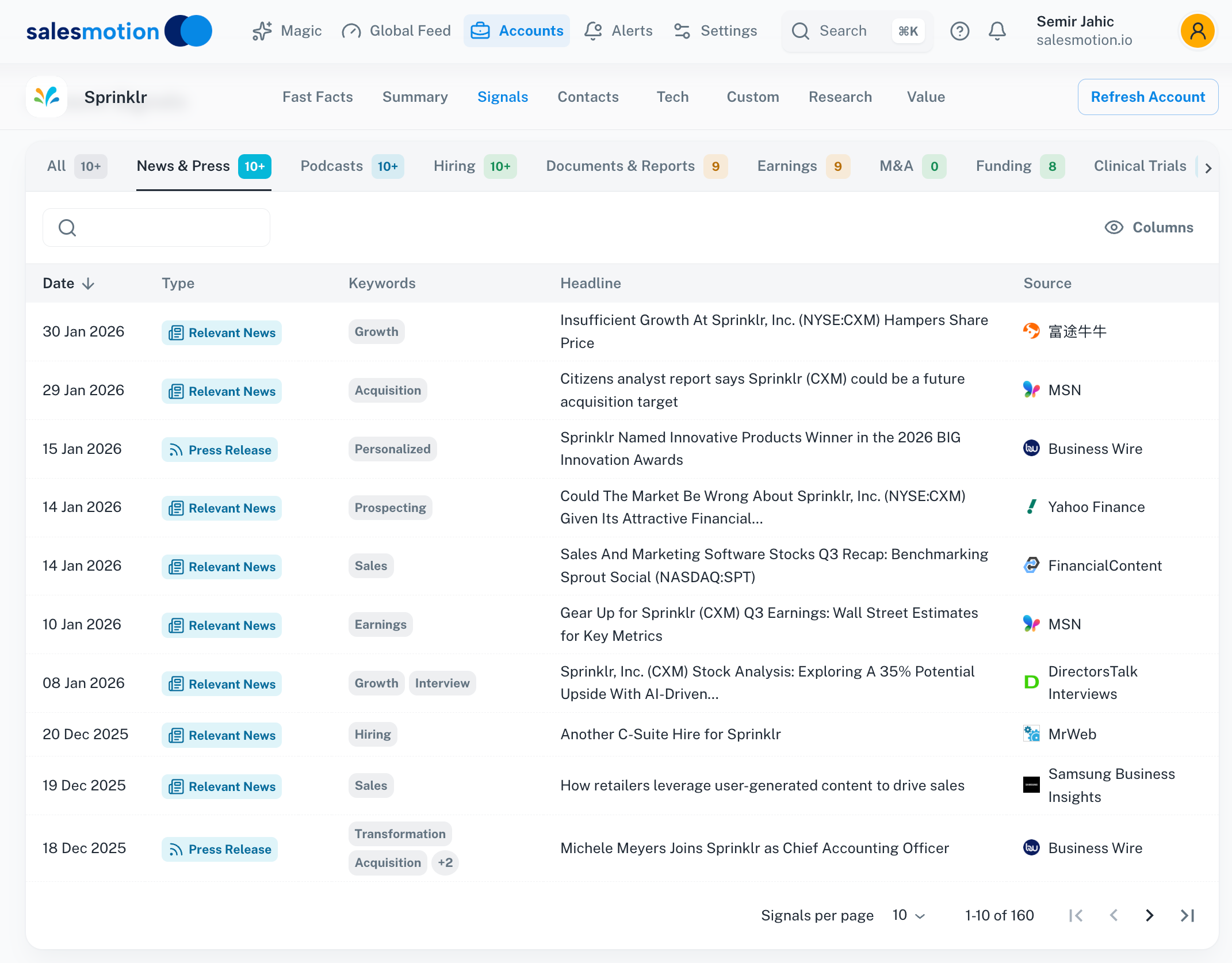 Real-time account signals surface exactly what to reference in outreach, eliminating manual research.
Signal-Based Personalization: The Shortcut to Relevance
Here is the uncomfortable truth about manual research: it is already stale by the time you finish it. You spend 30 minutes reading a prospect's 10-K filing, crafting a thoughtful email, and by the time it lands, the executive you referenced has left the company.
Signal-based personalization flips the model. Instead of asking "what can I learn about this prospect?" you start with "what just happened at this account that makes my outreach relevant right now?"
Growth List's compilation of trigger-event research found that the first seller to contact a prospect after a trigger event is 5x more likely to win the deal. That is not a marginal advantage. That is a category-defining one.
Digital Bloom's benchmarks put numbers to it: timeline-based hooks (referencing a specific, recent event) achieve a 10.01% reply rate compared to 4.39% for problem-statement hooks. The event itself does most of the personalization work.
Which Signals Drive the Best Responses
Not all signals are equal. The highest-converting outreach anchors to signals that imply both urgency and fit:
Tier 1 signals (highest urgency, reach out within 48 hours):
- New executive hire in a relevant role (VP Sales, CRO, VP RevOps)
- Funding round or acquisition announcement
- Earnings call with language about transformation, efficiency, or growth targets
- RFP or vendor review posted publicly
Tier 2 signals (moderate urgency, reach out within 1-2 weeks):
- Job postings for roles your product supports (hiring SDRs = scaling outreach)
- Product launches or new market entries
- Industry regulation changes affecting the account
- Competitive moves that force a response
Tier 3 signals (context builders, use when stacking with Tier 1-2):
- Tech stack changes (adopting or sunsetting tools in your category)
- Company awards, rankings, or press features
- Executive thought leadership (podcasts, articles, conference talks)
- Hiring velocity changes (accelerating or freezing)
The best outreach stacks multiple signals. Autobound found that multi-signal stacked outreach achieves 25-40% reply rates compared to 1-5% for generic cold outreach. When you reference two or three things actually happening at a prospect's company, response rates skyrocket because the email feels less like a pitch and more like a conversation the prospect was already having internally.
For a deeper breakdown of how to detect and act on these signals, see our guide on buying signals software.

“The talking points are gold. If they're in Salesmotion, I know they're being discussed inside that business. That makes it easy to spark a real conversation, which is 90 percent of the battle.”
Andrew Giordano
VP of Global Commercial Operations, Analytic Partners
The Anti-Patterns: What "Personalized" Outreach Should Not Look Like
If you're going to personalize outreach at scale, you need to know what bad personalization looks like. Because bad personalization is worse than no personalization. It signals that you tried to be relevant and failed, which tells the prospect you don't actually understand their world.
Anti-Pattern 1: The Fake Flattery Opener
"Hi Sarah, I loved your recent LinkedIn post about leadership in uncertain times!"
This fails for three reasons. First, "leadership in uncertain times" is so generic it could apply to any post from any executive in any industry. Second, the prospect knows you didn't actually read the post. Third, every AI tool in the market generates this exact opening. You just announced yourself as another automated sequence.
Anti-Pattern 2: The Wikipedia Opener
"I noticed [Company] is a leading provider of enterprise software solutions headquartered in San Francisco with over 5,000 employees."
Congratulations, you can read a LinkedIn company page. This tells the prospect nothing they don't already know about their own company. It wastes the most valuable real estate in your email (the first line) on information with zero insight.
Anti-Pattern 3: The Premature Solution
"Companies like yours typically struggle with low pipeline conversion rates, and our platform increases conversion by 35%."
You've made an assumption about their problem, declared it as fact, and pitched your solution, all in one sentence. The prospect has no reason to believe you understand their specific situation. This is a template wearing a thin disguise.
Anti-Pattern 4: The Over-Researched Creep
"I noticed you went to Michigan State, your daughter started kindergarten in September based on your Facebook post, and you recently moved to a new house in Westchester."
Real personalization is about professional relevance, not surveillance. There is a line between "I understand your business challenges" and "I have been studying your life." Stay on the business side.
What Good Personalization Actually Looks Like
Compare the anti-patterns above to this:
"Your Q3 earnings call mentioned a $15M investment in go-to-market expansion, and I noticed three new SDR openings posted last week. When teams scale outbound that fast, the first bottleneck is usually account research: reps can't study new accounts fast enough to write relevant outreach. Is that something you're seeing?"
That email works because it references a verifiable event (earnings call), connects it to an observable action (job postings), identifies a plausible implication (research bottleneck), and asks a genuine question. No flattery. No assumptions. For more on getting this right with senior buyers, see our breakdown on cold emailing executives.
End-to-End Example: Crafting a Signal-Triggered Email in Under 5 Minutes
Theory is worthless without execution. Here is a complete walkthrough of how a rep would personalize outreach at scale using signal-based context, from trigger to sent email, in under five minutes.
The Setup
You sell to VP-level sales leaders at mid-market SaaS companies. Your territory has 150 accounts. You cannot manually research all of them weekly. You need signals to tell you where to focus.
Minute 0-1: The Signal Fires
Monday morning. Your account intelligence platform flags that Acme Corp, one of your target accounts, just posted its Q4 earnings results. The CEO mentioned "doubling our sales team by end of year" and "investing heavily in pipeline generation." Simultaneously, you see that Acme posted four new SDR roles last week and that their VP of Sales, Jennifer Torres, was promoted from Director three months ago.
Three signals stacked: earnings language about growth, hiring velocity in sales, and a new leader still in her first 90 days. This account just moved from "someday" to "now."
Minute 1-3: Building the Context
You pull up the account brief. Salesmotion has already compiled the relevant context: the earnings commentary, the job postings, Torres's career path (she came from a competitor where she built an outbound team from 5 to 35 reps), and a recent podcast where she discussed the challenge of maintaining outreach quality while scaling headcount.
You now have everything you need. You didn't open LinkedIn, Google, or the company's investor relations page. The intelligence was already assembled and waiting.
Minute 3-5: Writing the Email
You draft a 47-word email (within Lavender's recommended range of 25-50 words for optimal response rates):
Subject: Scaling from 8 to 16 SDRs
Jennifer, your Q4 earnings mentioned doubling the sales team, and I saw four new SDR roles posted last week. When you scaled the outbound team at [Previous Company], did account research become the bottleneck? Curious if that's a concern this time around.
That email took four minutes and 47 words. It references a specific earnings call, a specific hiring action, and a specific detail from her career history. It asks a question she is genuinely thinking about. It does not mention your product, your company, or your features.
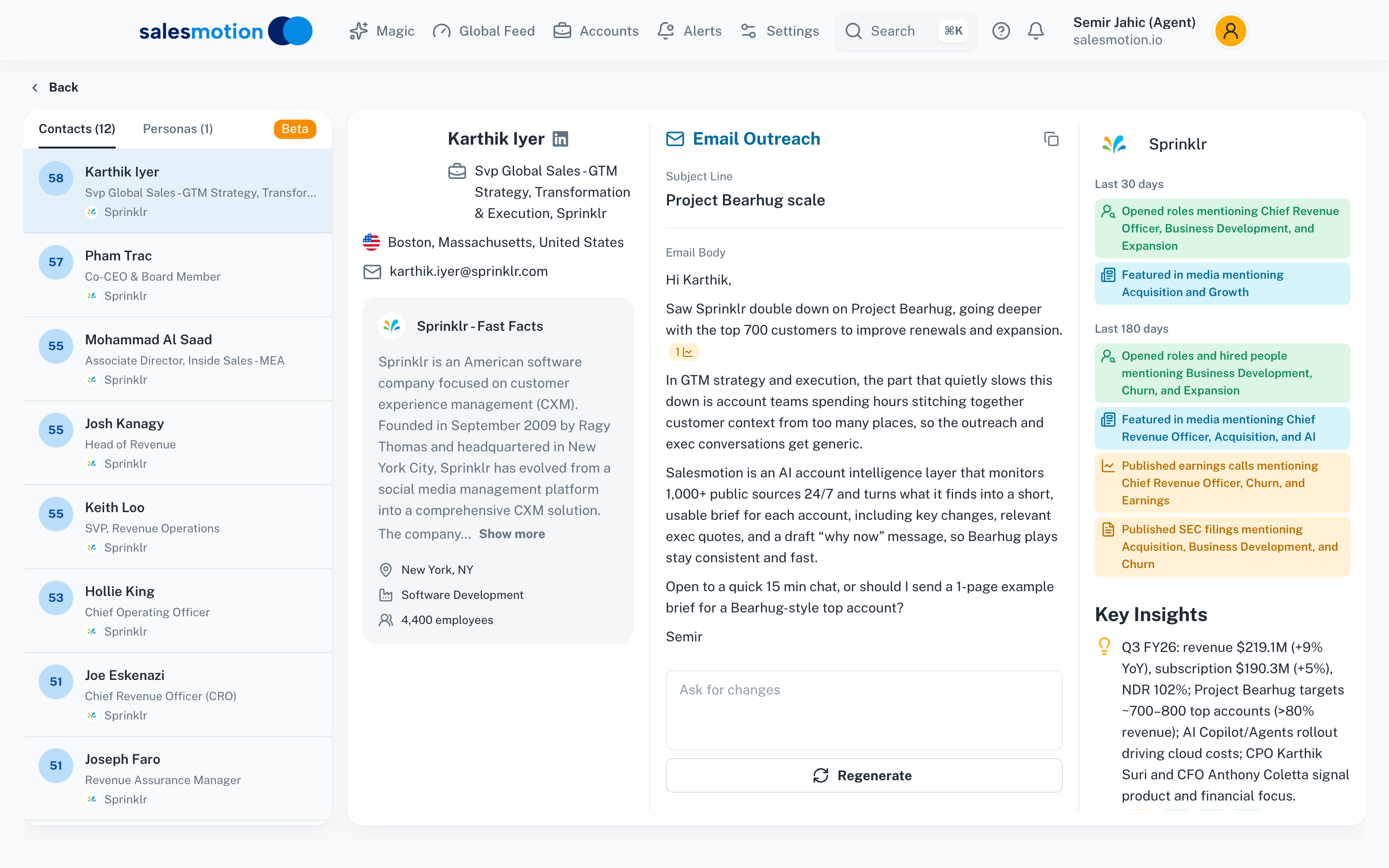 Signal-based context turns account intelligence into personalized outreach without manual research.
Why This Works
This email would fail as a template because every element is specific to this person and this moment. It would take 45 minutes to create manually because the research spans earnings transcripts, job postings, career history, and podcast appearances. But with signal-based context feeding the personalization, the entire process took under five minutes.
HubSpot's 2025 sales research found that only 5% of sellers personalize every email individually, while 51% rely on segment templates. The signal-based approach gives you the quality of that 5% at the speed of the 51%.
And Sopro found that 56% of buyers have actually purchased from cold outreach when it was personalized and problem-focused. Buyers are not opposed to outreach. They are opposed to irrelevant outreach.
For more on how AI SDR tools handle this balance between volume and quality, that comparison breaks down which tools genuinely personalize versus which ones just template faster.
Making It Scale: The Operational Framework
Personalization at scale is not about working harder. It is about building a system where signals do the research, and reps do the thinking.
The 15-5-1 Rule
For every 15 signals your system flags, 5 warrant outreach, and 1 is worth investing in individual-level (Layer 1) personalization. This triage prevents the common failure mode of trying to write bespoke emails for every account.
- 15 signals flagged daily across your territory (leadership changes, earnings mentions, hiring spikes, tech adoption signals)
- 5 accounts pass the relevance filter: the signal aligns with your value proposition and the account fits your ICP
- 1 account gets the full treatment: individual research on the decision-maker, multi-signal stacking, a carefully crafted 40-word email
- 4 accounts get company-level personalization: reference the specific signal, connect it to a relevant problem, ask a question. Takes 3-5 minutes each.
Batch by Signal Type, Not by Account
Most reps organize outreach by account list. That forces context-switching between different industries, company stages, and signal types. Instead, batch your outreach by signal type.
Monday morning: work through all leadership change signals. You are thinking about "new leader, first 90 days, mandate to make changes" for every email. The framing stays consistent, the specifics change per account.
Tuesday: work through all earnings-related signals. Now you are in "strategic initiative" mode, connecting public financial commentary to operational implications.
This batching approach is how the best prospecting tools in the market are designed: they surface signals by type, not by alphabet.
Measure Response Rate by Signal Type, Not by Sequence
Track which signals generate the highest reply rates for your specific market. A VP of Sales in healthcare SaaS might respond most to leadership changes (new leaders mean new vendor evaluations). A CFO at a manufacturing company might respond most to earnings-related outreach (financial language maps to their thinking).
Over 90 days, you will have enough data to prioritize which signals deserve your best personalization and which can be handled with lighter-touch context. This is how you increase email volume without sacrificing quality.
Key Takeaways
- Cold email averages have halved since 2019, but signal-personalized emails still achieve 18% response rates. The gap is relevance, not effort.
- Three layers of personalization (individual, company, industry) let you match depth to account value. Stack Layer 2 + Layer 3 at minimum. Add Layer 1 for high-priority targets.
- Signals replace manual research. The first seller to contact after a trigger event is 5x more likely to win. Let signals tell you what matters now instead of researching from scratch.
- Short beats long. Optimal cold email length is 25-50 words. Reference the signal, connect to an implication, ask one question.
- Bad personalization is worse than none. Fake flattery, Wikipedia openers, and premature solution pitches signal that you tried and failed to understand the prospect.
- Batch outreach by signal type, not by account list. This reduces context-switching and produces consistently higher-quality messaging.
- Platforms like Salesmotion compress the research step by surfacing real-time signals and pre-assembled account context, turning a 45-minute research task into a 5-minute outreach task.
Frequently Asked Questions
How many accounts can one rep realistically personalize per day?
With manual research, 5 to 8 accounts per day at a meaningful level of personalization. With signal-based tools that surface context automatically, 15 to 25 accounts per day while maintaining quality. The key variable is not writing speed but research speed. When signals eliminate the research step, the bottleneck shifts to message crafting, which takes 3 to 5 minutes per email when you already have the context. Instantly's benchmark data consistently shows that smaller, targeted campaigns outperform large blasts, so aim for quality over quantity even when you have the capacity to do more.
Does personalized outreach at scale require AI tools?
Not strictly, but doing it manually caps your throughput at a handful of accounts per day. The core requirement is real-time signal detection: knowing when something relevant happens at a target account before your competitors do. You could theoretically monitor earnings calls, job postings, and news alerts across 150 accounts manually. No one does. AI-powered account intelligence tools handle monitoring and assembly, freeing the rep to focus on judgment: which signal matters, what it implies, and what question to ask. The 87% AI adoption rate from Salesforce's State of Sales 2026 confirms this direction.
What is the difference between personalization and segmentation?
Segmentation groups prospects by shared attributes (industry, company size, role) and tailors messaging to the group. Personalization tailors messaging to the specific individual or company based on their unique situation and timing. HubSpot found that 51% of sales teams use segment templates, a reasonable baseline that still leaves significant performance on the table. The progression: generic template (worst) to segment template (baseline) to signal-personalized (best). True personalization at scale means using real-time context so each email feels written for that specific recipient, even when your system helped you get there efficiently.
How do I know if my personalization is actually working?
Track reply rates by personalization layer. Compare emails using only industry context (Layer 3) against those with company signals (Layer 2+3) and individual-level research (Layer 1+2+3). If your Layer 2+3 emails are not beating Layer 3-only by at least 2x on reply rate, your company-level personalization is not specific enough. Digital Bloom's benchmarks show timeline-based hooks achieve 10.01% reply rates versus 4.39% for problem-statement hooks. If your signal-anchored emails are not outperforming problem-led emails by a similar margin, you are likely referencing signals too vaguely.