Cold calling isn't dead. But blind cold calling — dialing down a list with no account context, no trigger event, and no personalization beyond the prospect's name and title — should be. Teams that use AI to accelerate their cold call prep are seeing the biggest gains. The data is clear: cold calls without research context have a 1-2% meeting conversion rate. Signal-informed calls, where the rep references a specific event at the prospect's company, convert at 5-8%. The difference isn't the channel. It's whether the call gives the prospect a reason to stay on the line beyond the first 10 seconds.
TL;DR: Heading into 2027, cold calling works when calls are informed by real-time account signals: leadership changes, hiring surges, earnings priorities, competitive evaluations, and funding events. Signal-informed calls convert 3-4x higher than blind cold calls because the opening references something specific and relevant to the prospect. This guide provides scripts for five signal types, data on optimal calling patterns, and a framework for integrating phone outreach with signal-driven account prioritization.
The Latest Data on Cold Calling
Before the scripts, the latest numbers that matter:
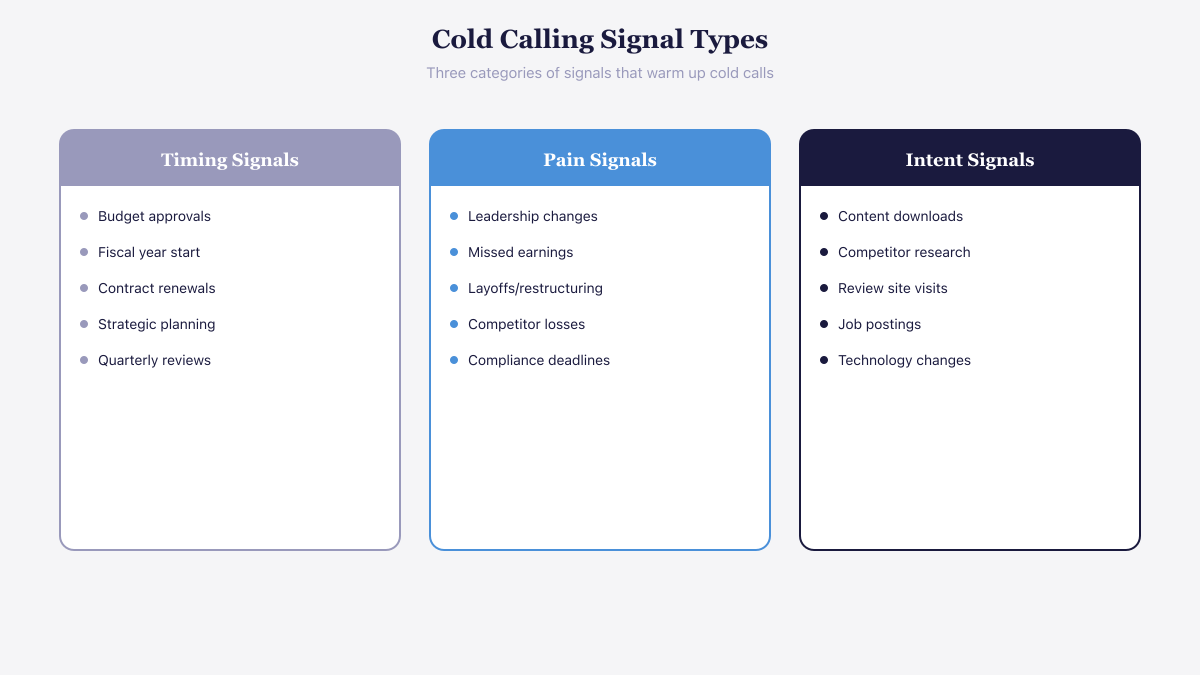 Signals transform cold calls into warm conversations by providing timing, pain, and intent context.
Activity benchmarks:
- Average cold calls to reach a decision-maker: 8-12 attempts
- Average connect rate (reaching a live person): 4-6%
- Average meeting conversion from connects (traditional cold call): 1-3%
- Average meeting conversion from connects (signal-informed call): 5-10%
- Best days to call: Tuesday through Thursday
- Best times to call: 10-11 AM and 2-4 PM in the prospect's time zone
- Optimal voicemail length: 18-25 seconds
The phone vs. email comparison:
- Phone conversations create 3x more pipeline per touch than email
- Prospects who take a phone call are 5x more likely to meet than those who only respond to email
- Multi-channel sequences (phone + email + LinkedIn) outperform single-channel by 2.5x
The phone remains the highest-converting channel for enterprise B2B sales. The reason most teams underperform on cold calling isn't the channel. It's the approach: calling without context produces rejection, which produces call reluctance, which produces lower volume, which produces fewer results. Signal-informed calling breaks this cycle by giving reps a relevant reason to call.
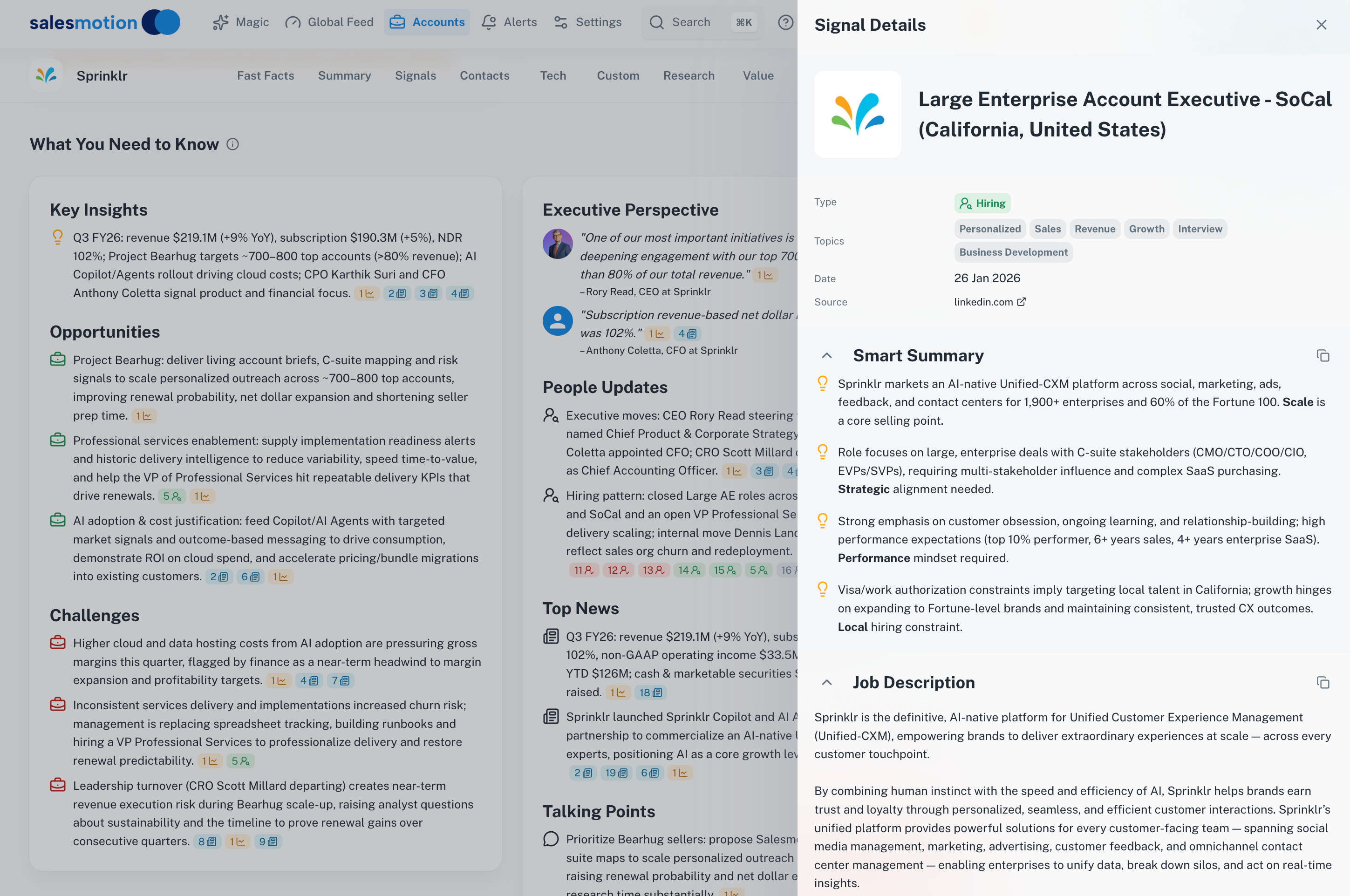 Before picking up the phone, Salesmotion surfaces hiring surges, leadership changes, and other signal context that gives reps a compelling reason to call.
See Salesmotion on a real account
Book a 15-minute demo and see how your team saves hours on account research.
Five Signal-Informed Cold Call Scripts
Script 1: Leadership Change Signal
Trigger: A new VP, C-suite executive, or department head has joined the target account within the past 30 days.
Why it works: New leaders audit existing tools and vendors within their first 90 days. They're receptive to conversations about how they can make an impact quickly in their new role.
Script:
"Hi [Name], this is [Your Name] with [Company]. I'm calling because I noticed you recently joined [Company] as [Title]. Congratulations on the new role. The reason for my call — when leaders step into roles like yours, one of the first things they typically evaluate is [specific area your solution addresses]. I work with [similar title] leaders at companies like [reference customer] on exactly that challenge. Would it be worth 15 minutes to share what we're seeing work for teams in your position?"
Key elements: Congratulate the transition. Reference the specific evaluation pattern. Name a similar customer. Ask for a specific time commitment.
Script 2: Hiring Surge Signal
Trigger: The account has posted 10+ job openings in a department relevant to your solution within the past 30 days.
Why it works: Hiring surges indicate investment and growth. Teams scaling rapidly need infrastructure to support that growth, and the hiring manager is actively thinking about how to onboard and enable the new hires.
Script:
"Hi [Name], this is [Your Name] with [Company]. I noticed [Company] is hiring aggressively for [department] — I'm seeing about [number] open roles right now. When teams scale that quickly, the biggest challenge I hear from leaders in your position is [specific challenge relevant to your solution]. We help teams like [reference customer] solve that, and they saw [specific result]. Is that a challenge you're running into as you build out the team?"
Script 3: Earnings or Strategic Priority Signal
Trigger: A public company released earnings or an annual report mentioning priorities aligned with your solution's value proposition.
Why it works: When the CEO tells analysts that "operational efficiency" or "digital transformation" is a top priority, budget follows that statement. Referencing specific executive language demonstrates preparation that prospects rarely experience.
Script:
"Hi [Name], this is [Your Name] with [Company]. I was reviewing [Company]'s recent [earnings call/annual report], and [CEO Name] mentioned [specific quote or priority]. We work with companies in [industry] that are tackling exactly that challenge. [Reference customer] used our platform to [specific outcome related to stated priority]. Given that this is a strategic focus for your organization, would it make sense to have a brief conversation about how other teams are approaching it?"
Script 4: Competitive Displacement Signal
Trigger: The account shows signs of dissatisfaction with a competitor: negative reviews, job postings mentioning competitor's tool, or approaching contract renewal.
Why it works: Approaching accounts during periods of competitor dissatisfaction dramatically increases receptivity. The prospect is already thinking about alternatives.
Script:
"Hi [Name], this is [Your Name] with [Company]. I'll be straightforward — I'm reaching out because we've been hearing from a lot of teams using [Competitor] that [specific limitation they're likely experiencing]. We built [specific capability] specifically to solve that gap. [Reference customer] switched from [Competitor] and saw [specific improvement]. I'm not sure if you're experiencing the same challenge, but if you are, it might be worth a quick conversation to see if what we've built would make a difference for your team."
Script 5: Funding Signal
Trigger: The account recently announced a funding round, IPO filing, or major investment.
Why it works: Post-funding companies are actively investing in growth infrastructure. They have budget, urgency, and specific plans they've committed to investors.
Script:
"Hi [Name], this is [Your Name] with [Company]. Congrats on the recent [funding round/announcement]. I saw you'll be focusing on [specific use of funds from announcement]. The reason I'm reaching out — we work with a lot of [similar stage] companies that are scaling [relevant function], and one of the challenges they face is [problem your solution solves]. [Reference customer] used us to [specific outcome] during a similar growth phase. Would it make sense to have a conversation about how we could help as you scale?"

“Automatic account profile detail I can use to manage my territory. Using Salesmotion AI to generate value statements per persona, account, etc. Using Salesmotion to give me a starting point based on new hires, or news alerts is critical.”
Adam Wainwright
Head of Revenue, Cacheflow
The Signal-Informed Calling Framework
Before the Call (2 Minutes)
- Review the signal. What event triggered this call? When did it happen? What does it imply about the account's priorities?
- Check the stakeholder. What's their role? How long have they been there? What's their likely perspective on the signal?
- Prepare the bridge. How does the signal connect to a problem your solution solves? What reference customer experienced a similar situation?
This two-minute prep process only works when signal data is already in the rep's workflow. Salesmotion surfaces these signals directly inside Salesforce: a leadership change fires, the account brief auto-updates with the new executive's background and likely priorities, and the rep sees it in their daily feed without opening another tab. That's the difference between signal-informed calling as a concept and signal-informed calling at scale. Without account intelligence automation, the research step alone takes 15-20 minutes per account, making this approach impractical for reps managing 50+ accounts.
During the Call
The 10-second test. You have 10 seconds before the prospect decides to stay on the line or hang up. The opening must pass the relevance test: does it reference something the prospect cares about right now?
Avoid these openers:
- "How are you today?" (immediately signals a sales call)
- "I'm calling from [Company], we're the leading provider of..." (no one cares about your positioning)
- "Did I catch you at a bad time?" (invites a no)
Use these instead:
- Reference the signal: "I noticed [specific event]..."
- Reference a peer: "I was talking with [similar title] at [peer company] about..."
- Reference a result: "We helped [similar company] achieve [specific outcome]..."
After the Call
If they took the meeting: Send a calendar invite within 5 minutes with a brief agenda connecting the signal to the meeting topics.
If they asked for email: Send within 1 hour. Reference the conversation and the specific signal. Don't send a generic pitch deck.
If no answer: Leave an 18-25 second voicemail referencing the signal. Follow up with an email within 10 minutes that builds on the voicemail content.
Optimal Calling Cadence
For signal-informed outreach to Tier 1 accounts, the recommended pattern:
| Day | Activity |
|---|---|
| Day 1 | Call + voicemail + email referencing signal |
| Day 3 | Email with additional context or content |
| Day 5 | Call (different time of day) + LinkedIn connection |
| Day 8 | Call + email with new angle or additional signal |
| Day 12 | Final call + breakup email |
For Tier 2 accounts without active signals, reduce to email-led sequences with phone reserved for signal-triggered escalation.
Teams like Cacheflow improved their territory prioritization by using buying signal data to determine which accounts warranted phone outreach versus email-only sequences, concentrating call effort on accounts showing real buying intent.

“The account and contact signals are key for reaching out at important times, and the value-add messaging it creates unique to every contact helps save time and efficiency.”
Daniel Pitman
Mid-Market Account Executive, Black Swan Data
Key Takeaways
- Cold calling remains the highest-converting channel for enterprise B2B sales when calls are informed by account-specific signals rather than made blindly from lists.
- Signal-informed calls convert 3-4x higher than traditional cold calls because the opening references something relevant and timely to the prospect.
- The five highest-value call triggers are: leadership changes, hiring surges, earnings priorities, competitive displacement signals, and funding events.
- Two minutes of pre-call preparation (reviewing the signal, checking the stakeholder, preparing the bridge) transforms call quality without significantly impacting volume.
- The 10-second rule applies to every call: if the opening doesn't reference something the prospect cares about right now, they'll end the conversation.
- Integrate phone into multi-channel sequences. The combination of signal-informed calls, email follow-up, and LinkedIn engagement produces 2.5x the results of any single channel alone.
Frequently Asked Questions
Is cold calling still effective in 2027?
Yes, but the definition of "cold" has changed. Calls without any account context or signal convert at 1-2%. Calls informed by real-time signals (leadership changes, hiring surges, earnings priorities) convert at 5-10%. The phone is still the highest-converting channel for enterprise B2B sales because a live conversation creates commitment and relationship that email alone can't. The key is ensuring every call has a relevant reason beyond "I'd like to introduce our company."
What is the best time to cold call?
Data from multiple studies consistently shows Tuesday through Thursday, with optimal windows at 10-11 AM and 2-4 PM in the prospect's time zone. Mondays and Fridays have lower connect rates. Early morning (before 9 AM) and late afternoon (after 5 PM) occasionally work for reaching executives before gatekeepers arrive or after they leave. Test timing within these windows for your specific audience.
How many cold calls does it take to book a meeting?
When targeting C-suite specifically, see our data-backed guide on booking executive meetings that lead to second meetings. With traditional cold calling, it typically takes 50-80 dials to book one meeting (accounting for connect rates and conversion). With signal-informed calling, the ratio improves to 20-40 dials per meeting because both connect rates and conversion rates improve when calling at the right time with the right context. The actual number varies by industry, seniority of the target, and quality of the signal triggering the outreach.
How do you overcome cold call reluctance?
Cold call reluctance usually stems from repeated rejection, which stems from calling without context. Signal-informed calling reduces rejection rates by 50%+ because the opening is relevant, and prospects are more receptive when you reference something happening at their company. The psychological shift is significant: reps stop feeling like they're interrupting and start feeling like they're providing timely information. Pair this with coaching that focuses on conversation quality rather than dial volume.