Your reps are toggling between five browser tabs to prepare for a single meeting. ZoomInfo for contacts, Bombora for intent signals, ChatGPT for company research, LinkedIn Sales Navigator for prospecting, and Google Alerts for news. By the time they piece it all together, the buyer has already moved on.
We hear this in nearly every conversation with sales leaders: "We're working 4-5 different sites just to prep for one meeting." A VP of Sales at a 600-person workforce planning company told us their team of 15 reps was toggling between ZoomInfo, LinkedIn Sales Navigator, ChatGPT, and Google Alerts — and still going into meetings under-prepared.
The real cost of a fragmented sales tech stack is not the $80K+ in annual subscriptions. It is the thousands of selling hours your team loses every year to context switching.
TL;DR: The real cost of 10 tools isn't the $80K+ in subscriptions — it's the 150-250 hours per rep per year lost to context-switching between them. Teams that consolidate to a single account intelligence platform cut research time by 50%+ and total cost of ownership by 30-40%. This guide walks through a 4-step framework — audit, score, migrate, verify — with the specific scoring criteria that separate must-keep tools from expensive dead weight. See what consolidation looks like.
The Real Cost of a Fragmented Sales Stack
The average B2B sales team uses between 5 and 8 tools for prospecting, research, and outreach. Individually, each tool solves a real problem. Collectively, they create a mess.
Here is what that mess actually costs:
Direct subscription costs
Most mid-market teams spend $50,000 to $100,000 per year on sales intelligence tools alone. That does not include CRM licenses, engagement platforms, or the RevOps headcount required to manage it all. ZoomInfo contracts regularly run $25,000 to $60,000 annually. Add Bombora or 6sense for intent data, LinkedIn Sales Navigator seats, and a handful of point solutions, and the number climbs fast.
The hidden cost: lost selling time
Forrester research shows that sales reps spend less than 30% of their week actually selling. A major contributor is the time spent switching between disconnected tools to gather account context before calls.
We hear this constantly in conversations with sales leaders:
- "We're working 4-5 different sites just to prep for one meeting."
- "Three tools don't talk to each other effectively."
- "We have a disjointed app stack with almost no integrations."
When reps spend 3 to 5 hours per week copying data between tabs, manually cross-referencing signals, and reformatting research into something usable, that is 150 to 250 hours per rep per year that should have been spent in front of buyers.
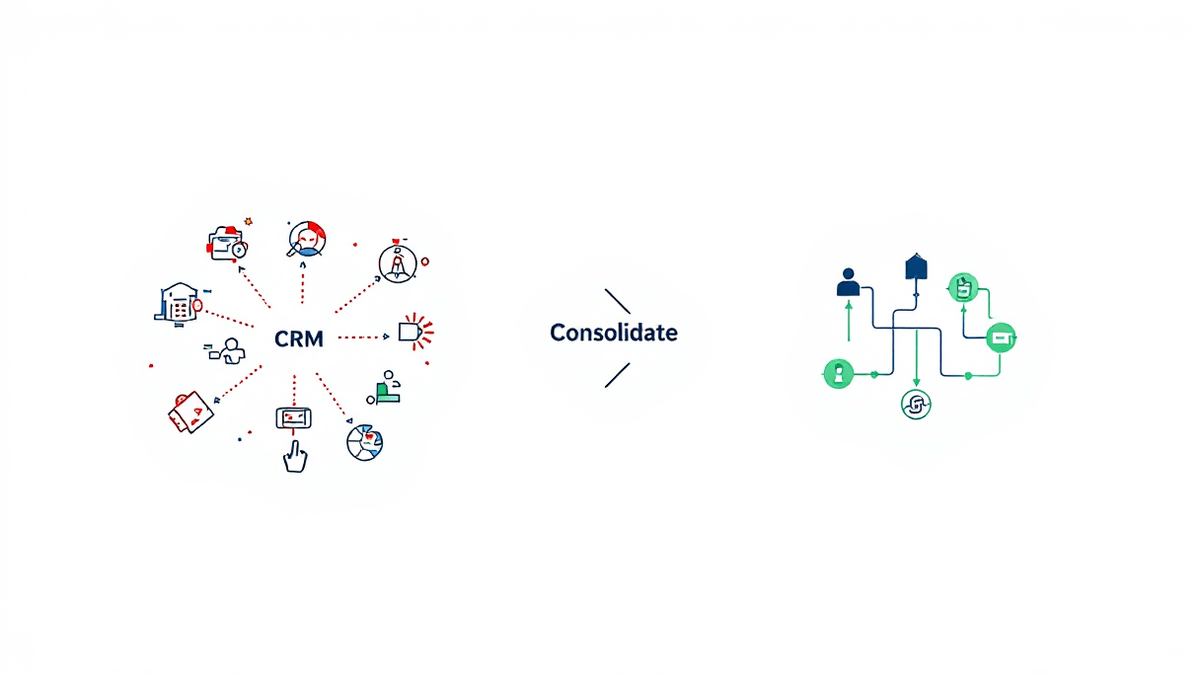 From 5+ disconnected tools to one intelligence layer.
Data silos kill deal quality
Fragmented tools also mean fragmented insights. Intent data lives in one system. Contact information lives in another. Company news and leadership changes sit in a third. No single tool gives your rep the full picture, which means they walk into meetings with partial context and generic talking points.
A RevOps leader at a brand management SaaS company described the problem precisely: "Intent was too unspecific, it was a blackbox. Too resource-intense — reading 10-Ks manually. And our SDRs were often too junior to read and lack business acumen to interpret what they found." The consolidation solved three problems at once: the data became specific and actionable, the interpretation was automated, and junior reps could act on signals that previously required senior-level business knowledge.
See Salesmotion on a real account
Book a 15-minute demo and see how your team saves hours on account research.
The Five Tools Most Teams Are Trying to Replace
When we talk to VP Sales and RevOps leaders about consolidation, the same five tool categories come up repeatedly.
1. Contact databases (ZoomInfo, Apollo, Lusha)
The core use case is finding email addresses and phone numbers for target accounts. These platforms have expanded into broader "sales intelligence" over the years, but most teams still use them primarily as contact directories. At $25K-60K per year, it is often the single largest line item in the sales tech budget.
2. Intent data providers (Bombora, 6sense, G2 Buyer Intent)
These tools promise to tell you which accounts are "in-market" based on content consumption and web activity. The challenge is that intent data on its own, without context about what the account is actually doing, often produces noisy signals that reps struggle to act on.
3. AI research assistants (ChatGPT, Perplexity)
Many reps have adopted general-purpose AI tools to summarize company backgrounds, draft emails, or research industries. The problem: these tools have no context about your specific accounts, your selling motion, or your ICP. Every query starts from zero.
4. Professional networking tools (LinkedIn Sales Navigator)
Sales Nav is deeply embedded in most outbound workflows. Reps use it for lead discovery, relationship mapping, and InMail outreach. But it operates as a silo, disconnected from your CRM, your signals, and your engagement data.
5. Signal monitoring (Google Alerts, manual research)
The most manual category of all. Reps set up Google Alerts, scan industry publications, check SEC filings, and browse LinkedIn posts to find buying signals like leadership changes, funding rounds, or expansion announcements. This ad hoc approach is time-consuming and inconsistent across the team.

“The moment we turned on Salesmotion, it became essential. No more hours on LinkedIn or Google to figure out who we're talking to. It's just there, served up to you, so it's always 'go time.'”
Adam Wainwright
Head of Revenue, Cacheflow
What a Consolidated Stack Actually Looks Like
Consolidation does not mean cramming every feature into one bloated platform. It means bringing signal monitoring, account research, and outreach preparation into a single workflow so reps can go from "this account is showing activity" to "here is my personalized outreach" without switching tools.
The key capabilities a consolidated platform should deliver:
- Real-time signal monitoring across news, leadership changes, earnings, hiring patterns, funding, and industry events
- Deep account research synthesized from hundreds of sources into one view
- AI-generated outreach that is personalized to each account's specific context, not generic templates
- CRM integration that syncs insights directly into your existing workflow
- Contact intelligence so you are reaching the right people, not just any people
Real results from consolidation
When Cytel, a 2,000-person life sciences analytics company, consolidated from five tools to one, the results were immediate. Their team had been bouncing between five disconnected research sources to prepare for account planning sessions and outreach.
After consolidation, Cytel cut account research time by 50% and reduced account planning prep by 30%. As one of their Business Development Managers put it: "I used to have to go to 5+ websites to gather all of the account intelligence needed for QBR and Account Planning prep. That has been cut down to 1 website and a significant time saver."
Cacheflow, a fast-growing CPQ startup (later acquired by HubSpot), saw similar results with an even faster timeline. Their team realized full value within 24 hours of implementation. Prep time dropped by 60%, and their reps stopped drowning in manual research across disconnected tools.
These are not theoretical savings. They translate directly into more pipeline, better conversations, and larger deals.
Step-by-Step Consolidation Playbook
Consolidating your sales tech stack is not a weekend project, but it does not need to be a six-month initiative either. Here is a practical playbook based on what we have seen work across dozens of teams.
Step 1: Audit your current stack
Start by mapping every tool your sales team touches during a typical week. Do not limit this to tools that have a formal contract. Include free tools, browser extensions, and AI assistants that reps use informally.
For each tool, document:
- Annual cost (including per-seat pricing at current headcount)
- Primary use case (what does the rep actually open this tool to do?)
- Usage frequency (daily, weekly, occasionally)
- Integration status (does it connect to your CRM or other tools?)
- Overlap (which other tools cover a similar use case?)
Most teams discover that 2-3 tools have significant functional overlap, and at least one tool is being paid for but barely used.
Step 2: Map capabilities to requirements
Create a simple requirements matrix. List the capabilities your team genuinely needs (not nice-to-haves) down one axis, and your current tools across the other. This makes overlap and gaps visible at a glance.
Common capability categories for account intelligence:
- Contact data and enrichment
- Company and account research
- Signal and intent monitoring
- Outreach personalization
- CRM sync and workflow integration
- Territory and account prioritization
Step 3: Run a parallel pilot
Do not rip and replace overnight. Run a parallel pilot for 2-4 weeks where a subset of your team uses the consolidated platform alongside their existing tools. This gives you a controlled comparison and builds internal confidence before you sunset anything.
Define clear success metrics upfront:
- Time spent on pre-meeting research (before vs. after)
- Number of accounts researched per week
- Outreach personalization quality (reply rates, meeting conversion)
- Rep satisfaction and adoption
Step 4: Measure before and after
Compare pilot results against your baseline. The numbers that matter most are time savings per rep per week, quality of account context going into meetings, and rep adoption (are they actually using it daily?).
If a consolidated platform saves each rep 3-5 hours per week and reps confirm the research quality is equal or better, you have a strong business case.
Step 5: Sunset legacy tools
Once you have validated results, begin sunsetting redundant tools at their next renewal date. Coordinate with finance to capture the cost savings and reallocate budget toward signal-based selling initiatives that drive pipeline.
Create a 90-day transition plan:
- Weeks 1-2: Full team onboarding on the consolidated platform
- Weeks 3-6: Run in parallel, migrate saved searches and account lists
- Weeks 7-10: Remove access to redundant tools, route all workflows through the new platform
- Weeks 11-12: Final audit, cancel legacy contracts, document new processes

“The Business Development team gets 80 to 90 percent of what they need in 15 minutes. That is a complete shift in how our reps work.”
Andrew Giordano
VP of Global Commercial Operations, Analytic Partners
When NOT to Consolidate
Consolidation is not about reducing your stack to a single tool for everything. Some tools serve unique purposes that an account intelligence platform should not try to replace.
Your CRM stays
Your CRM (Salesforce, HubSpot, or whatever you use) is your system of record. It is not going anywhere, and no intelligence platform should try to replace it. The goal is to feed better data into your CRM, not to replace it.
Specialized compliance and regulatory tools
If you are in a regulated industry like financial services, healthcare, or government contracting, you likely have compliance-specific tools that serve a distinct legal or audit purpose. These are not candidates for consolidation.
Conversation intelligence
Tools like Gong or Chorus that record and analyze sales calls serve a fundamentally different function than pre-call research and signal monitoring. They complement an account intelligence platform rather than overlapping with it.
Marketing automation
Your marketing automation platform (Marketo, HubSpot Marketing Hub, Pardot) handles demand generation workflows that sit upstream of sales. Integration matters, but replacement does not.
The consolidation opportunity is specifically in the pre-call research and account intelligence layer, where reps are doing the most manual, repetitive work across the most disconnected tools. That is where the time savings and productivity gains are most dramatic.
Key Takeaways
- The real cost is time, not subscriptions. Reps lose 3-5 hours per week context switching between 5-8 disconnected tools, which adds up to 150-250 lost selling hours per year.
- Five tool categories drive most of the bloat. Contact databases, intent providers, AI research assistants, LinkedIn Sales Nav, and manual signal monitoring are the most common targets for consolidation.
- Consolidation works best in the account intelligence layer. Bring signal monitoring, research, and outreach prep into one platform while keeping your CRM, compliance tools, and conversation intelligence separate.
- Run a parallel pilot before you rip and replace. Two to four weeks of side-by-side comparison with clear metrics gives you the data to make a confident decision.
- Real teams see real results. Cytel consolidated 5 tools to 1 and cut research time by 50%. Cacheflow realized full value within 24 hours and reduced prep time by 60%.
Frequently Asked Questions
How long does it take to consolidate from 5 tools to 1?
Most teams complete the transition in 8-12 weeks, including a 2-4 week pilot phase. The actual platform onboarding is fast (Salesmotion customers typically see value within the first week), but the organizational change management of sunsetting legacy tools and updating team workflows takes additional time. Plan for a 90-day transition from pilot kickoff to final legacy tool cancellation.
Will I lose data quality by consolidating vendors?
This is the most common concern, and it is valid. The key is to evaluate data quality during your pilot phase, not after you have already canceled contracts. Compare the depth of account research, signal coverage, and contact accuracy side by side. In practice, teams that consolidate to a purpose-built account intelligence platform often see improved data quality because insights are synthesized from hundreds of sources into a single view rather than fragmented across tools that each cover only a slice.
What is the typical ROI of sales tech stack consolidation?
The ROI comes from three sources: direct cost savings ($20,000-$60,000+ per year in eliminated subscriptions), time savings (3-5 hours per rep per week returned to selling), and improved deal quality from better account context. For a 10-rep team, the combined value typically exceeds $150,000 annually when you factor in the revenue impact of recovered selling time.
Should I consolidate if my team is happy with their current tools?
Satisfaction with individual tools does not mean the overall stack is working well. Ask your reps how much time they spend switching between tools, whether they have a complete picture of each account before meetings, and whether their tools share data seamlessly. Most reps are "happy" with each tool in isolation but frustrated with the collective experience. The consolidation case is strongest when you can show reps how much time they will get back, not when you take away tools they rely on without a clear replacement.