
Your sales reps spent roughly 11.2 hours selling this week. The other 28.8 hours went to research, CRM updates, internal meetings, and chasing bad data. According to the Salesforce State of Sales report, reps spend only 28-30% of their week on actual selling activities. Meanwhile, 78% of sellers missed quota in 2025, up from 69% the year before. These two numbers are not a coincidence. They are the same problem measured from different angles.
The standard response is to add tools, hire enablement, or run another training cycle. None of it works if the underlying time allocation stays broken. The real fix requires understanding exactly where the time goes, why conventional solutions make it worse, and what the top-performing minority does differently.
Where 72% of a Rep's Week Actually Goes
The Forrester Activity Study tracked 3,031 sales reps across industries and found that the average rep burns nearly two full days per week on administrative tasks alone. Layer on research, internal meetings, and tool navigation, and the picture gets grim fast.
Here is a realistic breakdown of a 40-hour selling week for a mid-market B2B rep:
| Activity | % of Week | Hours/Week | Revenue Impact |
|---|---|---|---|
| Active selling (calls, demos, negotiations) | 28% | 11.2 | Direct |
| Account research and call prep | 14% | 5.6 | Indirect |
| CRM data entry and pipeline updates | 17% | 6.8 | None |
| Internal meetings and syncs | 15% | 6.0 | Minimal |
| Email triage and admin | 14% | 5.6 | None |
| Scheduling and logistics | 12% | 4.8 | None |
That is 28.8 hours per week producing zero direct revenue. Over a year, each rep loses the equivalent of 37 selling weeks to non-selling activities. Multiply that by a team of 20 reps and you are burning 740 weeks of potential selling time annually.
The Bad Data Tax
One of the least visible time drains is data quality. ZoomInfo and Everstage research shows that reps spend 27.3% of their time working with inaccurate contact data. That translates to roughly 546 hours per year per rep spent dialing wrong numbers, emailing bounced addresses, and researching contacts who left the company months ago.
This is not a minor inefficiency. It is the single largest hidden cost in most sales organizations. A rep who spends two hours researching a prospect only to discover their champion left for a different company has lost more than two hours. They have lost the momentum, the preparation, and the motivation that comes with productive work.
The Meeting Trap
Internal meetings consume 15% of the average rep's week. Some of those meetings are valuable: deal reviews that surface blind spots, pipeline inspections that improve forecasting accuracy, coaching sessions that sharpen skills. Most are not. Standing syncs with no agenda, cross-functional updates that could be an email, and forecast reviews where reps read CRM data aloud into a screen all qualify as time theft.
The fix is not eliminating meetings. It is applying the same rigor to internal time that good sales leaders apply to customer-facing time. Every recurring meeting should have a clear output requirement. If it does not produce a decision, coaching moment, or action item in the first two occurrences, cancel it.

“With Salesmotion, you realize just how much time you were spending on low-value tasks. Now that our team isn't drowning in manual research, they can truly focus on execution, which is priceless for a startup.”
Adam Wainwright
Head of Revenue, Cacheflow
Why Adding More Tools Makes It Worse
The instinct when reps are drowning in non-selling work is to buy technology that automates it. This instinct is correct in principle and catastrophic in practice.
Salesforce data shows the average rep now uses eight different tools to close deals. Gartner's September 2024 survey of 1,026 sellers found that 72% of sellers feel overwhelmed by the number of tools they are expected to use. Worse, sellers overwhelmed by their tools are 45% less likely to hit quota.
The arithmetic is damning. Each tool was supposed to save time. In aggregate, they create a meta-problem: reps spend meaningful portions of their day switching between systems, reconciling conflicting data across platforms, and learning new interfaces that change every quarter.
This is the tool paradox: every individual tool has a defensible ROI model. But the cumulative cognitive load of switching between eight tools, maintaining logins, learning UI updates, and mentally synthesizing information from multiple sources creates a drag that wipes out most of the individual gains.
The Consolidation Imperative
Gartner's November 2025 forecast predicts that by 2028, AI agents will outnumber sellers 10:1, yet fewer than 40% of sellers will report that those AI agents actually improved their productivity. The bottleneck is not technology capability. It is integration architecture.
The winning approach is not "add another tool." It is consolidate intelligence into fewer surfaces. Instead of asking reps to check one tool for contact data, another for company news, a third for intent signals, and a fourth for tech stack information, the answer is a single company intelligence layer that aggregates all of it.
This is why signal-based selling has gained traction. Rather than requiring reps to pull information from multiple sources, the approach pushes consolidated, prioritized intelligence to them in a single view.
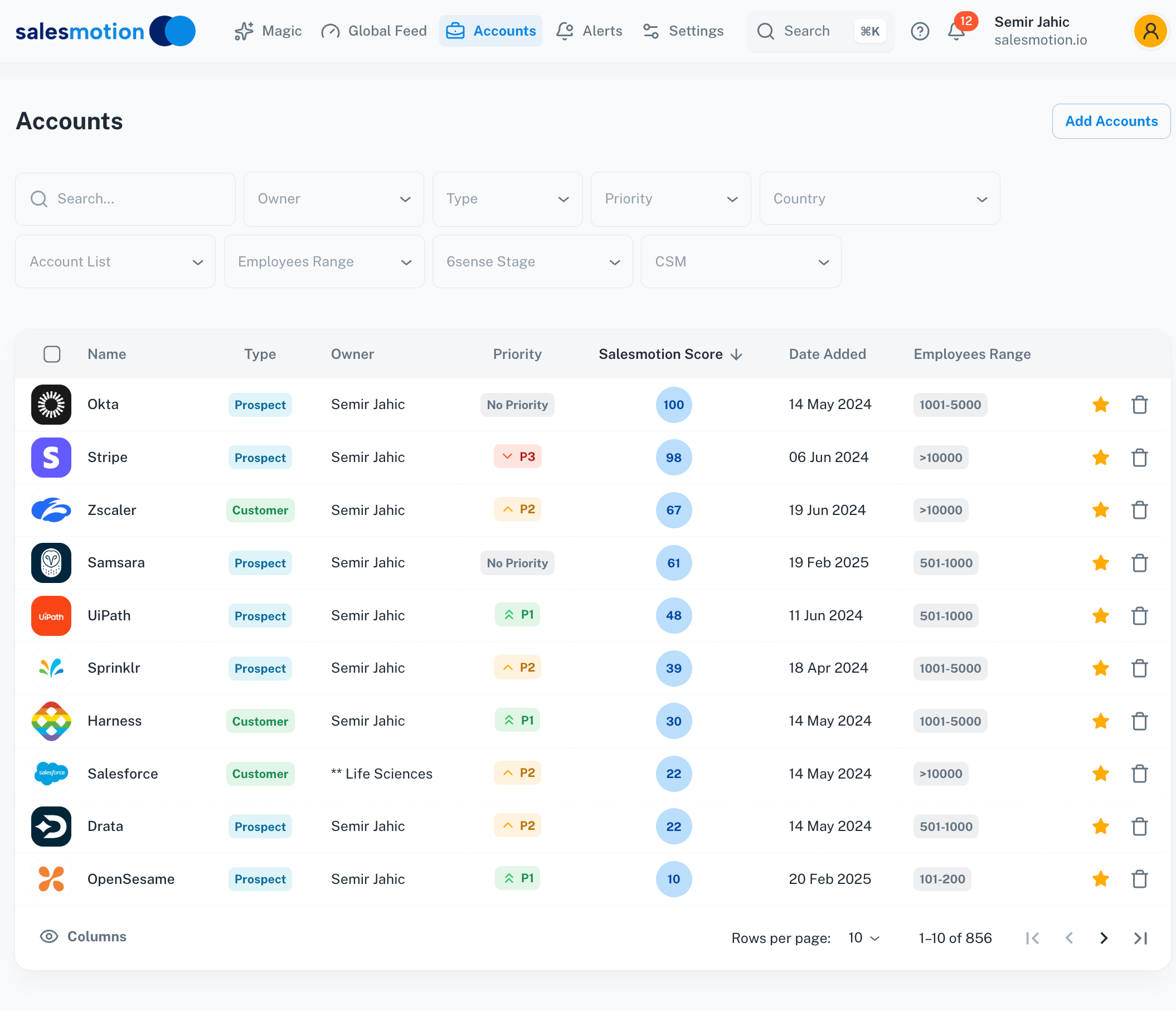 An account intelligence dashboard consolidates research, signals, and scoring into a single surface, eliminating the need to toggle between multiple tools.
See Salesmotion on a real account
Book a 15-minute demo and see how your team saves hours on account research.
What the Top 14% Do Differently
The Ebsta x Pavilion analysis of 655,000 opportunities revealed a staggering performance distribution: just 14% of sellers drive 80% of revenue. That is an 11x performance gap between the top tier and the rest.
Top performers do not have more hours in their day. Research from Abstrakt shows they spend 35-40% of their time on active selling compared to the 28% average. That 7-12 percentage point difference translates to 5-8 additional selling weeks per year.
Where does the extra time come from? Three places:
1. They Eliminate Research Redundancy
Average reps research the same account multiple times because they do not retain or centralize their findings. They check LinkedIn before a call, read a news article before an email, and Google the company before a QBR, never connecting the dots between sessions.
Top performers maintain a living account brief that updates continuously. Whether that is a well-maintained CRM record, a dedicated research document, or an account intelligence platform, the principle is the same: research once, reference many times. The best version of this is automated intelligence that refreshes without any rep effort at all.
2. They Prioritize Ruthlessly
Average reps spread effort evenly across their book of business. They give roughly equal attention to high-fit accounts showing active buying signals and dormant accounts that have not engaged in months. This is democratic and disastrous.
Top performers operate on a strict tiering model. They spend 60% or more of selling time on accounts with both strong ICP fit and active buying signals. They spend 25% on high-fit accounts in nurture mode. They spend less than 15% on everything else. This is not a suggestion. The data from Ebsta shows that delayed engagement reduces win rates by 113%. Speed to the right accounts is the single highest-leverage selling behavior.
3. They Let AI Handle the Grunt Work
The same Gartner survey that identified the tool overload problem also found the solution: sellers who partner with AI effectively are 3.7x more likely to meet quota. Bain's 2025 analysis confirms that AI-assisted sales teams see 30% productivity gains and 68% shorter deal cycles.
But partnering with AI does not mean using ChatGPT to write emails. It means deploying AI where it eliminates the specific activities that consume the 72% of non-selling time: automated account research, intelligent signal monitoring, dynamic prioritization, and pre-call brief generation. Bain estimates that AI could double the percentage of time sellers spend actually selling, from roughly 25% to 50%.
The reps who will thrive are the ones who treat AI as a research analyst and administrative assistant rolled into one, not as a novelty for drafting templates.
A Tale of Two Mornings: Account Intelligence in Action
To make this concrete, here is what the same Tuesday morning looks like for two reps at the same company, selling the same product, with the same quota.
Rep A: The Manual Grind
7:45 AM — Opens laptop. Checks email for 20 minutes, responding to internal threads and flagging customer replies.
8:05 AM — Logs into CRM. Scrolls through 47 accounts in her territory, trying to decide who to call first. Opens LinkedIn in another tab to check for updates. Nothing obvious jumps out.
8:25 AM — Picks an account she has not talked to in two weeks. Spends 15 minutes Googling recent news, checking their careers page for hiring signals, and reading their latest press release — the slow, manual account research that eats her morning. Finds nothing compelling enough to anchor a call around.
8:40 AM — Moves to a different account. Repeats the research process. Finds a relevant earnings mention but is not sure if her champion is still there. Checks LinkedIn. The champion left three months ago.
9:00 AM — Joins a 30-minute team standup. Reports on pipeline. Listens to eight other reps do the same.
9:30 AM — Finally picks up the phone. Calls a prospect she researched. Goes to voicemail. Leaves a generic message because her research did not surface a strong enough hook.
9:35 AM — Updates the CRM with call notes. Logs the activity. Adjusts the next step date.
9:45 AM — Two hours into her morning, Rep A has made one call. It went to voicemail.
Rep B: Signal-Driven Selling
7:45 AM — Opens laptop. Her account intelligence feed shows three accounts with new signals overnight: one announced a leadership change in the buying committee, one posted a job listing for a role that indicates her product category is a priority, and one had their CEO quoted in an industry publication about the exact problem her product solves.
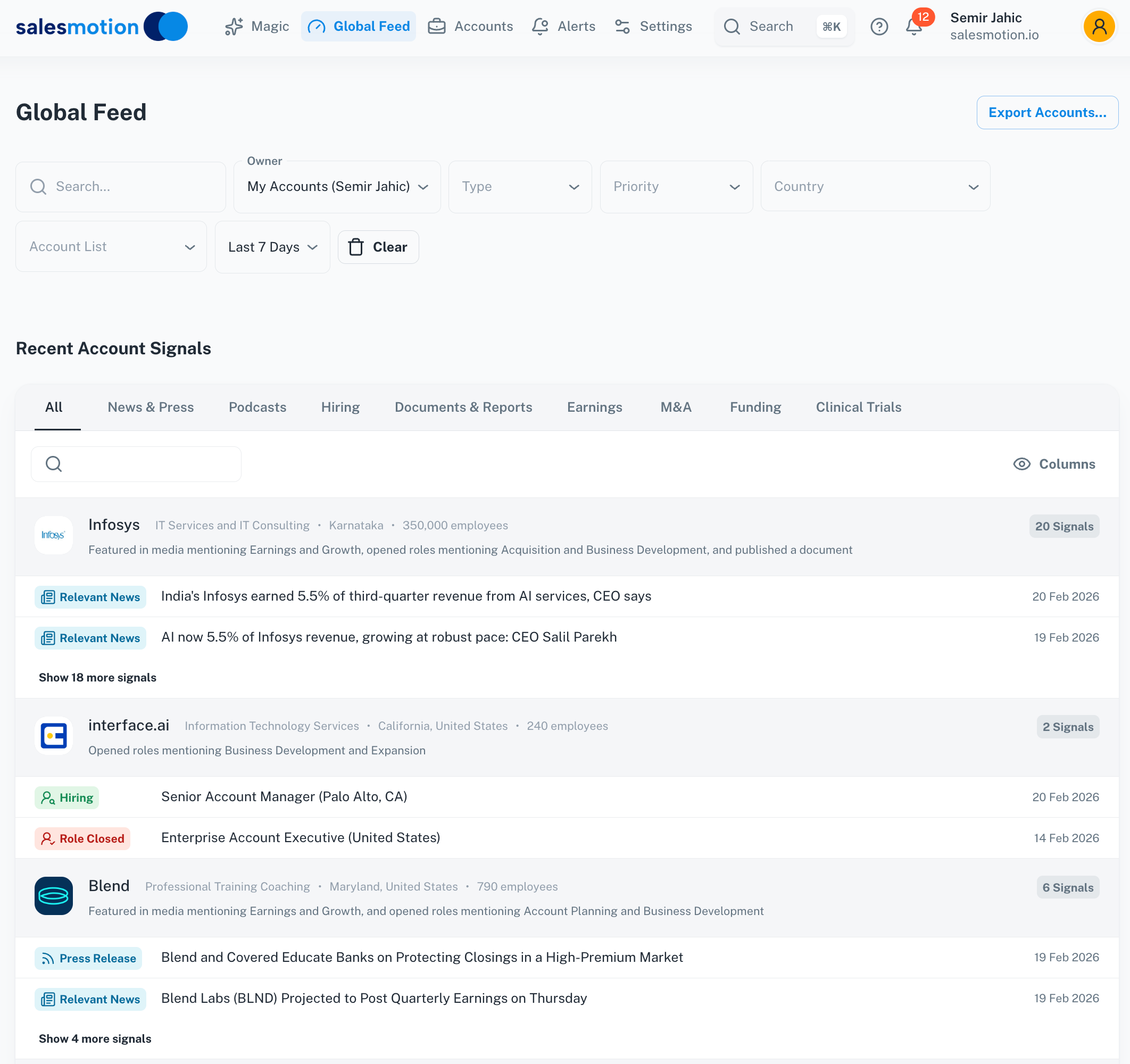 A signal feed surfaces the three highest-priority accounts with specific context for outreach, replacing the manual research cycle.
7:50 AM — Clicks into the top-priority account. The pre-built account brief shows the leadership change, the new contact's background, the company's recent initiatives, and recommended talking points. Five minutes of reading replaces 30 minutes of manual research.
7:55 AM — Drafts a personalized email referencing the leadership change and connecting it to a challenge the new contact likely inherited. Sends it.
8:00 AM — Moves to the second account. Reviews the job listing signal and the sales enablement framework the account brief recommends for this type of conversation. Calls the existing contact. Gets through. Has a 12-minute conversation anchored around the hiring signal, which the prospect confirms is tied to a new initiative launching in Q3. Books a demo for Thursday.
8:15 AM — Moves to the third account. The CEO quote gives her the perfect opening for a warm outreach to a new contact. She sends a LinkedIn connection request with a message referencing the quote and offering a relevant case study.
8:25 AM — Opens her prioritized pipeline view. Two deals have stalled. The intelligence layer flags that one of the stalled accounts just had a budget approval signal. She calls the contact immediately and learns the deal is back on track.
8:45 AM — One hour into her morning, Rep B has sent two personalized outreaches, had one live conversation that resulted in a booked demo, re-engaged a stalled deal, and updated her CRM automatically through activity capture. She still has 15 minutes before the team standup.
The difference is not talent. It is time allocation. Rep B spent zero minutes on manual research, zero minutes deciding who to call, and zero minutes on dead-end accounts. Every minute of her morning was spent on revenue-generating activity informed by real-time intelligence.

“The Business Development team gets 80 to 90 percent of what they need in 15 minutes. That is a complete shift in how our reps work.”
Andrew Giordano
VP of Global Commercial Operations, Analytic Partners
Building the System: A Practical Framework
Fixing the 72% problem is not a single purchase decision. It is an operational redesign with four layers.
Layer 1: Audit the Current State
Before changing anything, measure where time actually goes. Have every rep track their activities in 30-minute blocks for two weeks. Not what they think they do. What they actually do. Most sales leaders are shocked by the results. The gap between perceived selling time and actual selling time is typically 10-15 percentage points.
Layer 2: Eliminate Before You Automate
Cancel meetings that do not produce decisions. Remove CRM fields that nobody uses for reporting. Stop requiring reps to manually log activities that can be captured automatically. Kill the weekly forecast email that duplicates what is already in the CRM. The cheapest way to reclaim time is to stop wasting it, not to automate the waste.
Layer 3: Consolidate Intelligence
Replace the multi-tool research stack with a unified account intelligence layer. The goal is a single surface where reps see: which accounts to prioritize today, why those accounts matter right now, and what to say when they reach out. This is where tools like Salesmotion fit. Instead of asking reps to check six sources for account context, the intelligence comes to them in one view with scoring, signals, and recommended actions.
For a deeper look at how AI-powered prospecting tools fit into this stack, the key evaluation criteria are consolidation depth (how many research steps does it eliminate), signal quality (does it surface actionable triggers or just noise), and integration tightness (does it live inside the CRM or require another tab).
Layer 4: Redesign the Selling Day
With time freed and intelligence consolidated, restructure how reps spend their day:
- First 30 minutes: Review signal feed and prioritize outreach for the day
- Next 2-3 hours: Execute outbound based on signals (calls, emails, LinkedIn)
- Midday: Customer meetings, demos, and deal advancement calls
- Afternoon block: Follow-up, proposal work, and pipeline management
- Last 30 minutes: Next-day prep and CRM hygiene (most of which should be automated)
This structure ensures that the highest-energy hours go to the highest-value activities. For more on structuring selling time, see the full sales time management framework.
The Revenue Math That Should Terrify Sales Leaders
If your reps currently spend 28% of their time selling and you move that to 38%, here is what happens on a 20-person team:
- Current selling hours/week (team): 20 reps x 11.2 hours = 224 hours
- Improved selling hours/week (team): 20 reps x 15.2 hours = 304 hours
- Additional selling hours/year: 80 hours/week x 50 weeks = 4,000 hours
That is the equivalent of adding 7 full-time sellers to your team without a single new hire. If each rep carries a $1M quota, and your team is hitting 60% attainment on average, a 36% increase in selling time does not produce a linear 36% revenue increase. It compounds. More time on the right accounts means higher conversion rates, faster deal velocity, and better pipeline coverage. Conservative estimates suggest a 15-25% revenue lift from a 10-percentage-point improvement in selling time allocation.
The teams that figure this out first will use AI as an accelerant, not a gimmick. The teams that do not will keep hiring more reps to compensate for the productivity gap, spending more to grow less.
Key Takeaways
- The 28% problem is the quota problem. Reps spending only 28-30% of their week selling is the root cause behind the 78% quota miss rate. Fix the time allocation and quota attainment follows.
- More tools create more drag. The average rep uses 8 tools, and 72% feel overwhelmed. Sellers buried in tools are 45% less likely to hit quota. Consolidate before you add.
- Bad data is the silent killer. Reps lose 546 hours per year to inaccurate contact data. Fixing data quality produces more selling time than any process change.
- Top performers buy themselves 5-8 extra selling weeks per year by spending 35-40% of time on active selling. The difference is systems and prioritization, not hustle.
- AI done right is a 3.7x multiplier. But only when deployed against the specific non-selling activities that consume 72% of rep time: research, prioritization, and admin.
- Speed kills (in a good way). Delayed deal engagement reduces win rates by 113%. Real-time signals that tell reps which accounts to contact today, with specific context, are the highest-leverage investment in the stack.
- Audit before you act. Have reps track their actual time for two weeks. The gap between perceived and actual selling time is always larger than leaders expect.
Frequently Asked Questions
How do I calculate my team's actual selling time percentage?
Have every rep log their activities in 30-minute blocks for two full weeks. Categorize each block as either direct selling (live customer or prospect interactions, including calls, demos, negotiations, and active email exchanges about deals) or non-selling (everything else). Divide total selling blocks by total working blocks. Most teams land between 25-32%, with significant variation by rep. Do not use self-reported estimates, as reps consistently overestimate selling time by 10-15 percentage points. CRM activity data can supplement the manual audit but tends to undercount selling time because not all calls and meetings are logged accurately.
What is the fastest way to increase selling time without changing the tech stack?
Eliminate low-value meetings. Audit every recurring meeting on your team's calendar and ask: does this meeting produce a decision, coaching moment, or action item? If it has not done so in the last two occurrences, cancel it. Most mid-market sales teams carry 4-6 hours per week of recurring meetings that produce nothing. Cutting those in half gives every rep 2-3 hours back immediately. The second fastest lever is removing CRM fields that no one uses for reporting or decision-making. Every unnecessary field adds 30-60 seconds of data entry per opportunity update. Across hundreds of updates per month, that adds up to meaningful time savings.
How long does it take to see results from improving selling time allocation?
Expect leading indicators within 30 days and lagging indicators within 90 days. Leading indicators include: outbound activity volume (calls, emails, LinkedIn touches), meetings booked, and pipeline created. If your reps gain 4 hours of selling time per week, activity metrics should increase within the first month without any change in effort level. Lagging indicators like win rate improvement, average deal size increases, and quota attainment shifts take a full quarter to materialize because deals in the current pipeline were started under the old time allocation model. The exception is deal velocity: if reps respond to buying signals faster because they have fewer non-selling distractions, you can see cycle time improvements within 60 days.
Should I focus on automating research or eliminating admin first?
Start with admin elimination because it requires less change management and produces more immediate time savings. Canceling unnecessary meetings and removing unused CRM fields can be done in a single week with leadership authority. Automating account research requires tool selection, integration, and rep adoption, which typically takes 30-60 days. However, research automation produces the higher long-term return because it improves both the quantity and quality of selling time. Reps who start every outreach with fresh, signal-driven account intelligence do not just sell more. They sell better, with higher conversion rates and larger deal sizes. The ideal sequence is: eliminate admin waste in weeks one and two, then implement research automation in month two, then redesign the daily selling structure in month three.