The cybersecurity market is projected to exceed $300 billion by 2027, and every vendor in the space is chasing the same buyers: CISOs, security architects, and IT directors. The result is that cybersecurity decision makers are among the most heavily prospected professionals in B2B, and among the most skeptical of vendor outreach. Finding accurate contact data for cybersecurity sales is only half the challenge. The other half is reaching these contacts with enough context and timing to earn their attention.
TL;DR: Cybersecurity buyers are over-prospected and highly skeptical. Effective B2B contact data for cybersecurity sales requires specialized sourcing for security-specific roles, real-time monitoring for breach events and compliance deadlines that create buying urgency, and personalized outreach that demonstrates genuine understanding of the buyer's environment.
Why Cybersecurity Contact Data Is Different
Selling cybersecurity solutions means navigating a buyer landscape that is fundamentally different from other B2B verticals.
Security leaders are intentionally hard to reach. CISOs and security directors limit their digital footprint for professional reasons. Many use sanitized LinkedIn profiles, do not list direct contact information publicly, and route all vendor communication through procurement or a security operations team. This is not negligence. It is a deliberate practice by professionals who understand the risks of exposed contact information.
The buying committee crosses organizational boundaries. A cybersecurity purchase touches IT, security, compliance, legal, and often the board of directors. The CISO may champion the purchase, but the CTO controls infrastructure decisions, the CIO controls budget allocation, and the General Counsel evaluates liability implications. Your contact data must cover this multi-department buying committee.
Urgency is event-driven. Cybersecurity purchases often accelerate after a breach, a regulatory change, or an audit finding. These events create compressed buying windows where decisions that normally take 6-12 months happen in weeks. The teams that detect these urgency signals first gain a significant advantage. A Ponemon Institute study found that companies increase cybersecurity spending by an average of 20-30% in the 12 months following a significant security incident.
Key Decision Maker Roles in Cybersecurity Sales
Five roles form the core buying committee for most cybersecurity technology purchases.
Chief Information Security Officer (CISO)
The CISO is the primary buyer for security tools and services. They set security strategy, manage the security budget, and evaluate vendors. In large enterprises, the CISO may report to the CIO, the CTO, or directly to the CEO. Their reporting line affects their budget authority and decision-making independence. CISOs at companies with board-level security oversight tend to have larger budgets and faster purchase authority.
VP of Security / Director of Security
This role manages day-to-day security operations and typically reports to the CISO. They are the operational evaluator for security tools, conducting proof-of-concept tests, managing vendor relationships, and overseeing implementation. In many deals, the VP of Security is the person who drives the evaluation even though the CISO has final approval.
Security Architect
Security architects design the technical security infrastructure. They evaluate how new tools integrate with existing security stacks, assess technical compatibility, and make architecture decisions that determine which vendors can even be considered. Missing this contact means your product may be architecturally disqualified before it reaches business evaluation.
Head of Governance, Risk, and Compliance (GRC)
The GRC leader ensures the organization meets regulatory requirements, manages risk frameworks, and oversees audit readiness. They influence purchases related to compliance automation, risk management, and audit tools. For products that help organizations meet SOC 2, ISO 27001, or NIST framework requirements, the GRC head is often the initiating buyer.
IT Director
The IT Director manages infrastructure, network operations, and endpoint management. They evaluate security tools that integrate with IT operations, including SIEM, endpoint protection, identity management, and network security. In mid-market companies without a dedicated CISO, the IT Director often owns the security function entirely.

“The account and contact signals are key for reaching out at important times, and the value-add messaging it creates unique to every contact helps save time and efficiency.”
Daniel Pitman
Mid-Market Account Executive, Black Swan Data
Data Quality Challenges in Cybersecurity Prospecting
Cybersecurity contact data faces unique quality problems.
Security professionals minimize their digital footprint. Many CISOs and security leaders deliberately reduce their publicly available information. They use generic LinkedIn headlines, do not list email addresses on conference bios, and some maintain separate professional identities for vendor interactions. Standard B2B databases capture their name and company but often have outdated or generic contact information.
Titles are inconsistent across industries. The person responsible for cybersecurity might be called CISO at a tech company, VP of Information Security at a bank, Director of Cybersecurity at a healthcare system, and IT Security Manager at a manufacturer. Cross-industry prospecting requires title mapping that accounts for these variations.
The cybersecurity org chart is evolving. The security function is increasingly separated from IT, with CISOs reporting to CEOs or boards rather than CIOs. This organizational shift means security contacts are moving to new departments, changing reporting lines, and gaining or losing budget authority. Databases that still categorize security under IT may show the wrong org structure.
Vendor fatigue makes accuracy existential. Cybersecurity buyers receive dozens of cold outreach messages weekly. Any signal of inaccuracy, such as a wrong title, an outdated company reference, or an email to someone who left the role, confirms the buyer's assumption that the vendor did not do their homework. In this market, data accuracy is not just an efficiency issue. It determines whether your message gets read or deleted.
Where to Find Cybersecurity Contacts
Building a high-quality cybersecurity contact list requires specialized sourcing.
Security Industry Directories
Organizations like ISACA, ISC2, and SANS maintain member directories and publish speaker lists from major conferences. RSA Conference, Black Hat, and DEF CON speaker rosters provide high-quality contacts with built-in credibility indicators.
B2B Databases with Security Filters
ZoomInfo and Apollo provide broad coverage of cybersecurity contacts, especially at enterprise companies. Their security-specific filters help narrow results to CISO, VP Security, and related titles. Accuracy varies: enterprise companies are well-covered, while mid-market organizations often have outdated or missing security leadership data.
Signal-Based Monitoring
Breach events, regulatory deadlines, and security leadership transitions are the most actionable signals in cybersecurity sales. Salesmotion monitors these events across organizations, flagging accounts where a new CISO was hired, a compliance deadline is approaching, or a security incident was disclosed. These signals identify not just who to contact but when they are most likely to engage.
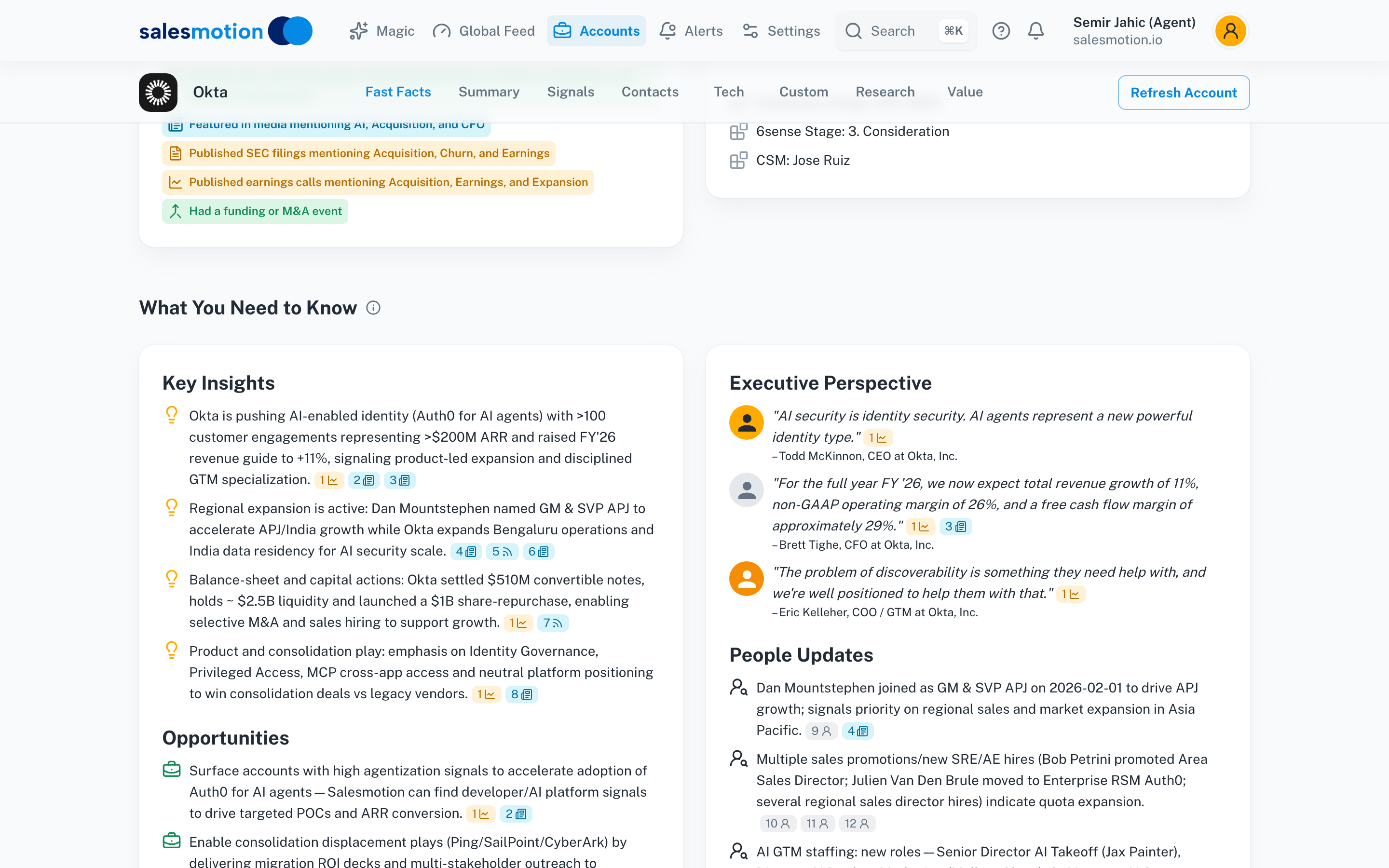 Salesmotion surfaces key insights, executive perspectives, people moves, and talking points — giving reps the context behind every contact.
Threat Intelligence and Regulatory Sources
Public breach notification databases, SEC cyber incident disclosure filings, and regulatory enforcement actions identify organizations that are actively dealing with security challenges. These are sensitive signals that require careful handling in outreach, but they reliably indicate budget allocation for security improvements.

“Salesmotion has been a game-changer for me. I used to spend 12 hours a week on prospect research, now it's down to 4. Plus I'm finding stuff I was totally missing - podcasts, news mentions, the good bits.”
George Treschi
Account Executive, FY25 President's Club, Sigma
Cybersecurity Contact Data: Source Comparison
| Source Type | Coverage | Accuracy | Cost | Best For |
|---|---|---|---|---|
| General B2B databases | Broad, enterprise-focused | Moderate (65-75%) | $15K-$60K/yr | Enterprise CISO contacts |
| Security industry directories (ISACA, ISC2) | Narrow, security-specific | High (member-verified) | Membership-based | Verified security professionals |
| Conference speaker lists (RSA, Black Hat) | Narrow, high-influence | High (public, current) | Varies | Reaching security thought leaders |
| Signal-based platforms | Real-time, event-enriched | High (verified + contextualized) | Mid-market pricing | Breach response, leadership transitions |
| SEC cyber disclosures | Narrow, incident-specific | Very high (regulatory filing) | Free | Identifying breach-response buying |
Building a Cybersecurity Sales Prospecting Workflow
Here is how a signal-driven cybersecurity prospecting workflow works in practice.
A mid-market fintech company files a cyber incident disclosure with the SEC and simultaneously posts two job listings: a CISO (new role) and a Senior Security Engineer. Salesmotion flags the account, surfaces the incident disclosure details, the company's technology stack, and the current IT Director who has been handling security responsibilities.
The rep reviews the account intelligence and builds two outreach tracks. The first targets the IT Director with a message acknowledging their expanded responsibilities and offering a specific capability relevant to the incident type disclosed. The second is prepared for the incoming CISO, ready to deploy as soon as the hire is announced.
This approach works because it is timed to genuine urgency, personalized to the buyer's situation, and respectful of the sensitivity involved. Cybersecurity buyers respond to competence and discretion, not aggressive sales tactics.
For a full list of B2B contact data providers, see our comparison. For more on using signals to drive pipeline, see our guide on buying signals and our alternatives page for competitive comparisons.
Key Takeaways
- CISOs and security leaders deliberately minimize their digital footprint, making standard contact sourcing methods less effective
- The cybersecurity buying committee spans security, IT, compliance, legal, and executive leadership, requiring broad contact coverage per account
- Breach events, regulatory deadlines, and CISO transitions create compressed buying windows where speed matters
- Security industry directories (ISACA, ISC2) and conference speaker lists provide higher-accuracy contacts than general B2B databases
- Data accuracy is especially critical in cybersecurity sales where vendor fatigue means any error gets your message deleted
- Signal-driven outreach timed to security events outperforms scheduled cadences by a wide margin in this vertical
Frequently Asked Questions
How do I reach a CISO who limits their contact information?
CISOs are intentionally difficult to reach through cold channels. The most effective approaches include warm introductions through mutual connections, engaging with their published content (conference talks, blog posts, LinkedIn articles), and attending security-specific events where they participate. When using cold outreach, reference specific security challenges at their organization to demonstrate genuine research, not just a name from a list.
What are the strongest buying signals for cybersecurity sales?
The strongest signals are: security incident disclosures (public filings or news reports), new CISO or VP Security hires (new leaders evaluate and replace vendors), regulatory compliance deadlines (SOC 2, ISO 27001, DORA), and security team hiring surges (indicating expanded capabilities). These signals indicate both budget availability and active evaluation windows.
How do I prospect into cybersecurity without being perceived as exploiting a breach?
This requires careful positioning. Never reference a breach directly in cold outreach. Instead, focus on the organizational signals around the event: new security leadership hires, compliance investments, and technology stack changes. Position your product as helping organizations strengthen their security posture proactively. The account research should inform your approach without becoming the message itself.
Is cold email effective for cybersecurity sales?
Cold email can work for cybersecurity sales when it demonstrates deep technical understanding and is timed to relevant events. Generic batch emails perform poorly because security professionals are trained to be skeptical of unsolicited messages. The most effective approach: send brief, technically specific emails that reference the buyer's actual environment and a relevant signal. Expect lower volume and higher conversion compared to other verticals.