A solid customer value proposition template is your roadmap for crafting a message that connects with buyers. It's not about generic claims. It’s about building a framework that helps you articulate exactly how your solution solves a specific customer's problem, why they should act now, and what business outcomes they can expect.
This is the difference between being ignored and starting a real sales conversation.
Why Your Generic Value Proposition Is Failing
Let's be blunt: most value propositions are forgettable. They’re often stuffed with buzzwords like "industry-leading" or "innovative solutions" that make you sound just like every competitor in your prospect's inbox. This one-size-fits-all approach consistently falls flat in complex B2B sales.
This is especially true in high-stakes industries like B2B SaaS, life sciences, and financial services, where buyers are sophisticated, skeptical, and have no time to waste. A generic message isn't just ineffective; it has real consequences for your revenue team.
The True Cost of Weak Messaging
When your sales team lacks a sharp, relevant message, your go-to-market motion grinds to a halt. Reps waste hours digging through scattered sources just to find a compelling reason to reach out. This leads to sloppy account planning and outreach that completely misses the mark.
This mess usually results in:
- Longer Sales Cycles: Deals stall because buyers don't see the urgency or how your solution connects to their immediate priorities.
- Wasted Rep Time: AEs and SDRs spend a huge chunk of their week on manual research instead of selling.
- Low Conversion Rates: Generic outreach gets deleted on sight, leading to poor reply rates and fewer meetings booked.
These problems create a massive value gap—the canyon between what your product does and what the customer actually needs right now. Closing this gap means ditching static statements and moving to a more dynamic approach.
A value proposition should be a living part of your sales process, not a static paragraph on your website. It must adapt to the buyer's context and be powered by real-time intelligence to create urgency.
Shifting to a Signal-Driven Approach
The solution is a dynamic, signal-driven Customer Value Proposition (CVP). This modern approach transforms your messaging from a megaphone blast into a targeted, relevant conversation. Instead of leading with your product, you lead with a deep understanding of the prospect’s world—their goals, challenges, and the pressures they're facing today.
Simply put, a generic value prop is static, while a signal-driven CVP is dynamic and adaptive.
Generic vs. Signal-Driven CVP At a Glance
Here’s a quick breakdown of how the two approaches stack up.
| Attribute | Generic Value Proposition | Signal-Driven CVP |
|---|---|---|
| Foundation | Based on internal product features and broad market assumptions. | Built on real-time account signals, challenges, and strategic priorities. |
| Focus | "What we do." (Product-centric) | "What you're trying to achieve, and why this matters now." (Customer-centric) |
| Timing | Sent anytime, hoping for a response. | Deployed at the moment of need, triggered by a specific event. |
| Personalization | Uses basic firmographics like industry or company size. | Hyper-personalized around recent events, hires, or stated goals. |
| Outcome | Low engagement, easily ignored, high chance of being seen as spam. | High relevance, sparks curiosity, and positions you as a strategic partner. |
Ultimately, a signal-driven approach makes your message impossible to ignore because it’s rooted in the prospect's reality, not your marketing brochure.
In B2B sales, a well-crafted CVP template isn't just a nice-to-have; it's a game-changer. Research shows that companies prioritizing clear, unique value propositions in their sales playbooks achieve 19% higher win rates in complex deals. Additionally, sales ops teams using structured CVP templates report 15-25% reductions in sales cycle times, because reps spend less time trying to manufacture a compelling "why now."
This is all about transforming how your team engages key accounts by connecting your solution directly to their most pressing business needs.
See Salesmotion in action
Take a self-guided interactive tour — no signup required.
Bringing the Signal-Driven CVP to Life
Alright, let's get practical. Enough with the theory. Your enterprise AEs and SDRs need a real tool they can use today. This is it: a signal-driven customer value proposition template built for the complex world of B2B sales.
Think of this less as a rigid script and more as a flexible framework for building a killer sales narrative. It forces your reps to connect your solution directly to a prospect's pressing goals and pains, making every conversation and email hit home.
This isn't just a messaging guide; it's a strategic asset for account planning. It gets every member of your revenue team—from the newest BDR to the most seasoned AE—approaching a target account with the same sharp, value-led point of view.
The Five Building Blocks of the Template
Our signal-driven customer value proposition template breaks down into five actionable parts. Each piece builds on the last, creating a logical and compelling argument for why a prospect should talk to you right now.
Here’s a look at the core components:
- The Core Problem: What's the specific business challenge or strategic priority keeping their leadership team up at night? This needs to go beyond surface-level pains.
- The 'Why Now' Trigger: What recent event, or signal, makes this problem impossible to ignore? This is your catalyst, the spark that demands action.
- Our Unique Solution: How does your solution directly solve the core problem, especially now that the 'why now' trigger has made it urgent? This is your clear, concise answer.
- Quantifiable Business Outcomes: What are the measurable, concrete results they can expect? We're talking dollars, percentages, and time—metrics that matter to the C-suite.
- Relevant Proof Points: Where have you done this before? Show them you've helped similar companies solve this exact problem. This is how you build trust and de-risk the decision.
Following this structure shifts your team's mindset from being product-centric ("We sell X") to problem-centric ("We solve Y, which you're dealing with today because of Z"). It’s a game-changer.
Deconstructing Each Piece of the CVP
To make this stick, let's break down what goes into each section. Mastering this structure is the key to effective signal-based selling, turning raw intelligence into a narrative that persuades.
The Core Problem
This is your anchor. It isn't a minor inconvenience; it's a significant business issue with executive attention. Think strategic imperatives like "improving clinical trial efficiency," "slashing cloud infrastructure spend," or "accelerating market entry in APAC."
You'll find these nuggets in earnings call transcripts, annual reports, or executive interviews. Nail this, and you instantly show you've done your homework and understand their big-picture goals.
The 'Why Now' Trigger
This is where the magic happens. The 'why now' trigger is the specific, timely event that pushes the core problem to the top of the priority list. It’s the hook that makes your outreach impossible to ignore.
A trigger can be anything: a new C-level hire, a recent acquisition, a critical mention in an analyst report, or a looming regulatory change. This signal provides the urgency and context for your entire message.
For example, a platform can help your team spot these critical signals, which are the foundation of this template.
A screenshot like this shows how an account intelligence platform like Salesmotion can surface these triggers automatically, saving reps countless hours of manual digging. By tracking events across target accounts, the platform delivers the 'why now' right into your team's workflow.
Our Unique Solution
Once you’ve established the problem and the trigger for action, you can introduce your solution as the logical next step. This is not a feature dump. It’s a clean, concise statement that connects what you do directly to their situation.
For instance: "Our platform automates clinical supply chain logistics, which helps life sciences firms like yours accelerate trial timelines—a key priority you mentioned in your Q2 earnings call."
The goal isn't to explain everything you do. It's to explain how you solve the one thing they care about most right now.
Quantifiable Business Outcomes
Enterprise buyers, especially executives, speak the language of numbers. Vague promises about "efficiency" or "improvement" will get you nowhere. You have to translate your solution’s benefits into the metrics that matter to the business.
Focus on outcomes tied to three core value pillars:
- Make Money: "Increase new customer acquisition by 15%."
- Save Money: "Reduce operational overhead by $2.1M annually."
- Reduce Risk: "Ensure 100% compliance with new data privacy regulations."
Using specific, hard numbers makes your value proposition feel real, tangible, and credible.
Relevant Proof Points
Finally, back it all up. This is where you provide the social proof that you’ve solved this exact problem for a company they respect. A strong proof point isn’t just a logo; it’s a mini-story.
For example: "We helped [Similar Company in their Industry] navigate their recent merger by integrating their disparate IT systems, resulting in 30% faster data migration than they projected."
This builds trust and shows the prospect you're a safe bet. It aligns perfectly with value-selling methodologies like MEDDICC, which focus heavily on metrics and proof.

“We're no longer fishing. We know who the right customers are, and we can qualify them quickly. Salesmotion has had a direct impact on pipeline quality.”
Andrew Giordano
VP of Global Commercial Operations, Analytic Partners
How to Research and Back Up Your CVP with Real Intelligence
A customer value proposition template is just an empty shell. Its power comes from the specific, credible, and timely information you pour into it. This is where the real work begins—and where most reps fall short. Solid research turns a generic pitch into a persuasive tool that opens doors.
It's about moving from assumptions to evidence. When you do this right, you're not just guessing what matters to an executive; you know. Let's walk through how to find the right information for each section of your CVP.
This entire process is driven by signals. You spot a trigger, which points to a problem, which allows you to position your solution and its outcomes with real proof.
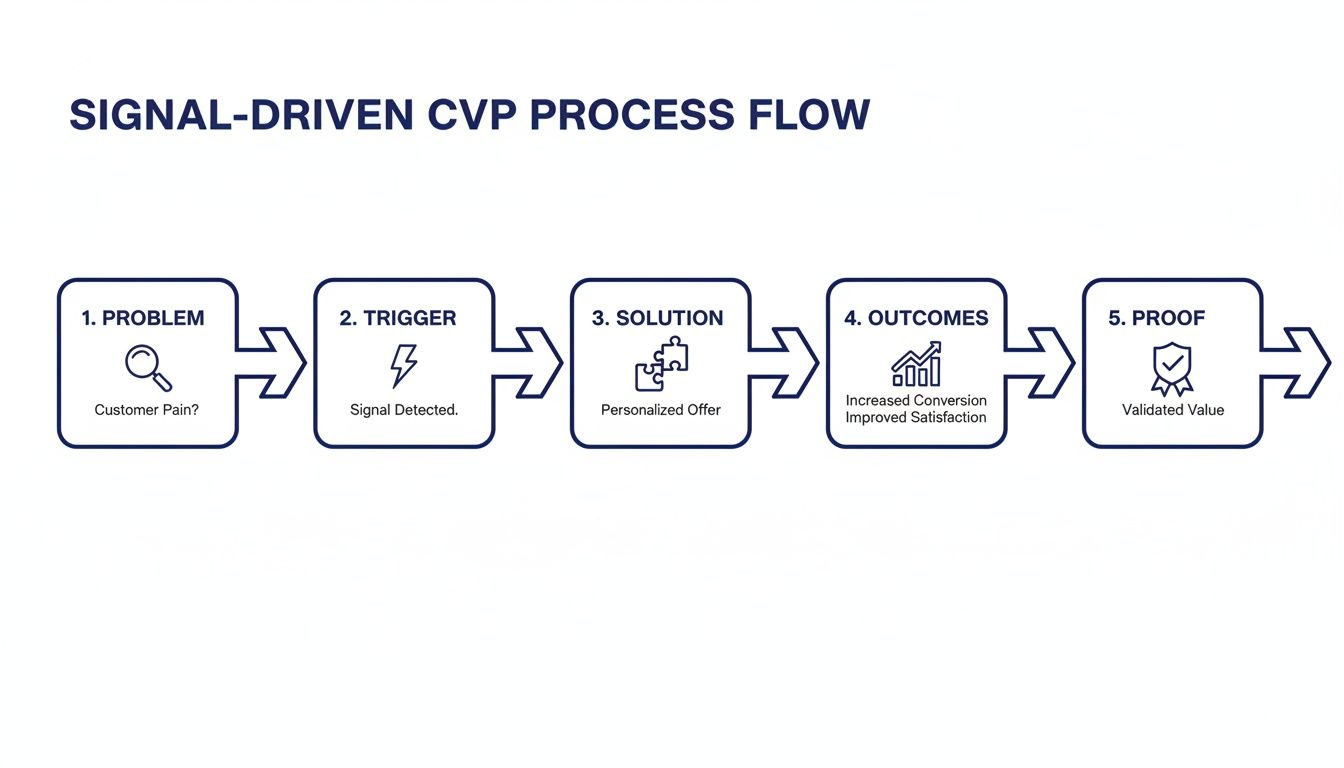
The big takeaway? A compelling CVP isn't created in a vacuum. It’s a direct response to a specific problem that has become urgent because of a timely trigger. Your solution becomes the logical next step.
Uncovering the Core Problem
The core problem isn’t just a minor pain point; it’s a strategic priority that already has the C-suite’s attention. Your job is to connect your solution to one of these big-ticket initiatives. To do that, you need to dig into the sources where leadership broadcasts their strategy.
Where to look for this intel:
- Earnings Call Transcripts: Executives will spell out their top priorities for the coming quarters. Listen for phrases like "our primary focus is" or "a key headwind we're facing." This is your cheat sheet.
- 10-K and Annual Reports: Don't skip these. The "Risk Factors" and "Management's Discussion and Analysis" (MD&A) sections are goldmines. They state the challenges the company is wrestling with and the market pressures they feel.
- Investor Day Presentations: This is where the company lays out its long-term vision. These presentations give you a clear roadmap of where the business is headed and what obstacles they expect to hit.
When you anchor your CVP in the company's own language, you immediately establish credibility. You’re not just another vendor; you're a strategic partner who understands their world.
The best reps don't sell products; they solve strategic problems. Your ability to articulate the core problem in the C-suite's own words is what separates you from the noise.
Identifying the "Why Now" Trigger
The "Why Now" trigger is the catalyst—the recent event that makes the core problem urgent enough to act on right now. This is where real-time account intelligence is essential.
Account signals are your best friend here. These are the specific, timely events that create an opening for a conversation.
Common "Why Now" Triggers to Watch For:
- New Executive Hire: A new CIO or VP of Operations wasn't hired to maintain the status quo. They have a mandate to drive change and are under pressure to show results within their first 90-120 days. That's your window.
- Recent M&A Activity: Mergers and acquisitions are chaotic. They create massive integration challenges, from combining IT systems to consolidating supply chains. This disruption is a powerful trigger for any solution that brings order to that chaos.
- Negative Analyst Report: If a major firm like Gartner or Forrester downgrades a company due to "inefficient operations," you have powerful, third-party validation for your outreach.
- Industry Trend or Regulation: A new data privacy law (like GDPR) or a major shift in consumer behavior can force a company to re-evaluate its strategy, creating an urgent need for solutions that help them adapt.
Turning these signals into a compelling narrative is what separates good from great. Understanding every touchpoint a customer has with a business is vital; learning about customer journey mapping can help you identify more nuanced triggers. The goal is to connect the signal directly to the problem you solve. For instance, "I saw you just hired a new Chief Transformation Officer; leaders in this role are often tasked with finding new efficiencies, which is exactly where we help."
Calculating Quantifiable Business Outcomes
Once you’ve nailed the problem and the trigger, it’s time to talk numbers. Vague promises of "improvement" will get you nowhere with senior leaders. You have to translate your solution's benefits into the metrics that CFOs and line-of-business owners care about.
The trick is to connect your solution to one of three core financial levers: increasing revenue, decreasing costs, or mitigating risk.
Simple Formulas for Proving Your Impact:
- Cost Reduction: (Current Cost) x (% Savings from Your Solution) = Annual Savings
- Example: "We help companies like yours reduce cloud spend by an average of 22%. For a company with a $10M cloud budget, that's $2.2M back to your bottom line."
- Revenue Growth: (# of Reps) x (Increased Productivity per Rep) x (Average Deal Size) = Added Revenue
- Example: "Our platform saves each of your 100 reps 5 hours a week. That's time they can use to close one extra deal per quarter, adding $2M in new pipeline."
- Risk Mitigation: (Cost of a Single Compliance Breach) x (Reduction in Breach Likelihood) = Value of Risk Averted
- Example: "With the average data breach now costing $4.45 million, our solution reduces that risk by over 60%, protecting both your balance sheet and your brand."
These aren't complex financial models. They're simple, back-of-the-napkin calculations that make the value of your solution tangible and easy for an executive to grasp. Tools can help streamline this research; you can explore the best account research software to automate data gathering so you can focus on analysis. This is how you build a business case that gets a "yes."
See the CVP Template in Action: 3 Real-World Examples
Theory is one thing, but seeing a customer value proposition template in action is where it all clicks. The magic happens when you turn raw account intelligence into a sharp, persuasive narrative that gets a buyer's attention.
Let's walk through three scenarios to show you how it’s done. We'll start with a raw account signal—the kind of trigger you'd get from an intelligence platform—and then build out the entire CVP. This shows how the framework flexes across different industries and personas.
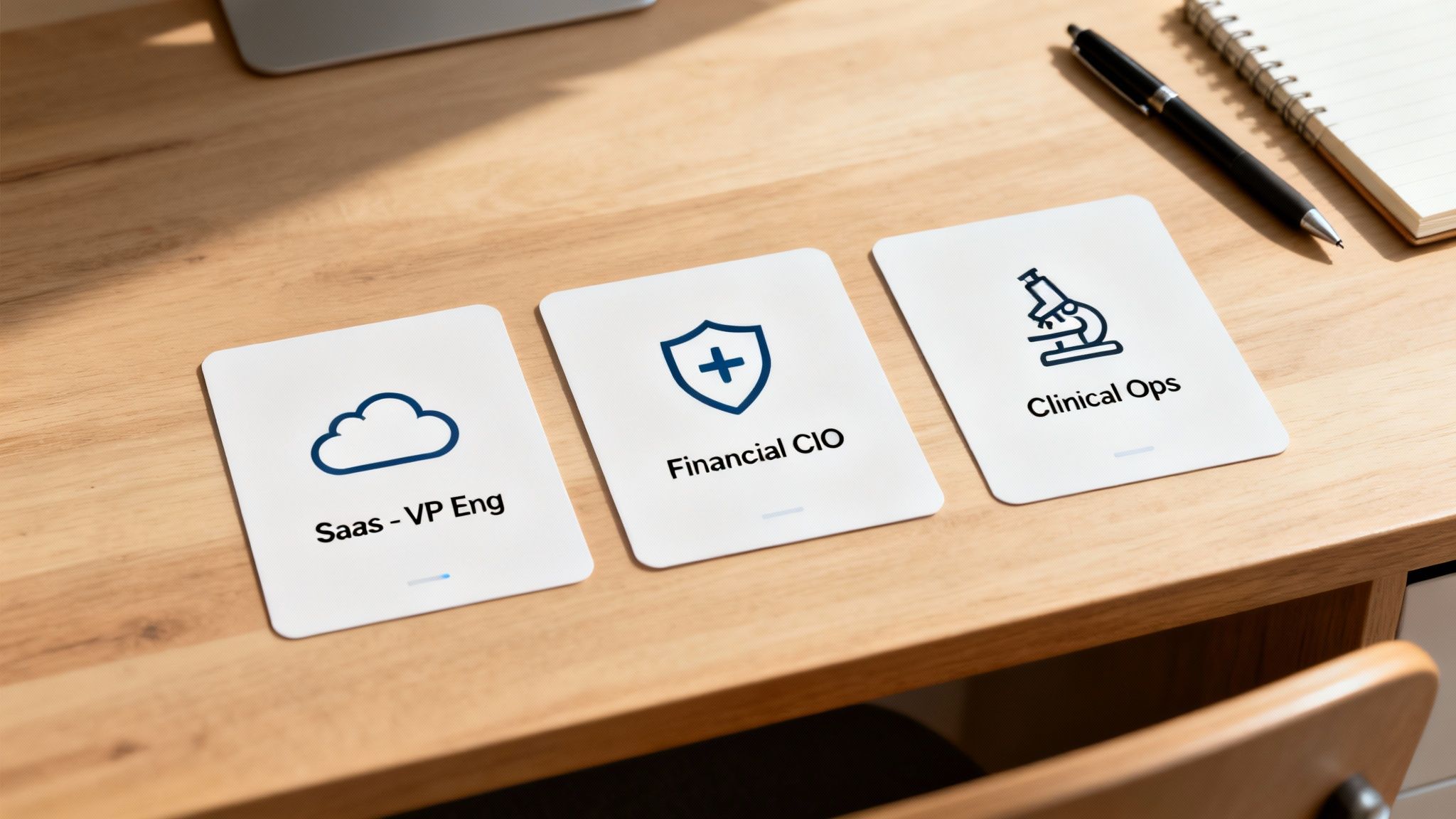
B2B SaaS Selling to a VP of Engineering
Imagine you sell a DevOps platform designed to streamline software development. You're targeting a fast-growing tech company, and your ideal buyer is the VP of Engineering.
The Raw Signal: “I see on LinkedIn that Acme Tech just hired a new VP of Engineering, Sarah Jones. Her profile mentions a background in scaling teams at hyper-growth startups.”
This is a classic "new leader" trigger. A new executive, especially one with a mandate to scale, is under immediate pressure to make an impact. Now, let’s flesh out the CVP.
Completed CVP Template:
- The Core Problem: The company needs to speed up its product roadmap to beat competitors, but current engineering processes are fragmented and inefficient, causing slow release cycles.
- The 'Why Now' Trigger: The hiring of Sarah Jones, a new VP of Engineering tasked with scaling the org, creates an urgent need to modernize their DevOps toolchain in her first 90 days.
- Our Unique Solution: Our integrated DevOps platform consolidates tooling and automates CI/CD pipelines, directly helping engineering leaders like Sarah improve developer productivity and ship code faster.
- Quantifiable Business Outcomes: We can help Acme Tech boost deployment frequency by 40% and cut lead time for changes by 30%, getting critical new features to customers a full quarter ahead of schedule.
- Relevant Proof Points: We helped a similar growth-stage SaaS company, Innovate Corp, get these exact results after they brought on a new engineering leader, which was a key factor in their successful Series C funding round.
This CVP transforms a simple LinkedIn update into a highly relevant, value-driven conversation starter.
IT Services Targeting a Financial Services CIO
Now, let's switch gears. You work for an IT services firm specializing in cloud migration and security. Your target is the CIO of a mid-sized regional bank.
The Raw Signal: “In their latest earnings call, Sterling Bank’s CEO mentioned a new strategic initiative to ‘modernize core banking infrastructure to enhance customer experience and operational efficiency.’”
This signal is gold. It’s a top-down strategic priority from the CEO, giving you the perfect opening to engage the CIO.
When you can connect your solution to a CEO-level initiative mentioned in an earnings call, your message is no longer a cold pitch. It's a strategic suggestion that proves you understand their business priorities.
Completed CVP Template:
- The Core Problem: Sterling Bank’s legacy on-premise infrastructure is expensive to maintain, slows the launch of new digital services, and exposes them to growing cybersecurity risks.
- The 'Why Now' Trigger: The CEO's public commitment to modernizing core infrastructure puts immense pressure on the CIO to deliver a cloud migration plan that shows progress within the next two quarters.
- Our Unique Solution: We provide managed cloud migration services for financial institutions, ensuring a secure and compliant transition of core banking systems to a modern, scalable environment.
- Quantifiable Business Outcomes: Our approach typically reduces infrastructure TCO by 25% annually and helps banks launch new digital products 50% faster, all while meeting stringent FFIEC compliance standards.
- Relevant Proof Points: We recently managed the full cloud migration for [Regional Bank Peer], resulting in $1.8M in operational savings and a successful audit with zero compliance issues.
This CVP connects your services directly to the bank's most important strategic goal, positioning you as an expert partner, not just another vendor.
Life Sciences Engaging a Director of Clinical Operations
Finally, let's look at a life sciences tech company selling a clinical trial management system (CTMS). Your buyer is the Director of Clinical Operations at a mid-sized biotech firm.
The Raw Signal: “PharmaCorp just announced in a press release that their lead drug candidate is entering Phase III trials, a major milestone for the company.”
This signal points to a massive increase in complexity and pressure. Phase III trials are incredibly expensive and operationally intense, making efficiency a top priority.
Completed CVP Template:
- The Core Problem: Managing a large-scale, multi-site Phase III trial with spreadsheets and disconnected systems leads to data errors, delays, and a high risk of non-compliance, which could jeopardize the drug approval process.
- The 'Why Now' Trigger: Kicking off the Phase III trial for their lead drug creates an immediate, high-stakes need to streamline clinical operations to ensure the trial runs on time and on budget.
- Our Unique Solution: Our unified CTMS platform provides a single source of truth for managing trial sites, patient recruitment, and data collection, designed for the complexity of late-stage clinical trials.
- Quantifiable Business Outcomes: Clients using our platform for Phase III trials typically see a 20% reduction in site startup times and a 15% improvement in patient enrollment rates, accelerating their timeline to a potential FDA submission.
- Relevant Proof Points: We supported [Similar Biotech Company] through their successful Phase III trial, which they completed three months ahead of schedule, citing our platform as a key reason for their operational efficiency.
Each of these examples shows how a customer value proposition template, when fueled by real-time intelligence, becomes a powerful tool for crafting messages that are impossible for your buyers to ignore.
“We have very limited bandwidth, but Salesmotion was up and running in days. The template made it easy to load our accounts and embedding it in Salesforce was simple. It was one of the easiest rollouts we've done.”
Andrew Giordano
VP of Global Commercial Operations, Analytic Partners
Putting Your CVP to Work in Your Sales Process
Creating a great customer value proposition template is a huge step, but it's only powerful when you weave it into your daily sales workflow.
A CVP sitting in a shared drive is just another document. But a CVP that informs every email, call, and meeting is a revenue-generating asset. The goal is to make it a living part of your sales motion, not just a box-checking exercise.
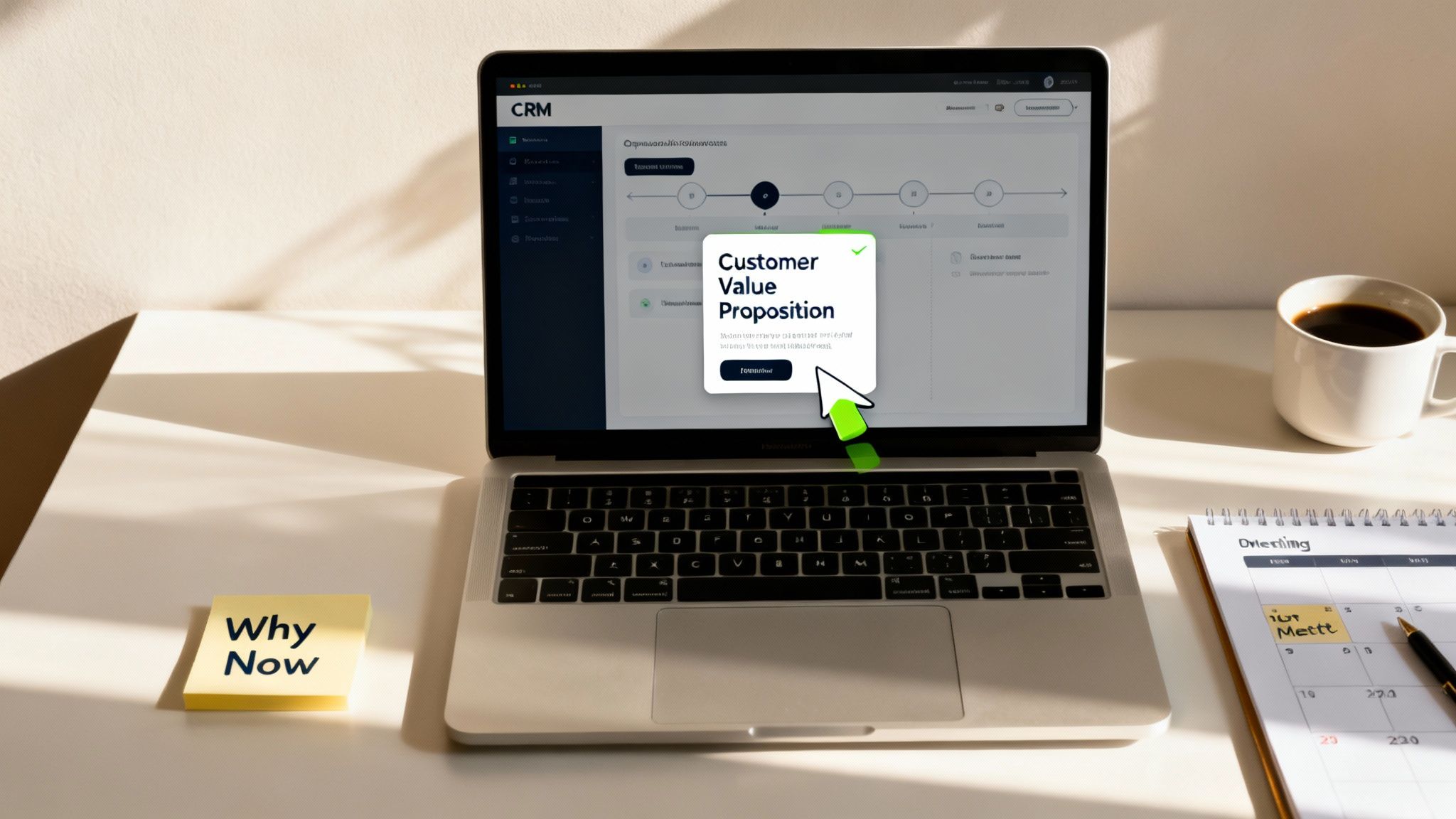
This is where you’ll see the return on your research and strategy. It’s about turning a static template into a dynamic tool that drives relevant engagement across your entire revenue team. Every conversation, from the first touchpoint, needs to be led by value.
Integrating the CVP into Your Core Workflows
To make the CVP effective, it has to be simple for reps to access and use where they work. This means embedding it directly into your key sales tools and processes.
Here’s how to put it to work:
- Embed it in Your CRM: Create custom fields or a dedicated object in your CRM for each of the five CVP components. This keeps the value prop tied to the account record, making it the source of truth for anyone who touches that customer.
- Power Your Outbound Sequences: Use the CVP to build highly personalized, multi-touch outbound sequences. The 'Why Now' trigger becomes your email subject line. The 'Core Problem' frames your opening paragraph. The 'Quantifiable Outcomes' provide a compelling call to action.
- Streamline Meeting Prep: Make reviewing the account’s CVP a mandatory step in your pre-call planning checklist. This ensures every AE walks into a meeting armed with a sharp point of view, ready to lead a strategic conversation instead of a generic product demo.
A well-structured CVP acts as the connective tissue for your GTM strategy. It aligns SDRs, AEs, and marketing on the same value-led message, ensuring a consistent and compelling customer experience.
Automating the 'Why Now' for Maximum Impact
Let's face it, the toughest part of keeping a CVP dynamic is consistently finding the timely signals for the 'Why Now' section. This is where automation is a game-changer. Manual research is slow, inconsistent, and a grind.
Platforms like Salesmotion can automate this intelligence gathering for you.
By tracking key accounts 24/7, the platform surfaces critical triggers—like executive hires, new strategic initiatives in earnings calls, or M&A activity—and delivers them directly into your reps' workflow. This transforms the CVP from a document that gets updated quarterly into an always-on asset fueled by real-time intelligence.
This level of personalization drives loyalty. For AEs and SDRs, this approach drastically reduces the 'generic sequence' pitfalls responsible for up to 65% of lost deals, as they can auto-generate trigger-based messaging.
This constant flow of relevant information ensures your team's outreach is always anchored to a specific, timely event, making it far more likely to cut through the noise. By turning raw signals into actionable insights, you can build a more effective sales enablement framework that scales relevance across the entire team.
Key Takeaways
- A signal-driven customer value proposition template transforms generic messaging into highly relevant sales conversations by connecting your solution to a prospect's specific priorities, pain points, and timely business triggers.
- The five building blocks of an effective CVP are: the Core Problem, the "Why Now" Trigger, Your Unique Solution, Quantifiable Business Outcomes, and Relevant Proof Points -- each building on the last to create a compelling argument.
- Companies prioritizing clear, unique value propositions achieve 19% higher win rates in complex deals, while structured CVP templates reduce sales cycle times by 15-25%.
- The "Why Now" trigger is the most critical element -- it provides the urgency and context that makes your outreach impossible to ignore, whether it is a new executive hire, a funding round, or a regulatory change.
- A CVP must be a living document embedded in your CRM and daily workflows, updated whenever material account signals emerge, not a static paragraph filed away in a shared drive.
Common Questions About CVP Templates
Even with a solid framework, questions pop up when putting a new process into practice. Let's tackle some of the most frequent ones we hear about using a signal-driven customer value proposition template. The goal is to clear up any confusion so you can get this strategy working for you.
How often should I update a CVP for an account?
A CVP isn't a "set it and forget it" document. Think of it as a living asset that evolves with the account and your relationship.
You should review and refresh it before any significant interaction, like a quarterly business review or a first meeting with a new stakeholder. More importantly, a CVP needs an immediate update whenever a new, material account signal emerges. This could be a leadership change, a new strategic initiative, or a major industry shift.
Using an account intelligence platform helps by alerting you to these triggers. That alert is your cue to refresh the CVP and ensure your messaging is always timely.
Can this template be used for both new and existing customers?
Absolutely. The framework is flexible enough for both breaking into new accounts and expanding your footprint in existing ones.
For new business, this template is your key to cutting through the noise. It lets you approach a target account with a sharp, relevant point of view that proves you’ve done your homework.
For existing customers, it becomes a powerful tool for expansion and cross-selling. You can adapt the CVP to focus on new challenges or opportunities, positioning your solution as a strategic partner for their next phase of growth. For instance, the "Why Now" trigger could be an internal efficiency initiative—the perfect opening to upsell a new module.
The biggest mistake reps make is making the CVP all about their product. They often lead with features ('We have an AI-powered widget') instead of the customer's problem ('We help CIOs like you reduce cloud spend by 30%').
A strong CVP is always written from the customer's perspective. It must demonstrate a deep understanding of their world—their pains, priorities, and metrics—and then connect your solution as the logical path forward. Always start with them, not you. This customer-first mindset is what makes a value proposition truly work.
Stop wasting hours on manual research and start winning more deals. Salesmotion is an AI-powered account intelligence platform that delivers the real-time signals and context your team needs to build value-driven narratives that connect with buyers.
See how it works at https://salesmotion.io.
Frequently Asked Questions
What is a customer value proposition template?
A customer value proposition template is a structured framework that helps sales teams articulate how their solution solves a specific prospect's problem, why they should act now, and what measurable business outcomes they can expect. Unlike a static marketing statement, a signal-driven CVP template adapts to each account's unique context, using real-time intelligence to make every message relevant and timely.
How is a signal-driven CVP different from a traditional value proposition?
A traditional value proposition is static and product-centric, focusing on what your solution does in broad terms. A signal-driven CVP is dynamic and customer-centric, built around real-time account signals like executive hires, funding rounds, or earnings call priorities. This approach ensures your messaging connects to the prospect's current reality rather than relying on generic claims.
What are the five building blocks of an effective CVP?
The five building blocks are the Core Problem (the strategic challenge keeping leadership up at night), the "Why Now" Trigger (the timely event that creates urgency), Your Unique Solution (how you solve their specific problem), Quantifiable Business Outcomes (measurable results like revenue gains or cost savings), and Relevant Proof Points (evidence from similar companies you have helped). Each element builds on the last to create a compelling argument for engagement.
How do you find the "Why Now" trigger for a prospect?
The "Why Now" trigger comes from monitoring real-time account signals such as new executive hires, M&A activity, funding announcements, regulatory changes, or strategic priorities mentioned in earnings calls. Account intelligence platforms can automate this monitoring, surfacing these triggers the moment they happen so your team can act while the window of opportunity is still open.
Can a CVP template be used for existing customers, not just new prospects?
Absolutely. For existing customers, the CVP template becomes a tool for expansion and cross-selling by focusing on new challenges or growth opportunities within the account. The "Why Now" trigger might be an internal efficiency initiative or a new strategic priority, giving you a natural opening to position additional solutions as part of their next phase of growth.
How often should a CVP be updated for a target account?
A CVP should be treated as a living document, not a one-time exercise. Review and refresh it before any significant interaction like a quarterly business review or a first meeting with a new stakeholder. More importantly, update it immediately whenever a material account signal emerges, such as a leadership change, a new strategic initiative, or a major industry shift.