Let's be honest: the old B2B marketing playbook is broken. For too long, we've been stuck chasing Marketing Qualified Leads (MQLs)—filling spreadsheets with contacts who downloaded an ebook but have no real intent to buy. It's expensive, inefficient, and creates friction between sales and marketing.
TL;DR: Modern demand generation is about creating genuine buyer interest, not hoarding MQLs. By educating and building trust with the 95% of your market that isn't buying today, you become the obvious choice when they are -- driving a more predictable, higher-quality pipeline.
A modern demand generation strategy isn't about collecting more "leads." It's a different mindset focused on creating genuine interest for your solution within your ideal customer base. The goal is to educate and engage potential buyers before they even start looking, making you their first choice when the time is right.
Moving Beyond Leads to Create Real Demand

The old model focuses all its energy on a tiny slice of the market. Research from The B2B Institute at LinkedIn revealed a critical insight: on average, just 5% of a company's total addressable market is actively looking to buy at any given time. The other 95% are not.
When you focus only on that 5%, you're jumping into an expensive fight against all your competitors for immediate attention. It’s a race to the bottom.
A true demand generation strategy flips this script. Instead of battling over the 5%, you invest your time building trust and brand preference with the other 95%.
Shifting Focus From Lead Capture to Demand Creation
The goal is to become the obvious choice long before a prospect fills out a "contact sales" form. This means you stop asking, "How can we capture more leads?" and start asking, "How can we become the most helpful, trusted resource for our ideal customers?"
This shift requires a few key changes in both mindset and execution:
- Educate, Don't Sell: Your content must solve real problems and deliver value, not just pitch product features. Think original research, actionable guides, and insightful webinars that help your audience improve at their jobs.
- Play the Long Game: Building authentic demand doesn't happen overnight. It's about consistently showing up for your audience to create a sustainable pipeline, not chasing short-term metrics that rarely translate to revenue.
- Focus on Accounts, Not Just Individuals: B2B decisions are rarely made by one person; they're made by committees. A smart strategy engages multiple stakeholders inside a target account, understanding the entire customer journey funnel from initial awareness to the final signature.
The core principle is simple: create so much demand with your ideal customers that when they are ready to buy, you're the only company they want to talk to. This is how you transition from a reactive, lead-chasing process to a proactive, revenue-driving engine.
Building a Sustainable Pipeline
This approach has a direct impact on your business. By thoughtfully engaging the 95% of the market that isn't buying today, you create a deep reservoir of future customers who already know your brand and value your expertise.
When a buying need arises for them, you aren't starting from scratch. You've already built the foundational trust needed for a productive sales conversation. The result is a more predictable, high-quality pipeline that isn't dependent on chasing the same handful of in-market buyers as everyone else.
For a deeper dive into modern B2B demand generation, check out these 10 Demand Generation Best Practices for B2B Growth. You can also explore our roundup of 10 B2B demand gen strategies that drive pipeline. This is how you build a real, defensible competitive advantage.
See Salesmotion in action
Take a self-guided interactive tour — no signup required.
Laying the Foundation with a Data-Driven ICP

Before you write a single line of copy or launch a campaign, every demand generation strategy needs a North Star: your Ideal Customer Profile (ICP).
This isn't just a vague description of a company you’d like to sell to. It's a dynamic, data-rich definition of the accounts that are a perfect fit for your solution.
Getting this right is critical. A fuzzy ICP leads to wasted ad spend, generic content, and sales and marketing teams pulling in opposite directions. But a sharp, data-driven ICP focuses all your effort on accounts with the highest propensity to buy, close, and become long-term partners.
 Salesmotion's search and intelligence features help demand gen teams refine ICP targeting by surfacing accounts that match specific keywords, signals, and contact-level criteria.
The stakes are high. The global B2B demand generation service market was valued at around $8 billion in 2024 and is projected to hit $15 billion by 2033. This growth is fueled by a simple reality: nearly 70% of the B2B buying journey happens online before a prospect even speaks to sales. With that much of the process happening in the dark, a precise ICP is non-negotiable.
Moving Beyond Basic Firmographics
A traditional ICP often stops at firmographics—industry, company size, and revenue. While these are useful starting points, they don't reveal what makes an account truly "ideal." A modern, effective ICP layers in richer data points to create a multi-dimensional picture.
This means expanding your definition to include:
- Technographics: What's in their current tech stack? Are they using a competitor's product or complementary technologies that make your solution a perfect fit?
- Buying Signals: What actions signal an immediate need? This could be a new funding round, a recent C-suite hire, or a surge in job postings for a specific department.
- Behavioral Data: Are key employees visiting your pricing page, attending your webinars, or downloading whitepapers? These actions offer clues about their challenges and priorities.
A truly data-driven ICP relies on solid market intelligence to catch these signals and understand buyer behavior. For a deeper dive, this guide on What Is Market Intelligence is a great resource.
Identifying High-Propensity Accounts with Account Intelligence
How do you find this information without spending all day on manual research? This is where account intelligence platforms are a game-changer. These tools automatically monitor your target accounts for critical signals, turning raw data into actionable insights.
For instance, an account intelligence tool can alert you when:
- A target account hires a new CMO. New leaders almost always have a budget and a mandate to shake things up, making them receptive to new ideas.
- A company in your ICP mentions "scaling customer support" on an earnings call. That’s a direct signal of a pain point your solution might solve.
- A competitor's customer posts negative reviews. This is a clear opening to present your alternative.
By focusing on these real-time signals, you shift from a static list of target accounts to a dynamic, prioritized queue of high-propensity opportunities. You’re no longer guessing who might be in-market; the data tells you.
From Data to Aligned Action
Once you have this enriched, signal-based ICP, the final step is to operationalize it across your entire revenue team. This isn't just a marketing document—it's a shared playbook for both sales and marketing.
When both teams are aligned on the profile of an ideal account, everyone wins. Marketing can build hyper-targeted ad campaigns and create content that speaks directly to the known challenges of these accounts. Sales can craft outreach that references specific, timely events, making their messaging far more relevant and effective.
A core part of this is enriching your CRM with this data. You can learn more about the mechanics in our guide on B2B data enrichment.
This alignment ensures that the demand marketing creates is exactly the kind of demand sales is equipped to pursue, eliminating friction and accelerating the entire revenue cycle.

“Salesmotion has been a game-changer for me. I used to spend 12 hours a week on prospect research, now it's down to 4. Plus I'm finding stuff I was totally missing - podcasts, news mentions, the good bits.”
George Treschi
Account Executive, FY25 President's Club, Sigma
Creating Content That Connects with the Buying Committee
Knowing who to target is half the battle. The other half is creating content that earns their attention. A powerful demand generation strategy hinges on creating content that genuinely connects with everyone involved in the deal, not just your initial contact.
This means moving beyond generic funnels and getting into the specifics of their day-to-day challenges.
The average B2B buying committee now involves six to ten decision-makers, each with their own questions and priorities. A technical buyer is focused on integration and security. A finance leader cares about ROI and total cost of ownership. Your content has to speak to all of them at the right time and in the right way.
This isn't about pumping out more content; it's about creating the right content. One finding highlights this: businesses with 401-1,000 website pages generate roughly 600% more leads than those with only 51-100 pages. That stat isn't just about volume. It shows that a multi-faceted approach, combining strategic account targeting with a robust library of persona-driven content, is what moves the needle. You can dive deeper into the numbers by exploring more demand generation statistics.
Mapping the Buyer's Journey and Committee Roles
Before you write a single word, you need a map. Start by outlining the stages a target account goes through—from realizing they have a problem to evaluating solutions and making a decision. It’s rarely a simple, linear path.
For each stage, identify the key players and what they care about. Consider these common personas in a B2B buying committee:
- The Champion: Your internal advocate who sees the value in your solution. They need content that helps them build a rock-solid business case to persuade everyone else.
- The End User: The people who will use your product daily. They care about features, usability, and whether it will make their job easier.
- The Technical Buyer: This person scrutinizes your solution for compliance, security, and how it fits into their existing tech stack. They need detailed technical specs, not marketing fluff.
- The Economic Buyer: The person with the budget and the final say. They need to see a clear path to ROI and understand the business impact.
- The Influencer: An external consultant or internal expert whose opinion carries weight. They need to be convinced your approach is sound.
Your goal is to arm your champion with the right assets to navigate their internal buying process. Think of your content library as their toolkit for convincing every other stakeholder.
Building a Practical Content Matrix
Once you’ve mapped the journey and the players, connect the dots with a content matrix. This simple but powerful tool helps you plan your content and ensures you have relevant assets for each persona at every stage.
A good content matrix stops you from creating content for the sake of it. Instead, every piece has a clear purpose: to answer a specific question for a specific person at a specific point in their journey. This strategic approach builds trust and positions your brand as a helpful guide, not just another vendor.
Here's a simple way to align your content and channels with the buyer's journey.
Sample Content and Channel Map by Buyer Stage
This table breaks down how to tailor content types and channels to the buyer's mindset at each stage.
| Buyer Stage | Key Questions | Content Format Examples | Primary Channels |
|---|---|---|---|
| Awareness | "How can we improve our team's productivity?" | Blog posts, original research reports, industry trend analysis, short videos. | Organic Search, LinkedIn, Paid Social Ads |
| Consideration | "What are the best tools for X? How does A compare to B?" | Webinars, in-depth buyer's guides, case studies, comparison sheets. | Retargeting Ads, Gated Content, Email Nurture |
| Decision | "What is the ROI? How does it integrate with our stack?" | ROI calculators, free trials, personalized demos, technical documentation. | Sales Outreach, Direct Mail, Customer Reviews |
This structured approach ensures you have a balanced content portfolio. You can't just rely on high-level blog posts. You also need the detailed, bottom-of-funnel assets that give a buying committee the confidence to sign the deal. This is a core pillar of any successful demand generation strategy.
Putting Your Strategy into Action with Signal-Based Campaigns
You've defined your ICP and mapped out your content. Now it's time to bring it to life. This is where you turn foundational work into timely, relevant campaigns that capture attention.
The old way was to blast generic messages and hope something stuck. The new way is to use buying signals as precise triggers for marketing and sales plays. You’re no longer guessing; you’re responding to real-time events.
This shift transforms your outreach from a cold interruption into a helpful interaction. The key is to orchestrate campaigns based on what your target accounts are doing, not just who they are.
This simple flow is at the heart of the entire approach.
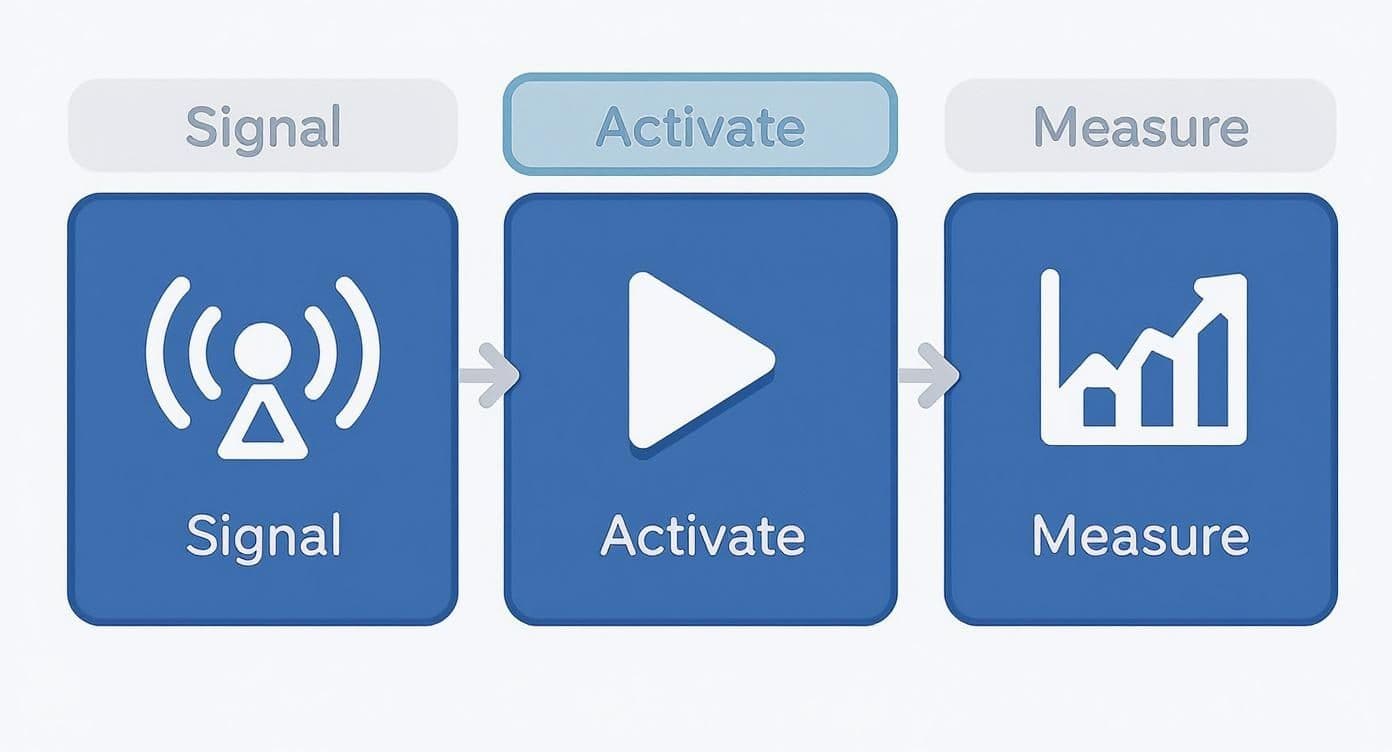
It's a powerful loop: you detect a relevant signal, activate a pre-planned play in response, and measure the outcome to get smarter next time.
Turning Buying Intent Signals into Campaign Triggers
What does a real-world trigger look like? It’s any event that signals a potential shift in an account's priorities, needs, or openness to a new solution. Your job is to spot these moments and have a playbook ready.
These signals provide the "why now" that gives your outreach context and urgency. Effective signal-based selling is what moves you from cold outreach to warm, relevant conversations.
Here are some of the most potent triggers to watch for:
- New Executive Hires: A new leader almost always brings a new budget and a mandate for change. They are 74% more likely to make a purchase decision within their first 100 days.
- Company Funding: A recent funding round is a clear sign of growth, expansion, and investment in new tools.
- Surges in Job Postings: If an account is rapidly hiring for a specific department (like sales or customer support), it points to a growing pain your solution might solve.
- Competitor Dissatisfaction: Are they leaving negative reviews for a competitor? Is their contract up for renewal? This is a prime opportunity to present your alternative.
The magic isn't just in spotting the signal. It's in having a coordinated, multi-channel response ready to launch the moment it appears. This is how you get in front of opportunities before your competitors even know they exist.
Orchestrating Multi-Channel Plays
A single email is not a campaign. True activation involves a coordinated sequence of touches across different channels, creating a cohesive experience for the entire buying committee. You want to surround the account with a consistent, helpful message.
This multi-touch approach ensures you’re engaging different members of the buying group where they are most active. A senior executive might respond to a personalized LinkedIn connection, while a hands-on manager might click on a targeted ad showing a relevant case study.
Example Playbook: New Executive Hire
Let's walk through a practical example. Your account intelligence platform alerts you that a top-tier target account just hired a new Chief Marketing Officer. Here’s a sample multi-touch play you could activate:
- Day 1 (Sales): The Account Executive sends a personalized LinkedIn connection request to the new CMO. The message is simple and non-salesy: "Congrats on the new role! Excited to see what you do at [Company Name]. I've been following your work since [Previous Company]." No pitch.
- Day 3 (Marketing): Launch a targeted LinkedIn ad campaign aimed at that specific account's marketing department. The ad features a thought leadership piece about a common challenge for new CMOs.
- Day 7 (Sales): The AE follows up with a brief, value-driven email. It might reference a recent article from the new CMO and connect it to a challenge your solution helps solve, attaching a relevant one-page case study.
- Day 10 (Sales): The SDR begins light outreach to other VPs and Directors on the marketing team, referencing the leadership change and sharing helpful resources to build wider support.
This orchestrated sequence feels natural, not automated. Each touchpoint builds on the last, establishing credibility and showing you’ve done your homework. This is what a modern demand generation strategy looks like in action.

“The Business Development team gets 80 to 90 percent of what they need in 15 minutes. That is a complete shift in how our reps work.”
Andrew Giordano
VP of Global Commercial Operations, Analytic Partners
Measuring What Matters for Revenue Growth
How do you know if your demand generation strategy is working? It has little to do with MQLs or website traffic. True measurement connects every marketing action directly to revenue.
If you’re still reporting on vanity metrics like lead volume or clicks, you’re missing the point. A successful strategy isn't measured by activity; it's measured by outcomes. The real questions are: Is marketing contributing to pipeline? Are we closing deals with the right accounts faster? Is our cost to acquire a customer sustainable?
Moving from Vanity Metrics to Impact Metrics
The shift in measurement starts with focusing on what the C-suite cares about. Your CEO cares about revenue, pipeline, and market share. Aligning your reporting to these priorities is the fastest way to prove your value.
This means trading surface-level numbers for deep performance indicators. Instead of celebrating a high click-through rate, celebrate a shorter sales cycle. Instead of a high volume of leads, focus on the dollar value of marketing-sourced pipeline.
A common pitfall is over-indexing on top-of-funnel engagement without tying it to bottom-of-funnel results. The goal isn't just to be busy; it's to be effective. Every metric on your dashboard should help answer the question, "Is this activity helping us generate more revenue?"
To put this into practice, it's helpful to see the difference between what looks good and what actually drives growth.
Vanity Metrics vs. Impact Metrics in Demand Generation
This comparison helps teams focus on performance indicators that truly reflect business impact.
| Metric Category | Vanity Metric (Avoid Over-Indexing) | Impact Metric (Focus On) |
|---|---|---|
| Lead Quality | Total MQLs Generated | Pipeline Sourced by Marketing |
| Sales Cycle | Time to MQL Conversion | Pipeline Velocity (Deal Size x Win Rate / Sales Cycle Length) |
| Efficiency | Cost per Lead (CPL) | Customer Acquisition Cost (CAC) |
| Revenue | Website Traffic/Impressions | Marketing-Sourced Revenue & Customer Lifetime Value (CLV) |
Focusing on these impact metrics gives you a clear, honest view of performance. Pipeline Velocity, for instance, is a powerful composite metric. It tells you how quickly deals are moving through your pipeline and how much value they represent, providing a much richer story than sales cycle length alone.
Creating Actionable Feedback Loops
Measurement isn't a one-and-done report. It’s a living process that fuels constant improvement. The most critical component is establishing a tight feedback loop between sales and marketing to ensure data insights translate into smarter actions.
Hold regular meetings where both teams review the data together. What's working? Are the accounts marketing is engaging turning into real opportunities? Sales feedback is invaluable here. If they report that leads from a certain campaign are consistently unqualified, you must adjust your targeting or messaging immediately.
This collaborative review turns your dashboard from a static report into a dynamic tool for strategic decision-making. By tying your efforts to these crucial KPIs, you can confidently demonstrate how your demand generation strategy is a core driver of the company's financial success. To get a better grasp of the metrics, our guide on lead generation key performance indicators offers a detailed breakdown.
Key Takeaways
- Modern demand generation is about creating genuine buyer interest with the 95% of your market not actively buying today, rather than fighting over the 5% already in-market.
- A data-driven Ideal Customer Profile (ICP) that goes beyond firmographics to include technographics, buying signals, and behavioral data is the foundation for every effective demand generation strategy.
- Content must be mapped to the full buying committee (typically 6-10 decision-makers), with specific assets for each persona at each stage of their journey, not generic one-size-fits-all messaging.
- Signal-based campaigns triggered by real-time events like new executive hires, funding rounds, or competitor dissatisfaction transform cold outreach into timely, relevant conversations that feel helpful rather than intrusive.
- Measure impact metrics like marketing-sourced pipeline, pipeline velocity, and customer acquisition cost instead of vanity metrics like MQLs and website traffic -- and expect 6 to 12 months for significant, measurable results.
Common Questions About Demand Generation Strategy
Even with a perfect plan, questions always come up. Let's tackle some of the most common ones we see from teams putting theory into practice.
Getting these fundamentals right ensures your entire revenue team is rowing in the same direction.
What is the difference between demand generation and lead generation?
This question comes up all the time, and the distinction is critical. Think of it like fishing.
Lead generation is catching the fish. It's a specific tactic focused on one outcome: getting someone's contact information. You put bait on a hook (like a gated e-book) and wait for a bite.
Demand generation is the entire strategy of creating the ecosystem where the fish want to be. It's about knowing the currents, picking the right part of the lake, and using the right food to attract the right kind of fish—long before you cast your line. Demand gen is the holistic process of building awareness and genuine interest. It warms up the entire market, so lead generation is there to simply "capture" that existing interest.
How long does it take to see results?
Patience is key. This isn't an overnight fix, and setting the right expectations with leadership is crucial.
You'll likely see encouraging early signs within the first 90 days—like more website traffic from ideal accounts or higher engagement rates on your content. But seeing a real impact on revenue takes longer.
For most B2B companies, expect it to take 6 to 12 months to see a significant, measurable lift in metrics like marketing-sourced pipeline and closed-won deals. Remember, you're building a sustainable growth engine, not just chasing a short-term spike in MQLs.
What is the most common mistake companies make?
The biggest and most damaging mistake is a lack of alignment between sales and marketing. A marketing team can build a brilliant, data-driven strategy, but if the sales team isn't bought in or equipped to handle the demand, the whole thing grinds to a halt.
This disconnect usually looks like this:
- Marketing celebrates "engaging" an account, but sales doesn't see it as a priority.
- Sales keeps using the same old generic outreach, clashing with marketing's personalized messaging.
- There's no shared definition of a "qualified account" or an agreed-upon handoff process.
Success depends on a shared mindset where both teams operate from the same playbook and talk to each other constantly.
Which tech tools are essential for a modern strategy?
While the exact stack will vary, a few integrated tools are non-negotiable. The goal isn't to have the most tools; it's to ensure data flows seamlessly between them to create a single source of truth.
Your foundational stack should include:
- A CRM (e.g., Salesforce, HubSpot): The central system for all customer and account data.
- A Marketing Automation Platform (e.g., Marketo, Pardot): The engine for executing and automating your campaigns.
- An Account Intelligence Platform (e.g., Salesmotion, 6sense): Your radar for identifying in-market accounts using buying intent signals.
- A Sales Engagement Platform (e.g., Outreach, Salesloft): This equips your sales team to run coordinated, multi-touch plays that turn warm demand into conversations.
Ready to stop guessing and start acting on real-time buying signals? Salesmotion provides the AI-powered account intelligence B2B revenue teams need to pinpoint "why now" opportunities and scale personalized outreach. See how you can save over 8 hours per rep each week and increase pipeline creation by 40% when you book a demo with Salesmotion today.
Frequently Asked Questions
What is a B2B demand generation strategy?
A B2B demand generation strategy is a holistic approach to creating genuine buyer interest within your ideal customer base, rather than simply collecting contact information. It focuses on educating and engaging the 95% of your market that is not actively buying today, so that when a need arises, your brand is already their first choice. The goal is to build a predictable, high-quality pipeline driven by trust and brand preference.
How long does it take for a demand generation strategy to produce results?
Most B2B companies should expect 6 to 12 months before seeing a significant, measurable lift in metrics like marketing-sourced pipeline and closed-won deals. Early indicators such as increased website traffic from ideal accounts and higher content engagement rates typically appear within the first 90 days. Building a sustainable demand generation engine requires patience and consistent investment.
What is the difference between demand generation and lead generation?
Lead generation is a specific tactic focused on capturing contact information, like gating an ebook behind a form. Demand generation is the broader strategy of creating the awareness, trust, and genuine interest that makes prospects want to engage with your brand. Demand gen warms up the entire market so that lead generation can capture the interest that already exists.
What metrics should I track to measure demand generation success?
Focus on impact metrics rather than vanity metrics. The most important KPIs include marketing-sourced pipeline, pipeline velocity (which combines deal size, win rate, and sales cycle length), customer acquisition cost (CAC), and marketing-sourced revenue. These metrics directly connect marketing activity to revenue outcomes, giving leadership a clear picture of your strategy's business impact.
How do buying signals fit into a demand generation strategy?
Buying signals like new executive hires, funding rounds, and competitor dissatisfaction serve as precise triggers for activating marketing and sales plays at the right moment. Instead of blasting generic messages, you respond to real-time events with relevant, helpful outreach. This signal-based approach transforms cold interruptions into timely conversations that feel natural to the buyer.
What is the most common mistake companies make with demand generation?
The biggest mistake is a lack of alignment between sales and marketing. Even a brilliant, data-driven strategy will fail if both teams are not operating from the same playbook with a shared definition of what constitutes a qualified account. Success requires regular communication, shared goals, and an agreed-upon handoff process between marketing and sales.