A VP of Sales told us he built his own account intelligence system "in two hours with N8N." It pulled news from Google, enriched contacts from an API, and pushed alerts to Slack. For his 80 accounts, it worked. Six months later, his team had grown to 400 accounts, the system was breaking daily, and the one engineer who built it had just put in his two weeks.
This story plays out constantly. According to Retool's 2026 Build vs. Buy Report, 35% of enterprises have already replaced at least one SaaS tool with a custom build. But the same research shows a 42% failure rate for those custom builds. The impulse to build is understandable. The outcome is predictable.
TL;DR: DIY account intelligence works for small account lists but collapses at scale. The real costs are hidden: bus factor risk, missing data sources behind paywalls, no proactive alerts, and no one to maintain the system when priorities shift. Purpose-built platforms cost less than the engineering time you will spend maintaining a homegrown solution.
Why Do RevOps Teams Build Account Intelligence Internally?
RevOps leaders and sales engineers are naturally builders. When they see a problem (reps need account intelligence), their first instinct is to solve it themselves. And the tools available today make it tempting. N8N, Make, Zapier, and custom Python scripts can all pull data from APIs and assemble basic account profiles.
The initial build is fast. A few API connections, some data transformations, a Slack notification. You have working account intelligence in a weekend. The team is impressed. Leadership is thrilled they avoided a software purchase.
Here is what happens next.
Where Does DIY Account Intelligence Break Down?
Every homegrown account intelligence system hits the same failure points. They just hit them at different times.
The scale wall
Below 200 accounts, a custom system can keep up. API rate limits are not an issue. Data volume is manageable. One person can debug problems in real time. Above 200 accounts, everything compounds. API calls start timing out. Data pipelines back up. The Slack channel fills with noise because there is no signal prioritization. A 2025 DaaSy analysis found that internal tool builds typically cost $15,000-$30,000 just to start, before accounting for ongoing maintenance.
The bus factor
Custom systems have a bus factor of one. The person who built it is the only one who understands it. When they go on vacation, get promoted, or leave the company, the system starts failing and no one knows how to fix it. This is not a theoretical risk. It is the single most common reason internal intelligence tools die.
The data source gap
Here is what a weekend build cannot access: earnings call transcripts (behind paywalls), SEC filings analysis (requires specialized parsing), podcast monitoring (no standard API), patent filings, clinical trial databases, and dozens of premium news sources. These are the sources that contain management-level strategic signals, the kind of intelligence that actually moves enterprise deals forward. Your N8N workflow can scrape Google News. It cannot tell you what a CEO said about operational efficiency on last quarter's earnings call.
No proactive monitoring
A custom build is fundamentally reactive. It runs when triggered or on a schedule. It does not monitor your territory 24/7 and push a signal to you the moment a key account posts a VP of Sales role. That proactive layer requires infrastructure that no automation platform provides out of the box.

“With Salesmotion, you realize just how much time you were spending on low-value tasks. Now that our team isn't drowning in manual research, they can truly focus on execution, which is priceless for a startup.”
Adam Wainwright
Head of Revenue, Cacheflow
The Hidden Cost Calculation
Let us do the math that nobody does before starting the build.
Engineering time to build: 40-80 hours (optimistic). At a fully loaded engineering cost of $150/hour, that is $6,000-$12,000 before the system processes a single account.
Ongoing maintenance: Custom data pipelines require 5-10 hours per week of maintenance. APIs change. Sources break. Edge cases appear. That is $39,000-$78,000 per year in engineering time alone.
Opportunity cost: Every hour your sales engineer spends debugging the intelligence pipeline is an hour they are not spending on revenue-generating work.
Data source subscriptions: Accessing premium data (earnings transcripts, patent databases, clinical trials) adds $2,000-$10,000 per month in API costs.
Total first-year cost: $60,000-$150,000+ for a system that covers a fraction of what a purpose-built platform provides.
Compare that to a team plan that gives your entire sales organization access to intelligence from 1,000+ sources, with proactive monitoring, CRM integration, and zero maintenance overhead. Analytic Partners was up and running in days and saw their business development team getting 80-90% of what they need in 15 minutes. Cacheflow cut prep time by 60% and tripled deal sizes within six months.
What Purpose-Built Intelligence Actually Provides
The gap between a DIY system and a purpose-built platform is not incremental. It is structural.
| Capability | DIY Build | Purpose-Built Platform |
|---|---|---|
| Data sources | 5-10 APIs you can connect | 1,000+ sources including paywalled content |
| Proactive alerts | Scheduled runs (hourly/daily) | Real-time 24/7 monitoring |
| Signal prioritization | Manual rules you maintain | AI-powered relevance scoring |
| CRM integration | Custom-built, fragile | Native Salesforce/HubSpot sync |
| Maintenance burden | 5-10 hrs/week engineering | Zero (vendor-managed) |
| Bus factor | 1 person | Vendor team |
| Scale ceiling | ~200 accounts before breaking | Territory-scale (5,000+ accounts) |
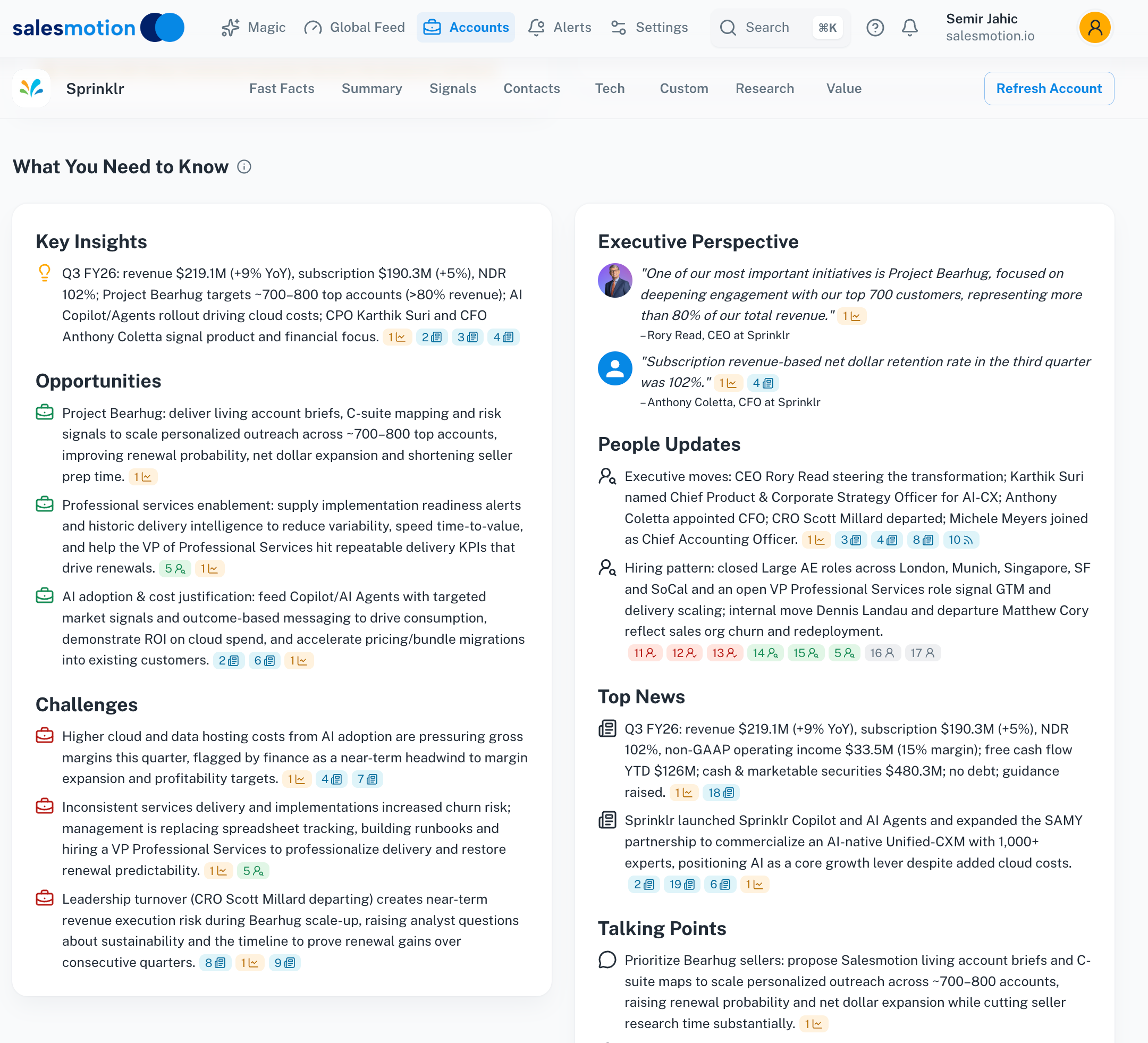 A single account brief replaces hours of manual research across multiple tools and tabs.
Here is a concrete example of the difference. A rep's target account posts three new engineering roles in payments infrastructure. A DIY system might catch the job postings (if it monitors Indeed). Salesmotion catches the job postings, cross-references them with the company's recent earnings call commentary about "investing in payment modernization," links both signals to the account brief, and surfaces the combined intelligence with AI-generated talking points. That is the difference between data and actionable intelligence.
See Salesmotion on a real account
Book a 15-minute demo and see how your team saves hours on account research.
When Building Makes Sense (And When It Does Not)
Building internally is not always wrong. It makes sense when:
- You have fewer than 50 accounts and a dedicated engineer with capacity
- Your use case is extremely niche and no vendor covers it
- You are building a competitive advantage that is core to your product (not your sales process)
Building does not make sense when:
- Your account list exceeds 200 and is growing
- You need proactive, real-time signal monitoring
- Multiple team members depend on the intelligence daily
- You cannot guarantee ongoing engineering support for maintenance
- You need data sources behind paywalls (earnings, patents, premium news)
The sales intelligence market reached $4.99 billion in 2026 precisely because enterprises learned this lesson. The 42% failure rate for custom builds is not a technology problem. It is a prioritization problem. Your engineering team has higher-value work to do than maintaining a data pipeline.
Key Takeaways
- DIY account intelligence works below 200 accounts but collapses at scale due to API limits, data volume, and maintenance burden
- The bus factor (one person who built it) is the most common reason internal intelligence systems die
- Hidden costs (engineering maintenance, data subscriptions, opportunity cost) typically exceed $60,000-$150,000 in the first year
- Purpose-built platforms access 1,000+ sources including paywalled content that custom builds cannot reach
- Proactive 24/7 monitoring requires infrastructure that no automation platform provides out of the box
- Teams like Cacheflow and Analytic Partners saw measurable results within days of switching from fragmented manual processes to purpose-built account intelligence
Frequently Asked Questions
Can I use N8N or Make to build account intelligence that scales?
Automation platforms like N8N and Make are excellent for connecting APIs and building workflows. But they are not account intelligence platforms. They lack proactive monitoring, signal prioritization, premium data source access, and CRM-native integration. According to n8n's own documentation, complex workflows can become difficult to manage at scale, and performance degrades when processing large datasets. For small account lists (under 50), they can work as a starting point. Beyond that, you are building and maintaining infrastructure, not doing sales.
What data sources can a DIY build not access?
The most valuable account intelligence comes from sources behind paywalls or requiring specialized parsing: earnings call transcripts, SEC filing analysis, patent databases, clinical trial registries, premium news services, and podcast transcripts. These sources contain management-level strategic signals that generic news APIs miss entirely. Accessing them individually can cost $2,000-$10,000 per month in API subscriptions, and parsing them requires specialized NLP that is not available in standard automation platforms.
How do I calculate the true cost of our internal intelligence system?
Add up: (1) initial build hours multiplied by fully loaded engineering cost, (2) weekly maintenance hours multiplied by 52 weeks multiplied by hourly cost, (3) premium data source subscription fees, (4) opportunity cost of engineering time diverted from revenue-generating projects, and (5) risk cost of the system failing when the builder leaves. Most teams find the total exceeds $60,000-$150,000 annually, well above what purpose-built platforms cost for unlimited team access.
When should a company transition from DIY to a purpose-built platform?
The clearest signals: your account list has grown past 200, maintenance is consuming more than 5 hours per week of engineering time, the system has broken during a critical selling period, or the person who built it is no longer available. Any one of these is sufficient reason to evaluate a dedicated platform. The transition itself is straightforward. Teams like Cytel consolidated five separate tools into one platform within a week.