The global education technology market reached $142 billion in 2024, according to HolonIQ, with enterprise learning and development (L&D) growing even faster than K-12 and higher education segments. Corporate learning alone is a $400 billion market, with 74% of companies failing to keep pace with organizational demand for new skills. For B2B sales teams selling into EdTech companies and education organizations, buying signals look different from other industries. Budget cycles follow academic calendars. Platform switches align with enrollment periods and contract expirations. Policy mandates and compliance deadlines reshape spending priorities overnight. Bond measures unlock infrastructure capital. Accreditation reviews force technology upgrades.
The sellers who win in education are the ones who can read these signals before they become obvious. If you are new to buying signals in sales, start with our foundational guide, then come back here for the education-specific playbook. This guide uncovers the non-obvious procurement triggers, funding mechanisms, and institutional dynamics that separate top-performing education sellers from the rest. Teams that adopt a signal-based selling approach in education consistently outperform those relying on generic outreach.
TL;DR: EdTech and L&D buying signals include budget cycle timing, platform RFPs, leadership changes, policy mandates, enrollment trends, workforce development initiatives, bond measures, accreditation reviews, E-Rate filings, LMS contract expirations, and compliance training mandates. The strongest signals are often the least obvious ones. Timing outreach to these signals dramatically improves engagement rates with education buyers.
Why EdTech Buying Signals Follow Different Calendars
Education organizations operate on academic and fiscal calendars that differ from the corporate world. K-12 districts typically have July 1 fiscal years, with budget finalization happening in spring. Higher education institutions plan budgets 12-18 months in advance. Corporate L&D budgets align with annual planning cycles, often set during Q4 for the following year. Missing these windows means waiting an entire year for the next opportunity.
The buying committee in education is also unique. A K-12 technology purchase involves the superintendent, CTO, curriculum directors, and often a school board vote. A higher education purchase involves the provost, CIO, department chairs, and procurement. Corporate L&D purchases involve the Chief Learning Officer, HR leadership, and business unit heads. Each stakeholder responds to different signals, and the procurement process is often slower and more formal than in commercial sectors.
Federal and state funding adds another layer. Title I funds, ESSER (Elementary and Secondary School Emergency Relief) allocations, Pell Grant expansions, and workforce development grants all create time-bound budgets that must be spent within defined periods. When an institution receives grant funding, it becomes a motivated buyer with an allocated budget and a deadline. But the smartest sellers are not just watching for funding announcements. They are monitoring the upstream indicators, such as grant applications, bond ballot measures, and accreditation timelines, that predict where funding will land months before it arrives.
See Salesmotion on a real account
Book a 15-minute demo and see how your team saves hours on account research.
Budget and Procurement Signals
Budget Cycle Timing
The most predictable EdTech buying signal is the budget cycle itself. K-12 districts finalize budgets in spring for July 1 fiscal years. Q2 (April through June) is the peak buying window, when schools transition from the consideration phase into active purchasing. Higher education institutions often plan in the fall for the following academic year. Corporate L&D teams set annual budgets during Q4 corporate planning. Understanding where your target accounts are in their budget cycle determines when outreach will land.
State Procurement Portal Activity
Most education technology purchases above a certain threshold must go through formal procurement channels. State procurement portals are a goldmine of intent signals most sellers overlook. When a district posts a Form 470 in the E-Rate Productivity Center, it is formally beginning the competitive bidding process for network infrastructure, and the filing windows are public. For FY2026, the Form 471 application window opened January 21, 2026, and closes April 1, 2026. Districts that file early are signaling urgency and budget readiness.
Beyond E-Rate, track state-level procurement portals such as GovWin, state education agency sites, and consortium purchasing groups. Many states require districts to post RFPs publicly 28 to 45 days before vendor selection. These filings reveal not just what institutions are buying, but what they are replacing, giving you a direct window into competitive displacement opportunities.
Bond Measures and Capital Funding
Public schools issued $82 billion in bonds in 2025, outpacing the broader municipal bond market. Over 150 proposed bonds are already set for 2026 votes, with more than 900 under discussion. Bond measures are among the most reliable leading indicators for large-scale technology purchases because they unlock dedicated capital budgets with explicit technology line items.
Dallas ISD's recent bond proposal includes $144 million specifically for technology upgrades. Portland Public Schools authorized $1.83 billion for construction, safety, and new technology. When a bond passes, the district has earmarked capital and a voter mandate to spend it. Track bond ballot measures on Ballotpedia and local school board agendas. A passed bond is a stronger buying signal than most grant awards because the funds are locally controlled, voter-approved, and carry a 3-5 year spending timeline.
The Post-ESSER Procurement Landscape
The expiration of nearly $200 billion in federal ESSER funding has fundamentally reshaped K-12 procurement. Districts that previously funded technology subscriptions with ESSER dollars are now facing a fiscal cliff. In an EdWeek survey, one in four respondents said they would not have any alternative funding sources for expenses previously covered by federal relief aid. A survey of 400 K-12 business officials found that 88% expect competition for district funding to be more challenging in the coming year.
This creates two distinct buying signals. First, districts actively consolidating their technology stack are signaling vendor review cycles and potential platform switches. A district auditing its EdTech licenses is a district ready to evaluate alternatives. Second, districts seeking cost-optimized replacements for ESSER-funded tools represent displacement opportunities where price competitiveness and evidence of ROI become decisive. More than a third of K-12 officials say vendors offering free trials are very likely to break through the noise, a signal that proof-of-value motions are more important than ever.
Federal Funding Allocations: E-Rate and Title Programs
The E-Rate program, funded at $4 billion annually, reimburses schools for internet services and network infrastructure. More than 21,300 school districts and 3,800 vendors participate. For FY2026, Category 2 funding rules have been updated: multiyear licenses and software previously reimbursed only for the first year can now receive reimbursement for remaining years. Districts now have more flexibility for software, licenses, and related support services tied to their internal networks.
Track E-Rate filings to identify which districts are actively investing in network infrastructure, because infrastructure upgrades frequently cascade into application-layer purchases (LMS platforms, assessment tools, digital curriculum) within 6-12 months.
When a school district receives a Title IV grant for technology, or a state allocates workforce development funds to community colleges, those institutions become immediate buyers. Salesmotion tracks these funding announcements alongside leadership changes and strategic initiatives, giving reps a complete picture of which education accounts have both budget and intent.

“We're saving about 6 hours per week per seller on account research alone. That's time they can reinvest in actually selling.”
Derek Rosen
Director, Strategic Accounts, Guild Education
K-12 District-Level Procurement Signals
Superintendent and CTO Transitions
K-12 districts are uniquely sensitive to leadership changes. A new superintendent often signals a comprehensive technology audit within their first year. Track superintendent appointments through state school boards association announcements and local media. A new CTO or Director of Technology is even more directly relevant because they typically conduct a vendor review within their first 90 days and have the authority to influence platform decisions without a full board vote.
School Board Strategic Plan Cycles
Most school boards adopt 3-5 year strategic plans that explicitly outline technology investment priorities. When a district publishes a plan that mentions "digital transformation," "one-to-one device initiative," "cybersecurity," or "data-driven instruction," it is a direct statement of buying intent with an attached timeline. These plans are almost always public documents available on district websites.
State Policy Mandates Driving K-12 Purchases
State and federal education policy changes drive technology purchasing in ways that are often less price-sensitive than discretionary buying. When a state mandates digital literacy standards, schools need curriculum platforms. When the Department of Education issues new accessibility requirements, institutions need compliance tools. When states expand career and technical education (CTE) funding, school districts purchase workforce readiness platforms. A $200 million FCC cybersecurity pilot has recently issued its first funding commitments, creating a new wave of security-focused purchasing for districts that secure allocations.
Higher Education-Specific Signals
LMS Contract Expiration Cycles
Learning management system contracts are typically 3-5 year agreements, and higher education LMS procurement follows distinct patterns. After the pandemic-driven surge of LMS adoptions in 2020-2021, many institutions are now entering their first renewal or replacement cycle. According to ListEdTech, higher education LMS RFPs declined in 2025 as institutions entered a stability-focused investment phase, but this means a wave of contract expirations is building for 2026-2028.
Track LMS contract timelines for your target institutions. When an institution's LMS contract is 12-18 months from expiration, it is entering the evaluation window. Signals that a switch is likely include: new CIO or CTO appointments, faculty senate resolutions on learning technology, and the institution posting instructional designer or learning technologist roles, all of which indicate dissatisfaction with the current platform.
Online Program Expansion and OPM Shifts
The online program management (OPM) market has reached $7.7 billion, with institutions increasingly shifting from costly end-to-end OPM contracts toward modular, fee-for-service models. When an institution announces a new online degree program, an OPM contract ending, or the hiring of a VP of Online Learning, it signals a technology evaluation cycle. Compared with pre-pandemic 2019, 2.3 million more undergraduates are studying online, and community colleges posted 3.2% year-over-year enrollment growth, making online expansion a primary growth strategy.
Institutions that engage an OPM can expect 30-40% enrollment increases in the first year, which means the supporting technology stack (LMS, CRM, analytics) must also scale. Track enrollment data from the National Center for Education Statistics and institutional press releases about new program launches.
Accreditation Review Cycles
Regional accreditation reviews are a non-obvious but powerful buying signal. Institutions accredited by HLC or SACSCOC undergo decennial (10-year) reviews, with a Fifth-Year Interim Report in between. In the 12-24 months before a reaffirmation visit, institutions invest heavily in technology to demonstrate compliance with standards around learning analytics, student outcomes tracking, and assessment infrastructure.
HLC adopted revised Federal Compliance Requirements in November 2025, effective September 1, 2026. Institutions preparing for their next review cycle under these new requirements will need to upgrade compliance-related technology. Track accreditation review schedules (often published on institutional websites) and connect them to technology purchasing patterns. An institution 18 months from its decennial review is a motivated buyer for assessment, analytics, and reporting platforms.
Enrollment Trends as Leading Indicators
Enrollment shifts signal budget changes in both directions. Growing enrollment creates demand for additional technology capacity and expanded LMS licensing. Declining enrollment triggers cost optimization and consolidation. The distinction matters for positioning: growing institutions need scale, while shrinking ones need cost savings.
“It's not even just about saving time — it's about uncovering things we otherwise might not research. Salesmotion helps us connect Guild to what's already publicly important to the company.”
Derek Rosen
Director, Strategic Accounts, Guild Education
Corporate L&D Signals
Upskilling and Reskilling Initiatives
The World Economic Forum predicts that 44% of core workplace skills will change by 2028, and 50% of employees will require reskilling due to automation and AI. When a company publicly announces a workforce transformation initiative, a large-scale reskilling program, or a partnership with an education provider, it is signaling multi-million-dollar L&D purchases. Guild Education's model of employer-funded education programs, where enterprise L&D deals can reach $20M+ and take up to 24 months, illustrates the scale and complexity of these opportunities.
Track corporate earnings calls, annual reports, and press releases for keywords like "workforce transformation," "upskilling investment," "skills-based organization," and "human capital strategy." These public statements often precede procurement timelines by 6-12 months.
Compliance Training Mandates
Regulatory compliance is one of the most reliable L&D buying triggers because it is non-discretionary. In 2026, several major compliance deadlines are converging: CMMC 2.0 Phase 1 requires Level 1-2 cybersecurity certification for defense contractors through late 2026, CIRCIA incident reporting takes full effect in May 2026 with 72-hour reporting windows, HIPAA Security Rule updates are elevating network segmentation to mandatory status, and the EU AI Act requires high-risk system compliance by 2026-2027. Each mandate generates demand for compliance training platforms, content development, and workforce certification tools.
Companies in regulated industries (financial services, healthcare, defense, energy) facing new compliance deadlines are active buyers. Track regulatory announcements from the SEC, FCC, and DOL. When a regulation is finalized with a compliance deadline, every company in the affected industry becomes a potential buyer of training and certification technology.
LXP Adoption and Platform Consolidation
The Learning Experience Platform (LXP) market is projected at $2.19 billion by 2026, growing at a CAGR of over 20%. However, the market is entering a consolidation phase. Many companies now use a hybrid approach, with an LMS for compliance tracking and an LXP front-end for discovery and personalized learning. Companies hiring Chief Learning Officers, VP of Learning & Development, or Director of Learning Technology roles are signaling a platform evaluation cycle.
AI-native learning systems are starting to replace traditional LXPs, with early adopters experiencing 40-50% reductions in L&D internal spend. When a company posts roles for "AI Learning Architect" or "Learning Technology Manager," it signals that their current stack is being reconsidered.
Organizational Signals
Leadership Changes
A new Chief Learning Officer, CTO, or superintendent signals a strategic reset. In education, new leaders often bring new technology priorities and new vendor relationships. Track leadership announcements at your target institutions and connect them to the leader's background and previous technology decisions. A CTO who implemented a specific platform at their previous institution is likely to evaluate it again at their new one.
Conference Presentations and Thought Leadership
Education conferences like ISTE, ASU+GSV Summit, ATD, and Learning Technologies reveal institutional priorities. When an institution's leaders present on a specific topic (AI in education, competency-based learning, workforce readiness), it signals active investment in that area. Conference participation is a leading indicator of purchasing intent, often preceding a formal procurement process by 6-9 months.
Strategic Plan Announcements
Many education institutions publish multi-year strategic plans that explicitly describe technology investment priorities. A university's strategic plan that mentions "digital transformation" or "learning analytics" is a direct statement of buying intent. Track strategic plan releases from your target accounts, and pay particular attention to the specific budget allocations and timelines embedded in these documents.
How to Operationalize EdTech Buying Signals
EdTech buying signals are scattered across state procurement portals, E-Rate filings, bond ballot databases, grant databases, enrollment reports, accreditation schedules, job boards, regulatory announcements, and industry publications. No rep can monitor all of these sources manually across a territory of education accounts.
Centralize signal monitoring. Aggregate signals from funding databases, procurement portals, leadership announcements, accreditation timelines, and enrollment data into a single platform. This gives reps a real-time view of which accounts are entering a buying window.
Align outreach to budget cycles. Map each target account's fiscal year and budget planning timeline. Build outreach sequences that land during the evaluation window, not after the budget is committed. For K-12, this means starting outreach in January-February for July 1 fiscal year decisions. For higher education, begin 18 months before their next major technology contract expires.
Score signal clusters, not individual signals. A single signal is informative. A cluster (leadership change + bond measure passing + accreditation review upcoming + job posting for Director of Technology) identifies a must-pursue account. Weight territory prioritization by signal density.
Build education-specific plays. Create playbooks for specific signal types: "post-ESSER consolidation," "bond-funded infrastructure," "accreditation compliance," "platform replacement," "compliance training mandate," and "workforce development expansion." Each play should include tailored messaging that speaks the language of education buyers, not generic B2B sales talk.
Salesmotion helps sales teams operationalize these signals by aggregating education-specific data sources alongside organizational and financial signals, delivering enriched account intelligence that combines funding events, leadership changes, and strategic priorities in one view.
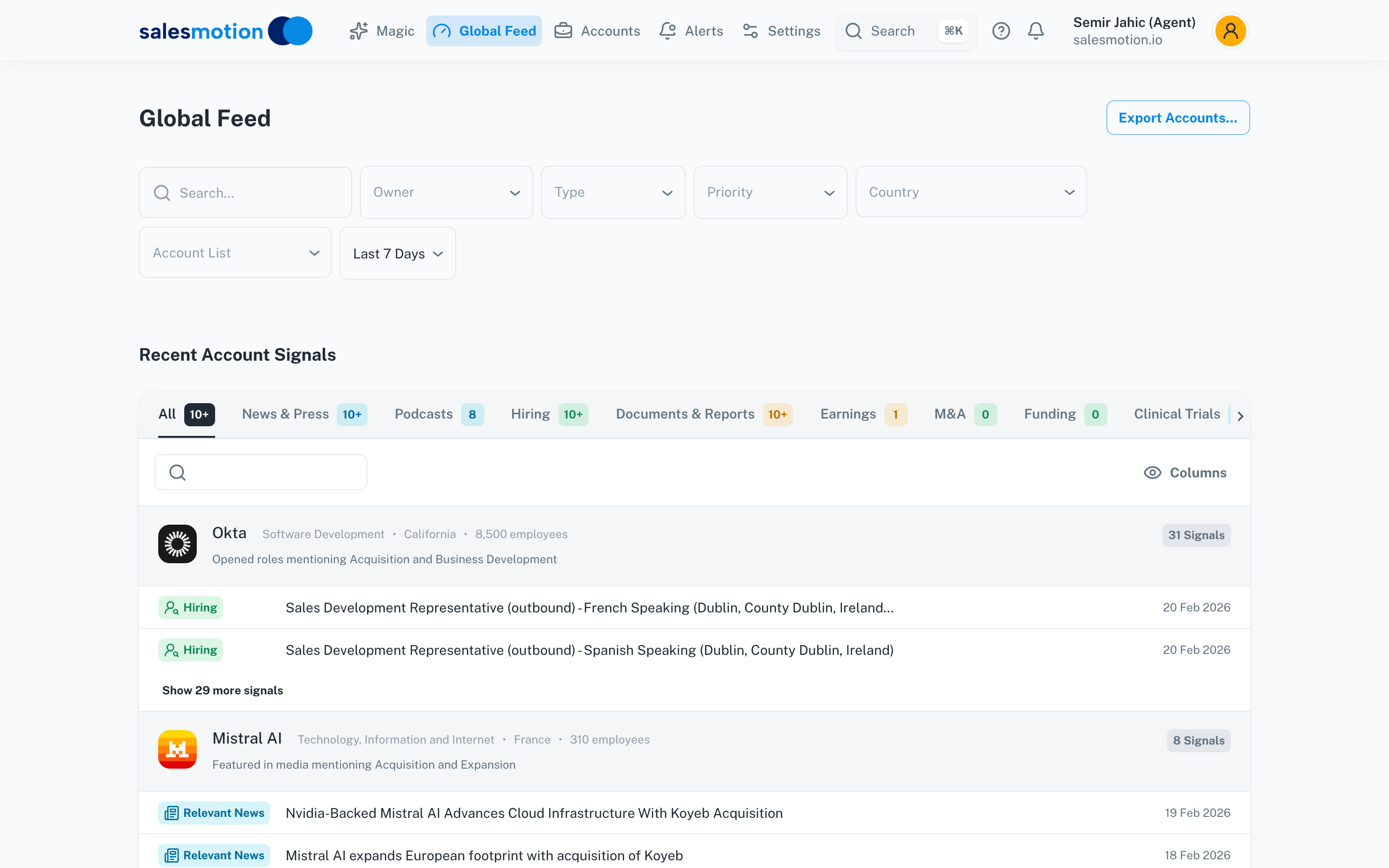 Salesmotion surfaces buying signals — hiring, earnings, news, M&A, funding — across your entire territory in a single feed, so reps act on the highest-value signals first.
Signal-Based Workflow: EdTech Example
Trigger: A state announces $50M in workforce development grants for community colleges. One of your target institutions recently passed a $79M bond measure that includes technology infrastructure upgrades. The institution also posts a Director of Workforce Partnerships role, and its regional accreditor (HLC) has scheduled its Fifth-Year Interim Report for the following year.
Platform action: The account brief updates with the grant announcement, the bond measure details, the new job posting, the institution's enrollment trends (growing by 8%), the upcoming accreditation milestone, and the president's recent keynote on expanding employer partnership programs.
Rep action: The rep reaches out to the VP of Academic Affairs, referencing the state workforce development funding, the bond measure's technology allocation, and the institution's growing employer partnership program. The outreach positions their learning platform as supporting both the workforce development model the institution is building and the learning outcomes data required for the upcoming accreditation review.
Outcome: The conversation is immediately relevant because the rep understands the institution's strategic direction, funding situation, and compliance timeline. The deal moves forward aligned with both the grant spending deadline and the accreditation preparation window.
For more on selling to education organizations, visit our sales intelligence for education page. Additional context on buying signals and account research is available in our glossary. If you sell into other verticals alongside education, see our guides to healthcare buying signals and HR tech buying signals.
Key Takeaways
- EdTech buying signals follow academic and fiscal calendars, not corporate quarters. Missing the budget planning window often means waiting a full year for the next opportunity.
- Non-obvious signals (bond measures, E-Rate filings, accreditation review cycles, LMS contract expirations) are often more actionable than headline news because fewer sellers are watching them.
- The post-ESSER fiscal cliff is creating two simultaneous buying motions: consolidation-driven vendor reviews and cost-optimization platform switches. Both represent displacement opportunities.
- Federal and state funding awards create time-bound buying urgency. When an institution receives grant funding, it has both budget and a deadline to spend it.
- Corporate L&D compliance mandates (CMMC, CIRCIA, EU AI Act) are non-discretionary triggers that affect every company in regulated industries, creating predictable demand for training platforms.
- Signal clusters (bond funding + leadership change + accreditation review + job posting) identify the highest-intent education accounts in your territory. Score by signal density, not individual signal strength.
- Build education-specific outreach plays that speak the language of academic and L&D buyers. Generic B2B messaging underperforms in education sales.
Frequently Asked Questions
What are the most important buying signals for selling to EdTech and L&D organizations?
The strongest EdTech buying signals are budget cycle timing (aligning outreach to fiscal year planning windows), federal and state funding awards (creating time-bound budgets), bond measures (unlocking dedicated capital with technology line items), platform RFPs and E-Rate filings (visible procurement events), accreditation review cycles (driving compliance purchases), LMS contract expirations (triggering vendor evaluations), policy mandates (driving compliance purchases), and leadership changes (signaling strategic resets). The most actionable signals are often the least obvious ones, like a district's E-Rate Form 470 filing or a university's upcoming decennial accreditation review.
How do federal funding programs create EdTech buying opportunities?
Federal programs like Title I, Title IV, E-Rate ($4 billion annually), ESSER (now expired, creating the fiscal cliff), and workforce development grants allocate dedicated budgets to institutions for specific technology and program investments. These funds come with spending deadlines and reporting requirements, creating urgency. E-Rate Category 2 funding rule changes in FY2026 now allow reimbursement for multiyear software licenses, expanding the range of tools districts can purchase with federal support. When an institution receives a grant award, it becomes an active buyer with allocated budget and a clear timeline for vendor selection.
Why do education sales cycles follow academic calendars?
Education institutions plan budgets around academic years, not calendar years. K-12 districts typically finalize budgets in spring for July 1 fiscal years, with Q2 (April-June) being the peak purchasing window. Higher education institutions often plan 12-18 months ahead, with LMS and major platform contracts on 3-5 year renewal cycles. Corporate L&D teams align with annual corporate planning cycles. Technology vendors who align their sales motion to these calendars, and who track the upstream signals (bond ballot dates, accreditation review schedules, E-Rate filing windows) that precede formal procurement, dramatically outperform those who treat education like any other B2B market.
How can sales teams track EdTech buying signals at scale?
EdTech signals come from state procurement portals, E-Rate filings, bond ballot databases, grant databases, accreditation review schedules, enrollment reports, conference agendas, regulatory announcements, and institutional strategic plans. Manual monitoring is not feasible for territories with dozens of education accounts. A sales intelligence platform that aggregates these sources and delivers enriched account briefs helps reps focus on the accounts with the strongest combination of budget, intent, and timing.
What is the post-ESSER fiscal cliff and how does it affect EdTech sales?
The ESSER fiscal cliff refers to the expiration of nearly $200 billion in federal pandemic relief funding that many districts used for technology purchases. With those funds exhausted, 88% of K-12 business officials expect competition for district funding to be more challenging. For EdTech sellers, this creates two opportunities: districts actively consolidating their technology stacks (vendor review signals), and districts seeking cost-effective replacements for previously ESSER-funded tools (displacement opportunities). Leading with ROI evidence and offering risk-free pilots are critical in this post-ESSER environment.