Most enterprise account plans fail before the first meeting. They sit in a shared drive, reviewed once a quarter, and forgotten by the reps who are supposed to execute them. According to Gartner, sellers who actively use account plans are nearly 2x as likely to identify significant growth opportunities within their accounts. The gap is not effort. The gap is that most account plans are static documents in a world that moves in real time.
TL;DR: The best enterprise account plans are living strategic documents that map power dynamics, connect stakeholder priorities to your value hypothesis, and update automatically as signals change. Static plans fail because enterprise deals shift faster than quarterly review cycles. Build your plan around five pillars: stakeholder mapping, power dynamics, value hypothesis, competitive positioning, and signal-triggered actions.
Why Most Account Plans Are Dead on Arrival
The typical account plan is a checkbox exercise. Fill in the org chart. List the opportunity. Note the next steps. File it away. Reps spend only about 40% of their time actually selling, with the rest consumed by admin tasks, data entry, and manual research. The account plan, ironically, often becomes another non-selling activity rather than a selling accelerator.
Here is what goes wrong:
- The plan is a snapshot, not a system. Enterprise deals run 6-18 months. The buying committee shifts. New stakeholders appear. Priorities change after earnings calls. A plan written in January is dangerously stale by March.
- It maps titles, not power. Knowing someone is a VP does not tell you whether they have budget authority, veto power, or influence over the evaluation criteria. Power and titles are not the same thing.
- It lacks a value hypothesis. Most plans list features the customer "might want" rather than articulating a specific business outcome tied to the account's strategic initiatives.
- Nobody reads it. If the plan lives in a 15-slide deck that takes 30 minutes to update, reps will skip it. The format kills adoption.
The fix is not a better template. It is a fundamentally different approach to what an account plan should be: a living intelligence document that changes as the account changes.
See Salesmotion on a real account
Book a 15-minute demo and see how your team saves hours on account research.
Stakeholder Mapping and Power Dynamics
Enterprise deals are won or lost in the white space between the org chart. You need to know not just who the decision-makers are, but how they influence each other, who has informal authority, and whose opinion the economic buyer actually trusts.
Start by identifying four roles in every deal:
| Role | What They Do | How to Identify |
|---|---|---|
| Economic Buyer | Signs the check. Holds budget authority. | Ask: "Who can approve a purchase of this size without escalation?" |
| Champion | Sells internally on your behalf. | The person who shares your content, asks for ROI data, and sets up meetings with peers. |
| Technical Evaluator | Tests feasibility and integration. | Usually asking detailed API, security, and compliance questions. |
| Blocker | Actively or passively opposes the deal. | The stakeholder who was not involved early but appears late with objections. |
The mistake most reps make is stopping at the org chart. The real work is mapping the relationships between these people. Does the Champion have the Economic Buyer's ear? Is the Blocker the Technical Evaluator's direct manager?
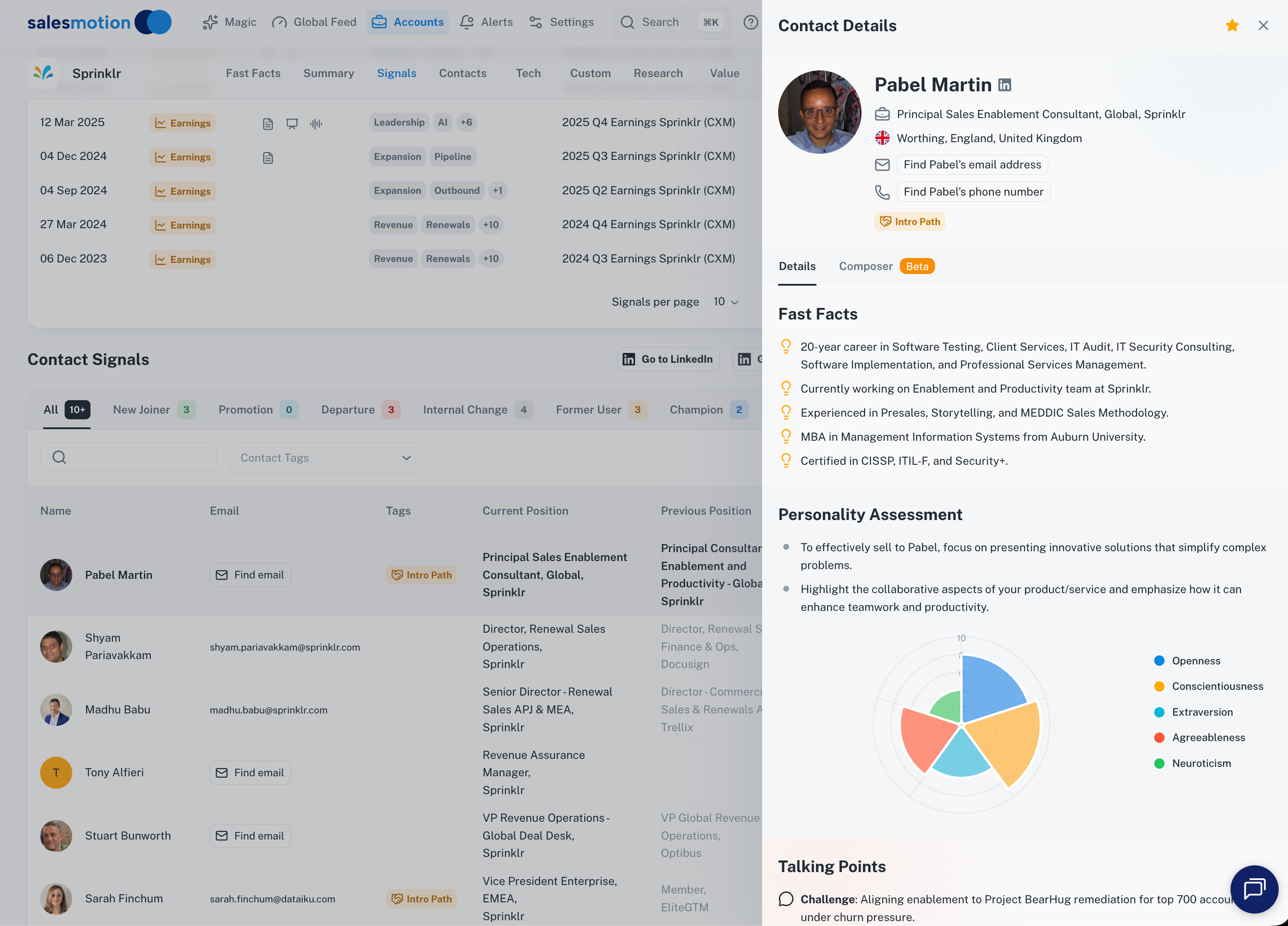 Contact intelligence surfaces personality insights, helping reps tailor their approach to each stakeholder's communication style.
When you layer in contact intelligence on top of title data, you start seeing the human dynamics that determine deal outcomes: communication preferences, recent role changes, and organizational influence patterns that a static org chart will never reveal.

“The talking points are gold. If they're in Salesmotion, I know they're being discussed inside that business. That makes it easy to spark a real conversation, which is 90 percent of the battle.”
Andrew Giordano
VP of Global Commercial Operations, Analytic Partners
Building a Value Hypothesis That Resonates
A value hypothesis is not a pitch. It is a testable belief about how your solution creates a specific, measurable business outcome for this particular account. Generic value propositions ("we help companies sell more") get ignored. Account-specific hypotheses ("your new CFO's mandate to reduce SG&A by 15% maps directly to our ability to consolidate five research tools into one") get meetings.
Here is how to build one:
- Identify the account's stated strategic priorities. These are public: earnings calls, annual reports, press releases, CEO interviews, job postings that signal investment areas.
- Map each priority to a pain point your solution addresses. Be specific. "Digital transformation" is too vague. "Migrating 200 field reps from spreadsheet-based territory management to CRM-integrated intelligence" is a hypothesis you can validate.
- Quantify the potential impact. Use industry benchmarks or case study data. Teams using Salesmotion have cut account research from 3 hours to 15 minutes per account, freeing 85% of that time for selling, according to results at Analytic Partners.
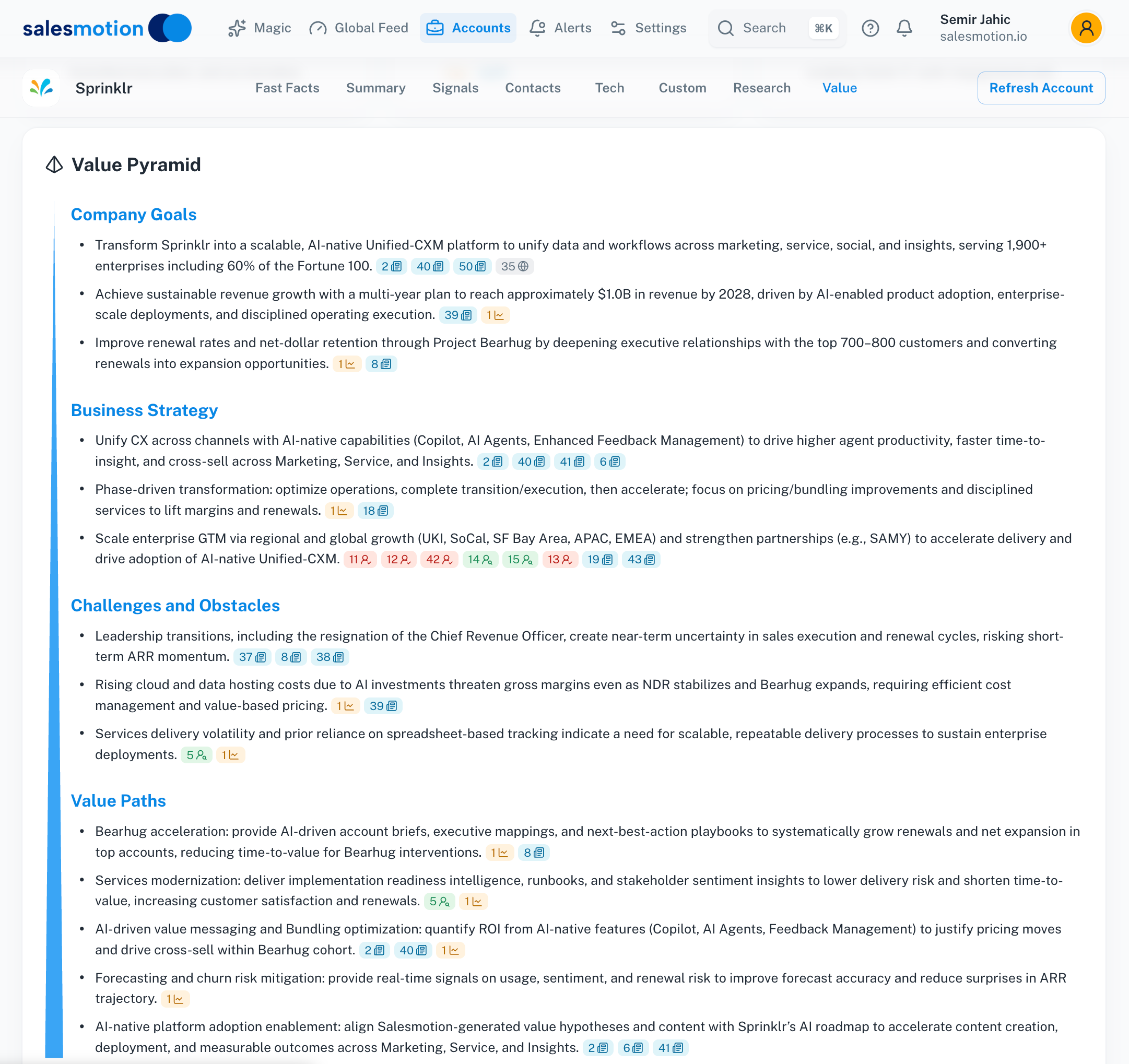 The Value Pyramid maps how your capabilities align with an account's strategic initiatives, from operational efficiency at the base to executive-level transformation at the top.
The Value Pyramid is a powerful framework for this analysis. At the base: operational improvements (time savings, process efficiency). In the middle: strategic advantages (competitive differentiation, market expansion). At the top: transformational outcomes (revenue growth, market leadership). The higher you map your value, the more likely you engage executive buyers rather than middle management.
Competitive Positioning That Wins
Every enterprise deal has competition, even if the competition is "do nothing." Your account plan needs a clear-eyed view of who you are up against and why your specific approach wins for this specific account.
The best competitive positioning is not feature-by-feature comparison. It is reframing the evaluation criteria around your strengths:
- Identify the current state. What tools, processes, or workarounds does the account use today? How many are they toggling between?
- Name the cost of the status quo. Quantify it. If reps spend 12 hours per week on manual research across five different tools, that is 600+ hours per year per rep that could go to selling.
- Position your differentiation around the buyer's priorities, not your feature list. If the CFO cares about consolidation, lead with "five tools to one." If the CRO cares about pipeline velocity, lead with the 42% sales velocity increase Frontify's team achieved.
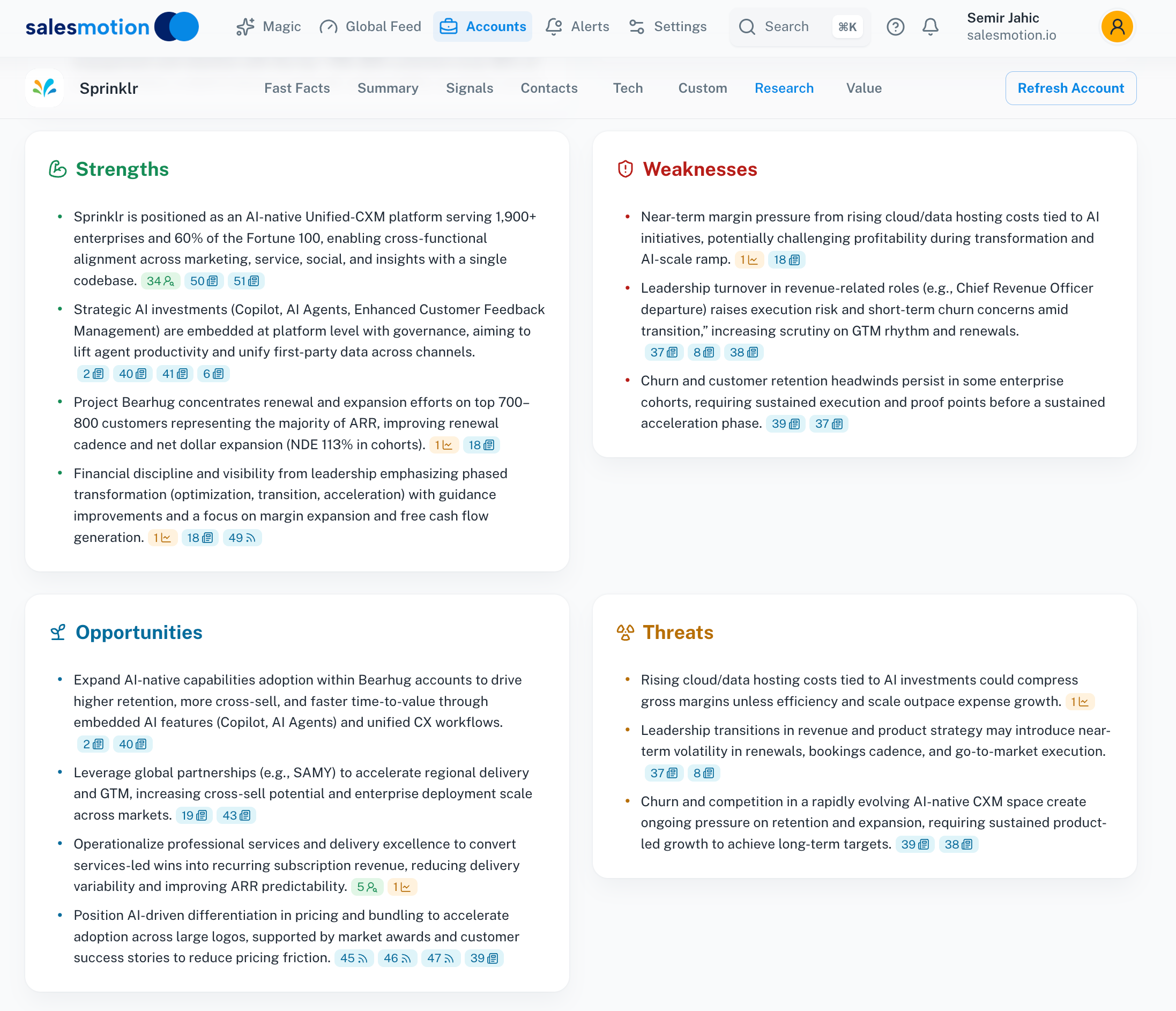 A SWOT analysis for the target account keeps competitive intelligence structured and actionable, updating as new signals emerge.
A living SWOT analysis, updated as competitive signals shift, beats a one-time slide deck every time. When a competitor launches a new feature, when the account posts a job signaling a technology evaluation, when a board member joins who has ties to a competitor, your plan should reflect it.

“We're saving about 6 hours per week per seller on account research alone. That's time they can reinvest in actually selling.”
Derek Rosen
Director, Strategic Accounts, Guild Education
The Signal-Triggered Action Plan
This is where most account plans break down at scale. The plan says "follow up in Q2," but the real buying window opened three weeks ago when the target account's new CRO mentioned "sales transformation" on their earnings call. Timing is everything in enterprise selling, and static calendars cannot capture it.
A signal-triggered action plan replaces arbitrary dates with event-driven motions:
| Signal | Action | Timeline |
|---|---|---|
| New executive hire in target department | Personalized welcome referencing their stated priorities | Within 48 hours |
| Earnings call mentions aligned initiative | Update Champion with relevant insight, request intro to new stakeholder | Within 1 week |
| Competitor mentioned negatively in reviews | Share differentiation brief with Technical Evaluator | Within 3 days |
| Budget cycle begins (fiscal year timing) | Deliver ROI analysis to Economic Buyer | 6-8 weeks before fiscal year start |
| Hiring surge in department you serve | Propose expansion conversation with Champion | Within 2 weeks |
The challenge is monitoring these signals across dozens of strategic accounts. Manually scanning LinkedIn, news sites, SEC filings, and earnings transcripts for 30+ accounts is a full-time job. This is why teams that rely on manual monitoring miss the majority of triggers that matter.
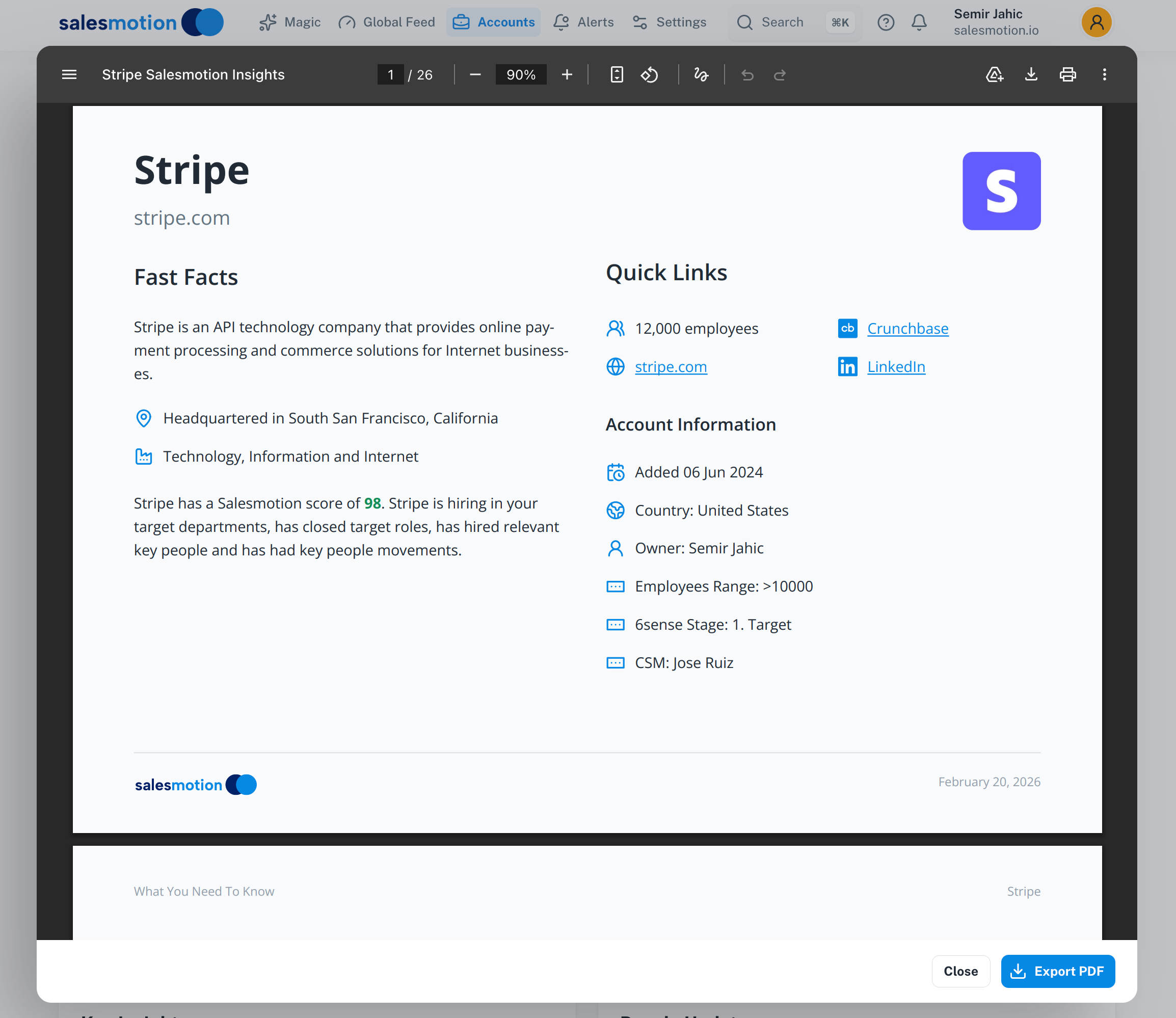 Export a complete account brief as a PDF to share with your deal team, leadership, or cross-functional partners before key meetings.
The best enterprise AEs treat the account plan as a living system, not a document. They feed it with real-time intelligence, review it weekly, and update actions based on what the account is doing right now, not what it was doing last quarter.
The 30-Minute Weekly Review
The account plan only works if it gets used. Here is a lean weekly review framework:
- Signal check (5 min). What has changed in the account this week? New hires, earnings mentions, press releases, competitor moves.
- Stakeholder update (5 min). Has anyone new entered the buying committee? Has the Champion's influence changed?
- Value hypothesis validation (5 min). Does our hypothesis still hold given new information?
- Competitive check (5 min). Any new competitive intelligence?
- Action items (10 min). What specific actions this week based on the above? Who is responsible?
This cadence turns an account plan from a dusty document into an operating rhythm. Teams that follow it consistently close larger deals faster because they never lose situational awareness on their most important accounts.
Key Takeaways
- Enterprise account plans fail when they are static documents reviewed quarterly. Build them as living intelligence systems that update as the account changes.
- Map power dynamics, not just titles. Identify the Economic Buyer, Champion, Technical Evaluator, and Blocker, then map the relationships between them.
- Build account-specific value hypotheses tied to stated strategic priorities, not generic capability pitches.
- Replace calendar-based follow-ups with signal-triggered actions. Earnings calls, leadership changes, and hiring surges create the buying windows that matter.
- Use a 30-minute weekly review cadence to keep the plan current. Teams at companies like Analytic Partners cut research time by 85% and grew qualified pipeline 40% YoY by making intelligence-driven account planning a weekly discipline.
- Export and share the plan with your deal team. An account plan that only lives in one rep's head is not a plan.
Frequently Asked Questions
What should an enterprise account plan include?
A complete enterprise account plan covers five pillars: stakeholder mapping with power dynamics (not just titles), a value hypothesis tied to the account's specific strategic initiatives, competitive positioning that addresses the cost of the status quo, a signal-triggered action plan that replaces arbitrary follow-up dates with event-driven motions, and a regular review cadence. Sellers who use structured account plans are nearly 2x as likely to find growth opportunities within their accounts.
How often should you update an enterprise account plan?
Weekly, at minimum. Enterprise deals shift constantly as new stakeholders enter, priorities change after earnings calls, and competitors make moves. A 30-minute weekly review covering signal checks, stakeholder updates, value hypothesis validation, and action items keeps the plan relevant. Quarterly reviews are too slow for deals with 6-18 month cycles where buying windows can open and close within weeks.
How do you map stakeholder power dynamics in a large deal?
Start by identifying four key roles: Economic Buyer (budget authority), Champion (internal advocate), Technical Evaluator (feasibility assessor), and Blocker (opponent). Then map the relationships between them. The Champion's proximity to the Economic Buyer matters more than the Champion's title. Use contact intelligence to understand communication preferences and organizational influence. Update the map weekly as new stakeholders emerge throughout the deal cycle.
What is a value hypothesis in account planning?
A value hypothesis is a testable belief about how your solution creates a specific, measurable business outcome for a particular account. Unlike generic value propositions, it connects the account's stated strategic priorities (from earnings calls, annual reports, and executive interviews) to a quantified impact your solution delivers. For example: "This account's new CFO mandate to reduce SG&A by 15% maps to our ability to consolidate five research tools into one, saving an estimated 600+ hours per year across their sales team."
How do signal-triggered actions improve account plan execution?
Signal-triggered actions replace calendar-based follow-ups with event-driven motions timed to real buying windows. Instead of "follow up in Q2," the action becomes "when the CRO mentions sales transformation on their earnings call, update the Champion within one week." This works because enterprise buying decisions are triggered by events like leadership changes, earnings guidance, and budget cycles, not arbitrary calendar dates.