Your CRM has 50,000 contacts. Names, titles, emails, phone numbers. And yet your reps still walk into discovery calls blind. They don't know that the VP they're calling changed jobs three months ago, that the company just promoted an internal champion to a buying role, or that the entire purchasing committee shifted after a reorg. This is the gap between contact data and contact intelligence, and it's costing your team deals every quarter.
TL;DR: Contact data tells you who someone is. Contact intelligence tells you what they're doing, why it matters, and when to engage. Teams that layer job change tracking, stakeholder mapping, and buying committee analysis onto raw contact records close faster and waste less time on dead leads.
What Is Contact Intelligence (and How Is It Different from Contact Data)?
Contact data is a static record: name, email, phone number, job title, company. It answers the question "who is this person?" Contact intelligence answers a fundamentally different set of questions: What has this person done recently? How do they relate to the buying decision? When is the right moment to reach out?
The distinction matters because B2B deals aren't won by having the right email address. They're won by understanding context. According to Gartner, the average B2B buying group now includes 8 to 13 stakeholders, depending on deal complexity. Each stakeholder has a different role, different priorities, and a different decision timeline. A static contact record tells you nothing about where each person fits in that picture.
Contact intelligence layers three types of information on top of raw contact data:
- Temporal context: What has changed recently? Job moves, promotions, company announcements, team restructures.
- Relational context: How does this person connect to others in the buying process? Who reports to whom? Who has budget authority?
- Behavioral context: Has this person engaged with your content, attended events, or visited your pricing page?
Without these layers, contact data is a phonebook. Useful for dialing, useless for selling.
Why Contact Data Alone Fails Your Sales Team
B2B contact data decays at roughly 22% to 70% annually, depending on the data field and the industry. Job titles change at a rate of 65.8% per year. Emails go stale at 3.6% per month. The contact record your rep pulled last quarter is, statistically, already wrong in at least one material way.
But decay is only half the problem. Even when data is accurate, it's incomplete. Here's what a typical contact record doesn't tell you:
The person changed companies and brought your competitor with them. A former champion at Account A is now VP of Operations at Account B. They already know your competitor's product. Without tracking that move, your rep is pitching blind against an entrenched advocate for someone else.
The buying committee expanded without your knowledge. The deal started as a conversation between your AE and the Director of Sales Ops. Then the CFO's office got involved. Then IT security. Your AE is still single-threaded into one contact while three other stakeholders are evaluating alternatives. Research from Forrester shows that 92% of B2B buying decisions are made by groups of two or more, and more than 40% of deals stall because internal stakeholders fail to align.
The contact's role changed, but their record didn't. Your database says "Director of Marketing." They were promoted to VP six months ago. Your outreach references the wrong title, signals that you haven't done your homework, and gets deleted.
The gap between contact data and contact intelligence isn't academic. It's the difference between a rep who walks into a meeting with context and one who walks in cold.

“It's not even just about saving time — it's about uncovering things we otherwise might not research. Salesmotion helps us connect Guild to what's already publicly important to the company.”
Derek Rosen
Director, Strategic Accounts, Guild Education
The Five Components of Contact Intelligence
Contact intelligence isn't a single feature. It's a system built from five interconnected capabilities.
1. Job Change Tracking
When a key contact leaves one company and joins another, two opportunities open simultaneously: a new potential buyer at their new company (they already know your product) and a replacement at their old company (the new hire needs to evaluate fresh solutions). According to research from UserGems, director and VP-level hires convert at 2.5x in their first three months compared with after a year in role.
The challenge is scale. A mid-market AE manages 50 to 100 accounts. Tracking job changes across all contacts at those accounts manually isn't realistic. This is where automated monitoring separates high-performing teams from the rest. Champion tracking across your full book of business turns every departure into two pipeline opportunities instead of a dead contact.
2. Role Context and Org Mapping
Knowing someone's title is different from knowing their role in a buying decision. A "Senior Director of IT" might be the economic buyer at one company and a technical evaluator at another, depending on the org structure. Role context means understanding where a contact sits in the decision hierarchy: Do they control budget? Can they block a deal? Are they an end user whose adoption drives renewal?
Org mapping takes this further by revealing reporting lines and departmental relationships. When your AE sees that the VP of Revenue Operations reports directly to the CRO (who's a former customer), the approach changes entirely.
3. Stakeholder Mapping and Buying Committee Analysis
Multi-threading is table stakes for enterprise deals, but most teams do it reactively. They discover new stakeholders when those stakeholders show up on a call unexpectedly. Buying committee analysis flips this from reactive to proactive. It identifies the likely decision-makers, influencers, blockers, and champions before the first meeting.
For complex deals, this analysis can make or break the outcome. Deals over $250,000 require an average of 19 external stakeholders, and committees now routinely span four or more functions: IT, finance, operations, and end users. If your team is mapped to two contacts, you're exposed to a "no decision" outcome before you even know it.
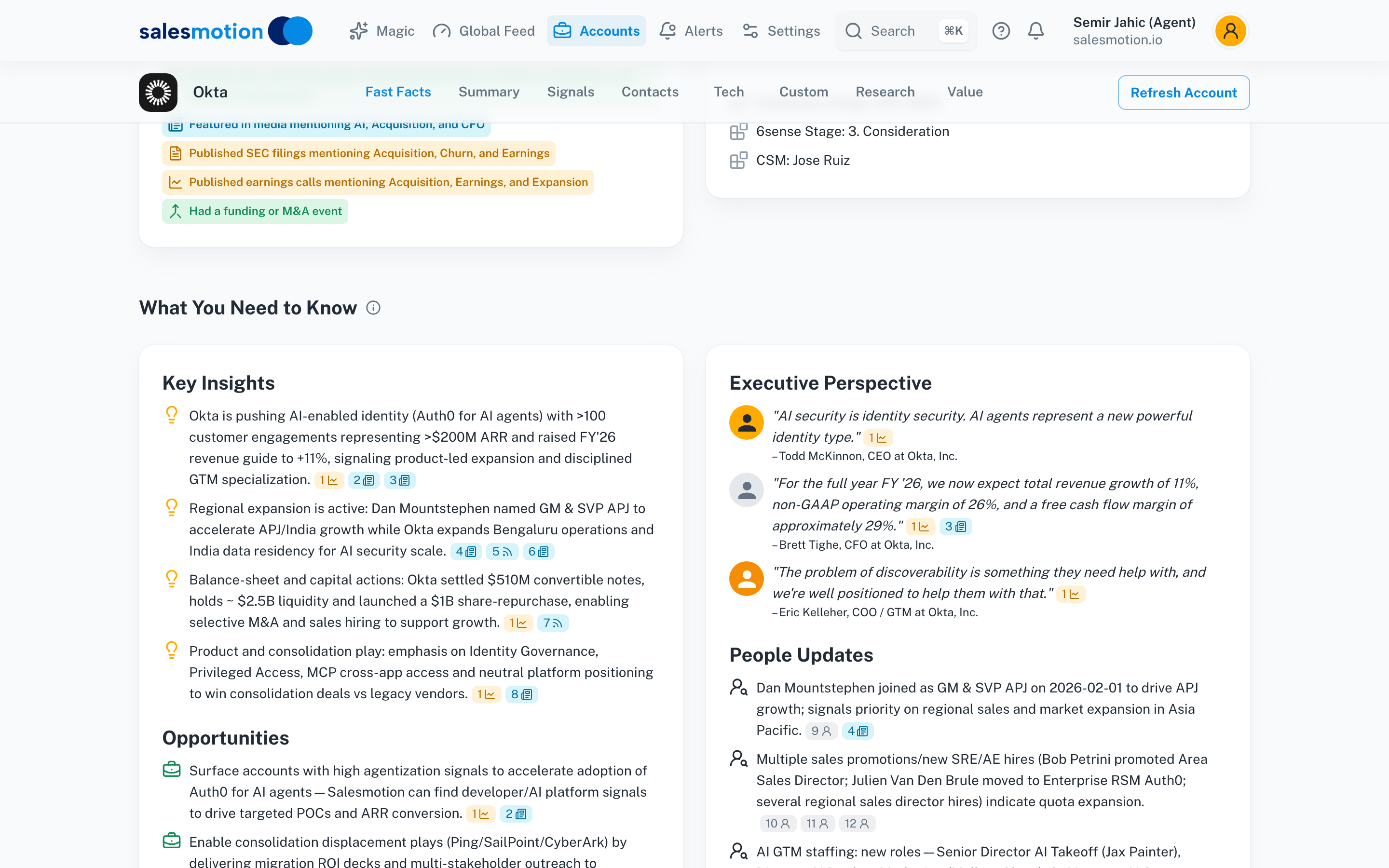 Salesmotion surfaces key insights, executive perspectives, people moves, and talking points — giving reps the context behind every contact.
4. Engagement History and Signal Correlation
Contact intelligence connects a person's engagement history (emails opened, content downloaded, meetings attended) with external signals (company funding, leadership changes, earnings commentary). A contact who downloaded your pricing PDF last week is interesting. A contact who downloaded your pricing PDF the same week their company posted three new sales roles and their CEO mentioned "sales transformation" on an earnings call is a priority.
This correlation is what transforms contact data from a static directory into a dynamic prioritization engine. Teams using signal-based selling don't just track contacts. They track the intersection of contact behavior and company-level buying signals.
5. Relationship Intelligence
Who on your team has the strongest relationship with each contact? Has your CEO exchanged emails with their CEO? Did your VP of Sales share a panel at a conference with their CRO? Relationship intelligence surfaces existing connections that can accelerate introductions and warm up cold outreach.
This layer is often overlooked because the data lives in individual inboxes and calendars rather than the CRM. But for enterprise deals where trust and credibility matter, knowing that your SVP has a direct relationship with the economic buyer changes the entire deal strategy.
How Contact Intelligence Changes the Sales Process
The impact of contact intelligence shows up at every stage of the pipeline.
Prospecting becomes targeted, not random. Instead of working a static list, reps prioritize contacts at companies showing buying signals: leadership changes, hiring surges, strategic initiative mentions. The outreach references something real and recent, not a generic value proposition.
Here's what this looks like in practice. A target account posts a VP of Sales Operations role on LinkedIn. Salesmotion flags the account and surfaces context: the new hire previously used a competitor's tool, the company's last earnings call mentioned a "go-to-market transformation initiative," and two other contacts at the account have visited the pricing page in the past month. The rep enters the first conversation already knowing the likely pain, the key stakeholders, and the timing of the initiative. Instead of a generic intro, the first meeting is consultative. Deal velocity increases because discovery is half-done before the call starts.
Discovery is informed, not exploratory. When your AE knows the buying committee structure, recent leadership changes, and strategic priorities before the first call, discovery shifts from "tell me about your challenges" to "I noticed your new CRO came from a company that centralized their sales intelligence stack. Is that something you're evaluating here?"
Deal progression is deliberate, not reactive. Contact intelligence reveals which stakeholders are engaged, which are missing from conversations, and where internal alignment is breaking down. Your AE can proactively loop in the CFO's office before the deal stalls, rather than learning about budget concerns at the eleventh hour.
Renewals and expansion become data-driven. When a champion leaves an existing account, you know immediately. When a new stakeholder joins who has no history with your product, you can initiate a re-engagement sequence before the renewal conversation. Teams with automated account monitoring catch these changes in real time instead of discovering them during a QBR.

“The Business Development team gets 80 to 90 percent of what they need in 15 minutes. That is a complete shift in how our reps work.”
Andrew Giordano
VP of Global Commercial Operations, Analytic Partners
Building a Contact Intelligence Workflow
A contact intelligence workflow isn't a single tool purchase. It's an operating rhythm that connects data, signals, and action. Here's a practical framework:
Step 1: Centralize your contact universe. Every contact your team has interacted with, across CRM, email, events, and marketing automation, needs to be accessible in one system. Fragmented contact data across five tools means five chances to miss a critical change.
Step 2: Layer signal monitoring on top. Set up automated tracking for job changes, promotions, company announcements, and engagement activity across your entire contact database. This monitoring should run continuously, not as a weekly manual check. The half-life of a buying trigger is days, not weeks.
Step 3: Build stakeholder maps for active deals. For every opportunity in pipeline, map the known contacts to their buying roles: economic buyer, technical evaluator, champion, end user, blocker. Identify gaps. If you don't have a relationship with the economic buyer, that's a red flag, not something to discover during negotiation.
Step 4: Create trigger-based workflows. When a tracked contact changes jobs, the system should automatically create a task for the owning rep with context about the move. When a new stakeholder appears at a target account, the system should flag them for outreach with relevant account context attached. When engagement spikes at a dormant account, the system should re-prioritize it in the rep's workflow.
Step 5: Review and act weekly. Contact intelligence is only valuable if reps act on it. Build a weekly ritual where each rep reviews their top signals: new job changes, emerging stakeholders, engagement spikes. This takes 15 to 20 minutes and consistently surfaces 3 to 5 actionable opportunities per week that would otherwise be missed.
Contact Intelligence for Different Sales Roles
SDRs and BDRs: Smarter Prospecting
SDRs live and die by their ability to reach the right person at the right time. Contact intelligence gives them two advantages: better targeting and better messaging. Instead of blasting a list, an SDR can prioritize contacts at accounts with recent leadership changes or hiring surges. Their outreach references specific events ("Congratulations on the VP hire. When teams expand leadership, they often re-evaluate their sales stack...") instead of generic templates.
The result is higher reply rates and more qualified meetings. When the handoff to an AE happens, it comes with context: here's the buying committee map, here's the signal that triggered outreach, here's what the contact engaged with.
Account Executives: Faster Deals
AEs need contact intelligence to multi-thread effectively and to maintain momentum on complex deals. Knowing the full buying committee before the first meeting means the AE can plan a coverage strategy from day one rather than discovering stakeholders midway through the cycle.
Salesmotion consolidates this workflow. Instead of toggling between LinkedIn, the CRM, news alerts, and a manual spreadsheet to piece together an account picture, AEs get a single account brief that surfaces contacts, org relationships, recent changes, and relevant signals in one view. Teams report cutting account research time from 60 minutes to under 5, freeing hours each week for actual selling.
Account Managers: Protecting and Growing Revenue
For AMs, contact intelligence is a retention tool. The moment a champion leaves an existing account, the AM needs to know. The moment a new decision-maker joins, the AM needs to engage them before a competitor does. Contact intelligence also surfaces expansion signals: when an account adds headcount, launches a new initiative, or posts roles that indicate they're building the capability your product supports.
The best AMs don't wait for the QBR to learn what changed. They have a continuous view of contact movement and company signals that lets them stay proactive and relevant between formal touchpoints.
Tools and Approaches for Contact Intelligence
The contact intelligence landscape ranges from point solutions that track a single signal type (like job changes) to comprehensive platforms that combine multiple intelligence layers.
Job change trackers focus on monitoring when contacts move between companies. Useful but limited to a single signal type. The risk: you optimize for one trigger and miss the dozen other signals that indicate buying readiness.
Sales intelligence platforms like ZoomInfo and Apollo provide large contact databases with enrichment. They answer "who is this person?" effectively, but their strength is data volume, not contextual intelligence. They tell you who to call but not why or when.
Account intelligence platforms combine contact data with signal monitoring, stakeholder mapping, and contextual research. This is where contact data becomes contact intelligence. Rather than tracking one signal or providing one data type, these platforms build a complete picture: the contacts, their roles, their recent activity, the company's strategic direction, and the signals that indicate timing.
The choice depends on your team's needs. If you're a 5-person SDR team doing high-volume outreach, a contact database might be sufficient. If you're an enterprise sales org running complex, multi-stakeholder deals with 6 to 12 month cycles, you need the full intelligence layer. The fragmented approach (one tool for contacts, another for signals, a third for research) breaks down past about 50 accounts because reps stop using tools they have to toggle between.
Key Takeaways
- Contact data tells you who someone is. Contact intelligence tells you what they're doing, why it matters, and when to engage. The distinction drives better prospecting, faster deals, and stronger retention.
- B2B contact data decays at 22% to 70% annually. Even accurate data is incomplete without temporal, relational, and behavioral context layered on top.
- The five pillars of contact intelligence (job change tracking, role context, stakeholder mapping, engagement history, and relationship intelligence) work together as a system, not as isolated features.
- Buying committees now average 8 to 13 stakeholders. Without proactive stakeholder mapping, your team is blind to the people who will decide the deal's outcome.
- Contact intelligence workflows should be automated and continuous, not manual and periodic. The half-life of a buying signal is days, and the rep who acts first has a 5x win rate advantage.
- Platforms like Salesmotion that combine contact data with signal monitoring and account research replace the 5-tool toggle that causes reps to abandon intelligence gathering entirely.
Frequently Asked Questions
What is the difference between contact data and contact intelligence?
Contact data is a static record of identifying information: name, job title, email, phone number, company. Contact intelligence adds dynamic layers of context, including job changes, role in the buying process, stakeholder relationships, engagement history, and behavioral signals. Contact data tells you who to call. Contact intelligence tells you why, when, and how to approach them for the highest chance of engagement.
How quickly does B2B contact data go stale?
B2B contact data decays at 22% to 70% per year, depending on the data field. Job titles change at a rate of 65.8% annually, and email addresses decay at roughly 3.6% per month. For sales teams, this means that a significant portion of any contact database is materially wrong within a single quarter, making continuous enrichment and signal monitoring essential.
Why is stakeholder mapping important for B2B sales?
According to Gartner, B2B buying groups include 8 to 13 stakeholders on average, spanning multiple functions and seniority levels. More than 40% of B2B deals stall because internal stakeholders fail to align. Proactive stakeholder mapping identifies the full buying committee before engagement begins, allowing sales teams to multi-thread effectively and prevent "no decision" outcomes.
How do job change signals create sales opportunities?
When a contact changes companies, it creates two simultaneous opportunities. At their new company, they buy differently — UserGems reports that director and VP-level hires convert at 2.5x in their first three months versus after a year in role. At their old company, the replacement hire needs to assess existing tools and may be open to alternatives. Teams that track these moves systematically generate pipeline from both sides of every departure.
What tools do I need for contact intelligence?
The tool choice depends on your sales motion. High-volume outbound teams may start with a contact database for basic enrichment. Enterprise teams running complex, multi-stakeholder deals need a comprehensive platform that combines contact data, signal monitoring, stakeholder mapping, and account research in one view. The fragmented approach of using separate tools for each capability breaks down at scale because reps stop using tools they have to switch between constantly.