Your customer health score says everything is green. Product usage is steady. Support tickets are low. NPS came back at 42.
Then your champion leaves. A reorg buries your project sponsor two levels down. Budget gets redirected to a different initiative. And six weeks later, you lose the renewal.
This is the blind spot most customer success teams live in: they track what is happening inside their product, but not what is happening at the company. Your customer health score tells you how people interact with your software. External signals show whether the business context that made them buy still exists.
For CSM teams managing 200 to 350 accounts per person, that blind spot is not just inconvenient. It is where churn hides.
TL;DR: Traditional customer health scores built on product usage, support tickets, and NPS miss the external events that actually drive churn: leadership changes, reorgs, budget cuts, and strategic pivots. CSM teams that layer external signals onto internal health data catch at-risk accounts weeks earlier and protect more revenue at renewal.
Why Do Internal Health Scores Miss the Biggest Churn Risks?
Most customer success platforms build health scores from the same inputs: login frequency, feature adoption, support ticket volume, NPS or CSAT responses, and billing status. These metrics tell you what customers are doing inside your product. They do not tell you why behavior might change. For the wider playbook, see these customer success strategies.
Health scores are only as good as the data feeding them, and the data feeding most health models is exclusively internal. Usage looks stable right up until the moment it is not.
The churn triggers that blindside CS teams almost always originate outside the product:
- Champion turnover. Churn guides such as Vitally's SaaS churn benchmarks list champions going dark or leaving the company as a key early-warning sign. If an executive sponsor departs, the risk is higher still.
- Budget reallocation. A company shifts investment from your category to a different priority. Usage might stay flat for months while the decision to cancel has already been made internally.
- Organizational restructuring. Mergers, acquisitions, and reorgs change reporting lines. Your power user now reports to someone who never signed off on your tool.
- Strategic pivots. The company announces a new direction in an earnings call or press release. If your product does not align with where they are headed, renewal is at risk.
- Hiring freezes or layoffs. A customer that is cutting headcount is simultaneously cutting software budgets. Every vendor is under review.
None of these show up in a product usage dashboard. By the time they affect login metrics, the decision is already made.
The External Signals That Predict Churn Before Usage Drops
External signals are publicly available events and changes at a company that indicate shifting priorities, financial pressure, or organizational instability. For customer success teams, the most predictive signals fall into a few categories.
Leadership and People Changes
When your champion posts a farewell on LinkedIn, that is a signal. When the VP who approved your contract gets replaced, that is a bigger one. Champion and executive sponsor departures are among the clearest early warnings of churn in B2B SaaS, and the job change signals guide covers how to catch them fast.
Multi-threading (building relationships with two to three contacts per account) is the standard mitigation advice. But you cannot multi-thread reactively. You need to know about the departure before the new stakeholder starts reviewing vendor contracts.
Financial and Strategic Indicators
Earnings calls, SEC filings, and investor presentations reveal where a company is directing resources. If your customer's CEO tells analysts they are "rationalizing the technology stack" or "focusing investment on core operations," your renewal is likely under scrutiny.
Budget cuts and hiring freezes follow a predictable pattern: first the public announcement, then internal reviews, then vendor cancellations. The gap between announcement and cancellation is your intervention window.
Competitive and Market Activity
When a customer starts evaluating competitors, they rarely tell their CSM. But they do leave signals: attending competitor webinars, following competitor executives on LinkedIn, downloading competitor content. Catching these early is what gives you time to respond.
Organizational Restructuring
Reorgs, M&A activity, and department consolidations change who makes decisions and what priorities survive. M&A is also the most common hard trigger event: 9.9% of companies tracked in Salesmotion's B2B buying signals benchmark had M&A news in a single quarter. A mid-market company acquiring a smaller competitor might consolidate on the acquired company's tech stack. A reorg that moves your sponsor from a P&L role to a staff function reduces their purchasing authority.

“It's not even just about saving time — it's about uncovering things we otherwise might not research. Salesmotion helps us connect Guild to what's already publicly important to the company.”
Derek Rosen
Director, Strategic Accounts, Guild Education
How a Signal-Aware Health Score Works in Practice
Here is an illustrative (hypothetical) example of how external signals change a CSM's workflow.
The scenario: A CSM manages 280 accounts across mid-market SaaS companies. One account, a $95K ARR customer, shows green across every internal metric. Usage is up 12% quarter over quarter. Support tickets are minimal. The last QBR went well.
The signal: The account's parent company announces a 15% workforce reduction in a press release. Two weeks later, the VP of Operations who sponsored the original purchase posts on LinkedIn that she is "exploring new opportunities."
Without external signals: The CSM sees nothing unusual. The next check-in is scheduled for six weeks out. By then, the new VP has already started a vendor review. The CSM walks into a conversation about cost-cutting instead of expansion.
With external signals: The CSM gets an alert about the layoff announcement the day it happens. A second alert fires when the executive sponsor departs. The CSM immediately:
- Updates the account risk profile from green to yellow
- Reaches out to remaining contacts to offer support during the transition
- Schedules an introductory call with the new stakeholder
- Prepares a value summary showing ROI tied to the account's current strategic priorities
- Loops in their manager for executive-to-executive outreach
The CSM arrives at the renewal conversation with context, credibility, and a relationship with the new decision-maker. The account renews.
This is the kind of workflow that Salesmotion's Signal Agent enables at scale. Instead of checking news sites and LinkedIn for 280 accounts manually, CSMs get real-time alerts on leadership changes, layoffs, earnings commentary, and strategic shifts across their entire book of business. See pricing and plans.
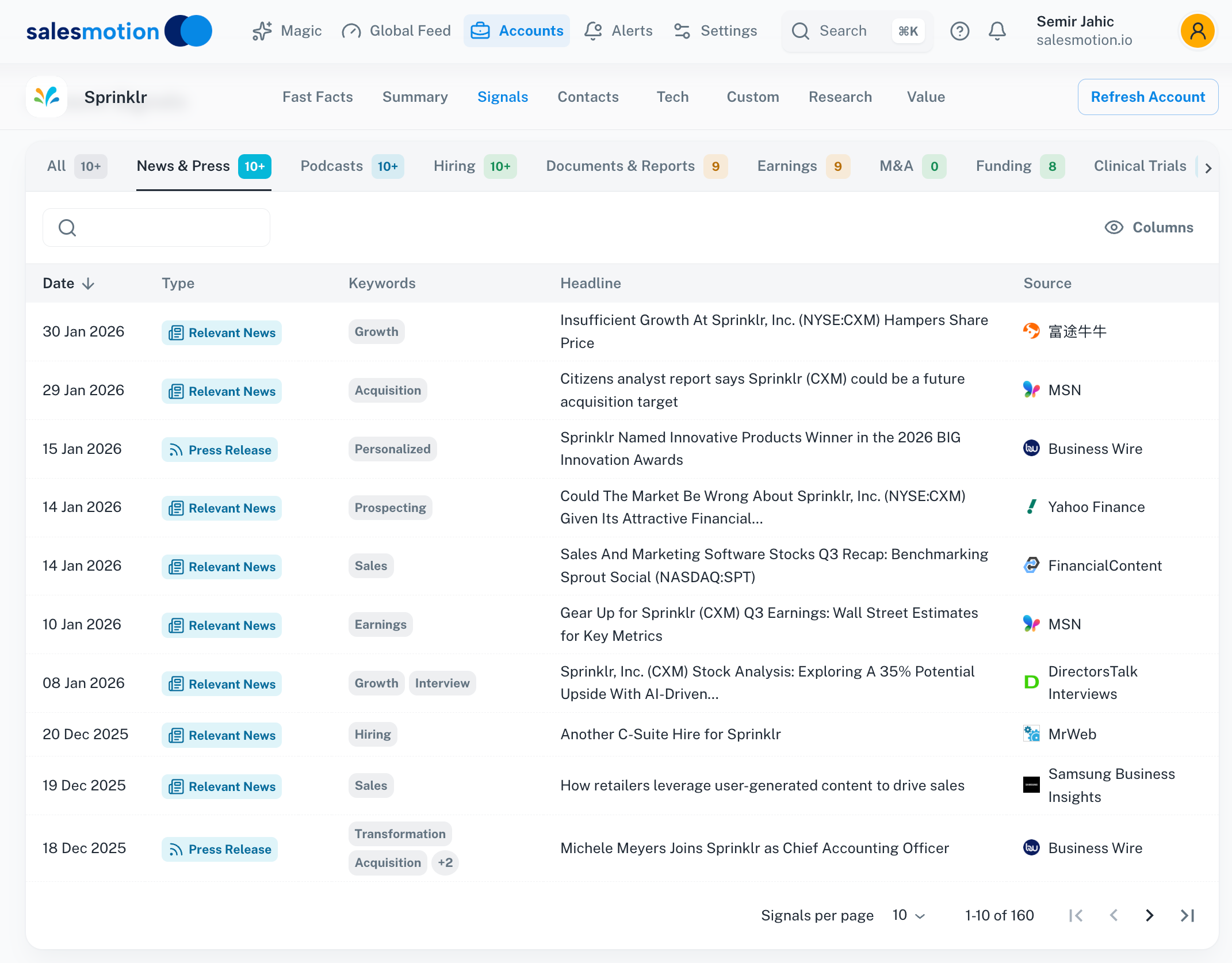 External signals like leadership changes, layoff announcements, and strategic pivots surface automatically, filling the gap internal health scores miss.
Building the Two-Layer Health Score
The most effective approach is not replacing your internal health score. It is adding a second layer on top of it. Think of it as two scorecards that together give you the full picture.
Layer 1: Internal Health (What You Already Have)
- Product usage and adoption metrics
- Support ticket volume and sentiment
- NPS/CSAT scores
- Billing and payment history
- Feature adoption breadth
- Engagement with training and documentation
This layer tells you whether the customer is getting value from your product today.
Layer 2: External Health (What You Are Missing)
These are the same public events sellers use for signal-based selling; the difference is that you watch them on accounts you already own, and the account expansion playbook covers the upside version.
- Leadership changes at the account (especially your champion and their chain of command)
- Financial signals: earnings calls, funding rounds, layoffs, hiring freezes
- Strategic shifts: new initiatives, M&A activity, market pivots
- Competitive activity: vendor evaluations, competitor engagement
- Industry headwinds: regulatory changes, market downturns affecting their sector
This layer tells you whether the conditions that made them buy still hold.
Combining the Layers
The real power is in the intersection. A green internal score plus green external signals means genuine health. But a green internal score plus red external signals (champion departed, budget cuts announced, competitor evaluation underway) means you have a window to act before the internal metrics catch up to the external reality.
Public events usually show up before usage drops, and that lead time is the difference between proactive outreach and a reactive save attempt.
For teams using Salesmotion, this two-layer approach works by surfacing external signals automatically alongside CRM and product data. Instead of building a separate monitoring workflow, the account intelligence platform continuously tracks 1,000+ public sources for changes at every account in your book.
Why Do Negative Signals Matter More Than Positive Ones?
Customer success teams naturally gravitate toward positive signals: expansion triggers, usage growth, executive promotions that increase budget authority. Those matter for growth. But for retention, negative signals carry disproportionate weight.
Here is why: positive signals confirm what you already expect (the customer is healthy, keep doing what you are doing). Negative signals reveal what you did not know (the customer is at risk, and nothing in your dashboard shows it yet).
The asymmetry matters operationally. Missing a positive signal means you might be late on an upsell opportunity. Missing a negative signal means you lose the account entirely. The cost difference is large: research by Frederick Reichheld of Bain & Company found that a 5% increase in retention raises profits by 25% to 95% (Harvard Business Review).
Negative signals to prioritize:
- Layoff announcements (immediate budget risk)
- Champion departure (relationship and advocacy risk)
- Earnings misses or revenue warnings (spending pressure)
- Reorgs that move your sponsor (authority and priority risk)
- Competitor funding rounds (increased competitive pressure on your customer's market, which cascades into budget pressure)
The same principle applies to account-based selling. Whether you are prospecting a new logo or protecting an existing customer, the external signal layer is what separates reactive teams from proactive ones.
The sale does not stop when the deal is done. The same intelligence that helps close a deal, tracking leadership changes, financial shifts, and strategic priorities, is exactly what protects the revenue after it closes.
Key Takeaways
- Internal health scores have a blind spot. Product usage, NPS, and support tickets only show what is happening inside your product, not what is happening at the company.
- External signals predict churn earlier. Leadership changes, budget cuts, reorgs, and strategic pivots create churn risk weeks before usage metrics reflect it.
- Champion turnover is the single biggest risk factor. Roughly half of accounts churn within a year of losing their internal champion.
- Negative signals outweigh positive ones for retention. Missing an upsell opportunity is costly. Missing a churn signal is catastrophic.
- Layer external signals on top of existing health scores. Do not replace what works. Add the context that is missing. Tools like Salesmotion automate this by monitoring 1,000+ sources across your entire book of business.
- Act in the gap between signal and impact. External events take weeks to affect product usage. That window is where proactive CSMs save renewals.
Frequently Asked Questions
What are external signals in customer success?
External signals are publicly available events and changes at a customer's company that indicate shifting priorities, financial pressure, or organizational instability. Examples include leadership departures, layoff announcements, earnings call commentary, M&A activity, and competitive evaluations. Unlike internal metrics (product usage, support tickets), external signals originate outside your product and often predict churn before any internal metric changes.
How do external signals improve customer health scores?
External signals add a second layer of context to traditional health scores built on product usage data, and they often appear before usage changes. By combining internal health metrics with external signals, CS teams can identify at-risk accounts while there is still time to intervene, rather than reacting after usage has already declined.
Can a CSM realistically monitor external signals across hundreds of accounts?
Not manually. A CSM managing 200 to 350 accounts cannot realistically track leadership changes, earnings calls, layoff announcements, and competitive activity across every account by checking LinkedIn and news sites individually. This is where automation matters. Platforms that aggregate and filter external signals across an entire portfolio surface only the changes that require action, turning what would be hours of daily research into a focused alert feed that a CSM can review in minutes.
What external signal is the strongest predictor of churn?
Champion and executive sponsor turnover consistently ranks as the strongest external predictor of churn. This is why multi-threading (building relationships with multiple stakeholders per account) is critical, and why knowing about departures as soon as they happen gives CS teams the best chance to protect the renewal.