The best buying signal tool for a B2B sales team is Salesmotion if you want to be told what changed at your accounts and why it matters: 50+ signal types from 1,000+ public sources, each cited to its source, from $85/month. Choose UserGems if you want buyer signals and first-party data unified into person-level intelligence for outbound and ABM, with 30+ native signals and plans priced per year from $40,000. Choose 6sense if marketing and sales run a shared account-based program on intent data.
Comparing signal-tracking platforms?
Most signal tools alert you. Salesmotion alerts you, briefs you, then drafts the outreach.
1,000+ public sources, verified contacts, AI-drafted messages — the full signal-to-meeting loop. From $85/mo.
TL;DR: The top three buying signal tools for 2027 are Salesmotion (sales teams that want account-level business signals with cited context, from $85/month on a monthly contract), UserGems (outbound and ABM teams that want person-level signals, a Research Agent and an MCP server, from $40,000/year) and 6sense (enterprise marketing and sales teams running account-based programs on intent data, quoted per organization). The other nine platforms in this guide each start from a different place: person-level buyer intelligence, contact data, topic intent, relationships, website visitors or build-your-own workflows.
Top picks
| Tool | Best for | Starting price |
|---|---|---|
| Salesmotion | Account-level business signals with cited context | From $85/mo |
| UserGems | Person-level signals for outbound and ABM | From $40,000/yr |
| 6sense | Intent-driven account-based programs | Custom, quote-only |
Why Trust This Guide?
Salesmotion publishes this guide, and Salesmotion is ranked first in it. Buying signals are the category Salesmotion is built for, so that placement is the one you should test hardest. Its entry says exactly what it tracks, what it costs and where it sits alongside the other platforms here.
Every price and product fact in this guide was checked against the vendor's own website on 10 October 2026. Where a vendor does not publish a price, the guide says so and does not estimate. Third-party figures are named where they appear: the contract medians quoted for 6sense, Demandbase, Bombora and ZoomInfo come from Vendr's marketplace data, with the number of purchases behind each one.
The ranking also reflects what buyers told us. We sat in 55 sales and customer calls between August and October 2026. In 22 of them the buyer wanted to be told what changed at their accounts instead of going to look.
"I'm looking more for surveillance on my accounts to pick up the stuff that I might miss."
Regional sales manager, cybersecurity
"one of the things I'm always trying to figure out is the right timing"
Owner, sales consultancy
See the product in action
Take a self-guided tour of the Salesmotion platform — no signup required.
Quick Comparison: Top 12 B2B Signal Tracking Platforms
Pricing is each vendor's published wording as of 10 October 2026. The order is explained under the table.
| Platform | Best for | Standout capability | Pricing | Free plan or trial |
|---|---|---|---|---|
| Salesmotion | Account-level business signals with cited context | 50+ signal types from 1,000+ public sources | From $85/mo | Interactive demo |
| UserGems | Person-level signals for outbound and ABM | 30+ native signals | Core $40,000/yr, Advanced $75,000/yr, Elite $150,000/yr | Data test on request |
| 6sense | Intent-driven account-based programs | Signalverse intent network | Custom, quote-only | Demo on request |
| Common Room | Buyer intelligence at the person and buying-committee level | Person360 | Essential $2,500/mo (billed annually) | Demo on request |
| ZoomInfo | Buyer signals on top of contact data | Copilot buyer signals | Custom, consumption-based | ZoomInfo Lite free tier |
| Demandbase | Account-based marketing with sales intelligence | Buying groups and advertising in one platform | Custom (platform fee + per-user fee) | Quote on request |
| Bombora | Topic-level intent data for an existing stack | Company Surge across 25,300+ intent topics | Custom, quote-only | Quote on request |
| LinkedIn Sales Navigator | Relationship and job change signals | Alerts on saved leads and accounts | Core $119.99/mo; Advanced $159.99/mo | Trial on Core and Advanced |
| Clay | Signals built into custom workflows | Job change, company news and web intent signals | Free; Launch $185/mo, Growth $495/mo | Free plan |
| Unify | Signal-triggered outbound plays | 100s of signals from 40+ data sources | Free forever (3 seats); Base $20, Pro $60/seat/mo | Free plan |
| Champify | Past customers and champions in Salesforce | Relationship Tracking | Core $2,000/mo, Pro $3,000/mo, Enterprise $6,000/mo | Data test on request |
| Warmly | Website visitor signals for inbound | AI web de-anonymization | From $10,000/yr (annual or quarterly) | Quarterly billing option |
What the order is based on. The list is ordered by fit for one buyer: a B2B sales team that wants to know which accounts to work this week and why. Platforms that deliver a broad set of signals a seller can act on directly come first. Platforms built around one signal family, a marketing-led program or a workflow you assemble yourself follow. A lower position is not a lower quality score. Each platform is the right pick for the buyer named in its entry.

“The account and contact signals are key for reaching out at important times, and the value-add messaging it creates unique to every contact helps save time and efficiency.”
Daniel Pitman
Mid-Market Account Executive, Black Swan Data
Detailed Platform Reviews
1. Salesmotion
What it is. Salesmotion is an AI account intelligence platform with three AI agents. The Signal Agent watches your accounts for changes, the Research Agent turns them into cited account briefs, and the Outreach Agent drafts messages from that research for a rep to review.
Best for. Enterprise and mid-market B2B sales teams that want real business events at their accounts, with the context to act on them.
What it is strong at.
- Breadth of business signals. 50+ signal types drawn from 1,000+ public sources, including earnings calls, leadership changes, hiring, funding and M&A activity.
- Every signal cited. Each signal links back to its source, so a rep can check it before using it in a message or a meeting.
- Context, not only alerts. A signal arrives with the account brief around it: what changed, why it matters and who is involved.
- Signals inside the tools a team already uses. A native Salesforce integration (managed package, one-way or bi-directional sync), a HubSpot integration, outreach drafts pushed to lemlist, a REST API, and an MCP server that works with Claude, ChatGPT and other assistants.
Here is what that looks like in practice. A target account posts a new VP of Revenue Operations role. Salesmotion flags the account, shows the hiring signal next to recent earnings commentary about a sales transformation initiative, and generates a research brief. The rep walks into discovery already knowing the likely pain, the key stakeholders and the timing.
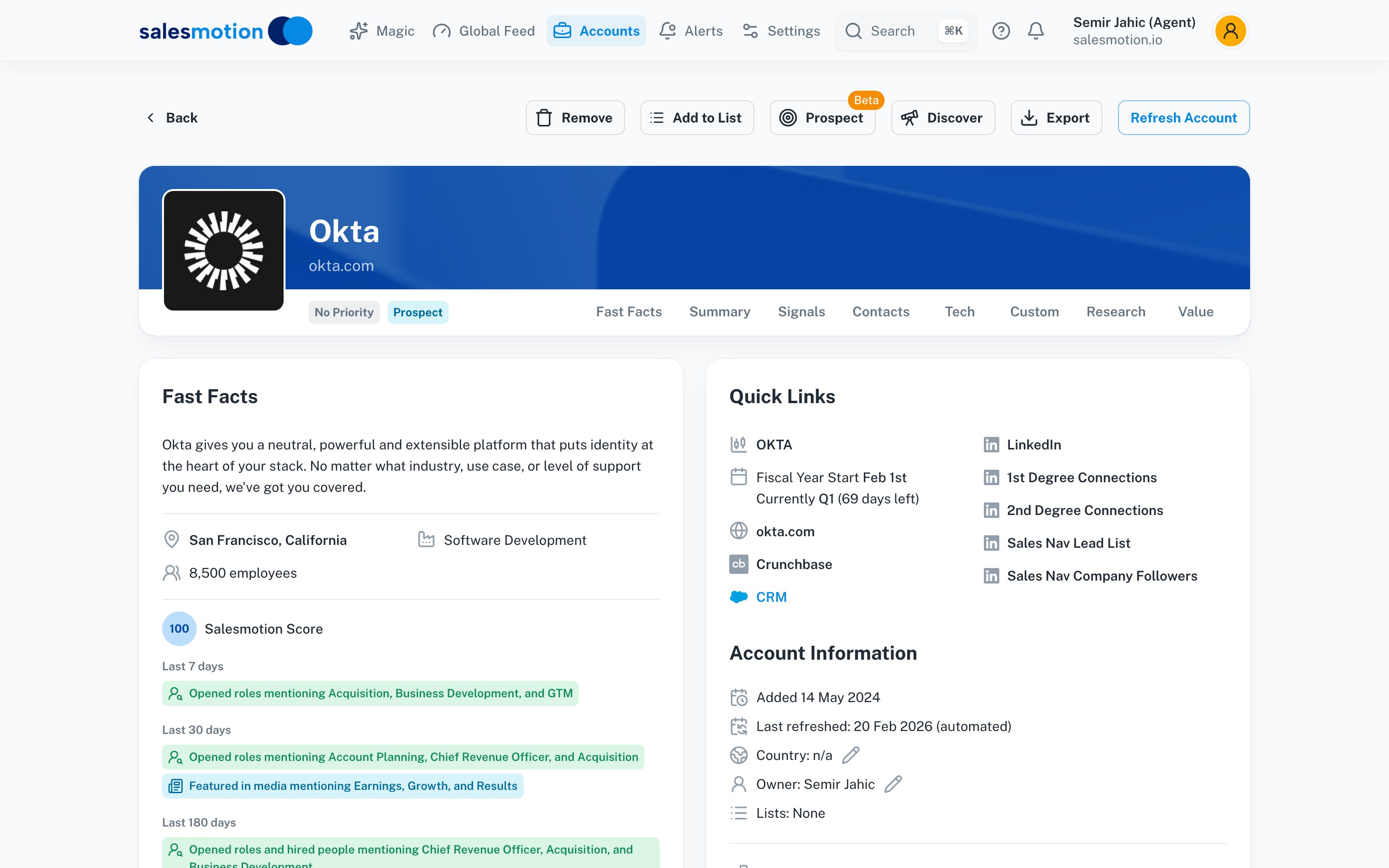 Salesmotion shows signals such as hiring, earnings, clinical trials, M&A and press releases in a single timeline with source attribution.
Customer results. Analytic Partners increased qualified pipeline by 40% and cut research time by 85%. Incredible Health increased meetings booked by 50% after a three-day implementation. Cacheflow reduced prep time by 60%.
Pricing. $85/month for individuals on a monthly contract, covering up to 100 accounts and 200 contact credits a month for verified email and phone. Custom pricing for teams and enterprise.
Choose it if your reps need a reason to reach out that is grounded in something the account has said or done. Salesmotion is the account intelligence and signal layer that sits alongside a contact database or a sequencer.
2. UserGems
What it is. UserGems describes itself as the AI Command Center for outbound and ABM. It unifies buyer signals and first-party data into person-level intelligence, and orchestrates sales and marketing through AI agents, including directly in Claude and ChatGPT.
Best for. Outbound and ABM teams that want signals resolved to the individual buyer and routed into the CRM, sales engagement and advertising tools they already run.
What it is strong at.
- 30+ native signals. UserGems lists job changes, contact-level intent, website visits, M&A and hiring among them. Its signals page also names past champions, new hires at target accounts, funding, leadership changes, earnings reports and product launches as native signals.
- Research Agent. Launched in September 2026 and included on every pricing tier, the Research Agent runs external and internal research: finding custom signals from public sources and analyzing call transcripts and CRM data.
- UserGems MCP. Live since September 2026, the MCP works in Claude and ChatGPT. UserGems describes using it to research an account before a call, rank who to reach, pull signal history and draft a message.
- Integrations. CRMs (Salesforce, HubSpot, Dynamics), marketing automation (HubSpot, Marketo), sales engagement platforms (Outreach, Salesloft, Gong Engage) and advertising platforms (LinkedIn, Meta, Google Ads).
Pricing. UserGems publishes three tiers priced per year: Core at $40,000/year, Advanced at $75,000/year and Elite at $150,000/year. Every tier includes unlimited admin and end users. Source: UserGems pricing. See also our UserGems pricing review and our UserGems and Salesmotion comparison.
Choose it if you want one system for person-level signals, from job changes to intent and website visits, with agents that research and write, and your team works in Claude or ChatGPT.
3. 6sense
What it is. 6sense is a revenue intelligence platform built on its Signalverse intent network. 6sense cites 13 years of proprietary Signalverse intent and says the Signalverse captures one trillion signals every day.
Best for. Enterprise marketing and sales organizations running coordinated account-based programs. Read our full 6sense pricing breakdown for details.
What it is strong at.
- Intent at scale. Intent Data, Web Deanonymization and Predictive Modeling are core parts of the platform.
- Tools for sellers. Sales Copilot, Account Prioritization, Sales Alerts and RevvyAI, which offers account research, meeting prep and sales strategy.
- Marketing execution. Advertising, Audience Builder and AI Email Agents sit on the same data.
- Analyst recognition. 6sense's homepage notes it was named a Leader in The Forrester Wave: Revenue Marketing Platforms for B2B, Q1 2026.
Pricing. 6sense does not publish list pricing; contracts are quoted per organization. Vendr's marketplace data reports a median annual contract value of $62,220 across 386 purchases, with a range of $11,234–$176,511. See our 6sense vs. Salesmotion comparison for a feature breakdown.
Choose it if marketing owns an account-based program, sales works from the same account scores, and you want one platform for both teams.
4. Common Room
What it is. Common Room, owned by Zoom since July 2026 and still sold under its own name, positions itself as complete buyer intelligence that turns intent into pipeline. See our Common Room pricing analysis for details.
Best for. Teams that want person-level buyer intelligence, enrichment and prospecting from one vendor.
What it is strong at.
- Person-level buyer intelligence. Person360, Buying Committee and AI Scoring are core products, alongside Enrichment and Prospector.
- AI for sellers. Account research, contact research, message personalization and live in-call guidance, plus RoomieAI and an MCP and CLI.
- Data and reach. A 400M+ contact directory, with connections to Salesforce, HubSpot, Slack, Outreach and 50+ other integrations.
- Zoom's revenue products. The product navigation now includes Zoom's Revenue Accelerator, Auto Dialer, Engage, AI Coaching and Forecast.
Pricing. Common Room publishes its entry tier at $2,500/month billed annually (Essential, 5 seats, 100k contacts). Advanced and Enterprise are quote-only. There is no free tier or self-serve trial on the pricing page. For teams exploring other options, see our Common Room alternatives guide.
Choose it if you want buyer intelligence, enrichment and a contact directory in one product, or Zoom's revenue tools are already part of your stack.
5. ZoomInfo
What it is. ZoomInfo is a go-to-market data platform with verified data on 500M+ contacts and 100M+ companies. For alternatives, see our ZoomInfo alternatives guide.
Best for. Sales teams that want buyer signals in the same platform as the contact record. See our ZoomInfo pricing breakdown for costs.
What it is strong at.
- Copilot signals. ZoomInfo Copilot names verified buyer signals, growth opportunity alerts, AI-powered deal alerts, re-engagement signals, and risk and expansion alerts, with priorities that update in real time as new signals come in.
- From signal to contact. A rep can go from a flagged account to org charts and contact details without leaving the platform.
- Signal-triggered workflows. GTM Studio builds and runs go-to-market workflows triggered by buying signals.
- Intent as an option. Streaming Intent is available as an add-on to base plans.
Pricing. ZoomInfo does not publish list pricing; contracts are quoted per organization; its own pricing page states that no specific dollar amounts are published because pricing is consumption-based. Vendr reports a median contract of $33,500 a year based on 1,576 purchases, with a range of $7,233–$156,053. ZoomInfo Lite is a permanent free tier with 10 credits a month.
Choose it if contact data is your first need and you want signals and intent layered onto it by the same vendor.
6. Demandbase
What it is. Demandbase is an account-based go-to-market platform spanning marketing, advertising, sales and data. Read our Demandbase pricing review for cost details.
Best for. Enterprise marketing and sales teams that want advertising, intent and sales intelligence in one platform.
What it is strong at.
- First-party and third-party data together. Demandbase describes combining 1st and 3rd-party data with transparent AI.
- Buying groups. Its sales product focuses sellers on the right accounts and buying groups, and maps those groups.
- One platform. Demandbase states that it does not split the product into separate marketing and sales solutions. Advertising can be a starting place, and its data solutions can be used on their own.
- Integrations. HubSpot, Microsoft Dynamics 365, Eloqua, Outreach, Salesloft and LinkedIn are among the integrations shown.
Pricing. Demandbase does not publish list pricing; contracts are quoted per organization; its pricing page describes a platform fee plus a flat fee per user. Vendr reports a median annual contract value of $68,591 across 187 purchases, with a range of $24,000–$164,037.
Choose it if you run account-based marketing with paid media and want sales working from the same account and buying-group data.
7. Bombora
What it is. Bombora is an intent data provider. Its Company Surge product is built on a data co-op of publishers and brands that share content consumption data.
Best for. Teams that want topic-level intent data to feed into the sales and marketing tools they already own.
What it is strong at.
- Topic coverage. Company Surge covers 25,300+ intent topics, across 16B+ monthly events and 5M+ company domains.
- The co-op. Bombora describes hundreds of publishers and brands and thousands of B2B sites, and says 86% of co-op data is shared exclusively with Bombora.
- A wider product set. Identity and enrichment (including Visitor Insights), B2B digital audiences and campaign measurement.
- Partner reach. Featured partners include The Trade Desk, Reddit, Adobe and Apollo.
Pricing. Bombora does not publish list pricing; contracts are quoted per organization. Vendr reports a median annual contract value of $25,000 across 35 purchases, with a range of $13,000–$80,450.
Choose it if you already have the platforms to act on intent and want a dedicated source of company-level topic surges.
8. LinkedIn Sales Navigator
What it is. LinkedIn Sales Navigator is LinkedIn's sales product, built on a network of 1+ billion members.
Best for. Individual sellers and teams that rely on relationships and want signals about the people in their accounts.
What it is strong at.
- People signals from the source. Alerts when saved leads have important updates such as a job or role change, plus content-engagement and shared-activity alerts.
- Buyer Intent. On Advanced and Advanced Plus, Buyer Intent shows which companies are actively showing interest.
- Warm paths. TeamLink, Relationship Explorer and Relationship Map.
- CRM connections. Integrations with Salesforce, HubSpot, Microsoft Dynamics and Oracle.
Pricing. LinkedIn publishes Sales Navigator pricing: Core at $119.99/month or $1,079.88/year, Advanced at $159.99/month or $1,799.88/year, and Advanced Plus on request. All three plans include 50 InMail credits a month.
Choose it if your motion is social selling and you want the most direct view of who moved, who was promoted and who is engaging.
9. Clay
What it is. Clay is a data enrichment and workflow platform that brings 150+ data providers into one table, with native signals and a sequencer.
Best for. RevOps teams and GTM engineers who want to define their own signals and what happens when one fires.
What it is strong at.
- Native signals by plan. Job change signals (job changes, promotions and new hires), company news signals and social listening signals on Launch and above. Web intent signals and signal automation through webhooks on Growth and above.
- Account Agents. Agents that reason over what you know about an account, monitor a book of business and track what changed.
- Action in the same place. Clay's native sequencer and CRM integrations turn a signal into a next step.
- Assistant access. Clay MCP works in ChatGPT, Claude and Codex.
Pricing. Clay publishes its pricing: a free tier, Launch from $185/month and Growth from $495/month (about $167 and $446 on annual billing), then custom Enterprise on an annual commitment. Paid plans start with a 14-day trial, include unlimited seats, and meter usage in Actions and Data Credits. Clay introduced these plans in spring 2026; customers on the legacy Starter, Explorer and Pro plans can stay on them.
Choose it if you have an operations owner who wants to build signal workflows to your own specification.
10. Unify
What it is. Unify sells outbound agents for every rep: a unified platform for prospecting, research and sequencing.
Best for. Outbound teams that want signals to trigger sequences in the same product.
What it is strong at.
- Signal breadth. Unify cites 100s of signals from 40+ data sources, with examples including web search, job changes, funding, hiring, web visits and tech stack.
- Plays and sequencing. Automated plays and multi-channel sequencing sit alongside its signals in one product.
- A low entry point. A free forever plan for up to 3 seats, with Base and Pro billed monthly.
- Integrations. Salesforce and HubSpot integrations, with bulk APIs usable in Claude or Codex.
Pricing. Unify publishes its pricing: a free forever plan for up to 3 seats, Base at $20 and Pro at $60 per seat per month, then custom Business. Pro includes a 14-day free trial with no credit card required.
Choose it if you want one product that detects a signal, enriches the contact and sends the sequence.
11. Champify
What it is. Champify turns a company's existing relationships into new revenue. It finds former customers at new companies and past lost deals ready for re-engagement.
Best for. Salesforce teams with a large base of past customers, users and closed-lost contacts.
What it is strong at.
- Relationship Tracking. Tracks contacts as they move, with volumes from 15,000 contacts on Core.
- Insider AI. Synthesizes intel across call transcripts, emails and CRM to direct who, when and how to re-engage.
- New Executive Hires. Surfaces key executive new hires across target accounts.
- Native to Salesforce. Champify is an official Salesforce ISV partner, with integrations including Outreach, Salesloft, Gong, Slack, 6sense and Demandbase.
Pricing. Champify publishes its pricing: Core from $2,000/month (15,000 contacts), Pro from $3,000/month (40,000 contacts) and Enterprise from $6,000/month (150,000 contacts).
Choose it if your CRM is Salesforce and your best pipeline comes from people who already know your product.
12. Warmly
What it is. Warmly sells Inbound Agent, TAM Agent, Context Graph and Signals, with plans built around AI web de-anonymization and inbound chat. Warmly announced on 30 June 2026 that it has entered into an agreement to be acquired by HubSpot, and said existing contracts, pricing and integrations remain unchanged for customers.
Best for. Teams that want to identify website visitors and engage them, with social and research intent alongside.
What it is strong at.
- Three intent sources. Warmly lists first-party web intent, second-party social activity and third-party research intent.
- A wide signal list. Web visitor behavior, product usage, CRM data, new hire identification, job changes, keyword research and competitor research are among its listed signal types.
- Inbound engagement. Inbound Chat and AI Inbound Autopilot plans build on the visitor data.
Pricing. Warmly publishes annual pricing from $10,000/year for AI Web-Deanonymization, $20,000 for Inbound Chat and $30,000 for AI Inbound Autopilot. Billing is annual or quarterly; quarterly costs materially more ($4,875/quarter on the entry plan).
Choose it if inbound is your main channel and you want to know who is on your site and engage them in the moment.
Changes from earlier editions. Apollo acquired Pocus in March 2026, and pocus.com now offers a waitlist, so Pocus no longer holds a numbered slot. See our Pocus alternatives guide. Also in this space: G2 Buyer Intent and Coldreach.
What Makes a Great B2B Signal Tracking Platform?
Signal platforms are built in different ways. Some track one signal family in depth. Others cover many. Six traits are worth testing in any evaluation.
Multi-signal coverage. A single signal type gives a partial picture. The strongest setups combine first-party signals (product usage, website visits) with third-party signals (hiring, earnings calls, M&A activity, leadership changes) so you see the full buying context.
Freshness. Signals lose value fast. A leadership change from three weeks ago is already old news to the account. Ask each vendor how often sources are checked and how quickly a signal reaches the rep.
CRM integration. Signals that live in a separate dashboard get ignored. Check that signals surface where reps already work, inside the CRM, the sequencer or the AI assistant.
Actionable context. A raw data point ("Company X posted 3 new job listings") is not useful without context. Strong platforms explain what the signal means: why the company may be entering a buying window, who the stakeholders are and what the initiative looks like.
Traceable sources. A rep who repeats a signal to a buyer needs to know it is true. Ask whether every signal links back to its source.
Transparent pricing. Eight of the twelve vendors in this guide publish prices. Published pricing makes it easier to judge return before the first demo.

“Automatic account profile detail I can use to manage my territory. Using Salesmotion AI to generate value statements per persona, account, etc. Using Salesmotion to give me a starting point based on new hires, or news alerts is critical.”
Adam Wainwright
Head of Revenue, Cacheflow
Signal Type Coverage: How Platforms Compare
Platforms start from different signal families. This section lists what each vendor says it covers, by family.
- Business events (earnings, leadership, hiring, funding, M&A). Salesmotion tracks 50+ signal types from 1,000+ public sources, with every signal cited. UserGems lists funding, M&A activity, IPO and 10K filings, hiring, leadership changes, earnings reports and product launches among its native signals. Clay offers company news signals, and Unify lists news and company events and fundraising signals.
- People and relationship signals. UserGems lists past champions, new hires at target accounts, promotions and role changes. Champify tracks former customers at new companies and new executive hires. LinkedIn Sales Navigator alerts on job and role changes. Clay, Unify and Warmly each list job change signals.
- Third-party intent. Bombora's Company Surge covers 25,300+ intent topics. 6sense runs the Signalverse intent network. ZoomInfo sells Streaming Intent as an add-on. UserGems lists contact-level intent, and Warmly lists third-party research intent.
- Website visitors. Warmly, 6sense (Web Deanonymization), UserGems (contact-level website visits), Clay (web intent signals on Growth and above) and Bombora (Visitor Insights) each identify or act on site traffic.
- First-party and product signals. Demandbase combines first-party and third-party data. UserGems supports bring-your-own signals such as product usage. Warmly lists product usage and CRM data among its signal types.
- Person-level buyer intelligence. Common Room's Person360 and Buying Committee, and UserGems' person-level intelligence, are built around the individual buyer.
For teams that want to capture every buying signal, the practical question is which families matter for your motion and which platform delivers them in a form your reps will use.
How to Choose the Right Signal Platform for Your Team
The right platform depends on your go-to-market motion, team size and budget.
You run signal-driven outbound. You need business events (leadership changes, earnings commentary, hiring surges) that give reps a reason to reach out and something specific to say. That is what signal-based selling depends on, and it is the case Salesmotion is built for.
You want person-level signals across outbound and ABM. UserGems. It resolves signals to the individual buyer, includes a Research Agent and works in Claude and ChatGPT through its MCP.
You run ABM with close marketing and sales coordination. 6sense or Demandbase. Both combine intent with advertising and tools for sellers. 6sense is built on its Signalverse intent network. Demandbase leads with buying groups and one platform for marketing and sales.
Your best deals come from past customers. UserGems or Champify. Both track people who already know your product as they move to new companies. Champify is native to Salesforce.
You want buyer intelligence, enrichment and a contact directory in one product. Common Room, now owned by Zoom and sold alongside Zoom's revenue tools.
You need a contact database and signals from one vendor. ZoomInfo.
You have a RevOps builder. Clay for full control over signal workflows, or Unify if you want signals and sequencing in one product.
Inbound is your main channel. Warmly for acting on website visitors.
You only need intent data. Bombora, fed into the platforms you already own.
Budget matters too. Published entry prices in this guide include free plans (Clay, Unify), $85/month (Salesmotion), $2,000/month (Champify), $2,500/month billed annually (Common Room), $10,000 a year (Warmly) and $40,000 a year (UserGems Core). 6sense and Demandbase quote per organization; Vendr reports median annual contracts of $62,220 and $68,591. Decide first whether you need a full account-based platform, or better buying signals and account intelligence for the sales team.
Key Takeaways
- Buying signal tools help sales teams prioritize accounts and people showing change or intent, and they differ most in which signal families they start from.
- Intent data shows that a company is researching a topic. Business event signals show what is happening at the company, with context you can verify, such as earnings calls, leadership changes and hiring.
- Salesmotion ranks first for B2B sales teams because it tracks 50+ signal types from 1,000+ public sources with every signal cited, from $85/month on a monthly contract.
- UserGems is the pick for person-level signals across outbound and ABM, with 30+ native signals, a Research Agent and an MCP server. 6sense is the pick for intent-driven account-based programs.
- The best platform depends on your motion: signal-based selling teams need business event coverage, ABM teams need intent plus orchestration, and inbound-led teams need website visitor signals.
- Before you buy, audit your current stack. Many teams already pay for several tools that partly overlap.
Frequently Asked Questions
What is the best buying signal tool for 2027?
For a B2B sales team that wants to know what changed at its accounts and why, Salesmotion is the best fit: 50+ signal types from 1,000+ public sources, each cited, from $85/month on a monthly contract. UserGems is the pick for person-level signals across outbound and ABM, with 30+ native signals, a Research Agent and an MCP server, priced per year from $40,000. 6sense suits enterprise teams running account-based programs on intent data.
What is buying signals software?
Buying signals software, also called a signal tracking platform, monitors data sources for events and behaviors that suggest a company or a person may be entering a buying cycle. These signals include intent data (web research activity), business events (leadership changes, earnings reports, funding rounds), job changes, product usage and community engagement. The software surfaces them to sales and marketing teams so they can prioritize the accounts most likely to convert.
How is signal tracking different from intent data?
Intent data is one type of signal. It tracks web research activity: which companies are reading about specific topics. Signal tracking is broader. It includes intent data plus business events (earnings calls, M&A activity, hiring surges), relationship signals (job changes, social engagement) and product signals (feature adoption, trial activity).
What types of buying signals matter most for B2B sales?
It depends on your sales motion. Leadership changes and hiring patterns are useful early indicators because they show organizational priorities before a company starts evaluating vendors. Earnings call language reveals strategic initiatives. Job postings indicate budget and capability gaps. Job changes among past customers open warm conversations. The reliable approach is to track several signal types at once, so you catch a buying window whichever trigger fires first.
How much do buying signal tools cost?
Prices range from free plans to annual enterprise contracts. Clay and Unify have free plans. Salesmotion is $85/month for individuals on a monthly contract. LinkedIn Sales Navigator Core is $119.99/month. Champify starts at $2,000/month and Common Room's Essential tier is $2,500/month billed annually. Warmly starts at $10,000 a year. UserGems publishes three tiers priced per year, from $40,000. 6sense, Demandbase, Bombora and ZoomInfo do not publish list pricing; Vendr reports median annual contracts of $62,220, $68,591, $25,000 and $33,500.
What are signal-based selling tools?
Signal-based selling tools detect a change at an account or with a person and help a rep act on it. Some focus on detection (Bombora for topic intent), some add research and context (Salesmotion's cited account briefs, UserGems' Research Agent), and some add execution (Unify's plays and sequencing, Clay's sequencer). Most teams combine a signal source with the CRM and sequencer they already use.
What is the best alternative to Bombora for intent signals?
It depends on what you want from intent. If you want an intent network with a platform to act on it, look at 6sense or Demandbase. If you want intent alongside contact data, ZoomInfo sells Streaming Intent as an add-on. If you want business events with cited context in place of topic surges, Salesmotion tracks 50+ signal types from 1,000+ public sources.
Can I combine multiple signal tracking platforms?
Yes, and many teams do. A common stack pairs a business event platform (earnings, hiring, leadership and M&A signals) with a contact database such as ZoomInfo and a relationship layer such as LinkedIn Sales Navigator. Check for overlap before you add a tool. Cognism's Pro package, for example, uses Bombora's Company Surge data for intent, so check for overlap before buying both.