Global cybersecurity spending is projected to reach $240 billion in 2026, a 12.5% increase from the prior year. Yet cybersecurity budgets as a share of IT spending actually declined from 11.9% to 10.9% in 2025, breaking a five-year upward trend. CISOs have more money to spend but face greater scrutiny on every dollar. If you sell to security teams, your pitch must be about measurable risk reduction, not feature lists.
TL;DR: CISOs buy based on risk reduction, compliance requirements, and platform consolidation. Successful sellers quantify business impact in dollars, navigate technical evaluation alongside procurement, and time outreach to breach incidents, regulatory deadlines, and security leadership transitions.
Understanding the CISO Buyer
CISOs operate at the intersection of technology, business risk, and regulatory compliance. Unlike most B2B buyers, they are not primarily motivated by efficiency or revenue growth. Their core mandate is reducing organizational risk to an acceptable level while staying within budget.
According to IBM's 2025 research, organizations using AI security tools extensively save $1.9 million per breach. That is the language CISOs respond to: financial impact of security investments measured against breach cost. The average data breach now costs $4.88 million, making every security purchase a cost-avoidance calculation.
The CISO's buying behavior has shifted dramatically in recent years. Budget growth is slowing, but the scope of the CISO's responsibility continues to expand. Over 75% of CISOs now report cybersecurity risks directly to their boards, which means they need to articulate ROI in boardroom language, not technical jargon. Sellers who help CISOs build that board narrative earn influence.
One critical dynamic: approximately 15% of corporate cybersecurity spending now comes from outside the CISO's budget, according to McKinsey. Business units, engineering teams, and product teams purchase security tools independently. This creates both an opportunity (multiple budget sources) and a challenge (fragmented decision-making).
See Salesmotion on a real account
Book a 30-minute demo and see how your team saves hours on account research.
Key Decision Makers and Their Priorities
CISO / VP of Security
The economic buyer for security tools. CISOs evaluate solutions based on risk reduction, mean time to detect (MTTD), mean time to respond (MTTR), and integration with existing security infrastructure (SIEM, SOAR, EDR, XDR). They are increasingly focused on platform consolidation, moving from 15+ point solutions to 3 to 5 integrated platforms.
Security Architects and Engineers
The technical evaluators who test your solution against real-world attack scenarios. They assess detection accuracy, false positive rates, deployment complexity, and API quality. Their recommendation carries significant weight in the final decision. Expect a proof-of-concept (POC) or technical evaluation lasting 2 to 4 weeks.
IT Operations
For solutions that touch network infrastructure, endpoints, or cloud environments, IT operations teams evaluate deployment impact, performance overhead, and compatibility with existing tools. They need to ensure your solution does not create operational disruption.
Risk and Compliance
In regulated industries (financial services, healthcare, government), the risk and compliance team evaluates whether your solution addresses specific regulatory requirements (SOX, HIPAA, PCI DSS, NIST, DORA). Their approval is often a prerequisite for procurement.
Procurement
Security procurement typically follows formal vendor evaluation processes with RFIs, scoring matrices, and reference checks. Large enterprises may involve their third-party risk management (TPRM) team to assess your company's security posture as a vendor.

“The moment we turned on Salesmotion, it became essential. No more hours on LinkedIn or Google to figure out who we're talking to. It's just there, served up to you, so it's always 'go time.'”
Adam Wainwright
Head of Revenue, Cacheflow
The Sales Approach That Works
Quantify Risk in Financial Terms
CISOs must justify every purchase to their board. Help them by translating your solution's impact into financial terms: breach cost avoidance, regulatory fine prevention, and operational efficiency gains. Instead of "our platform detects threats faster," say "our platform reduces mean time to detect by 40%, which reduces average breach cost by $800K based on IBM's breach cost research."
Before outreach, research the target company's industry-specific threat landscape, recent security incidents (if public), compliance requirements, and technology stack. Salesmotion can surface this intelligence automatically, pulling signals about security-related hiring, compliance initiatives, and technology investments across your target accounts.
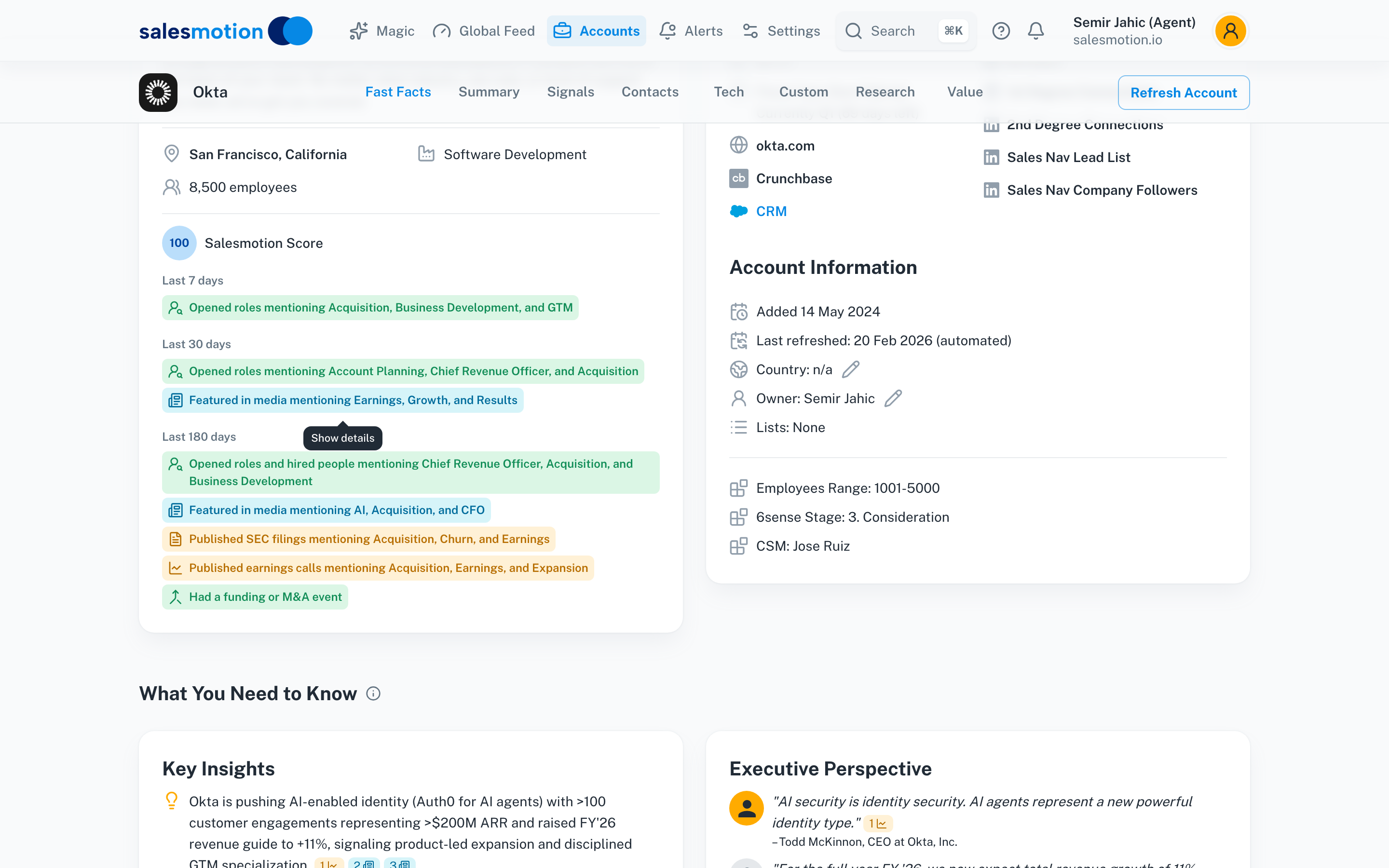 Salesmotion generates a complete account brief in minutes — key insights, executive quotes, opportunities, and talking points — so reps walk into every meeting prepared.
Lead with Platform Consolidation
Budgets are shifting away from point solutions toward consolidated platforms. CyberSaint's research identifies platform consolidation as the fastest-growing budget category for 2026. If your solution replaces multiple tools, lead with the consolidation story: fewer vendors to manage, lower total cost, and unified visibility.
Expect and Embrace the POC
CISOs do not buy security tools based on demos alone. Expect a 2 to 4 week proof-of-concept where your solution runs in their environment. Prepare for this by having a streamlined POC deployment process, clear success criteria, and dedicated technical resources to support the evaluation. The POC is not a hurdle; it is where you win the deal.
Signals That Indicate Purchase Readiness
Security teams generate specific buying signals that indicate active evaluation:
Security Incidents: Public breaches, ransomware events, or data exposure incidents at a target account (or their direct competitors) create immediate budget urgency. CISOs who just experienced an incident have board-level mandate to invest. Incidents at competitors trigger proactive investment.
Regulatory Deadlines: The CIRCIA reporting requirements taking effect in May 2026 will mandate incident reporting to CISA. New regulations create mandatory compliance investments with firm deadlines.
CISO Turnover: A new CISO typically reviews the entire security stack within their first 90 days. New security leaders want to put their stamp on the program and often bring vendor preferences from their previous organization.
Budget Planning Cycle: Most security budgets are planned in Q3/Q4 for the following year. Engage CISOs during this window to influence budget allocation for your category.
Hiring Patterns: Organizations posting security engineering, SOC analyst, or security architecture roles are scaling their security program, which often correlates with new tool investments.
Board-Level Attention: When a company's earnings call, annual report, or board minutes reference cybersecurity as a strategic priority, budget is being allocated. This language signals executive-level commitment.

“The account and contact signals are key for reaching out at important times, and the value-add messaging it creates unique to every contact helps save time and efficiency.”
Daniel Pitman
Mid-Market Account Executive, Black Swan Data
Outreach Templates for Security Buyers
Example: Post-Incident Outreach to a CISO
Signal: Competitor in the same industry experienced a publicized ransomware attack.
Subject line: Security posture review after the [Competitor] incident
Body: The [Competitor] incident is prompting security reviews across the industry. If you are reassessing your detection and response capabilities in light of that event, I would welcome the chance to share how organizations in your sector are closing the gaps that attackers are exploiting.
We help security teams consolidate threat intelligence and account monitoring into a single platform. Would a 20-minute conversation be useful?
Example: New CISO Outreach
Signal: Company appointed a new CISO. Previous role was at a company where your solution category is deployed.
Subject line: Security stack review for the new role
Body: Welcome to the new position. In my experience, new CISOs review their security stack within the first 90 days, evaluating what to keep, consolidate, or replace.
If intelligence and monitoring tooling is part of that review, I would value 15 minutes to share how we work with security teams in your industry. Would next week work?
Common Mistakes When Selling to CISOs
Selling features instead of risk reduction. CISOs evaluate security tools through a risk lens. Every conversation should answer the question: "What risk does this reduce, and by how much?" Feature-focused pitches lose to competitors who speak in risk and financial terms.
Skipping the technical evaluation. Trying to close a CISO without a successful POC is a losing strategy. Security teams require hands-on validation in their environment. Invest in making your POC process efficient and well-supported.
Overpromising detection rates. CISOs have heard every vendor claim 99.9% detection. They are deeply skeptical and will validate every claim during the POC. Be honest about your solution's strengths and limitations. Credibility matters more than marketing claims.
Ignoring the compliance angle. In regulated industries, compliance requirements often drive security purchases more than technical capability. If your solution maps to specific regulatory frameworks (NIST, SOX, HIPAA, DORA), make that mapping explicit.
Selling to the CISO alone. Security purchasing decisions involve engineers, architects, IT operations, and compliance teams. Build relationships across the security organization to ensure the CISO's decision has internal consensus.
Explore the Sales Intelligence for Cybersecurity page for security-specific use cases and workflows.
Frequently Asked Questions
How long does the security vendor evaluation process take?
Security vendor evaluations typically take 3 to 9 months from initial engagement to signed contract. The POC phase alone usually runs 2 to 4 weeks, followed by security questionnaire review (2 to 4 weeks), procurement negotiation (4 to 8 weeks), and final approval. For enterprise deals, expect 6 to 12 months total. Starting the compliance documentation and POC process early in parallel is the most effective way to compress timelines.
How do I compete when CISOs are consolidating to fewer platforms?
Position your solution as part of the consolidation strategy, not another point solution to manage. Show how your platform replaces multiple existing tools, reducing vendor management overhead and total cost. If you are a point solution, demonstrate deep integration with the platforms the CISO is consolidating around (CrowdStrike, Palo Alto, Microsoft, SentinelOne) and position yourself as a complement that enhances their platform investment.
What metrics do CISOs use to evaluate security tools?
The most influential metrics are mean time to detect (MTTD), mean time to respond (MTTR), false positive rate, coverage of the MITRE ATT&CK framework, and total cost of ownership. Increasingly, CISOs also evaluate cyber risk quantification: how much financial risk does the tool reduce? According to Wiz, CISOs need to answer "What is our current risk exposure in dollars?" and "What investment most reduces our financial risk?" Align your ROI narrative to these questions.
How important is compliance mapping when selling to security teams?
Critical, especially in regulated industries. CISOs in financial services, healthcare, and government must demonstrate compliance with specific frameworks (NIST CSF, SOX, HIPAA, PCI DSS, DORA). If your solution maps to these frameworks, provide explicit compliance mapping documentation showing which controls your tool addresses. This accelerates the evaluation process and gives the CISO ready-made board reporting material.
Key Takeaways
- CISOs evaluate security purchases through a risk and financial lens. Quantify your value in breach cost avoidance and risk reduction dollars.
- Platform consolidation is the fastest-growing budget category. Position your solution as reducing vendor sprawl, not adding to it.
- Expect and embrace the POC process. Security teams require hands-on validation before purchasing. Make your POC deployment efficient and well-supported.
- Time outreach to security incidents (at competitors), regulatory deadlines, CISO turnover, and Q3/Q4 budget planning for the highest response rates.
- Build relationships across the security organization (engineers, architects, compliance), not just the CISO, to ensure internal consensus.
- Visit the Sales Intelligence for Cybersecurity page for security-specific use cases.