The average CMO lasts 4.1 years in the role, shorter than any C-suite peer except the COO. During that window, they must prove marketing's contribution to revenue while navigating a martech landscape that has ballooned to over 15,000 solutions. Budget constraints are the number one challenge for 63% of CMOs, and 59% say their current budget is insufficient to execute their strategy. If you sell to marketing leaders, every conversation must acknowledge this tension between ambition and constraint.
TL;DR: CMOs and marketing leaders buy solutions that prove ROI fast, integrate cleanly with existing martech, and align with revenue goals. Successful sellers speak in pipeline and revenue metrics, demonstrate fast time to value, and time outreach to budget planning cycles, leadership changes, and strategic pivots. Understanding the competitive landscape your CMO buyer navigates, from HubSpot to Salesforce Marketing Cloud to Adobe, is essential for positioning your solution effectively.
Understanding the CMO Buyer
CMOs are under more pressure than nearly any other C-suite buyer. They own pipeline generation, brand awareness, and increasingly customer retention, but they often lack the budget to execute on all three simultaneously. Half of CMOs identified short-term needs impeding long-term strategic planning as their most pressing challenge, according to Gartner's 2026 priorities research. Revenue growth remains the top priority, with 46% of CMOs asking how they can prioritize the initiatives most likely to drive growth.
Marketing leaders buy differently from sales leaders. They evaluate solutions across three dimensions: revenue attribution (can they prove it works?), operational efficiency (does it save time?), and competitive differentiation (does it give them an edge?). Solutions that score high on all three get funded. Solutions that only score on one dimension get stuck in evaluation.
Budget allocation in marketing typically splits into paid media (31%), labor (22%), martech (22%), and agencies (21%), according to the Gartner 2025 CMO Spend Survey. Overall marketing budgets remain flat at 7.7% of company revenue, though the CMO Survey from Duke's Fuqua School of Business shows budgets recovering to 9.4% across all business types. The martech slice is where most B2B vendors compete, and it is not growing fast. That means every new purchase displaces something else. Your solution must replace an existing tool or demonstrably improve a metric the CMO reports to the CEO.
Marketing technology consolidation is accelerating. 81% of marketing technology leaders are either piloting or have implemented AI agents, but 39% of CMOs are simultaneously cutting agency budgets and renegotiating contracts. CMOs are buying fewer, more capable platforms rather than adding point solutions. Regular stack audits, conducted annually by 58% of organizations, help identify redundant tools, and consolidation efforts can recover 15-30% in wasted tool costs.
The Competitive Landscape CMOs Navigate
Before you can sell effectively to a CMO, you need to understand the ecosystem they already manage. Most B2B marketing teams are anchored to a core platform, and the platforms they choose shape how they evaluate everything else.
CRM and Marketing Automation Platforms
Salesforce Marketing Cloud dominates enterprise marketing with deep CRM integration, Journey Builder for multi-step orchestration, and Einstein AI for send-time optimization and engagement scoring. Salesforce holds 21.8% CRM market share, more than its four largest competitors combined, so many enterprise CMOs are locked into this ecosystem. Pardot (now Marketing Cloud Account Engagement) starts at $1,250/month for B2B automation.
HubSpot Marketing Hub has expanded aggressively upmarket, growing to over 216,000 customers and $2.6 billion in annual revenue. Its all-in-one approach (CRM, marketing, sales, and service in one platform) appeals to mid-market teams that want fast time to value without integration headaches. HubSpot holds approximately 29-34% marketing automation market share and is increasingly displacing Salesforce in mid-market deals.
Adobe Marketo Engage (acquired for $4.7 billion) remains the enterprise standard for complex B2B demand generation. Marketo excels at lead scoring, multi-touch nurturing, and ABM workflows, but it requires skilled MarOps specialists to operate and typically needs a separate CRM (Salesforce or Microsoft Dynamics).
Intent Data and ABM Platforms
6sense and Demandbase own the account-based experience category, surfacing buying intent signals across anonymous web activity and third-party data sources. These platforms help marketing teams identify in-market accounts, but they are expensive (typically six-figure annual contracts) and require significant data infrastructure to operationalize.
Bombora provides B2B intent data as a standalone feed, often integrated into the platforms above.
What This Means for Sellers
CMOs are not evaluating your solution in isolation. They are evaluating it against their existing stack and against the platforms listed above. If your product overlaps with a capability their CRM or MAP already provides, you will lose. If your product fills a gap that none of these platforms address well, and you can prove it integrates cleanly, you have a path. The winning pitch positions your solution as a force multiplier for the tools the CMO already owns, not a replacement for them.

“The talking points are gold. If they're in Salesmotion, I know they're being discussed inside that business. That makes it easy to spark a real conversation, which is 90 percent of the battle.”
Andrew Giordano
VP of Global Commercial Operations, Analytic Partners
Key Decision Makers and Their Priorities
CMO / VP of Marketing
The economic buyer who evaluates solutions based on pipeline contribution, brand impact, and marketing efficiency. They need tools that make them look smart to the CEO and CFO. Metrics they care about: marketing-sourced pipeline, cost per opportunity, marketing's contribution to revenue, and customer acquisition cost. With 37% of Fortune 500 CEOs having significant marketing experience, today's CMOs know that strong revenue results can be a stepping stone to the top job.
Demand Generation / Growth Marketing
The operational buyer who evaluates day-to-day usability, integration with MAP (HubSpot, Marketo, Pardot), campaign performance, and lead quality. They are often the champion who identifies the need and brings it to the CMO. Their biggest pain: too many tools, not enough connected insights. The martech landscape has grown to 15,384 solutions across 49 categories, so demand gen leaders are overwhelmed by vendor noise.
Marketing Operations
The technical evaluator who assesses data quality, integration architecture, reporting accuracy, and workflow automation. MarOps teams increasingly own the martech stack and serve as gatekeepers for new tool adoption. Gartner projects that by 2026, MarOps professionals will be the primary architects of marketing infrastructure, not IT or procurement. They will audit your data model, API, and CRM sync before recommending approval.
CFO / Finance
For purchases above $50K annually, expect CFO involvement. CMOs who partner closely with their CFO throughout the year, as Forrester recommends, are better positioned to defend budgets. Sellers who help the CMO build the CFO business case accelerate deals. The strongest business cases include payback period calculations, cost-per-opportunity reduction projections, and a clear replacement narrative (which existing tool or process this new purchase eliminates).
The Sales Approach That Works
Speak in Revenue, Not Engagement
CMOs are tired of vendors pitching "engagement," "reach," and "impressions." They are evaluated on pipeline and revenue. Frame your value proposition around metrics the CFO recognizes: cost per opportunity reduction, pipeline velocity improvement, marketing-sourced revenue growth, and customer lifetime value increase.
Before outreach, research the company's recent marketing hires, campaign strategies, competitor positioning, and any public commentary from their CMO about priorities. A strong account research practice is what separates reps who earn meetings from reps who get ignored. Salesmotion surfaces leadership changes, strategic initiatives, and hiring patterns across marketing teams, giving sellers the context they need for relevant outreach.
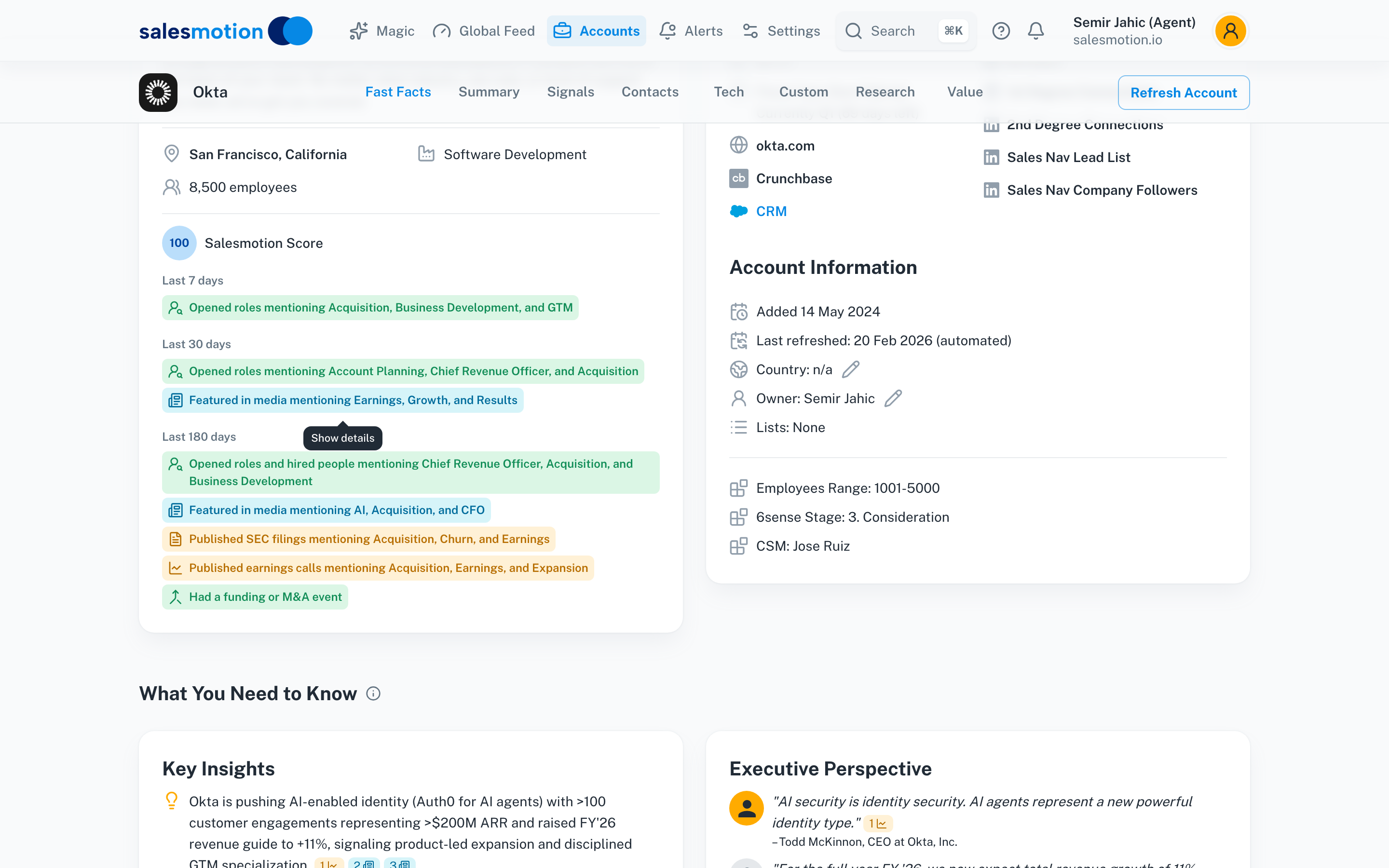 Salesmotion generates a complete account brief in minutes — key insights, executive quotes, opportunities, and talking points — so reps walk into every meeting prepared.
Demonstrate Integration Depth
CMOs will not add another silo to their stack. Your solution must integrate with their CRM (Salesforce or HubSpot), marketing automation platform, and analytics tools. Demonstrate native integrations in your first demo and show how data flows bidirectionally. If integration requires professional services, be transparent about the timeline and cost.
With platform suites absorbing adjacent categories (CRMs now offer marketing automation, MAPs expanding into CDP territory), the argument for specialized solutions gets weaker unless you prove the integration story is seamless. Show how your product fits into the workflow they already use daily.
Prove Time to Value in Weeks, Not Quarters
CMOs want speed, not sweeping transformation. Offer a 30-day quick-start program that delivers measurable value within the first month. This approach reduces procurement friction and gives the CMO an early win to share with their CEO.
Consider how Analytic Partners, a marketing analytics company whose sales team sells measurement solutions to CMOs at Fortune 500 brands, prepared their reps for those conversations. Their commercial team used Salesmotion to research CMO buyers before meetings, cutting account research time from 3 hours to 15 minutes per account. The result: a 40% increase in qualified pipeline year over year, because reps walked into CMO conversations already knowing the buyer's strategic priorities, earnings commentary, and competitive pressures. Read the full case study.
This is a useful model for any team selling to marketing leaders. When your reps can reference a CMO's published priorities, recent hires, or board-level mandates in the first 30 seconds of a call, the conversation shifts from "let me tell you about our product" to "I noticed your team is focused on X, and here is how we can help."

“My ultimate goal is to know more about the company than they know themselves. Before, that took hours across multiple tools. With Salesmotion, I can get there in 30 minutes or less and walk into a Fortune 500 conversation fully prepared.”
Jeff Dalo
Senior Director Business Development, Analytic Partners
Signals That Indicate Purchase Readiness
Marketing teams generate visible buying signals that indicate active evaluation. A signal-based selling approach helps you act on these triggers before competitors do:
CMO Turnover: The average CMO tenure is just 4.1 years, and new CMOs review the martech stack within their first 90 days. They bring preferences from their previous company and often have budget authority to make changes. 62% of departing CMOs go on to equal or bigger roles at other companies, so track where former CMOs land as well.
Budget Planning Cycle: Marketing budgets are typically planned in Q3/Q4 for the following calendar year. Engage during this window to influence budget allocation. Some organizations also have a mid-year budget review (Q2) that creates a secondary window. Marketers predict an 8.9% increase in overall marketing spending and 11.9% growth in digital marketing spending over the next year, so budget conversations are active.
Strategic Pivots: When a company announces a rebrand, new market entry, product-led growth shift, or account-based marketing initiative, the marketing team needs supporting technology. These announcements signal active budget allocation.
Hiring Patterns: Companies posting demand generation, marketing operations, or growth marketing roles are scaling their marketing function, which correlates with new tool investments. For a complete taxonomy of these triggers, see our guide to buying signals in sales.
Competitive Pressure: When a company's direct competitors launch aggressive marketing campaigns, ABM programs, or new product positioning, the marketing team feels pressure to respond. Track competitor activity across your target accounts.
AI Mandate: Earnings calls or board communications that mention "AI in marketing," "marketing efficiency," or "demand generation optimization" signal top-down pressure. 90% of marketers say they will have budgets for AI tools, so AI-related language in public communications is a strong indicator of active evaluation.
Outreach Templates for Marketing Leaders
Template 1: New CMO Outreach
Signal: Company hired a new CMO from a competitor where ABM and marketing analytics were core strategies.
Subject line: Marketing intelligence for the new role
Body: Welcome to the new position. Based on your background in ABM at [Previous Company], I expect marketing intelligence and account targeting will be part of your early-stage stack review.
We help marketing and sales teams align on account intelligence, so ABM programs target the right accounts at the right time. One marketing analytics company saw their qualified pipeline increase 40% in the first year.
Would 15 minutes next week be useful to explore fit?
Template 2: Budget-Cycle Outreach to a VP of Demand Gen
Signal: Q3 budget planning. Company recently launched a new product line.
Subject line: Demand gen support for the new product launch
Body: With the new product launch and FY27 planning underway, your demand gen team is likely evaluating how to build pipeline for the new line efficiently.
We help B2B marketing teams identify and prioritize accounts showing buying intent, so campaigns target prospects actively evaluating solutions in your category. Happy to share how similar teams have accelerated pipeline for new product launches.
Quick call this week?
Template 3: Martech Consolidation Play
Signal: Company announced cost-cutting measures. Earnings call mentioned "marketing efficiency" or "operational optimization." LinkedIn posts from MarOps team discussing stack rationalization.
Subject line: Consolidating your martech stack without losing coverage
Body: I noticed [Company]'s recent focus on operational efficiency. With martech stacks averaging 15,000+ solutions industry-wide, most marketing teams are finding that 30-40% of their tools overlap in functionality.
We have helped B2B teams replace 3-5 point solutions with a single account intelligence layer that feeds directly into Salesforce/HubSpot. The result is fewer vendor invoices, cleaner data, and reps who actually use the tool because it lives where they already work.
Worth a 15-minute conversation to see if there is overlap in your current stack?
Template 4: Competitive Pressure Outreach
Signal: A direct competitor of your prospect just launched a major ABM campaign, hired a new VP of Marketing, or announced a product expansion. The CMO's team is likely feeling pressure to respond.
Subject line: [Competitor Name] just made a move. Here is what we are seeing.
Body: [Competitor Name] recently [describe specific move: launched ABM program, expanded into new vertical, hired aggressively in demand gen]. Based on what we track across the market, this signals a shift in how they are approaching [relevant category].
We help sales and marketing teams monitor competitive moves in real time and turn those signals into targeted outreach. One team used competitive intelligence to identify 12 accounts actively evaluating alternatives within two weeks of a competitor announcement.
Would it be useful to see what signals we are tracking in your space?
Template 5: Cold Call Framework for CMO Gatekeepers
Most CMOs are shielded by executive assistants and full calendars. Cold calls to marketing leaders work best when they reference something specific.
Opening (15 seconds): "Hi [Name], I am calling because I saw [Company] just posted three demand gen roles on LinkedIn. When marketing teams are scaling that fast, account targeting usually becomes a bottleneck. I work with companies like [reference customer] on that exact problem."
Bridge (if they engage): "Most teams we talk to are spending 2-3 hours per account trying to build a picture of who to target and why. The reps at one of our customers, a marketing analytics firm selling to Fortune 500 CMOs, cut that to 15 minutes and grew qualified pipeline 40% in a year."
Ask: "I am not asking for a 30-minute demo. Would a 10-minute call this week make sense to see if the problem even resonates?"
Common Mistakes When Selling to CMOs
Pitching technology instead of outcomes. CMOs do not care about your AI model or data infrastructure. They care about pipeline, revenue, and competitive advantage. Lead with metrics and let the technology be the supporting evidence.
Ignoring marketing operations. MarOps controls the martech stack and has effective veto power over new tools. Build a relationship with MarOps early and provide technical documentation that addresses their integration and data quality concerns. 61% of CMOs plan to redesign team structures to emphasize adaptive creativity with AI-driven workflows, so MarOps influence is growing.
Underestimating attribution requirements. Every marketing tool purchase must prove its contribution to pipeline and revenue. If your solution cannot demonstrate attribution through CRM integration and reporting, it will not survive the evaluation process.
Adding to tool sprawl. The martech landscape grew 9% last year to 15,384 tools, but over 1,200 tools also exited the market. CMOs are actively consolidating. Positioning your solution as "one more tool" is a losing strategy. Show how you replace existing tools or significantly enhance the platforms they already use.
Missing the CFO partnership. CMOs who get budget approved have strong CFO relationships. Sellers who help CMOs build the CFO business case, with ROI models, competitive benchmarks, and payback period calculations, close more deals.
Selling to the wrong persona. Only 40% of Fortune 500 marketing leaders actually hold the title "CMO." Many companies use Chief Growth Officer, Chief Revenue Officer, or VP of Marketing instead. Research the actual org structure before targeting outreach. Selling to a "CMO" who does not exist at the company signals you did not do your homework.
Explore the Sales Intelligence for Marketing Analytics page for marketing-specific use cases and workflows.
Frequently Asked Questions
How do CMOs evaluate and justify marketing technology purchases?
CMOs evaluate martech based on three criteria: revenue attribution (can the tool prove its impact on pipeline and revenue?), operational efficiency (does it reduce manual work and consolidate existing tools?), and competitive advantage (does it provide capabilities competitors lack?). To justify purchases, CMOs build business cases around cost per opportunity reduction, time saved on manual processes, and projected pipeline impact. The Gartner 2025 CMO Spend Survey found that 39% of CMOs are planning labor and agency reductions, so solutions that demonstrate clear efficiency gains have an advantage in procurement.
What is the best time to sell to marketing leaders?
Q3/Q4 is the primary budget planning window, making it the ideal time for initial engagement. Mid-year budget reviews (Q2) create a secondary window. CMO turnover creates time-sensitive opportunities year-round, as new marketing leaders typically review the martech stack within 90 days. With average CMO tenure at just 4.1 years, these windows occur frequently. Year-end can work for pre-committed budget that must be spent before fiscal close.
How do I differentiate my solution in a crowded martech landscape?
The martech landscape now includes 15,384 solutions, so standing out requires more than feature comparisons. Lead with business outcomes: specific customer results (pipeline increase, cost reduction, time savings), seamless integration with the buyer's existing stack, and fast time to value (30-day quick-start programs). Providing ROI modeling specific to the buyer's team size, target market, and revenue goals also helps your solution stand out. Most importantly, show how you reduce tool count rather than add to it.
How important is ABM alignment when selling to marketing teams?
Increasingly critical. Account-based marketing is now a standard strategy at most B2B companies, and CMOs expect new tools to support or enhance their ABM programs. Platforms like 6sense and Demandbase have established the category, and CMOs evaluate new tools based on how well they complement existing ABM investments. If your solution provides account intelligence, buying signals, or target account prioritization, position it as an ABM enablement layer. Show how your tool helps marketing and sales align on which accounts to target and when to engage them.
What role does AI play in CMO buying decisions today?
AI has moved from a nice-to-have to a core evaluation criterion. 81% of marketing technology leaders are either piloting or have deployed AI agents, and 90% of marketers say they will have AI tool budgets. CMOs are looking for AI that delivers measurable efficiency, not feature-level AI claims. GenAI investments are delivering ROI through time efficiency (49% of respondents), cost efficiency (40%), and increased capacity (27%). If your solution uses AI, frame it in terms of those outcomes, not the underlying model.
Key Takeaways
- CMOs are evaluated on pipeline and revenue, not engagement metrics. Frame your value proposition around the metrics they report to the CEO and CFO.
- Marketing budgets remain flat at 7.7-9.4% of company revenue, with martech competing against paid media, labor, and agencies for a limited slice. Every new purchase must replace an existing tool or demonstrably improve a key metric.
- Understand the competitive landscape your CMO navigates: Salesforce, HubSpot, Adobe Marketo, 6sense, and Demandbase are the anchoring platforms. Position your solution as a force multiplier for what they already own.
- CMO turnover (average tenure: 4.1 years), budget planning cycles (Q3/Q4), strategic pivots, and AI mandates are the highest-intent buying signals for marketing technology.
- Analytic Partners' sales team used account intelligence to prepare for Fortune 500 CMO meetings, cutting research from 3 hours to 15 minutes and growing qualified pipeline 40%. Read the case study.
- Visit the Sales Intelligence for Marketing Analytics page for marketing-specific use cases.