US training expenditures reached $102.8 billion in 2025, a 4.9% increase over the prior year, while the K-12 edtech market is projected to grow from $28.6 billion to over $209 billion by 2033. Yet according to EDUCAUSE's 2025 survey, 42% of higher education institutions expect IT budget decreases in the 2025-2026 academic year. The education technology market is enormous and growing, but the buying process is fragmented, cyclical, and deeply different depending on who you are selling to.
This guide breaks down the three distinct buyer segments -- K-12 school districts, higher education institutions, and corporate L&D teams -- with specific procurement cycles, decision makers, and outreach frameworks for each.
TL;DR: Education and L&D buyers span three distinct segments, each with different budget cycles, decision makers, and procurement rules. K-12 districts buy on a July-June fiscal year with peak purchasing in March through June. Higher education runs formal RFPs that take 90 to 125+ days. Corporate L&D teams plan during Q3/Q4 with a December year-end spending window. Successful sellers match their approach to the specific segment.
Three Distinct Buyer Segments
The biggest mistake sellers make is treating "education" as a single market. In reality, it contains three segments with fundamentally different buying dynamics.
K-12 School Districts
The US K-12 market represents approximately 13,000 school districts spending an average of $17,277 per student across roughly 50 million students. However, districts generally have only 10-15% of their annual budget as discretionary spending. The rest is consumed by salaries, facilities, and mandated programs. Technology purchases compete for a narrow slice of available funding.
Decision makers include superintendents, curriculum directors, chief technology officers, and building principals. Purchases above $50,000 typically require board approval, and purchases above $100,000 to $200,000 often require a formal competitive bidding process. State-level procurement rules vary significantly, with some states mandating specific vendor registries or cooperative purchasing agreements.
Higher Education Institutions
US post-secondary institutions spend $702 billion annually, with technology representing a growing share despite current budget pressures. The buying process is more centralized than K-12 but more fragmented than corporate. A single university may have separate procurement paths for academic technology (managed by a provost or dean), IT infrastructure (managed by the CIO), and student services (managed by enrollment or student affairs leadership).
Formal RFP processes are standard for purchases above $50,000 to $100,000. Evaluation committees typically include faculty representatives, IT staff, procurement officers, and end users. Accessibility compliance (WCAG 2.1 AA) and data privacy (FERPA) are non-negotiable requirements.
Corporate Learning and Development
Corporate L&D is the fastest-moving of the three segments. US companies spent an average of $874 per learner in 2025, with 16% of training budgets going to learning technologies. The World Economic Forum's Future of Jobs Report projects that 39% of workers' core skills will be outdated by 2030, driving urgent demand for reskilling platforms.
But corporate L&D is not monolithic either. Central L&D teams buy enterprise learning platforms. Department heads buy function-specific training: engineering leaders procure technical upskilling tools, sales leaders purchase enablement platforms, and operations leaders invest in compliance and safety training. These are often separate budget lines, which means separate sales motions.
See Salesmotion on a real account
Book a 15-minute demo and see how your team saves hours on account research.
Procurement Cycles by Segment
Understanding when and how each segment buys is the single most important factor in education sales success.
K-12 Procurement: The July-June Fiscal Year
Most US school districts operate on a July 1 to June 30 fiscal year. The purchasing cycle follows a predictable annual pattern.
September through November (Planning Phase). District administrators and department heads draft technology needs for the following fiscal year. This is the time to build relationships, run pilots, and get on evaluation lists. November has the lowest purchasing activity of the year.
January through February (Budget Discussions). According to EdWeek Market Brief, 32% of district administrators say the most critical budget discussions occur in January and February. If you are not already in conversations by this point, you are likely too late for the current cycle.
March through April (Peak Decision-Making). Forty percent of K-12 officials say the most impactful budget conversations occur during March and April. Building principals submit preliminary budgets to the district in late April or early May.
May through June (Year-End Spending Sprint). Purchase order volume rises 4 to 5 times in June compared with mid-year months. Districts spend surplus budget before the fiscal year closes on June 30, making this the sharpest closing window of the year.
July through August (New Fiscal Year Execution). Large strategic purchase orders are issued in July as new budgets open. August sees high-volume tactical spending as classrooms prepare for the school year.
The total K-12 sales cycle runs 6 to 17 months. A quarter of school and district leaders say they need more than a year to make a smart purchasing decision for major curriculum or platform investments.
Higher Education Procurement: The RFP Gauntlet
Higher education procurement is the most formal and slowest of the three segments. Most universities follow an academic fiscal year (July to June), though some private institutions operate on different calendars.
Needs Identification (Ongoing). Department heads and faculty identify technology needs throughout the year. Getting on a CIO's or dean's radar early is critical because formal procurement often starts with an informal shortlist.
Budget Approval (Fall through Winter). IT budgets are typically set during fall planning for the following academic year. With 42% of institutions expecting budget decreases, competition for funding approval is intense. Position your solution as a cost-reduction or efficiency tool, since 83% of institutions are actively exploring technology for operational efficiencies.
RFP Issuance and Evaluation (Variable, 90-125+ Days). Once budgeted, formal solicitations take 90 to 125+ days for complex technology purchases. Software purchases can take an additional 33 to 99 business days for accessibility reviews. Evaluation committees score proposals on price, quality, vendor reputation, and institutional alignment.
Contract Negotiation and Award. After selection, contract negotiation adds weeks to months. Total cycle from initial need to signed contract can reach 12 to 18 months for enterprise platform decisions.
One shortcut worth knowing: many universities can use cooperative contracts established by purchasing consortia like E&I Cooperative Services or NASPO to bypass lengthy RFP processes. If your solution is available through a cooperative contract, promote that prominently.
Corporate L&D Procurement: The Q3/Q4 Budget Window
Corporate L&D teams typically operate on a January to December fiscal year, with budget planning concentrated in the second half of the year.
Q1 through Q2 (Execution and Evaluation). Teams are executing current-year plans and evaluating existing tools. This is the time to run pilots, build relationships with L&D leaders, and generate data that supports a budget request for the following year.
Q3 (Budget Planning). Training Industry research notes that L&D leaders begin assembling budget requests during Q3. Sixty-three percent of L&D professionals expect their budget to increase or stay steady. Position your solution during this window so your champion can include it in their FY27 budget request.
Q4 (Approval and Year-End Spending). Budgets are finalized and approved. December creates a unique closing window: L&D teams with remaining budget often make purchases before fiscal year-end to avoid losing allocation. This "use it or lose it" dynamic can accelerate deals that might otherwise slip to Q1.
Corporate sales cycles for L&D technology typically run 3 to 9 months. Enterprise learning platform decisions involving CHRO and CFO approval can extend beyond that, especially for large organizations where deals can reach $20M or more.

“We're saving about 6 hours per week per seller on account research alone. That's time they can reinvest in actually selling.”
Derek Rosen
Director, Strategic Accounts, Guild Education
Key Decision Makers by Segment
K-12 Decision Makers
- Superintendent: Sets district-wide priorities and approves major purchases. Evaluates technology in terms of student outcomes and operational efficiency.
- Curriculum Director / Chief Academic Officer: Owns instructional technology decisions. Evaluates based on pedagogical alignment and standards compliance.
- Chief Technology Officer / IT Director: Manages technical infrastructure. Evaluates integration, security, data privacy, and deployment complexity.
- Building Principals: Influence adoption at the school level. Can champion or block district-wide rollouts based on teacher feedback.
- School Board: Approves budget allocations and high-dollar purchases. Concerned with community accountability and measurable results.
Higher Education Decision Makers
- CIO / VP of Information Technology: Owns campus-wide technology strategy. Evaluates infrastructure fit, security, and total cost of ownership.
- Provost / VP of Academic Affairs: Approves academic technology investments. Evaluates based on teaching effectiveness and accreditation alignment.
- Deans and Department Chairs: Influence purchases within their college or department. Often initiate the procurement process for discipline-specific tools.
- Procurement Officers: Manage the formal RFP process and ensure compliance with institutional and state purchasing regulations.
- Faculty: Serve on evaluation committees and ultimately determine adoption success. Faculty buy-in is essential for any academic technology purchase.
Corporate L&D Decision Makers
- Chief Learning Officer / VP of L&D: Owns the learning strategy and is typically the economic buyer for enterprise platforms. Reports to the CHRO and must justify investments in business impact terms.
- Chief Human Resources Officer: Approves major learning technology investments. Gartner's 2025 survey identifies leadership and manager development as the top CHRO priority for the third consecutive year.
- Department Heads / Line Managers: Buy function-specific training on separate budget lines. Engineering, sales, operations, and compliance each have distinct training needs and purchasing authority.
- Procurement and IT: Evaluate SOC 2 compliance, SSO integration, and LMS interoperability (SCORM, xAPI). Corporate procurement cycles are generally faster than academic ones.
The Sales Approach That Works
Frame Everything in Segment-Appropriate Outcomes
Each segment measures success differently, and your value proposition must reflect that.
For K-12, frame outcomes in terms of student achievement, teacher retention, and operational efficiency. District leaders care about test scores, graduation rates, and reducing administrative burden.
For higher education, emphasize enrollment outcomes, student retention, accreditation support, and research productivity. With 42% of institutions expecting budget cuts, any solution that demonstrably reduces operational costs gets attention.
For corporate L&D, connect your solution to business metrics the C-suite cares about: employee retention, time to productivity, revenue per employee, and leadership pipeline strength. Instead of "our platform delivers personalized learning paths," say "organizations using our platform reduce time to productivity for new hires by 30% and see 15% lower voluntary turnover in the first year."
Align with Strategic Priorities Through Deep Research
L&D spending that ties directly to business strategy gets funded. Spending that looks like a "nice to have" gets cut. Before outreach, research the organization's strategic priorities: Is the district implementing a new curriculum standard? Is the university launching a new online program? Is the company expanding internationally or facing attrition in critical roles?
Guild Education, a workforce development company, uses Salesmotion to research enterprise accounts where individual deals can reach $20M or more and sales cycles extend to 24 months. Their Director of Strategic Accounts, Derek Rosen, saves over 6 hours per week on account research, using that time for relationship building instead. Read the full case study.
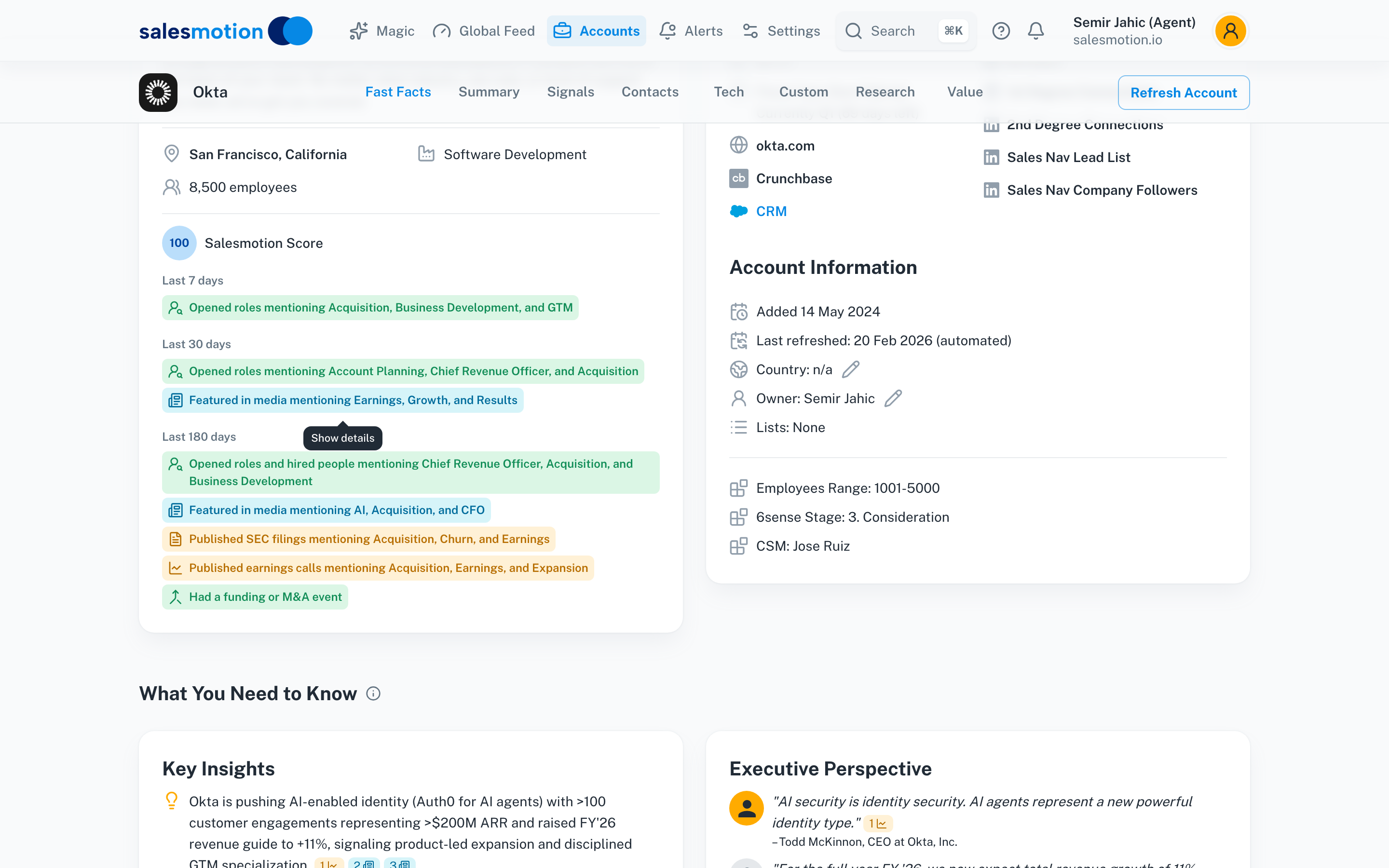 Salesmotion generates a complete account brief in minutes — key insights, executive quotes, opportunities, and talking points — so reps walk into every meeting prepared.
Offer Structured Pilots with Built-In Measurement
Education buyers across all three segments are skeptical of vendor claims. A structured pilot program with predefined success metrics removes risk and accelerates decisions. Define the pilot scope (specific school, department, or team), the timeline (60 to 90 days), and the metrics you will measure together. For K-12, that might be student engagement and teacher satisfaction. For higher education, course completion rates and student feedback. For corporate L&D, skill assessment scores and business impact indicators.
“It's not even just about saving time — it's about uncovering things we otherwise might not research. Salesmotion helps us connect Guild to what's already publicly important to the company.”
Derek Rosen
Director, Strategic Accounts, Guild Education
Outreach Frameworks by Segment
K-12 District Outreach Framework
Timing: October through February for relationship building; March through June for closing.
Signal: District announces new STEM initiative in a school board meeting. Curriculum director is evaluating math intervention tools.
Subject line: Supporting [District Name]'s STEM goals for the 2026-2027 school year
Body: I noticed [District Name] is prioritizing STEM outcomes in the upcoming school year. Our platform helps districts improve student performance in math and science by [specific mechanism], with measurable results in similar-sized districts.
We are available through [relevant cooperative purchasing contract] and can run a no-cost pilot at one or two schools this spring to generate data for your budget request.
Would 15 minutes next week work to explore whether this fits your priorities?
Higher Education Outreach Framework
Timing: Fall for relationship building; align with RFP cycles when published.
Signal: University posts an RFI for learning management system modernization. CIO discusses digital transformation at a conference.
Subject line: LMS modernization support for [University Name]
Body: I saw that [University Name] is evaluating learning management options. Our platform is deployed at [X number] of peer institutions and is available through [E&I Cooperative / relevant consortium], which can streamline your procurement timeline.
We meet WCAG 2.1 AA, FERPA, and SOC 2 requirements. I would be happy to arrange a demo tailored to your faculty and IT team.
Worth a conversation this month?
Corporate L&D Outreach Framework: Budget-Cycle Timing
Timing: Q2/Q3 for budget planning influence; December for year-end spending.
Signal: Q3 budget planning. Company recently announced a "workforce transformation" initiative in their earnings call.
Subject line: Workforce transformation support for FY27 planning
Body: With the workforce transformation initiative underway and FY27 planning in progress, I imagine you are evaluating how to scale skill development across the organization.
We help enterprise L&D teams deliver measurable skill outcomes at scale. One enterprise client reduced new-hire ramp time by 35% in the first year while cutting per-learner costs by 20%.
Worth 15 minutes to see if our approach aligns with your FY27 priorities?
Corporate L&D Outreach Framework: Year-End Budget
Signal: December. Company has historically invested in L&D but has not announced a new platform purchase this year.
Subject line: Using remaining 2026 L&D budget before year-end
Body: If you have remaining L&D budget to deploy before year-end, we offer a pre-commitment model where you can secure 2027 capacity at 2026 pricing.
Our platform focuses on leadership development and skill measurement, the two areas Gartner identifies as top CHRO priorities for the coming year.
Quick call this week to explore fit?
Signals That Indicate Purchase Readiness
Timing your outreach to the right buying signals dramatically improves conversion rates across all three segments. A signal-based selling approach ensures your team acts on these triggers systematically rather than spotting them by chance.
Budget Planning Cycles: Engage K-12 districts during October through February, higher education during fall budget planning, and corporate L&D teams during Q2/Q3. Each segment has a different window, and missing it means waiting 12 months.
Year-End Budget Surplus: June for K-12 districts (fiscal year-end), June for most universities, and December for corporate L&D teams. These "use it or lose it" windows can close deals that would otherwise require a full new budget cycle.
Leadership Changes: A new superintendent, CIO, CLO, or CHRO signals a strategic review of technology. New leaders typically evaluate the existing stack within their first 120 days.
Strategic Initiatives: School board votes on new curriculum standards, university announcements about online program launches, and corporate earnings call mentions of reskilling or workforce transformation all indicate active budget allocation.
Regulatory and Compliance Requirements: New state education mandates, accreditation reviews for universities, and industry compliance changes (healthcare, financial services, safety certifications) trigger mandatory training purchases that are less price-sensitive than discretionary learning.
Hiring and Growth Signals: Companies rapidly scaling headcount need onboarding and training infrastructure. Track job posting volume as an indicator of L&D tool demand. Similarly, school districts with growing enrollment are more likely to invest in new technology.
Common Mistakes When Selling to Education Buyers
Treating education as a single market. K-12, higher education, and corporate L&D have completely different procurement processes, evaluation criteria, budget structures, and decision-making timelines. Using the same sales approach for all three signals a lack of domain understanding.
Leading with technology instead of outcomes. Education buyers care about learning outcomes, workforce capability, and measurable impact. Leading with AI features or platform architecture misses the mark. Always start with the result and work backward to the solution. For a broader framework on aligning your team around buyer outcomes, see our guide to sales enablement best practices.
Missing the budget cycle window. Education budgets are highly cyclical. Missing the planning window in any segment means waiting up to 12 months for the next opportunity. Map budget cycles for every target account and time your engagement accordingly.
Underestimating compliance requirements. K-12 requires COPPA and FERPA compliance, often with state-level procurement certifications. Higher education requires WCAG 2.1 AA accessibility, FERPA, and frequently state purchasing registry enrollment. Corporate buyers evaluate SOC 2 compliance and LMS interoperability. Not having the right certifications for your target segment is an immediate disqualifier.
Failing to provide measurable ROI. L&D teams that cannot prove ROI to their CFO lose budget. School districts that cannot demonstrate student outcome improvements face board scrutiny. Help your champion build the business case by providing ROI calculators, benchmark data, and case study evidence from similar organizations.
Explore the Sales Intelligence for Education page for education-specific use cases and account intelligence workflows.
Frequently Asked Questions
What is the typical budget for corporate L&D technology purchases?
Corporate L&D budgets vary significantly by company size and industry. US companies spent an average of $874 per learner in 2025, with technology representing roughly 16% of total training budgets. Large-scale learning platform investments range from $100K to $500K annually, while point solutions may cost $20K to $100K. Enterprise organizations allocate $500 to $1,500 per employee for total training spend. Budget availability is highest during Q3/Q4 planning cycles and the December year-end window.
How long does the K-12 procurement process take?
K-12 procurement cycles typically run 6 to 17 months from initial engagement to signed contract. Purchases under $50,000 may move faster, especially from discretionary budget. Purchases above $100,000 to $200,000 typically require formal competitive bidding and school board approval. The fastest closing window is March through June, when districts are making final budget decisions and spending surplus funds before the July 1 fiscal year reset.
How do I sell to higher education institutions?
Higher education procurement is the most formal of the three segments. Purchases above $50,000 to $100,000 typically require a formal RFP process that takes 90 to 125+ days. Build relationships with CIOs, deans, and faculty well before an RFP is issued. Ensure your solution meets WCAG 2.1 AA accessibility and FERPA data privacy requirements. Availability through cooperative purchasing consortia like E&I Cooperative Services can significantly shorten procurement timelines.
What signals indicate an education buyer is ready to purchase?
The strongest signals vary by segment. For K-12, watch for school board budget votes, new curriculum standards, and fiscal year-end spending in May and June. For higher education, monitor RFP postings, CIO conference presentations, and accreditation reviews. For corporate L&D, track Q3 budget planning activity, workforce transformation announcements in earnings calls, and December year-end budget surplus. New leadership appointments across all segments are consistently high-intent signals.
How do I compete when education budgets are tight?
Focus on total cost of ownership, not just license fees. Show how your solution reduces instructor costs, eliminates redundant tools, or improves outcomes that have direct financial impact (student retention for higher ed, employee retention for corporate). Offer flexible pricing models that scale with the buyer's needs. For K-12, highlight availability through existing cooperative purchasing agreements. Pilot programs with measurable ROI are the most effective way to overcome budget objections across all three segments.
Key Takeaways
- Education technology is a $100B+ market in the US, but K-12, higher education, and corporate L&D are three distinct segments with different buyers, budgets, and procurement processes.
- K-12 districts buy on a July-June fiscal year with peak purchasing from March through June. Build relationships during October through February and close during spring and early summer.
- Higher education runs formal RFPs that take 90 to 125+ days. Get on shortlists early, ensure compliance certifications are current, and leverage cooperative purchasing contracts.
- Corporate L&D teams plan during Q3/Q4 with a December year-end spending window. Frame value in business outcomes like retention, productivity, and revenue impact.
- Leadership changes, strategic initiative announcements, and regulatory requirements are high-intent buying signals across all three segments.
- Guild Education saves over 6 hours per week on account research for their $20M+ enterprise education deals by using account intelligence to understand each prospect deeply before engagement.
- Visit the Sales Intelligence for Education page for education-specific use cases and workflows.