The average healthcare software deal takes roughly 12 months to close and involves about 9 decision-makers. Even a $10K software sale to a small clinic can take 60 to 90 days, while enterprise EHR implementations stretch to two years. If you are selling B2B into healthcare, understanding these dynamics is not optional. It is the difference between building pipeline and burning quota.
TL;DR: Healthcare buying committees are large, compliance-driven, and slow to move. Successful sellers lead with clinical outcomes, map stakeholders across clinical, administrative, and IT functions, and time outreach to budget cycles, regulatory changes, and leadership transitions.
Understanding the Healthcare Buyer
Healthcare organizations are not one buyer. They are a network of competing priorities spread across clinical, operational, financial, and technical stakeholders. According to Sagefrog, it takes 8 or more touchpoints across channels to convert a B2B healthcare decision-maker, with prospects engaging through industry events, LinkedIn, and direct outreach.
Hospital systems and health networks operate on fiscal-year budgets, typically finalized in Q3/Q4 for the following year. But capital expenditure budgets for technology often sit separately from operational budgets, which means your solution might need approval from two different budget owners.
The compliance layer adds another dimension. HIPAA, HITECH, and state-specific regulations mean every vendor goes through security assessments, business associate agreements, and sometimes legal review before a contract is signed. Sellers who treat compliance as a late-stage hurdle rather than a first-meeting topic add months to their sales cycle.
Healthcare procurement is also increasingly influenced by Group Purchasing Organizations (GPOs). These entities negotiate contracts on behalf of hospital networks, and getting on a GPO contract can open doors to hundreds of facilities simultaneously. Understanding whether your target accounts use GPO-negotiated purchasing is a critical early qualification step.
Key Decision Makers and Their Priorities
C-Suite: CEO, CFO, CMO (Chief Medical Officer)
Hospital CEOs care about margin improvement, patient volume, and strategic positioning. CFOs evaluate total cost of ownership and payback period. CMOs focus on clinical outcomes, patient safety, and quality metrics. For technology purchases above $100K, expect at least one C-suite member on the buying committee.
Clinical Leadership
Department heads, chief nursing officers, and medical directors evaluate solutions based on clinical workflow impact, patient outcomes, and staff adoption. They are often the most influential voices in the buying committee because their endorsement signals that the solution will actually be used.
IT and Information Security
Healthcare IT teams evaluate integration with existing EHR systems (Epic, Cerner, Meditech), data security architecture, interoperability standards (HL7, FHIR), and disaster recovery capabilities. With healthcare data breaches costing an average of $408 per record, three times higher than the cross-industry average, IT has significant veto power.
Procurement and Supply Chain
Procurement evaluates vendor credentials, pricing models, contract terms, and GPO alignment. They manage the formal RFP process and coordinate the vendor qualification steps. Building a direct relationship with procurement early prevents surprises late in the cycle.

“There's been a big focus on hyper personalization and relevance in our outbounding efforts. Salesmotion has been a key partner in hitting our significantly increased meeting targets. What stands out is how simple it is. Reps can log in and get valuable account insights within 30 seconds to a minute.”
Joe DeFrance
VP of Sales, Incredible Health
The Sales Approach That Works
Prove Clinical and Operational Impact First
Healthcare buyers evaluate technology through the lens of patient outcomes and operational efficiency, not features. Frame your value proposition around metrics they report to their board: patient satisfaction scores, readmission rates, staff productivity, cost per procedure, or revenue cycle improvements.
Before outreach, research the organization's recent CMS quality ratings, their community health needs assessment, any recent service line expansions, and leadership changes. This level of preparation signals credibility. Teams using Salesmotion can pull account briefs covering financial performance, leadership changes, strategic initiatives, and hiring patterns across healthcare organizations in minutes rather than hours.
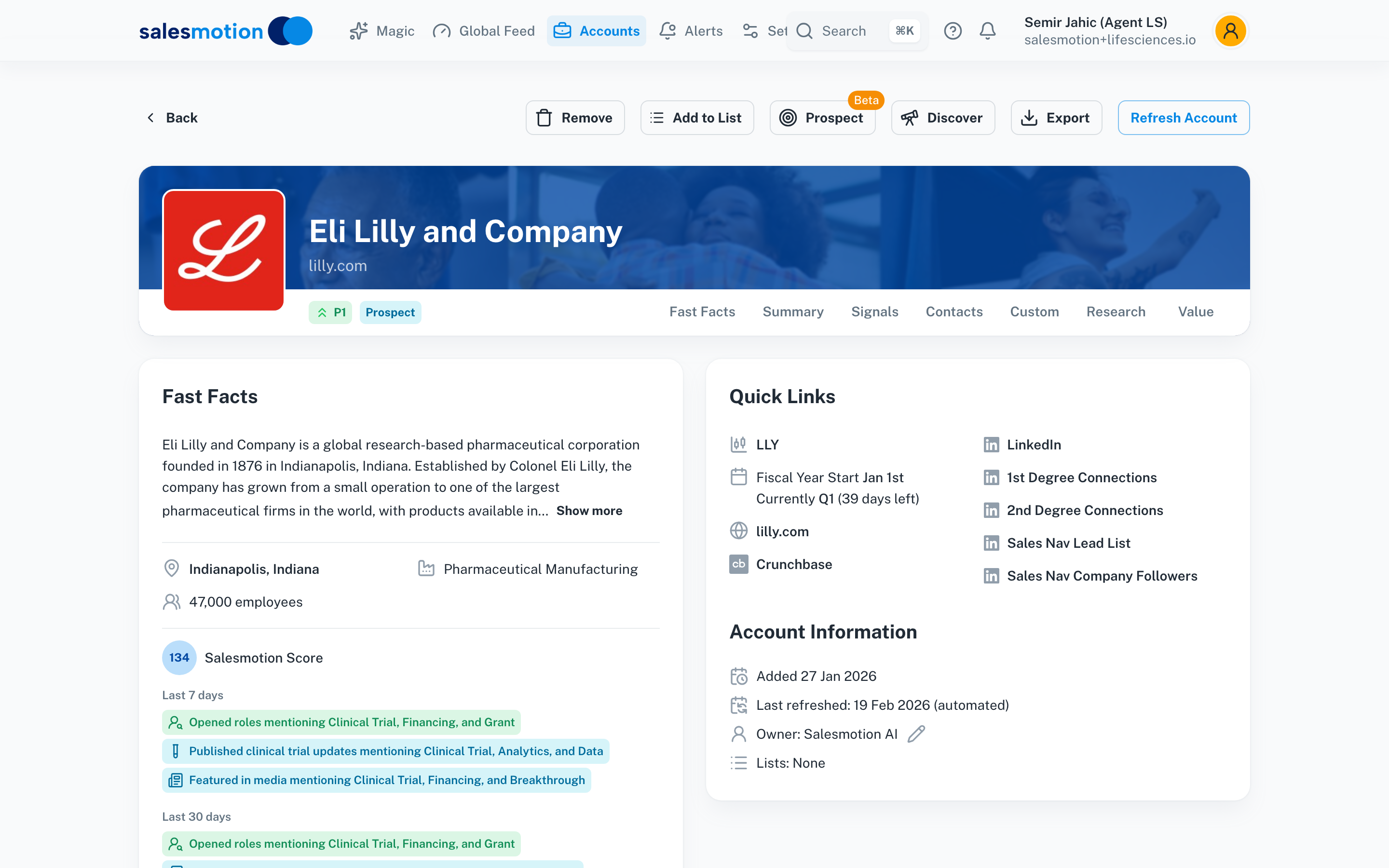 Salesmotion generates complete account briefs for life sciences companies — key insights, executive commentary, clinical trial activity, and strategic priorities — in minutes instead of hours.
Navigate the Long Cycle with Value-Building Touchpoints
A 12-month sales cycle means you cannot rely on a single compelling meeting. Build a sequence of value-adding interactions: share relevant case studies after the first meeting, offer a clinical workflow assessment, connect your champion with a reference customer in a similar health system, and provide ROI modeling specific to their patient volume and payer mix.
Each touchpoint should advance the deal by addressing a different stakeholder's concern. The CFO gets ROI data. The clinical lead gets outcome evidence. IT gets security documentation. Procurement gets contract templates and compliance certifications.
Lead with Interoperability
Integration with Epic, Cerner, or other EHR platforms is non-negotiable for most healthcare technology purchases. If your product has certified EHR integrations, lead with that in every conversation. If it does not, be transparent about your integration roadmap and offer API documentation upfront.
Signals That Indicate Purchase Readiness
Timing outreach to buying signals dramatically improves response rates in healthcare. Here are the signals that matter most:
Leadership Transitions: New hospital CEOs, CFOs, or CIOs typically review vendor relationships within their first 120 days. A new Chief Nursing Officer might prioritize clinical workflow tools. Track executive appointments across your target accounts.
Service Line Expansions: When a health system announces a new cardiac center, cancer institute, or ambulatory surgery center, they need supporting technology. These announcements typically appear in local business journals, health system press releases, and board meeting minutes.
Merger and Acquisition Activity: Hospital consolidation continues to accelerate. Post-merger integration creates windows for new vendors as IT teams evaluate which platforms to standardize across the combined organization.
Regulatory Changes: New CMS requirements, quality measure updates, or state-level regulations often trigger technology purchases to ensure compliance. The transition to value-based care models is creating ongoing demand for analytics and population health tools.
Budget Cycle Timing: Q2 and Q3 are the best times to engage healthcare buyers, as they are actively planning budgets for the next fiscal year. Outreach in Q4 often arrives too late.
Incredible Health, a healthcare technology company, increased quarterly meetings booked by 50% by using account intelligence to time outreach to the right signals at hospital systems. Their VP of Sales, Joe DeFrance, saw the platform go from signature to full adoption in just 3 days. Read the full case study.

“All of the vendors that I've worked with, all of the onboarding that I have had to deal with, I will say, hands down, Salesmotion was the easiest that I have had.”
Lyndsay Thomson
Head of Sales Operations, Cytel
Outreach Templates for Healthcare Buyers
Example: Post-Merger Outreach to a Health System CIO
Signal: Two hospital networks announced a merger. Integration planning is underway.
Subject line: IT consolidation for the combined system
Body: With the merger closing, your team is likely evaluating which platforms to standardize across both organizations. In similar integrations, we have seen health systems running 3 to 5 overlapping tools for the same function across legacy organizations.
We help healthcare IT teams consolidate vendor relationships and standardize workflows during integration. Would 15 minutes next week make sense to see if there is a fit?
Example: Budget-Cycle Outreach to a CFO
Signal: Q3 budget planning season. Health system recently posted lower-than-expected margins in their quarterly financials.
Subject line: Margin improvement for FY27 planning
Body: As you finalize FY27 budgets, I wanted to share how similar health systems have improved operating margins by streamlining vendor costs and improving clinical workflow efficiency. One system reduced per-procedure costs by 12% in the first year.
Happy to share the specifics in a brief call. Would Thursday work?
Common Mistakes When Selling to Healthcare
Treating all healthcare organizations the same. A 20-bed rural hospital has completely different needs, budgets, and buying processes than a 15-hospital urban network. Segment your approach by organization size, type (academic medical center, community hospital, health plan), and market position.
Ignoring the clinical buyer. Technology purchases in healthcare ultimately succeed or fail based on clinical adoption. Skipping the clinical stakeholder in your sales process creates risk that the deal stalls when the CMO or CNO raises concerns late in evaluation.
Underestimating compliance timelines. HIPAA compliance, business associate agreements, and security assessments are not negotiable and cannot be rushed. Build 8 to 12 weeks of compliance review into every deal timeline.
Selling features instead of outcomes. Healthcare buyers do not care about your AI engine or cloud architecture. They care about reduced readmissions, improved patient throughput, lower cost per acquisition, and better staff retention.
Missing the GPO opportunity. If your solution is relevant to multiple facilities in a network, explore GPO partnerships early. A single GPO contract can unlock access to thousands of hospitals.
Explore the Sales Intelligence for Healthcare page for industry-specific use cases and see how account intelligence helps teams navigate healthcare buying committees.
Frequently Asked Questions
How do I shorten the sales cycle when selling to hospitals?
The most effective approach is front-loading compliance and security documentation. Prepare your HIPAA compliance package, SOC 2 certification, and business associate agreement template before your first meeting. This removes 4 to 8 weeks from the typical cycle. Second, multi-thread across clinical, IT, and administrative stakeholders simultaneously rather than sequentially. Third, offer pilot programs or limited deployments that let the organization validate outcomes before committing to a full contract.
What is the best time to reach healthcare buyers?
Q2 and Q3 are optimal for initial engagement, as organizations are actively building budgets for the next fiscal year. Q1 is challenging because budgets are already allocated. Q4 can work for solutions that address urgent compliance requirements or use remaining budget allocations. Year-round, leadership transitions and M&A announcements create time-sensitive outreach windows regardless of budget cycle.
How important is EHR integration when selling to healthcare organizations?
EHR integration is typically a requirement, not a nice-to-have. Epic and Cerner dominate the market, and healthcare IT teams will ask about integration capabilities in the first or second meeting. If you have certified integrations, lead with that. If you are pre-integration, be transparent about your roadmap and offer interim data exchange solutions. Lack of EHR integration is the most common technical disqualifier in healthcare technology sales.
How do I navigate Group Purchasing Organizations in healthcare sales?
Start by identifying which GPOs your target accounts use (Vizient, Premier, HealthTrust, Intalere are the largest). Getting on a GPO contract requires a formal application, pricing negotiation, and compliance review, which can take 6 to 12 months. The payoff is significant: a single GPO contract provides access to thousands of member hospitals. For early-stage companies, consider targeting GPO members individually first, then using those reference customers to support your GPO application.
Key Takeaways
- Healthcare sales cycles average 12 months with 9+ stakeholders. Plan for multi-threaded engagement across clinical, administrative, IT, and procurement functions.
- Front-load compliance documentation (HIPAA, SOC 2, BAA) to remove weeks from the sales cycle.
- Time outreach to leadership transitions, service line expansions, merger activity, and Q2/Q3 budget planning cycles.
- Frame your value proposition around clinical outcomes and operational metrics, not technology features.
- Incredible Health increased quarterly meetings by 50% by timing outreach to the right buying signals at hospital systems.
- Visit the Sales Intelligence for Healthcare page for healthcare-specific use cases and workflows.