According to Gartner, 92% of CHROs are now piloting or implementing AI within their function, up from just 19% two years ago. Yet more than half of all AI-in-HR technologies sit at the early Innovation Trigger stage, and generative AI in HR has already entered the Trough of Disillusionment. HR leaders are spending aggressively on technology but struggling to prove value. If you sell to HR leaders, that gap between investment and outcomes is your opportunity.
TL;DR: CHROs and HR leaders buy technology that proves ROI in business terms (productivity, retention, revenue impact), not HR metrics alone. Successful sellers align with leadership development, workforce planning, and people analytics priorities, and time outreach to annual planning cycles, strategic workforce initiatives, and leadership transitions.
Understanding the HR Buyer
HR leaders operate under a unique tension: they own the most strategic function in any organization (people) but consistently struggle to secure adequate budgets. According to SHRM's 2026 CHRO Priorities report, leadership and manager development is the most critical area of focus for CHROs for the second consecutive year, followed by employee experience and workplace culture.
The buying behavior of HR leaders differs from sales or marketing leaders in several important ways. First, HR purchasing decisions are heavily influenced by employee experience considerations. A tool that improves HR efficiency but creates friction for employees will face internal resistance. Second, HR leaders must navigate a complex stakeholder environment that includes legal, compliance, IT, finance, and the C-suite. Third, HR technology purchases are increasingly evaluated by the CEO and CFO, who want to see impact on business outcomes like revenue per employee, voluntary turnover cost, and time to productivity.
Budget cycles for HR technology typically align with annual planning in Q3/Q4, with some organizations running mid-year reviews. However, strategic workforce initiatives (reorganizations, M&A integration, new market expansion) create off-cycle budget windows throughout the year.
The HR technology landscape is also evolving toward what HR Executive describes as platform "clusters": separate HR systems that are closely connected and function as a unified network. This means HR buyers evaluate new tools based on how they fit into their existing ecosystem (Workday, SAP SuccessFactors, BambooHR), not as standalone solutions.
Key Decision Makers and Their Priorities
CHRO / VP of Human Resources
The strategic leader who evaluates tools based on alignment with business strategy, leadership development, workforce planning, and culture. They report to the CEO and must justify every investment in business impact terms. Their top priorities: leadership development, employee experience, and workforce planning.
VP of Talent Acquisition
Owns the recruiting function and evaluates tools based on time to hire, quality of hire, candidate experience, and sourcing effectiveness. They are often an independent budget holder for recruiting technology and can move faster than the broader HR organization.
VP of Total Rewards / Compensation
Evaluates tools related to compensation benchmarking, benefits administration, and pay equity analysis. Budget decisions in this area often require CFO approval due to the direct financial impact.
HR Technology / HRIS Director
The technical evaluator who manages the HR technology stack, including Workday, SAP SuccessFactors, or other HCM platforms. They assess integration architecture, data migration complexity, SSO requirements, and ongoing maintenance burden. Their recommendation strongly influences the CHRO's decision.
CFO / Finance
For HR technology purchases above $100K, expect CFO involvement. Gartner's CEO survey shows 53% of CEOs cite growth as their number one priority and 77% are pursuing cost-efficiency measures. HR leaders must frame technology investments in these terms.

“We're saving about 6 hours per week per seller on account research alone. That's time they can reinvest in actually selling.”
Derek Rosen
Director, Strategic Accounts, Guild Education
The Sales Approach That Works
Frame HR Technology as a Business Investment
The biggest mistake vendors make when selling to HR is speaking in HR language exclusively. CHROs who get budget approved frame their investments in business terms: reduced voluntary turnover saves $X in replacement costs, faster time to productivity improves revenue per employee by Y%, and leadership development reduces manager-caused attrition by Z%.
Help your HR champion build this business case. Provide ROI calculators, benchmark data, and case study examples that translate HR outcomes into financial impact. The CHRO presents to the CFO; your job is to arm them with numbers the CFO respects.
Align with the Top Priority: Leadership Development
For the third consecutive year, leadership and manager development is the top HR priority, according to Gartner. If your solution touches manager effectiveness, leadership assessment, succession planning, or executive development, position it against this priority. Even if your tool is primarily a data or intelligence platform, show how it improves the quality of people decisions that managers and leaders make.
Prove AI Value, Not Just AI Presence
HR leaders have been burned by AI promises. Gartner places generative AI in HR in the Trough of Disillusionment, meaning early excitement has given way to skepticism about real-world results. If your product uses AI, lead with specific outcomes, not capabilities: "Our AI reduced time to shortlist by 40% for enterprise recruiting teams" is persuasive. "Our AI-powered platform" is not.
Guild Education, a workforce development company that sells to HR leaders at major enterprises, uses Salesmotion to research HR and L&D decision-makers at their target accounts. With deal sizes reaching $20M+ and sales cycles extending to 24 months, deep account intelligence on each HR buyer's strategic priorities is essential. Derek Rosen, Director of Strategic Accounts, saves over 6 hours per week on research by having account briefs delivered automatically. Read the full case study.
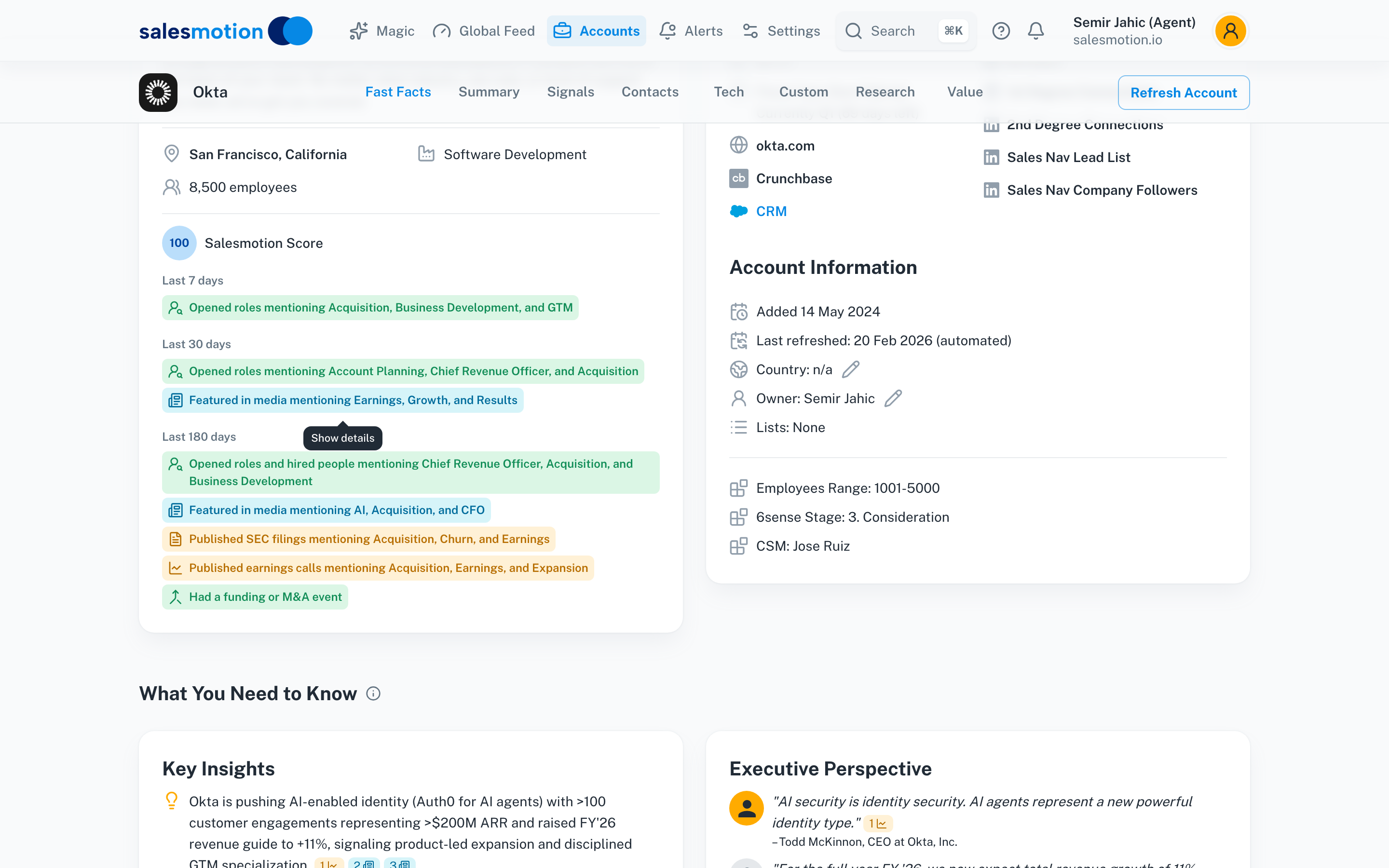 Salesmotion generates a complete account brief in minutes — key insights, executive quotes, opportunities, and talking points — so reps walk into every meeting prepared.
Signals That Indicate Purchase Readiness
HR leaders generate specific buying signals that indicate active technology evaluation:
CHRO Turnover: A new CHRO typically reviews the HR technology stack within their first 120 days. New HR leaders want to put their stamp on the function and often have budget authority to make changes.
Workforce Transformation Announcements: Companies announcing restructuring, reorganization, new market expansion, or significant headcount changes need supporting HR technology. Track these announcements in earnings calls, press releases, and job postings.
Leadership Development Initiatives: When a company announces a formal leadership development program, management training overhaul, or succession planning initiative, they need supporting technology.
Annual Planning Cycle: HR budgets are planned in Q3/Q4 for the following year. Engage during this window to influence budget allocation. Mid-year reviews create a secondary window at some organizations.
M&A Activity: Post-merger integration creates massive HR technology needs: system consolidation, culture integration, compensation harmonization, and organizational design. The 12 to 24 months post-announcement is a prime buying window.
People Analytics Investment: When a company hires a Head of People Analytics, promotes data-driven HR initiatives, or mentions "data-driven talent decisions" in their public communications, they are actively building analytics capability that needs technology support.
Regulatory Changes: New labor laws, pay transparency requirements, or DE&I reporting mandates create compliance-driven technology purchases with firm deadlines.
“This is my singular place that very simply summarizes a company's top initiatives, strategies and connects them to my solution. Something I would spend hours researching manually, now it's automated.”
Derek Rosen
Director, Strategic Accounts, Guild Education
Outreach Templates for HR Buyers
Example: New CHRO Outreach
Signal: Company hired a new CHRO. Previous role was at a company known for progressive people analytics.
Subject line: People analytics infrastructure for the new role
Body: Welcome to the new position. With your background in people analytics at [Previous Company], I expect building data-driven HR capabilities is high on your agenda for the first 120 days.
We help commercial teams that sell into HR leadership understand each buyer's strategic priorities, so outreach lands on the right topic at the right time. Would 15 minutes be useful to discuss how we support teams selling into your space?
Example: Leadership Development Initiative Outreach
Signal: Company announced a company-wide leadership development initiative in their recent earnings call.
Subject line: Supporting the leadership development initiative
Body: Your Q3 commentary on the enterprise-wide leadership development initiative caught my attention. Programs at that scale require deep account intelligence to identify the right stakeholders, map decision-making authority, and understand each business unit's specific needs.
We help sales teams that sell leadership development, workforce planning, and HR technology to prepare for these conversations efficiently. Happy to share examples from teams selling into similar enterprises.
Common Mistakes When Selling to HR Leaders
Speaking in HR jargon to the CFO. HR technology purchases require CFO approval. If your business case only speaks to HR metrics (engagement scores, NPS, learning completion rates), it will not survive the CFO's scrutiny. Translate every HR metric into financial impact.
Ignoring the HRIS team. The HRIS director manages the technology ecosystem and has effective veto power over solutions that do not integrate cleanly with Workday, SAP SuccessFactors, or their HCM platform. Engage HRIS early with integration documentation and technical specifications.
Overpromising AI capabilities. HR leaders are in the Trough of Disillusionment with AI. Vendors who lead with "AI-powered" without specific, measurable outcomes lose credibility. Lead with results, then explain the technology behind them.
Treating all HR buyers the same. A VP of Talent Acquisition evaluates tools completely differently from a VP of Total Rewards or a CHRO. Tailor your messaging, demo content, and ROI models to the specific HR function you are selling into.
Missing the business case connection. HR leaders who cannot prove ROI to their CEO lose budget. Help your champion build the business case with data-driven evidence that connects HR outcomes to revenue, productivity, and retention cost savings.
Explore the Sales Intelligence for HR Tech page for HR-specific use cases and workflows.
Frequently Asked Questions
What are the top CHRO priorities that should shape my sales approach?
According to Gartner and SHRM, the top CHRO priorities for 2026 are leadership and manager development, AI adoption and value realization, strategic workforce planning, employee experience and culture, and reskilling at scale. If your solution aligns with any of these priorities, frame your value proposition around that specific priority. Leadership development has been the number one priority for three consecutive years, making it the most stable entry point.
How do I get HR technology budget approved by the CFO?
Build a business case that translates HR outcomes into financial metrics the CFO tracks: reduced voluntary turnover saves $X in replacement costs (typically 1 to 2x annual salary per departing employee), faster time to productivity improves revenue per employee, and improved manager effectiveness reduces team attrition. Provide benchmark data from similar companies and offer ROI modeling specific to the buyer's headcount, turnover rate, and average compensation. Frame the investment as driving growth and efficiency, not just HR improvement.
What signals indicate an HR leader is ready to purchase technology?
The strongest signals are new CHRO appointments (they review the stack within 120 days), workforce transformation announcements, leadership development program launches, and annual budget planning cycles (Q3/Q4). M&A activity also creates urgent HR technology needs for integration and harmonization. Companies hiring for people analytics or HRIS roles are actively building technology infrastructure.
How should I position AI-based HR tools given current skepticism?
Lead with specific, measurable outcomes rather than AI capabilities. HR leaders have seen too many AI promises fail to deliver. Show concrete results: "reduced screening time by X%," "improved quality of hire by Y%," or "predicted attrition risk with Z% accuracy." Reference customers who achieved these results. Be transparent about what the AI does well and where human judgment is still required. Positioning AI as augmenting HR decision-making, not replacing it, resonates with CHROs who value the human element of their function.
Key Takeaways
- CHROs evaluate technology based on business impact (productivity, retention cost savings, revenue per employee), not HR metrics alone. Help your champion build a CFO-ready business case.
- Leadership and manager development is the top CHRO priority for the third consecutive year. Align your solution with this priority for the strongest positioning.
- HR leaders are skeptical of AI promises. Lead with specific, measurable outcomes rather than technology capabilities.
- CHRO turnover, workforce transformation announcements, leadership development initiatives, and Q3/Q4 budget planning are the highest-intent buying signals.
- Guild Education saves 6+ hours per week on account research for their $20M+ enterprise HR and education deals using automated account intelligence.
- Visit the Sales Intelligence for HR Tech page for HR-specific use cases.