According to 6sense's 2025 research, 92% of B2B SaaS buyers start their journey with at least one vendor already in mind, and 95% of the time, the winning vendor is already on the buyer's day-one shortlist. If you sell to SaaS companies, you are not competing in discovery calls. You are competing for mindshare weeks before the prospect ever fills out a form.
TL;DR: SaaS buyers are technically sophisticated, self-directed, and move fast. Winning deals requires early brand presence, deep product knowledge, and outreach timed to funding rounds, leadership changes, and tech stack signals. Generic outreach gets deleted. Signal-driven engagement gets meetings.
Understanding the SaaS Buyer
SaaS companies are simultaneously the most technically literate and the most vendor-fatigued buyers in B2B. Their leadership teams evaluate dozens of tools every quarter, and they know every sales tactic in the playbook because they use the same ones on their own customers.
The average B2B SaaS deal now takes 84 days to close across all segments, with enterprise deals stretching beyond 180 days. But SaaS mid-market deals can close in 30 to 60 days when the timing is right and the buyer is already educated.
Buying groups at SaaS companies have grown dramatically. LinkedIn's B2Believe 2025 report found the average B2B buying group now includes 22 people. In a SaaS company selling to other SaaS companies, this means your deal involves sales leadership, RevOps, finance, security, and often the CEO or CTO at smaller organizations.
What makes SaaS different from other verticals is velocity. SaaS buyers expect rapid time to value: fast onboarding, quick integration with their existing stack (Salesforce, HubSpot, Outreach, Gong), and measurable ROI within the first quarter. If your product requires a 6-month implementation, you are at a structural disadvantage against competitors who deliver value in weeks.
Key Decision Makers and Their Priorities
VP of Sales / CRO
The primary economic buyer for most sales tools. They evaluate solutions based on quota attainment impact, pipeline velocity, and rep productivity. They want proof that your tool will help their team hit targets, not theoretical frameworks.
RevOps / Sales Operations
The technical evaluator who assesses data quality, CRM integration, workflow automation, and reporting capabilities. RevOps has become the gatekeeper for sales technology decisions. They will test your API, audit your data sources, and benchmark you against alternatives before recommending approval. Read more about revenue operations priorities.
Finance / CFO
For deals above $50K annually, expect finance involvement. SaaS CFOs are sophisticated about pricing models and will scrutinize per-seat costs, usage-based pricing, contract terms, and renewal escalation clauses. They also evaluate the tool's impact on CAC and LTV ratios.
Security and IT
Even at 200-person SaaS companies, security review is standard. Expect SOC 2 questionnaires, SSO requirements, and data handling assessments. SaaS buyers know these processes well because they go through them with their own customers.

“The moment we turned on Salesmotion, it became essential. No more hours on LinkedIn or Google to figure out who we're talking to. It's just there, served up to you, so it's always 'go time.'”
Adam Wainwright
Head of Revenue, Cacheflow
The Sales Approach That Works
Demonstrate Product-Market Fit for Their Specific Stage
A 50-person Series A startup has fundamentally different needs than a 2,000-person public SaaS company. Segment your approach:
Early-stage (Series A/B, 20 to 100 employees): Founder-led sales are still common. The buyer values speed, simplicity, and pricing flexibility. Lead with quick wins and offer startup-friendly pricing.
Growth-stage (Series C/D, 100 to 500 employees): RevOps is being built out. The buyer values data quality, integration depth, and scalability. Lead with how your solution scales from 10 reps to 100.
Enterprise SaaS (500+ employees, often public): Procurement is formalized. The buyer values security compliance, admin controls, and enterprise-grade SLA commitments. Lead with references from similar-sized companies.
Use Their Language
SaaS buyers speak in metrics: ARR, NDR, CAC payback, magic number, pipeline coverage ratio. Your outreach should reference these metrics. Instead of "we help you sell more," try "teams using our platform see a 35% improvement in win rates and a 31% reduction in sales cycle length." Frontify, a brand management SaaS company, saw exactly those results after deploying Salesmotion, growing self-sourced revenue from 4% to 16% of total bookings within three quarters. Read the full case study.
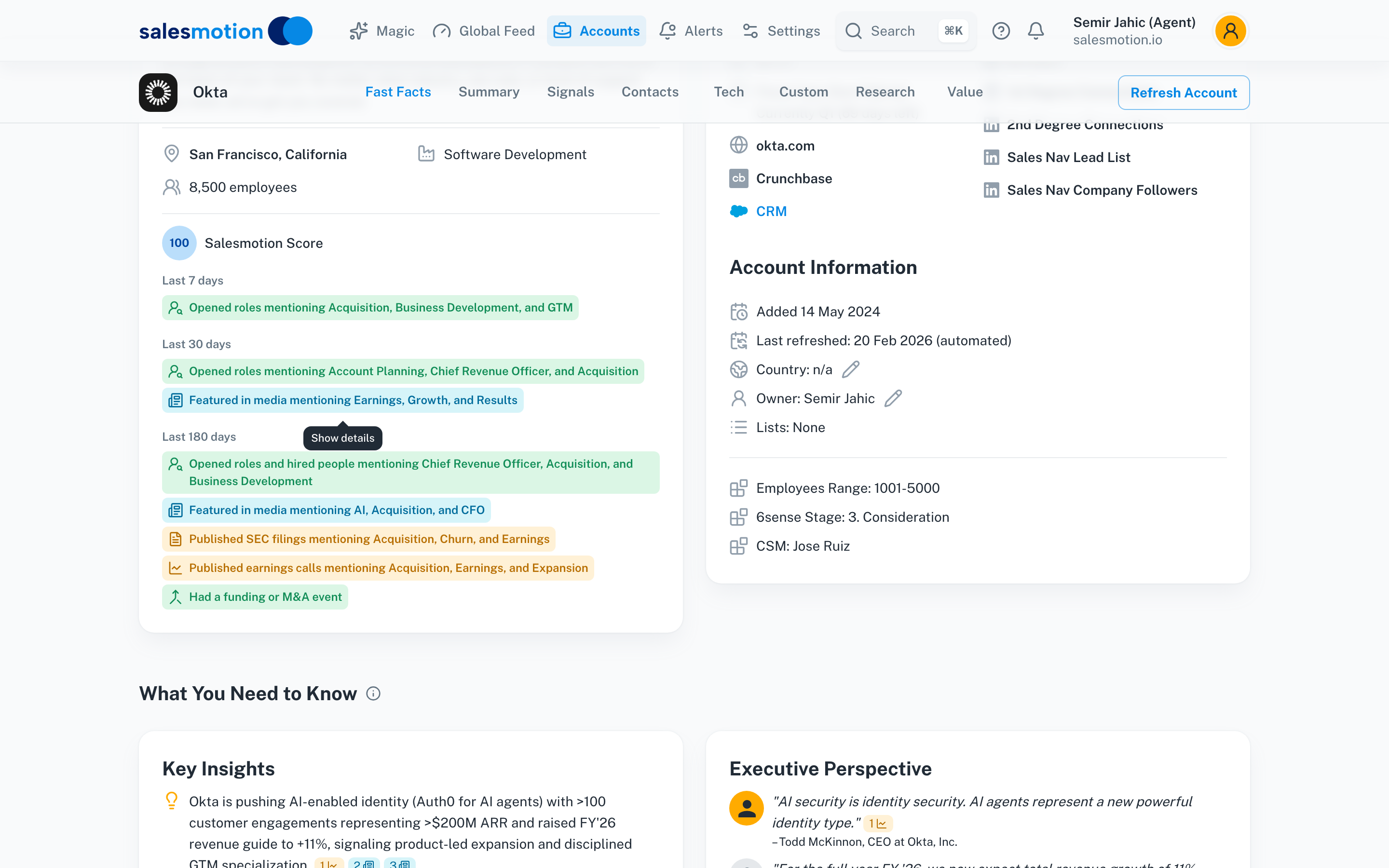 Salesmotion generates a complete account brief in minutes — key insights, executive quotes, opportunities, and talking points — so reps walk into every meeting prepared.
Build Consensus, Not Just Champion Buy-In
With 22-person buying groups, relying on a single champion is a losing strategy. Use multi-threading to build relationships with RevOps, the VP of Sales, and at least one senior leader. Provide each stakeholder with persona-specific collateral: ROI modeling for finance, integration documentation for RevOps, and competitive differentiation for sales leadership.
Signals That Indicate Purchase Readiness
SaaS companies generate highly visible buying signals that you can track systematically:
Funding Rounds: A new funding round, especially Series B and above, signals growth hiring, expanded sales teams, and new tool investments. The 6 months after a funding round is the highest-intent window for sales technology purchases.
Leadership Hires: When a SaaS company hires a new VP of Sales, CRO, or Head of RevOps, expect a tool stack review within 90 days. New leaders bring new preferences and new budget authority.
Rapid Headcount Growth: SaaS companies adding 5+ sales roles in a quarter are scaling their go-to-market. Scaling teams need intelligence tools, enablement platforms, and automation to maintain productivity as they grow.
Tech Stack Changes: Job postings mentioning Salesforce, HubSpot, Outreach, or Gong indicate the GTM stack the company uses. If your product integrates with these tools, that is a qualifying signal.
Earnings and Revenue Announcements: For public SaaS companies, earnings calls that mention "sales efficiency," "GTM optimization," or "rep productivity" signal active evaluation of sales tools. These phrases indicate budget allocation to the problem you solve.
Product Launches and Market Expansion: SaaS companies entering new markets or launching new product lines need account intelligence for unfamiliar territories. This is a strong signal for research and intelligence tool purchases.

“Salesmotion empowers me to cultivate a great buyer experience. I'm able to challenge prospects' thinking and be a trusted consultative seller. A major part of this is Salesmotion insights.”
Austin Friesen
Account Executive, FY25 #1 President's Club, Clari
Outreach Templates for SaaS Buyers
Example: Post-Funding Outreach to a CRO
Signal: SaaS company raised Series C ($50M), announced plans to triple their sales team.
Subject line: Scaling from 15 to 50 reps without losing velocity
Body: Congrats on the Series C. Tripling the sales team is exciting, but the common pitfall is that new reps take 6+ months to ramp while existing reps slow down from onboarding burden.
We help growth-stage SaaS companies give new reps instant access to account intelligence, so they prospect like tenured reps from week one. One growth-stage SaaS team saw their new reps reach quota attainment 40% faster using automated account research.
Worth 15 minutes to see if it fits your scaling plan?
Example: New VP of Sales Outreach
Signal: SaaS company hired a new VP of Sales from a competitor where Salesmotion is already deployed.
Subject line: Intelligence stack for your new team
Body: Welcome to the new role. In my experience, new sales leaders at SaaS companies review their tool stack within the first 90 days. If evaluating account intelligence is on your list, I would love to show you how we work with SaaS sales teams at your stage.
Quick call next week?
Common Mistakes When Selling to SaaS Companies
Underestimating the RevOps gatekeeper. In SaaS, RevOps often controls the shortlist before the VP of Sales ever sees it. Build your relationship with RevOps early and provide technical depth in your first conversation.
Overselling and under-demonstrating. SaaS buyers want to see the product, not hear about it. Offer a hands-on trial or live demo within the first interaction. Every meeting without a product demo is a missed opportunity.
Ignoring the competitive landscape. SaaS buyers are evaluating 3 to 5 alternatives simultaneously. According to 6sense research, 94% of buying groups rank their shortlist before initiating contact with sales. You need to win the shortlist ranking before the first call.
Pricing misalignment. Early-stage SaaS companies have tight budgets. Enterprise SaaS companies have procurement processes. Offer flexible pricing that matches the company stage, and be transparent about cost escalation as usage grows.
Slow time to value. If your onboarding takes more than 2 weeks, you will lose deals to competitors who can show value faster. Cacheflow, a SaaS company acquired by HubSpot, reached full platform utilization with Salesmotion within 24 hours of signing.
Explore the Sales Intelligence for SaaS page for SaaS-specific use cases and workflows.
Frequently Asked Questions
What is the fastest way to get on a SaaS buyer's shortlist?
Brand presence before the buying journey starts is the single most effective strategy. According to 6sense, 92% of SaaS buyers already have a vendor in mind before they begin formal evaluation. Invest in thought leadership content, industry comparisons, customer proof points, and G2/TrustRadius reviews. By the time a SaaS buyer starts evaluating, your brand should already be familiar.
How should I price my product when selling to different-stage SaaS companies?
Offer stage-appropriate pricing tiers. Startup plans with lower seat minimums and flexible contracts work for Series A/B companies. Growth plans with volume discounts and annual commitments fit Series C/D companies. Enterprise plans with dedicated support, SLAs, and custom integrations serve public or late-stage companies. Transparency about pricing on your website also builds trust with SaaS buyers, who expect it.
How do I handle the RevOps evaluation process?
Prepare for a technical deep-dive. RevOps teams will evaluate your CRM integration depth, data accuracy, API documentation, and reporting capabilities. Provide a sandbox environment or trial account, share integration documentation proactively, and offer a technical call with your solutions engineering team. The goal is to make RevOps your advocate, not your obstacle.
What buying signals are most reliable for SaaS companies?
Funding rounds (Series B+) are the highest-intent signal for sales tool purchases, as they directly correlate with sales team expansion. Leadership hires (VP of Sales, CRO, Head of RevOps) are the second most reliable, as new leaders review the tool stack within 90 days. Rapid headcount growth in sales roles is the third indicator. Combining multiple signals on a single account creates the strongest timing indicator for outreach.
Key Takeaways
- 92% of SaaS buyers start with a vendor already in mind. Brand presence before the buying journey is critical.
- Segment your approach by company stage: early-stage values speed, growth-stage values scalability, enterprise values security and compliance.
- RevOps is the gatekeeper for SaaS technology purchases. Build technical credibility with them early.
- The highest-intent signals are funding rounds, leadership hires, and rapid sales headcount growth.
- Frontify grew self-sourced revenue 4x and improved win rates by 35% using account intelligence to identify and engage the right SaaS accounts at the right time.
- Visit the Sales Intelligence for SaaS page for SaaS-specific use cases.