HR tech buying signals are the workforce events that force an HR team to buy: a restructuring, a hiring surge, an HCM platform switch, a new employment law, an acquisition or a new CHRO. Because every company has an HR function, the signals show up in any account list, and hiring is the most common of them. In Salesmotion's B2B buying signals benchmark, 17.4% of tracked companies posted relevant new job postings in a single quarter, more than any single type of hard trigger event. For B2B sales teams selling HR technology, the challenge is connecting each change to the right HR buyer at the right time. For a foundational overview of buying signals, start with the guide to buying signals in sales.
TL;DR: HR tech buying signals include workforce restructuring, HCM platform switches, compliance mandate changes, benefits expansion, remote work policy shifts, leadership changes, and annual planning cycles. Tracking these signals helps B2B sellers engage HR leaders and HR tech companies when purchasing decisions are actively being made.
Why HR Tech Buying Signals Reflect Organizational Change
Every significant organizational change creates HR technology needs. A company restructuring its workforce needs talent management, outplacement, and analytics tools. A company expanding remote work needs collaboration, engagement, and performance management platforms. A company growing headcount rapidly needs ATS, onboarding, and benefits administration solutions. HR technology purchasing is a direct reflection of organizational health and strategy. A signal-based selling framework helps teams connect these organizational changes to timely outreach.
The HR tech buying committee has expanded significantly. Decisions once made solely by the CHRO now involve the CIO (for security and integration), CFO (for total compensation analytics), and line-of-business leaders (for workforce planning). In large enterprises, a VP of HR Technology or VP of People Analytics may own the technology stack. Understanding who influences and who decides at each account is critical.
HR tech also has unique budget dynamics. Open enrollment drives benefits technology purchases on a fixed annual cycle. Annual planning cycles set workforce technology budgets for the following year, usually in the last quarter of the company's fiscal year. Compliance mandate deadlines create unplanned, urgent purchases. Mapping these timing patterns to your target accounts' fiscal calendars is essential.
Workforce and Organizational Signals
Workforce Restructuring
Layoffs, reorganizations, and workforce transformations are highly visible buying signals. A company conducting a reduction in force needs outplacement services, severance management tools, and often new workforce planning platforms. A company restructuring into new business units needs organizational design tools and change management technology. Track restructuring announcements in press releases, 8-K filings, state WARN Act notices (employers file them with state workforce agencies before large layoffs), and news coverage.
Hiring Surges and Headcount Growth
Rapid headcount growth drives purchasing across the HR tech stack: ATS capacity, onboarding platforms, benefits administration, payroll processing, and employee engagement tools. A company that doubles its open roles in a quarter will outgrow its current systems. Track hiring velocity through job posting volume and headcount growth, as the guide to hiring surges as a buying signal explains.
Remote Work and Location Policy Shifts
When a company shifts to hybrid or remote-first work, it needs virtual collaboration tools, remote employee engagement platforms, home office stipend management, and distributed workforce compliance solutions (multi-state tax, employment law). When a company mandates return-to-office, it needs office management, space planning, and in-person culture tools. Both shifts are buying signals.

“We're saving about 6 hours per week per seller on account research alone. That's time they can reinvest in actually selling.”
Derek Rosen
Director, Strategic Accounts, Guild Education
Technology and Platform Signals
HCM Platform Switches
A switch from one HCM (Human Capital Management) platform to another is one of the largest HR technology decisions a company makes. Workday, SAP SuccessFactors, Oracle HCM, ADP, and UKG implementations are long projects that open buying windows for integration tools, data migration services, training platforms, and complementary applications. Track HCM platform decisions through job postings (mentioning specific platforms), consultant announcements, and industry press.
Benefits Platform Changes
When a company switches its benefits administration platform, it triggers a cascade of changes: new enrollment tools, benefits communication platforms, employee experience portals, and data integrations. Benefits platform switches often align with open enrollment timelines, creating predictable buying windows.
AI and Automation Investments in HR
Companies investing in AI for HR (recruitment automation, predictive analytics, employee sentiment analysis, chatbot-based support) are in active buying cycles. Track announcements about HR AI initiatives, hiring for HR analytics and data science roles, and conference presentations on AI in HR.
Compliance and Policy Signals
Compliance Mandate Changes
Federal and state employment law changes drive HR technology purchases. New pay transparency laws, paid leave mandates, workplace safety requirements, and reporting obligations all require technology solutions. California's pay transparency law (SB 1162), in force since January 1, 2023, requires employers with 15 or more employees to put pay scales in job postings for roles that could be filled in California (Davis Wright Tremaine summary of the Labor Commissioner's FAQs), which sent employers looking for compensation structure and job architecture tools. Track legislative changes from the U.S. Department of Labor and state labor departments.
Benefits Expansion Announcements
When a company announces expanded benefits (mental health coverage, fertility benefits, student loan repayment, expanded parental leave), it needs technology to administer and communicate those benefits. Benefits expansion announcements are often made in press releases and on company career pages, making them publicly trackable signals.
Annual Planning and Budget Cycles
HR technology budgets are typically set during annual planning cycles, often in Q4 for the following year. Companies that publish their fiscal year calendars give sales teams advance notice of when budget decisions are made. Track fiscal year timing for your target accounts and align your sales cadence to their planning window.
“This is massive and saves me hours of searching Google and reading annual reports. Using Salesmotion as my very first place to go when I'm doing anything account-related now.”
Derek Rosen
Director, Strategic Accounts, Guild Education
Organizational and Leadership Signals
Leadership Changes
A new CHRO, VP of People, or VP of HR Technology signals a strategy shift. New HR leaders usually review the current technology stack early and often bring preferred vendors and approaches. A new CHRO at a growing company is particularly strong: they need to build or overhaul the people infrastructure. A new CHRO appears in Salesmotion as a New Executive Hire signal, alongside the same company's hiring, layoffs and strategic announcements; the job change signals guide covers how to turn them into meetings.
M&A and Integration Events
Mergers and acquisitions create HR technology integration needs: consolidating HRIS systems, harmonizing benefits, standardizing policies, and integrating payroll. These integrations run for many months and create buying windows across multiple HR technology categories.
Company Culture and Employer Brand Initiatives
When a company invests in employer brand, culture transformation, or employee experience initiatives (often announced in press releases, blog posts, or awards applications), it signals technology investment in engagement, recognition, feedback, and internal communication platforms.
How to Work HR Tech Buying Signals
HR signals are the easiest to find and the easiest to misread. A layoff can mean an outplacement buyer or a frozen budget; a hiring surge can mean an ATS upgrade or a team too busy to evaluate anything. Sort each one by the HR problem it creates before you write.
Read the job descriptions, not just the counts. Postings for HRIS analysts, people analytics leads or an "HR Technology" manager name the systems the team runs and the ones it is moving to. Salesmotion reads the job description itself and flags a Tech Match when it names a stack you care about.
Keep a state-by-state compliance calendar. Pay transparency, paid leave and reporting rules take effect on fixed dates, state by state. Map those dates to where each account employs people.
Time budget conversations to the planning cycle. Find each account's fiscal year end and start the conversation a quarter before its annual plan is set, not after the budget is committed.
Salesmotion builds account intelligence briefs that put workforce events, leadership changes and announcements for each account on one page, and its Outreach Agent drafts the first email from those signals for a rep to review and send.
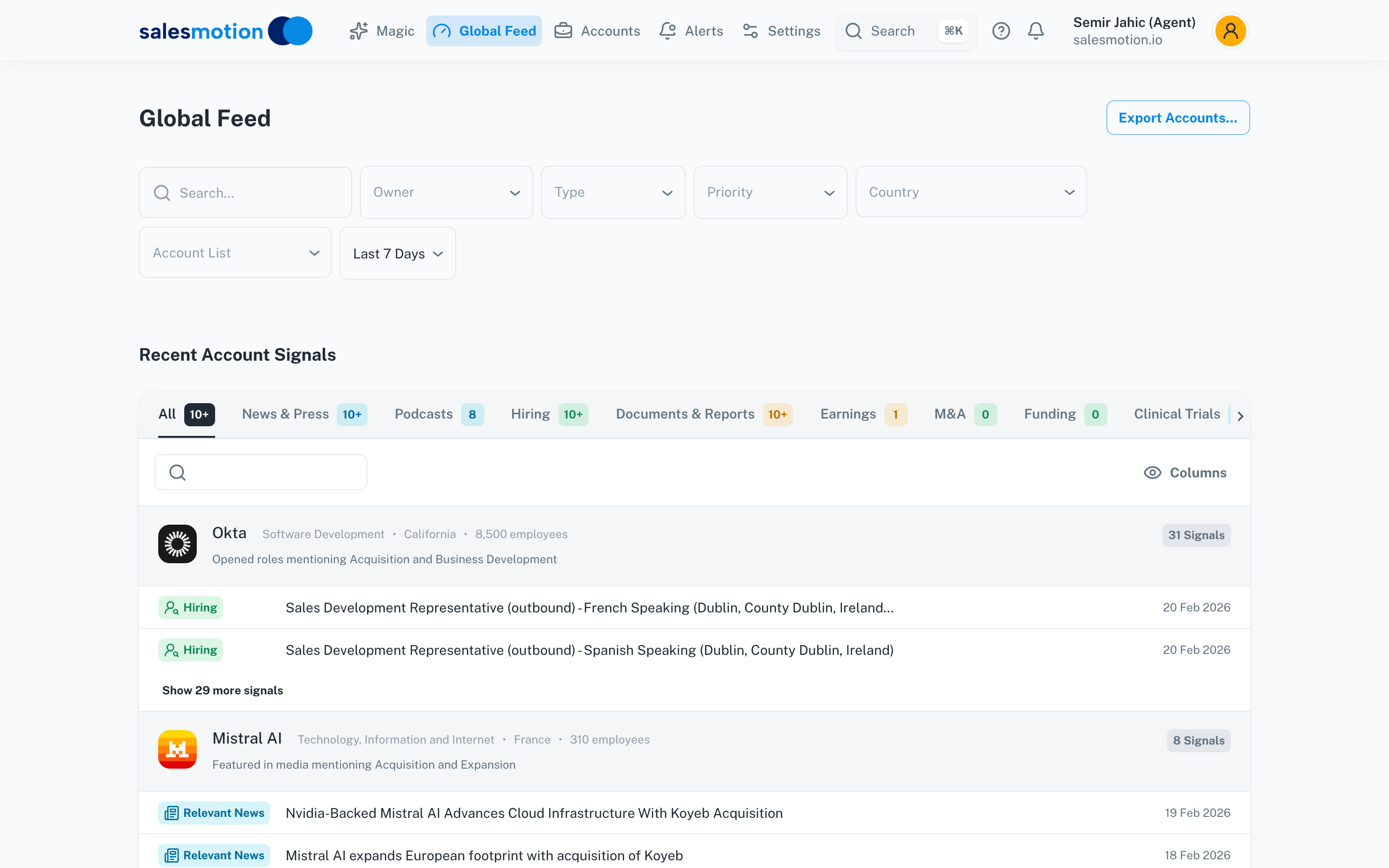 The Global Feed groups each account's signals by type. For HR tech sellers, the Hiring tab is the main stream: it shows which accounts are adding people-operations, HRIS and analytics roles this week.
Illustrative Scenario: HR Tech
A hypothetical example: a company moving to hybrid work.
Signals: A mid-market technology company announces a hybrid policy of three office days a week. In the same month it posts a VP of People Operations role, and its careers blog mentions "investing in our employee experience platform."
What the rep sees: The account brief lists the policy announcement, the VP search, the blog post and the HR systems named in recent job descriptions, each linked to its source.
Rep action: The rep writes to the current Head of HR about running the hybrid transition before the new VP starts (engagement across offices, desk booking, multi-state compliance) and asks one question about who will own the employee experience platform.
Why it works: The email is about the problem the HR team announced, in its own words. That is signal-based selling for HR buyers: the policy change is the reason, the open VP role is the timing. The guide on how to sell to HR leaders covers the buying committee, and sales intelligence for HR tech covers territory-level coverage.
Key Takeaways
- HR tech buying signals reflect organizational change. Restructuring, hiring surges, remote work shifts, and M&A integration all create technology purchasing needs across the HR stack.
- HCM platform switches create long buying windows that extend far beyond the primary vendor to integration tools, training, data migration, and complementary applications.
- Compliance mandates (pay transparency, paid leave, workplace safety) create predictable, deadline-driven buying cycles that are often less price-sensitive than discretionary purchases.
- Annual planning cycles set HR technology budgets. Engage target accounts a quarter before the plan is set, not after budgets are committed.
- New HR leadership (CHRO, VP of People) usually triggers an early review of the technology stack. Track these hires as one of the most actionable HR tech buying signals.
Frequently Asked Questions
What are the most important buying signals for selling HR technology?
The strongest HR tech buying signals are workforce restructuring events (creating immediate technology needs), HCM platform switches (opening long, multi-vendor buying windows), compliance mandate changes (driving deadline-driven purchases), HR leadership changes (triggering vendor evaluations), and rapid headcount growth (outgrowing current systems). These signals indicate active budget allocation and organizational readiness for new solutions.
How do HCM platform switches create buying opportunities?
Switching from one HCM platform to another (Workday, SAP SuccessFactors, Oracle HCM, ADP) affects nearly every HR workflow. Beyond the HCM vendor itself, the organization needs data migration services, integration middleware, training platforms, benefits administration tools, and complementary applications that work with the new platform. This creates a multi-year buying window across dozens of vendor categories.
Why are compliance mandates such strong HR tech buying signals?
Employment law changes have fixed implementation deadlines and legal consequences for non-compliance. When a state mandates pay transparency or expands paid leave requirements, every employer in that jurisdiction must comply. This creates urgent, budget-approved purchasing for compensation analytics, benefits administration, and compliance reporting tools. The deadline removes the "we can wait" objection that slows many HR tech purchases.
How should B2B sales teams track HR tech buying signals at scale?
Split them by source. Employment law changes (state pay transparency, paid leave and reporting rules) go on one compliance calendar for the territory. Account events (WARN notices and layoffs, HR job postings, CHRO and VP of People hires, HCM announcements, acquisitions) need monitoring per account. A sales intelligence tool that reads job descriptions, press releases and filings for each account handles the second list, so reps spend their time on the conversations.