Your CRM is full of accounts that looked like they were buying. Marketing flagged them. SDRs worked them. AEs ran discovery calls. Then nothing happened. The problem is not effort. It is qualification. Understanding what intent data is and how it works is the first step to fixing this.
TL;DR: 67% of lost sales stem from improper lead qualification. Intent data fixes this by revealing which accounts are actively researching solutions, not just matching firmographic criteria. The key is layering first-party engagement signals over third-party research data, then scoring by signal intensity and ICP fit. Teams that combine both data types see 2x higher conversion rates and 30% lower acquisition costs.
Why Traditional Lead Qualification Breaks Down
Most B2B qualification models rely on static criteria. Does the company match our ICP? Does the contact have the right title? Did they fill out a form? These checks confirm basic fit but reveal nothing about timing or urgency.
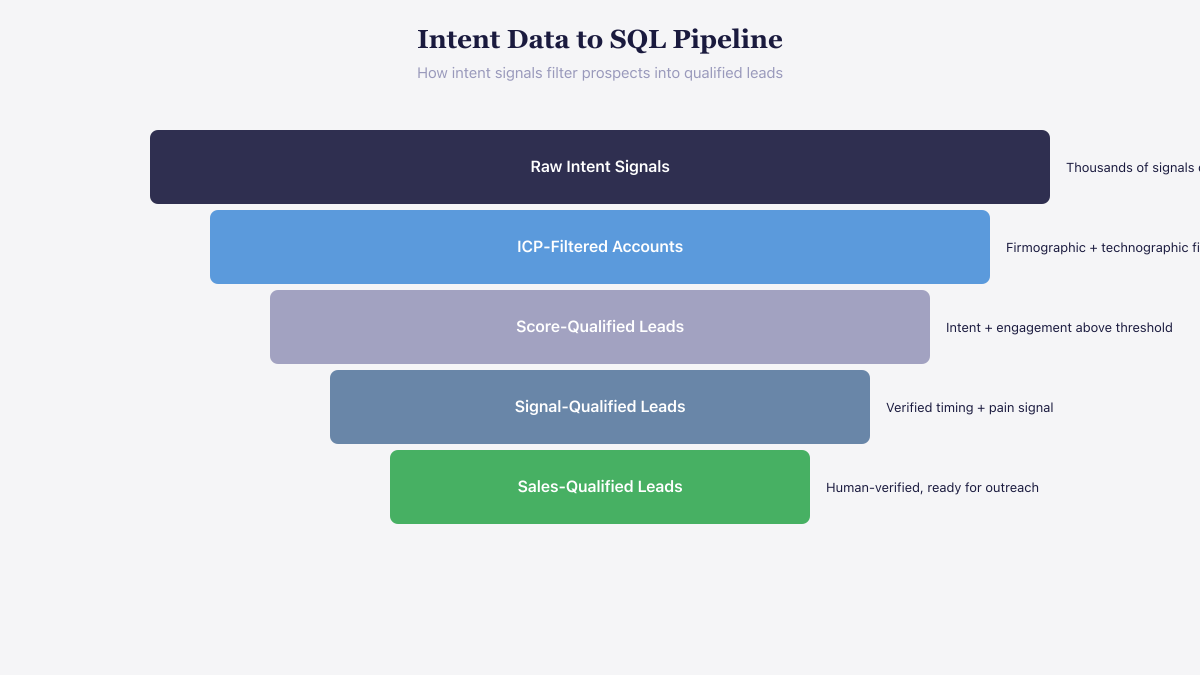 Intent data becomes actionable only after passing through ICP, scoring, and verification filters.
The result: 79% of marketing leads never convert to sales. And 84% of businesses say converting MQLs to SQLs is one of their most significant challenges. The funnel is not broken at the top. It is broken in the middle, where qualification happens.
Intent data changes the equation by adding a behavioral layer. Instead of asking "does this account fit?", you can ask "is this account actively looking for a solution right now?" That distinction is the difference between cold outreach and a timely conversation with a motivated buyer.
See Salesmotion on a real account
Book a 15-minute demo and see how your team saves hours on account research.
First-Party vs. Third-Party Intent: You Need Both
Not all intent signals carry equal weight. Understanding the source determines how you act on them.
First-party intent data comes from your own properties: website visits, pricing page views, content downloads, demo requests, email clicks. These signals are high-confidence because the prospect engaged directly with your brand. A HubSpot study found businesses using first-party intent data achieve a 50% increase in lead-to-customer conversions. The limitation is scope. You only see prospects who already found you.
Third-party intent data comes from external sources: review sites, publisher content, industry research, competitor comparison pages. These signals catch buyers earlier in the research cycle, before they visit your website. The trade-off is noise. Third-party data shows category interest, not necessarily purchase intent for your specific solution.
According to a survey of 200 senior B2B marketers, 55% use a combination of both data types. Of those, 75% lean more heavily on first-party data. The winning approach layers third-party signals for early detection on top of first-party signals for validation.
Practical framework:
- Third-party signals identify accounts researching your category (early awareness)
- First-party signals confirm those accounts are engaging with your specific solution (active consideration)
- An account showing both signals simultaneously is your highest-confidence SQL

“We're no longer fishing. We know who the right customers are, and we can qualify them quickly. Salesmotion has had a direct impact on pipeline quality.”
Andrew Giordano
VP of Global Commercial Operations, Analytic Partners
Scoring Leads by Signal Intensity
A prospect who visited your pricing page three times this week is not the same as someone who read one blog post six months ago. Your scoring model must reflect that difference.
High-intent signals (score heavily):
- Pricing page visits (especially repeat visits)
- Demo or trial requests
- Competitor comparison research on G2 or similar platforms
- Multiple contacts from the same account engaging simultaneously
Medium-intent signals (score moderately):
- Webinar attendance
- Case study or whitepaper downloads
- Feature page visits
- Attending industry events where you exhibit
Low-intent signals (minimal scoring):
- General blog reading
- Social media engagement
- Single website visit with no follow-up
The critical insight is frequency and recency. A single pricing page visit is curious. Three visits in a week is urgent. Build your scoring model to weight recency heavily, because buying signals decay fast. Research shows the vendor who responds first wins up to 50% of sales.
Dynamic scoring also means accounts move between tiers. An account that scored high last month but has gone silent should drop in priority. An account with no prior engagement that suddenly surges in activity should jump to the top. Static lists are the enemy of intent-driven qualification.
Combining Intent With ICP Fit
Intent without fit is noise. A student researching your software for a thesis generates intent signals but will never buy. A company in the wrong industry or revenue band might show high engagement but cannot become a customer.
The filter works in two stages:
Stage 1: Qualify for fit. Does the account match your ICP on firmographics (industry, company size, revenue) and technographics (current tech stack, relevant tools)? If not, intent signals do not matter.
Stage 2: Prioritize by intent. Among accounts that pass the fit filter, rank by signal intensity. This ensures your team focuses on accounts that can actually buy and are showing signs of active evaluation.
One sales leader shared that spending just five minutes qualifying each account before outreach, checking tech stack, confirming funding, verifying the right buyer persona, jumped reply rates from 2% to 8-12%. That is a 4 to 6x improvement from basic qualification hygiene.
For enterprise deals, go further. The average B2B buying group now includes 22 stakeholders. Intent from a single junior contact means less than intent from multiple decision-makers at the same account. When your account intelligence shows three people from the same company researching your category, that is a buying committee mobilizing. Treat it accordingly.

“Automatic account profile detail I can use to manage my territory. Using Salesmotion AI to generate value statements per persona, account, etc. Using Salesmotion to give me a starting point based on new hires, or news alerts is critical.”
Adam Wainwright
Head of Revenue, Cacheflow
Acting on Intent Signals Before They Expire
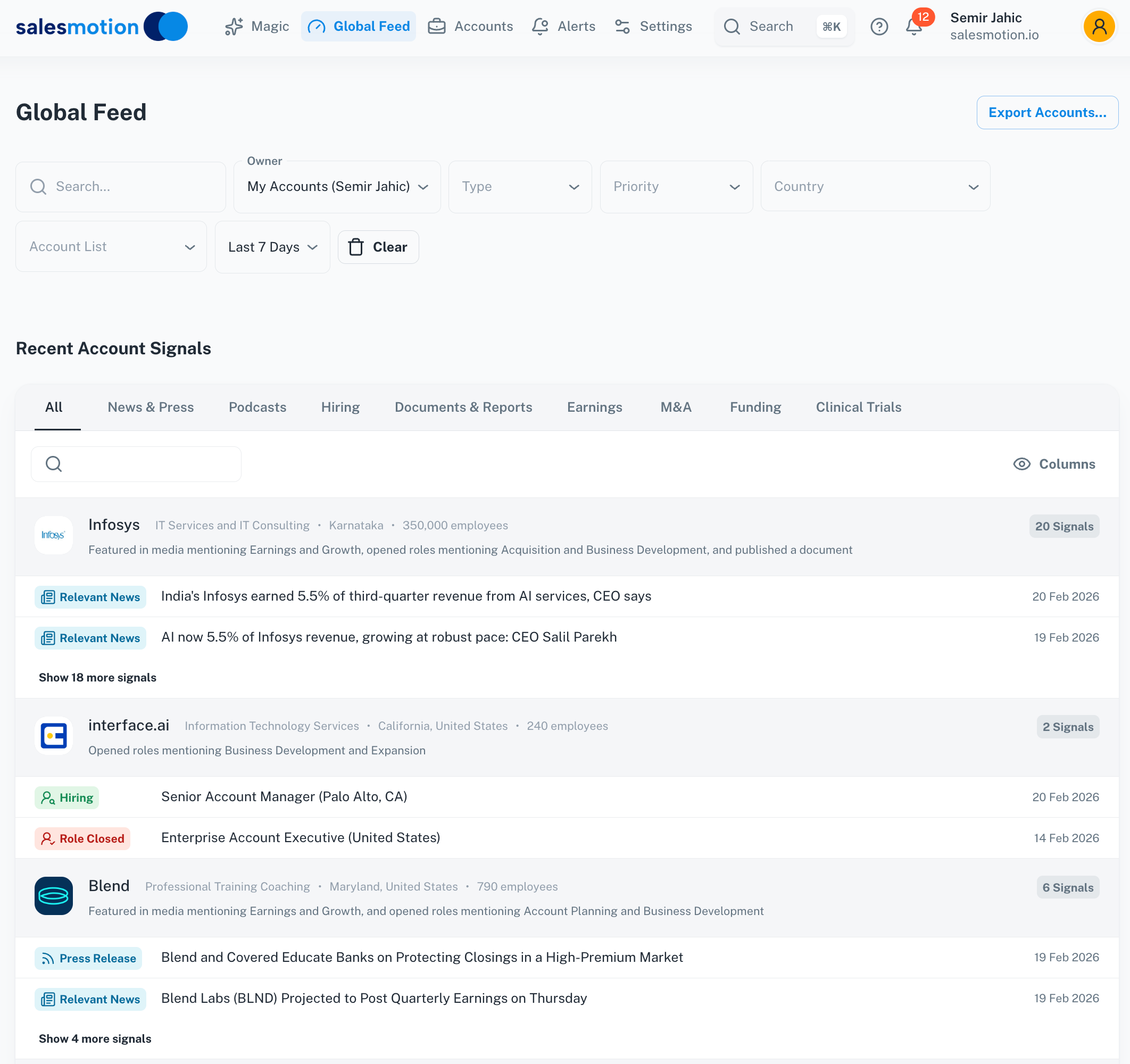 A real-time signal feed ensures reps see high-intent triggers the moment they fire, not days later when the buying window has closed.
Intent data has a shelf life. A pricing page visit from last month is not a buying signal today. The teams that convert intent into pipeline act within hours, not days.
Map the signal to the buyer's stage and adjust your approach:
- Awareness stage (reading "What is [category]?" content): Send educational resources. Do not ask for a meeting. The goal is to be helpful and stay visible.
- Consideration stage (reading competitor comparisons, attending webinars): Share relevant case studies. Address differentiation directly. Offer a consultation, not a demo.
- Decision stage (visiting pricing, checking security docs, multiple stakeholders engaged): This is your green light for a direct ask. Propose a specific meeting to discuss their use case and pricing.
The mistake most teams make is treating every intent signal as a demo request. A prospect in the awareness stage who receives a hard sales push will disengage. Match your response to their readiness.
Automate the alert process so reps do not miss high-intent moments. Push notifications to Slack or email when a target account hits decision-stage behavior. At Frontify, consolidating these signals into a single view helped the team increase self-sourced meetings by 400% because reps could see exactly which accounts to prioritize each morning.
Using Intent Data for Retention and Expansion
Intent data is not just for new business. The same signals that identify prospects can protect and grow existing customers.
Churn prevention: If a current customer starts visiting your cancellation page, researching competitors on G2, or reading "alternatives to [your product]" content, that is a retention signal. Route it to your Customer Success team immediately. Early intervention dramatically improves save rates.
Expansion opportunities: Track when existing customers start researching features they do not currently use. A customer on your basic plan who begins visiting enterprise feature pages is signaling upgrade readiness. Your Account Manager should reach out with a relevant expansion offer before the customer starts evaluating competitors.
Cross-sell signals: When a customer's company shows intent signals for a different product category you serve, that is a cross-sell opportunity that most teams miss entirely because they only monitor intent for new business.
Key Takeaways
- 67% of lost sales come from poor qualification. Intent data fixes the timing problem that static ICP criteria cannot solve.
- Combine first-party engagement data (high accuracy) with third-party research data (broad reach) for the most reliable signal.
- Score leads dynamically based on signal intensity, recency, and frequency. Static lists kill conversion rates.
- Always filter for ICP fit before prioritizing by intent. Intent without fit is noise.
- Match your outreach approach to the buyer's stage. Not every signal deserves a demo request.
- Apply intent monitoring to existing customers for churn prevention and expansion revenue.
Frequently Asked Questions
What is the difference between intent data and buying signals?
Buying signals is a broader category that includes any indicator a prospect might be ready to purchase, such as budget approval, hiring activity, or competitive displacement. Intent data specifically refers to behavioral signals showing active research, like content consumption, search activity, and website engagement. Intent data is one type of buying signal, but not all buying signals are intent data.
How accurate is third-party intent data?
Accuracy varies significantly by provider. Third-party intent data works at the account level (identifying companies researching a topic) but rarely identifies the specific individual doing the research. Treat it as a targeting signal to narrow your list, then use first-party data and direct outreach to confirm interest at the contact level. Teams that rely solely on third-party intent without layering in additional qualification often find the signal too noisy to act on.
How quickly should we act on high-intent signals?
Within hours, not days. Research shows the first vendor to respond wins up to 50% of sales opportunities. Set up automated alerts for decision-stage signals (pricing page visits, demo requests, multiple stakeholders from the same account) and route them directly to the assigned rep via Slack, email, or CRM task creation. Speed-to-lead is the single biggest factor in converting intent into pipeline.