
The sales intelligence market is projected to reach $4.5 billion in 2026, and Lusha is one of the most recognizable names in the space. But recognizable does not mean affordable, and affordable does not mean cost-effective. Before you commit to a Lusha subscription, you need to understand exactly what each tier includes, how the credit system works, and where the real costs hide. Paid plans start at $37.45 a month on annual billing, or $49.90 billed monthly.
Lusha pricing looks straightforward on the surface: published plans, clear rates, a free tier. Look closer, though, and the credit system matters more than the plan price: a phone number costs five times what an email does. As of October 2026 the self-serve tiers are Free, Starter ($37.45 a month on annual billing), Professional ($52.45), and Premium ($299.95), with Scale as the custom enterprise option. Lusha's self-serve plans cover teams of up to 5 users; larger teams are routed to sales.
TL;DR: Lusha offers five plans from free to custom enterprise pricing: Starter at $37.45, Professional at $52.45 and Premium at $299.95 per month on annual billing ($49.90, $69.90 and $399.90 billed monthly). The credit system charges 1 credit per email and 5 credits per phone number (up to 6 for both on the same contact), which means phone-heavy teams burn through credits five times faster than email-first teams. Self-serve plans cover teams of up to 5 users; larger teams go to sales for a Scale quote. For teams that need full account intelligence beyond contact data, Lusha alternatives may deliver better ROI.
 Lusha pairs verified contact data with live signals — plans are credit-based from a free tier upward.
Lusha
Free–$399.90/mo
published tiers · monthly billing
Salesmotion
From $85/mo
monthly contract · verified contacts included
Lusha is built for fast contact lookup. Salesmotion adds 24/7 account monitoring and cited account briefs on top of verified contacts.
- 3 AI agents on every account: signals, research briefs, drafted outreach
- Live in an hour, monthly billing, no annual contract
- Verified contacts included; CRM integration on custom team & enterprise plans
Lusha vs Salesmotion at a Glance
Before digging into each tier, here is how Lusha's contact-data pricing compares to an account intelligence platform:
| Lusha | Salesmotion | |
|---|---|---|
| Starting price | Free plan; paid from $37.45/month on annual billing ($49.90 billed monthly) | $85/month individual plan |
| Pricing transparency | Published for self-serve tiers; Scale is quote-only | Published on the pricing page |
| Contract | Monthly or annual billing | Self-serve monthly individual plan, no annual commitment; custom pricing with unlimited users on team plans |
| What you get | Contact data: emails, phone numbers and company signals, metered by credits | Account intelligence: buying signals across 1,000+ sources, AI research briefs, and AI agents |
See the product in action
Take a self-guided tour of the Salesmotion platform — no signup required.
Key Takeaways
- Lusha's Free plan gives you up to 40 credits per month, enough to test data quality but not enough for real prospecting at scale.
- Starter ($37.45/month), Professional ($52.45/month), and Premium ($299.95/month) on annual billing are the self-serve tiers as of October 2026. Billed monthly they cost $49.90, $69.90, and $399.90.
- Lusha's self-serve plans cover teams of up to 5 users; larger teams are routed to sales.
- Phone number reveals cost 5 credits each against 1 for an email, so a phone-first motion drains an allocation roughly five times faster than an email-first one.
- Lusha also lists 26 buying signals on named companies, refreshed weekly, plus API and MCP access. Check Lusha's plan comparison for which tier includes each.
- Unused credits on annual plans reset at the end of the billing cycle with no rollover.
- Teams that need account research beyond contact data, including earnings insights, filings, and competitive moves, should evaluate account intelligence platforms alongside a contact database.

“The moment we turned on Salesmotion, it became essential. No more hours on LinkedIn or Google to figure out who we're talking to. It's just there, served up to you, so it's always 'go time.'”
Adam Wainwright
Head of Revenue, Cacheflow
Lusha Pricing Plans at a Glance
Here is how the five Lusha tiers compare based on Lusha's published pricing as of October 2026:
| Feature | Free | Starter | Professional | Premium | Scale |
|---|---|---|---|---|---|
| Billed annually (per month) | $0 | $37.45 | $52.45 | $299.95 | Custom |
| Billed monthly | $0 | $49.90 | $69.90 | $399.90 | Custom |
| Credits per month | 40 | 400 | 600 | 3,400 | Custom |
| Browser extension | Yes | Yes | Yes | Yes | Yes |
Each price buys a fixed monthly credit pool. Monthly billing costs about a third more than annual. Scale is quote-only: Vendr reports a median Lusha contract of $15,999 a year across 147 purchases, ranging from $6,000 to $70,403, with buyers saving 11% on average.
The Free Plan: Good for Testing, Not for Selling
Lusha's free tier gives you up to 40 credits per month. That is enough to verify a handful of contacts and test whether Lusha's data covers your target market. You get the browser extension and basic company data.
What you cannot do on the free plan is run a real outbound campaign. At 40 credits per month, you can reveal 40 emails or just 8 phone numbers at the 5-credit rate.
The free plan works for individual contributors who need to spot-check a contact before a meeting. It does not work for sales teams building pipeline.

“The Business Development team gets 80 to 90 percent of what they need in 15 minutes. That is a complete shift in how our reps work.”
Andrew Giordano
VP of Global Commercial Operations, Analytic Partners
Starter and Professional Plans: The Entry Points with Tight Limits
The Starter plan runs $37.45 per month on annual billing ($49.90 billed monthly) and includes 400 credits per month, or 4,800 per year. Professional costs $52.45 per month on annual billing ($69.90 billed monthly) with 600 credits per month.
For email-only prospecting, Professional's 600 credits give you up to 600 new contacts per month. Add phone numbers at 5 credits each, and that number drops sharply. A rep who reveals both email and phone for every contact burns 6 credits per contact, cutting the effective total to 100 contacts per month.
Per-user credit limits are available on Scale plans, according to Lusha's pricing page. Check Lusha's plan comparison for which tier includes the API access, signals, and CRM sync depth you need.
For solo users and two-person teams doing email-first outreach, Starter or Professional can work. The moment phone numbers become central to your motion, the credit math pushes you up a tier.
Premium Plan: More Credits, Still Credit-Constrained
Premium runs $299.95 per month on annual billing ($3,599.10 a year), or $399.90 billed monthly. The allocation is 3,400 credits per month, or 40,800 per year.
The jump from Professional to Premium is about volume, not unit price: the cost per credit is roughly the same on both (about $0.09 on annual billing), so Premium makes sense for teams that consistently exhaust Professional's allocation.
But the same credit constraints apply. At 3,400 credits per month, a phone-heavy team revealing mobiles at 5 credits each gets about 680 phone numbers monthly across the whole account. Split among five reps, that is 136 dials' worth of new numbers each.
Monthly billing costs about a third more than annual. If you are not sure about committing for a year, that uncertainty is priced in.
Scale Plan: Enterprise Pricing, Enterprise Requirements
Scale is Lusha's enterprise tier with custom pricing. Vendr reports a median Lusha contract of $15,999 a year across 147 purchases, ranging from $6,000 to $70,403, with buyers saving 11% on average.
Lusha describes Scale as fully customizable, and it is where per-user credit limits become available. Teams larger than 5 users are routed to sales.
Because the terms are set in the contract rather than on the pricing page, pin down credit volume, seat count, and renewal terms in writing before signing.
Scale is quoted by Lusha's sales team; the pricing page gives no contract terms for it.
How Lusha's Credit System Actually Works
The credit system is the core of Lusha's pricing model, and it is where most budgeting surprises originate.
Credit costs by data type (per Lusha's published rates as of October 2026):
- Email reveal: 1 credit
- Phone number reveal: 5 credits
- Revealing both for one contact: up to 6 credits
Credits are consumed every time you reveal a new contact. If you have already revealed a contact's email and return later for their phone number, you only pay the additional credits for the phone.
Rollover rules differ by billing cycle. Monthly plans allow credits to roll over up to twice your plan's monthly limit. If you are on Professional with 600 credits per month, you can accumulate up to 1,200 unused credits. Annual plans front-load your entire credit allocation at the start of the year, and any unused credits reset at the end of the annual cycle.
This creates an odd incentive: annual plan users need to spend consistently throughout the year or risk losing paid credits. Teams that ramp slowly after purchase or have seasonal selling patterns may find significant waste.
Hidden Costs That Inflate Your Lusha Bill
The sticker price on Lusha's pricing page tells only part of the story. Here are the mechanics to check before you buy:
Team size. Lusha's self-serve plans cover teams of up to 5 users. Beyond that you are routed to sales for a Scale quote, so price a growing team at Scale rather than at the published tiers.
Mid-cycle upgrades. Upgrades take effect, and are charged, immediately, not at renewal. Build that into the budget for a growing team.
Auto-renewal. Plans renew automatically, and a cancellation takes effect at the end of the plan cycle. Put the renewal date in a calendar the week you buy.
Is Lusha Worth It in 2026?
Lusha earns its G2 rating of 4.3 out of 5 for a reason. The browser extension is genuinely easy to use, email data quality is competitive, and for small teams doing targeted email-first outbound, the Starter and Professional plans offer reasonable value. If you are weighing other options, our guide to Lusha alternatives compares the leading contenders side by side.
But Lusha is built around contact data with company-level signals attached. It tells you who someone is and how to reach them. Salesmotion is built around account research across earnings, filings, news and hiring.
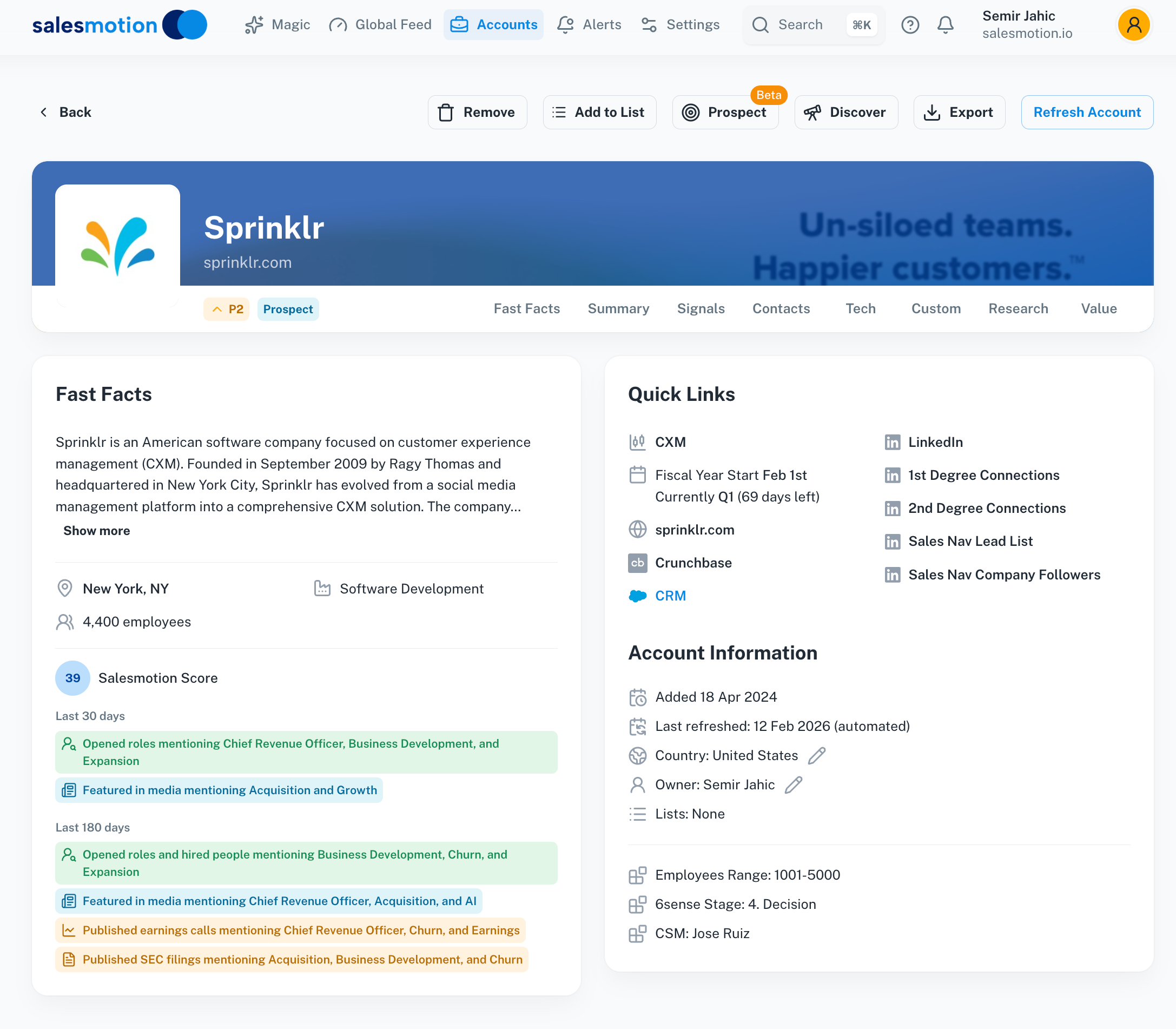 An account-level view — company profile, score, and the signals behind it — shows what is happening at the account, not just who works there.
For teams that have outgrown contact data and need account intelligence, the gap becomes clear. Platforms like Salesmotion monitor 1,000+ sources for buying signals, leadership changes, earnings insights, and competitive moves, giving reps the context they need before every conversation. With flexible account-based pricing starting at $85/month and unlimited users on team plans, the economics look very different from Lusha's credit model.
The right tool depends on your stage. If you just need emails and phone numbers for a small team, Lusha's Professional or Premium plans work. If you need to understand accounts deeply enough to sell consultatively at scale, a contact database alone will not get you there.
Salesmotion's Take
Lusha is the tool people genuinely like — the extension is fast, the lookups are clean, and for grabbing a number before a call it just works. The pattern I hear, though, is that it's "great for testing, not for selling." Reps love it for a one-off lookup and then hit the credit ceiling the moment they try to run a real motion. And the harder truth is that a phone number answers "how do I reach this person," not "why would they take my call this week." Most teams I talk to aren't short on contacts anymore — they're drowning in data and starving for action. Knowing the right account and the right reason to reach out is a different category, and it's the one we built for.

Semir Jahic
CEO & Co-Founder, Salesmotion
Lusha vs Account Intelligence: A Different Category
These platforms solve different problems, but buyers often evaluate them side by side:
| Dimension | Lusha | Salesmotion |
|---|---|---|
| Primary function | Contact data (emails, phone numbers) | Account intelligence (signals, research, context) |
| Pricing model | Credit-based plans with published monthly and annual rates | Account-based (from $85/mo, unlimited users on team plans) |
| Seat limits | Self-serve plans cover up to 5 users; larger teams go to sales | Unlimited users on team plans |
| Credit system | 1 credit/email, 5 credits/phone | No credits; unlimited account research |
| CRM integration | Salesforce, HubSpot, Zoho, Pipedrive and others | Salesforce and HubSpot integration (Enterprise plan) |
| Buying signals | 26 buying signals on named companies (funding, hiring, leadership and job changes) | 24/7 monitoring across 1,000+ sources |
| Account research | Company records, signals and ICP scoring | Deep briefs with earnings, initiatives, competitive moves |
| G2 rating | 4.3/5 | 4.8/5 |
| Free trial | Free plan (40 credits/month) | Interactive demo available |
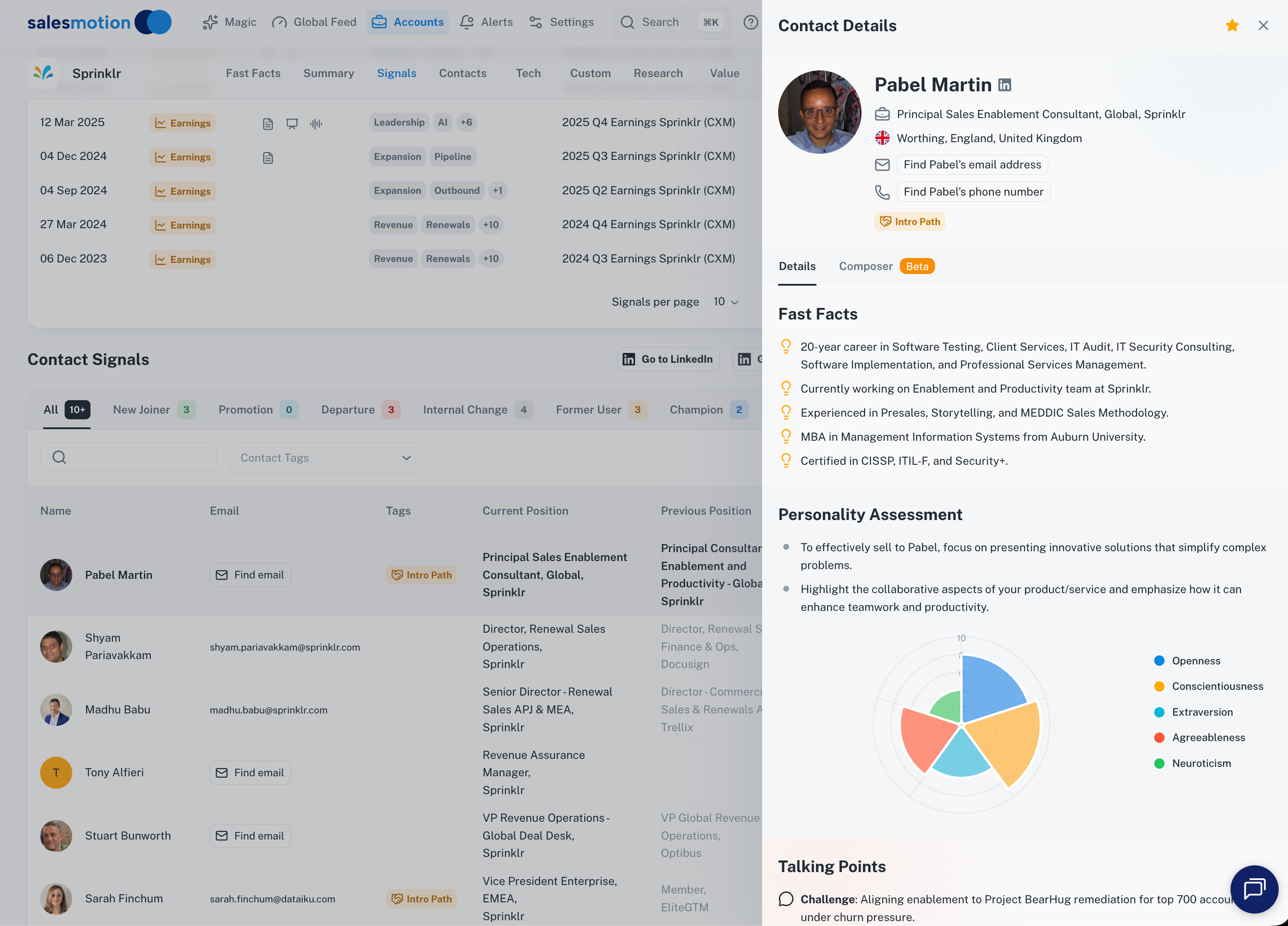 A contact record enriched with role history, talking points, and account signals — the practical difference between revealing a number and knowing why to call.
The comparison is not about which platform is "better" in absolute terms. It is about what your team actually needs. If the bottleneck is finding contact information, Lusha addresses that. If the bottleneck is knowing which accounts to prioritize and what to say when you reach them, that is a different problem entirely.
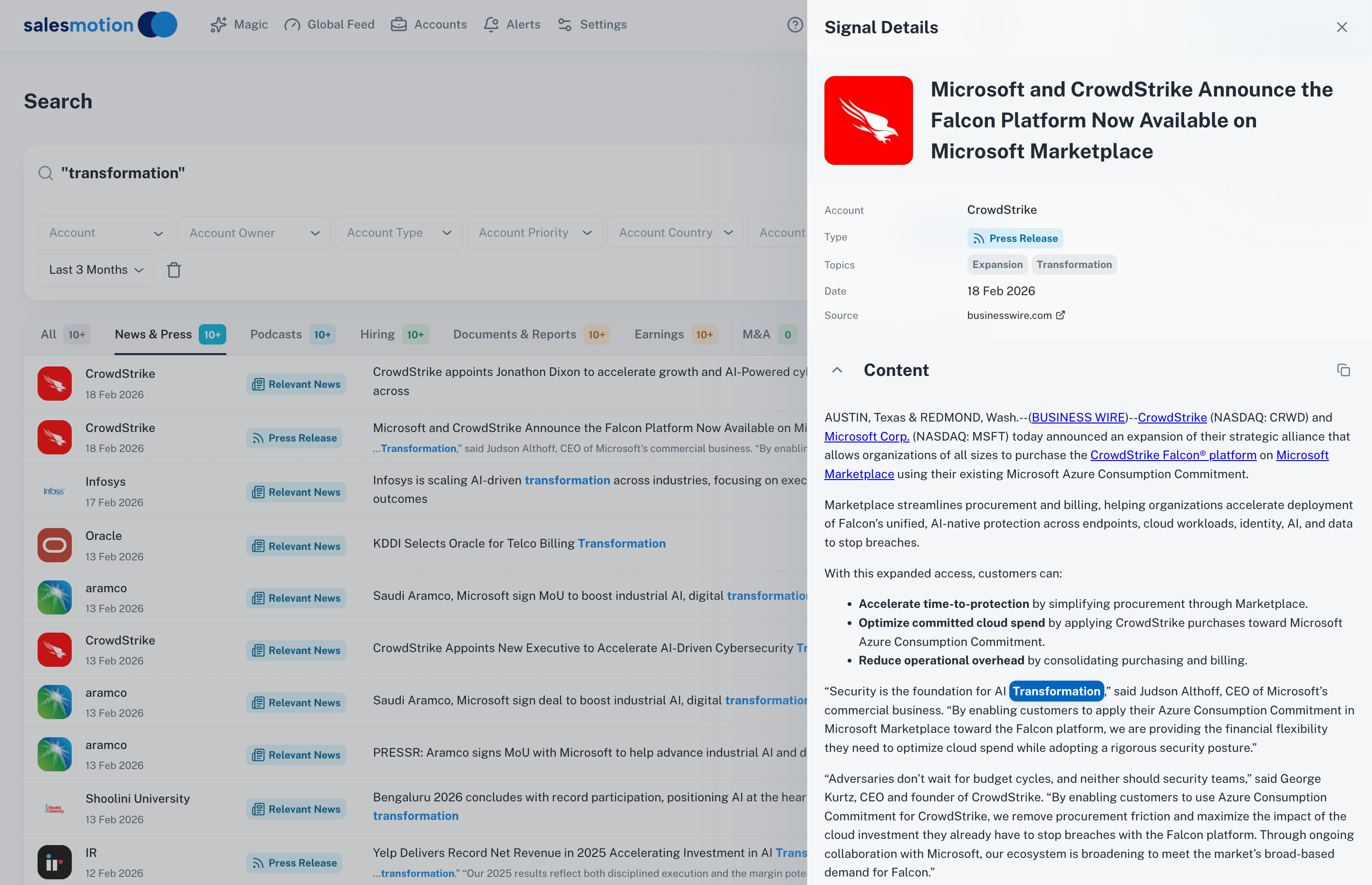 Searchable, source-cited account events like this announcement give reps a concrete reason to reach out — context that sits outside a contact database's scope.
Frequently Asked Questions
How much does Lusha cost per month?
As of October 2026, Lusha's Starter plan costs $37.45 per month on annual billing ($49.90 billed monthly) with 400 credits per month. Professional runs $52.45 ($69.90 billed monthly) with 600 credits, and Premium costs $299.95 ($399.90 billed monthly) with 3,400 credits. The Scale plan is quote-only: Vendr reports a median Lusha contract of $15,999 a year across 147 purchases.
Does Lusha have a free trial or free plan?
Yes. Lusha's pricing page lists a free plan, Lusha Free, at $0 with up to 40 credits per month, so you can try it without paying. This includes the browser extension and basic company data. The free plan is useful for testing Lusha's data quality against your target market, but the low credit limit is not sufficient for team-based prospecting or outbound campaigns.
Is Lusha cheaper billed monthly or annually?
Lusha is cheaper on annual billing. Starter is $37.45 a month billed annually ($449.10 a year) against $49.90 billed monthly, Professional is $52.45 ($629.10 a year) against $69.90, and Premium is $299.95 ($3,599.10 a year) against $399.90. On monthly plans, unused credits roll over up to twice the plan's credit limit; on annual plans they reset at the end of the annual cycle.
How does the Lusha credit system work?
Every contact data reveal consumes credits: 1 credit for an email address and 5 credits for a phone number under Lusha's published rates. Revealing both for the same contact costs up to 6 credits. Monthly plan credits can roll over up to twice your monthly limit. Annual plans front-load all credits at purchase, and unused credits expire at the end of the year with no rollover.
Is Lusha worth it?
Lusha is worth it if your bottleneck is contact data: small teams running targeted, email-first outbound get competitive data quality and a genuinely easy browser extension at a published price. It is harder to justify for phone-heavy prospecting (5 credits per number drains allocations five times faster than emails) or for teams that want cited account research on which accounts to prioritize and why. For account prioritization and research, compare Lusha alternatives before committing to an annual plan.
Is Lusha better than ZoomInfo?
Lusha and ZoomInfo serve similar markets but at different price points — see our ZoomInfo vs Lusha comparison for a full breakdown. Lusha is generally more affordable for small teams, with paid plans starting at $37.45 per month on annual billing. ZoomInfo does not publish list pricing: Vendr reports a median contract of $33,500 a year based on 1,576 purchases. ZoomInfo targets mid-market and enterprise buyers with a broader platform. You can also compare Apollo vs Lusha and Cognism vs Lusha. Lusha's G2 rating is 4.3/5 against ZoomInfo's 4.5/5.
Can I use Lusha without an annual contract?
Yes. Lusha's Starter, Professional, and Premium plans offer monthly billing at $49.90, $69.90, and $399.90 per month, about a third more than annual billing. Scale is quoted by Lusha's sales team. Monthly plans offer credit rollover (up to twice your monthly limit), while annual plans reset unused credits at the end of the annual cycle.