Enterprise sales teams spend tens of thousands of dollars a year on intent data and still walk into calls cold. The problem is not a lack of signals. It is a lack of the right signals. Traditional intent data tells you that someone at a target account searched for a topic related to your category. Management intent data tells you that the CEO just told analysts on an earnings call that the company is shifting its entire go-to-market strategy. One of those signals gets ignored by reps. The other starts a real conversation.
TL;DR: Traditional intent data flags broad topic interest but rarely translates into pipeline because reps cannot act on vague, anonymized signals. Management intent, the strategic signals that come from earnings calls, executive statements, and published initiatives, gives reps the specific context they need to open doors at enterprise accounts.
Why Does Traditional Intent Data Keep Failing Enterprise Teams?
The pitch is simple: buy intent data, learn which accounts are in-market, and close more deals. The reality is different. In DemandScience's 2026 State of Performance Marketing Report, 87% of organizations said their marketing investments yield unreliable or inflated intent signals, and only 26% of "intent" signals converted to qualified opportunities. That is a staggering gap between promise and performance.
The core issue is not the technology itself. It is what traditional intent data actually measures. Most providers track third-party content consumption across publisher co-ops: someone at Company X read an article about "cloud security." That is the signal. No name, no role, no context about why they were reading, and no way for a sales rep to turn that into a meaningful outreach.
For enterprise sales teams calling on Fortune 500 accounts, this creates a fundamental mismatch. A rep preparing for a meeting with a CFO needs to understand that company's strategic priorities, not that an anonymous employee browsed a whitepaper. As one sales leader put it during a recent conversation: "Intent was too unspecific. It was a blackbox." We wrote up that conversation and two others that shaped how we see account intelligence.
Why Reps Stop Trusting Intent Data
The trust problem compounds quickly. When a rep acts on a traditional intent signal and the prospect has no idea what they are talking about, the rep loses confidence in the data. Within a few months, even well-funded intent data investments end up unused.
The ROI numbers reflect it. In Intentsify's State of Intent Data 2024 survey, only 24% of respondents reported exceptional ROI on their intent data investment. Part of the reason is that topic data does not map to how enterprise sellers actually work. Enterprise selling is about understanding a company's strategic direction, its leadership priorities, and the business pressures that create urgency. Topic-level browsing data cannot deliver any of that.
What Is Management Intent and How Is It Different?
Management intent is a fundamentally different category of signal. Instead of tracking anonymous web browsing, it captures what company leaders are saying publicly about their priorities, challenges, and investment plans.
These signals come from sources that traditional intent providers largely ignore:
- Earnings calls and investor presentations: When a CEO tells analysts "we are doubling our investment in digital transformation," that is a declared strategic priority. It is public, attributable, and directly relevant to sellers whose products support digital transformation.
- Executive podcast appearances and conference talks: Leaders increasingly share strategic thinking on podcasts, panels, and industry events. A CTO discussing plans to consolidate their tech stack on a podcast is a signal worth acting on.
- SEC filings and annual reports: These documents contain explicit statements about risk factors, strategic initiatives, and capital allocation plans. A mention of "sales productivity" in a 10-K filing tells you where the company is spending money.
- Leadership changes and executive hires: When a company hires a new VP of Revenue Operations, that signals an upcoming shift in how they run their go-to-market motion. The new hire's background tells you which direction.
- Published strategic initiatives: Press releases about new market entries, product launches, or restructuring all indicate where a company is heading and what they will need.
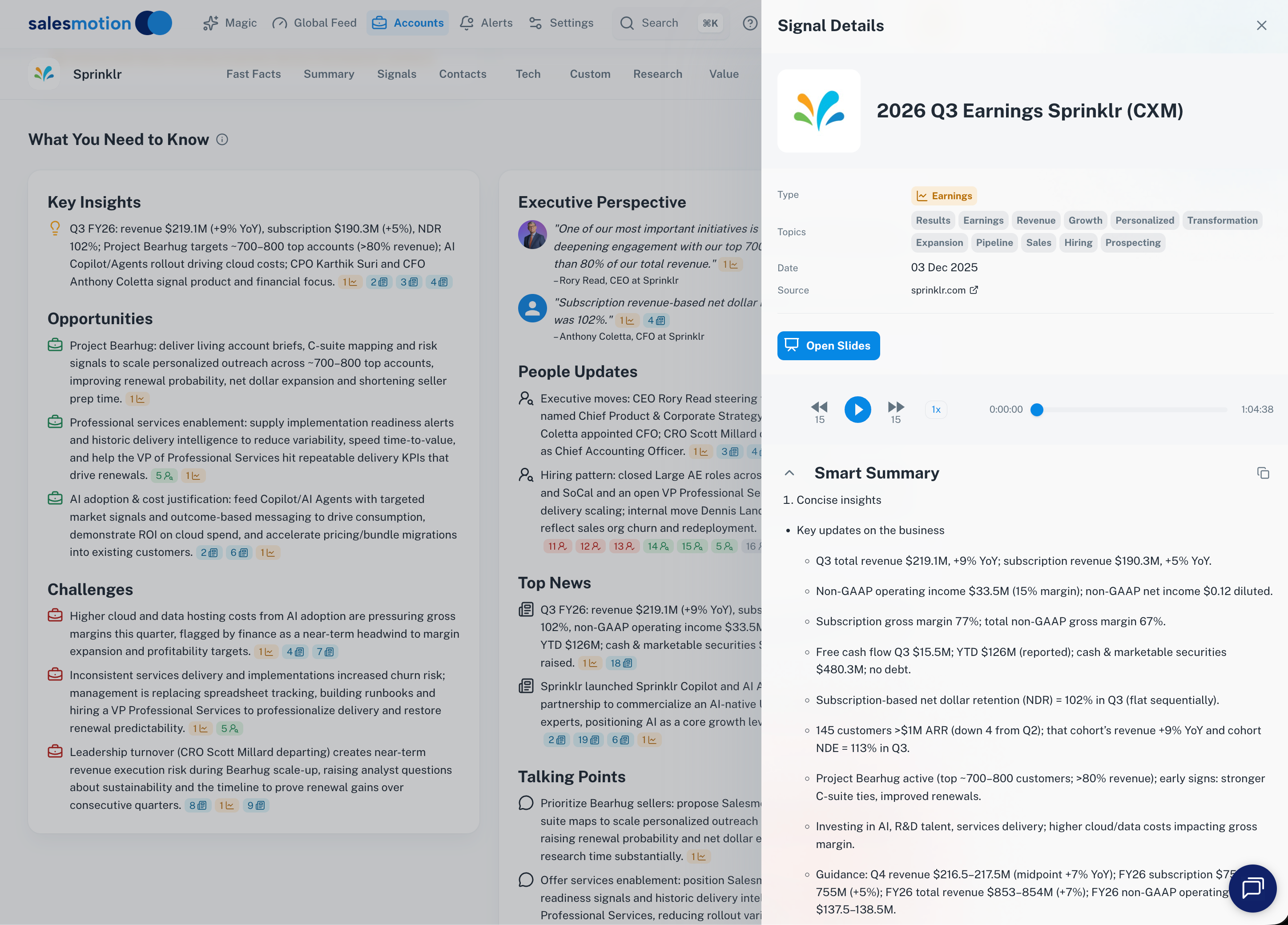 Management intent extracted from earnings calls: CEO commentary on strategic priorities, automatically linked to your account brief.
The critical difference: management intent is specific, attributable, and verifiable. A rep can reference exactly what was said, by whom, and when. That transforms cold outreach into a relevant business conversation.

“The talking points are gold. If they're in Salesmotion, I know they're being discussed inside that business. That makes it easy to spark a real conversation, which is 90 percent of the battle.”
Andrew Giordano
VP of Global Commercial Operations, Analytic Partners
The Gap Between "In-Market" and "Ready to Talk"
Traditional intent providers have built their entire value proposition around the concept of "in-market" accounts. The problem is that "in-market" as defined by topic-level browsing data is too broad to be useful for enterprise sales.
Consider the difference in practice:
Traditional intent signal: "Acme Corp is showing high intent for 'sales enablement' based on increased content consumption this week."
A rep receiving that signal has almost nothing to work with. Which division? Which leader? Why now? What specific problem are they trying to solve? The rep still needs to do hours of manual research before making a call.
Management intent signal: "Acme Corp's new CRO mentioned on last quarter's earnings call that the company is investing in 'rep productivity tools to reduce ramp time for new hires,' and they posted 12 new sales roles in the past 30 days."
Now the rep knows who cares (the CRO), what they care about (rep productivity and ramp time), why it matters now (they are hiring aggressively), and what to say in the opening line of an email or call. That is the difference between a signal and a conversation starter.
This distinction matters more as deal sizes grow. For a $5,000 software purchase, a topic-level intent signal might be enough. For a $100,000+ enterprise deal with a six-month sales cycle, reps need the kind of strategic context that only management intent provides.
Teaching Business Acumen at Scale
One of the most underappreciated benefits of management intent is that it solves a persistent sales enablement challenge: business acumen. Enterprise reps need to understand their prospect's business well enough to have a peer-level conversation with a VP or C-suite executive. Traditionally, that knowledge took years to develop.
As one revenue leader described it: "It is hard to find that kind of context and teach every rep to have the business acumen to walk into those conversations prepared."
When management intent signals are delivered with context, such as a summary of what the CEO said on an earnings call plus the specific strategic initiatives they highlighted, even a relatively junior rep can walk into a meeting sounding informed. The platform does the business research that used to require a decade of industry experience.
A Concrete Workflow: From Signal to Booked Meeting
Here is how management intent works in practice, from trigger to booked meeting:
-
Trigger: A target account's CFO states on a quarterly earnings call that the company plans to "reduce vendor sprawl and consolidate tools in our go-to-market tech stack" over the next two quarters.
-
Platform detection: Salesmotion identifies this as a strategic initiative signal, surfaces it in the rep's account feed, and generates a brief summarizing the CFO's statement alongside related signals (three recent GTM tool job postings, and a new VP of Sales Operations who used your product at a previous company).
-
Rep action: The rep opens the account brief, reads the earnings call summary and talking points, and drafts a personalized email referencing the CFO's public comments about tool consolidation. The email connects that priority directly to how the product helps.
-
Outcome: The prospect responds because the outreach demonstrates genuine understanding of their business priorities, not a generic "I saw you were interested in our category." The meeting gets booked because the rep proved they did the homework before reaching out.
This workflow replaces 3 hours of manual research (reading earnings transcripts, scanning LinkedIn, searching news) with a 5-minute review of a pre-built account brief. Across a team of 20 reps working 50+ accounts each, that is the difference between reactive pipeline and proactive, strategic outreach.
How to Evaluate Management Intent vs. Traditional Intent
Not every team needs to abandon traditional intent data entirely. But enterprise teams selling complex, high-value solutions should understand where each type fits.
| Factor | Traditional Intent Data | Management Intent |
|---|---|---|
| Signal source | Third-party content consumption (publisher co-ops) | Earnings calls, filings, news, exec statements |
| Attribution | Anonymous (company-level at best) | Named executives with specific statements |
| Actionability | Low: rep must research context manually | High: context is built into the signal |
| Best for | Top-of-funnel awareness, marketing campaigns | Enterprise sales, strategic account planning |
| Rep trust | Erodes quickly without clear context | High: reps can verify the source themselves |
| Time to act | Hours of additional research needed | Minutes: talking points included |
For teams already using a traditional intent data provider, management intent fills the gap between knowing an account is "in-market" and knowing what to say when you call. The two approaches can complement each other: traditional intent for broad awareness, management intent for sales execution.
To understand the full spectrum of signals available, our guide to buying signals in sales breaks down every category from behavioral triggers to corporate events.
What Salesmotion Actually Monitors: The Signal Taxonomy
A common question from teams evaluating account intelligence platforms: is this really different, or just a fancier version of basic intent data? Here are the signal categories in Salesmotion's standard catalogue, monitored across 1,000+ public sources and grouped by type.
Financial and Strategic Signals
- Earnings calls: each new call or transcript, with CEO and CFO statements on priorities, investments, risks and guidance summarized per account
- SEC filings (10-K): stated strategic priorities and the business challenges disclosed in risk factors
- Funding and IPOs: new funding rounds and IPO announcements
- M&A and partnerships: acquisitions, mergers, and formal partnerships, integrations or co-sell agreements
- Cost cutting and layoffs: announced savings programs, reductions in force and office closures
Leadership and People Signals
- Executive hires (CXO and VP): new leaders who often bring new vendors with them
- Promotions and new joiners: people stepping into new scope at your accounts
- Key departures: a champion or executive sponsor leaving
- Past champions: a past user or buyer of your product joining a target account
Talent and Hiring Signals
- Hiring by department: open roles in the function you sell to
- Aggressive hiring: five or more open roles, a funding or high-growth pattern
- Pain keywords and tech matches: job descriptions that mention the problems you solve or the tools in your category
- New strategic initiatives: investment in a new team or business unit
Market and News Signals
- Product launches and rebrands: new products, services or go-to-market motions
- Customer wins and awards: evidence the account's own go-to-market is working
- Competitive signals: a competitor mentioned in posts, reviews or filings
- Security incidents: outages or breaches that force a vendor review
- Expansion: new offices and new markets
Beyond the standard catalogue, teams can add custom signals for anything detectable in public sources, such as a CFO talking about "vendor rationalization" on an earnings call. The key differentiator versus traditional intent data: every one of these signals is attributable (you know who said it or what triggered it), verifiable (you can check the source), and actionable (the Research Agent builds a brief with talking points before you pick up the phone). Salesmotion's Signal Agent delivers them to the rep without anyone having to go and look.
For teams still relying on anonymous topic-level browsing data, the gap is not incremental. It is categorical.
Making the Shift: What Enterprise Teams Should Do Next
Moving from traditional intent to management intent does not require ripping out your entire tech stack. It starts with recognizing that enterprise selling demands a different quality of signal.
Start with your highest-value accounts. Pick your top 50 strategic accounts and ask: do we know what their CEO said on the last earnings call? Do we know their published strategic initiatives? If the answer is no, you have a management intent gap.
Audit your current intent data ROI. Look at the last six months. How many deals were actually sourced or influenced by traditional intent signals? If the answer is "we are not sure," that is the problem. Only 24% of respondents in Intentsify's 2024 survey reported exceptional ROI from intent data, and vague signals that cannot be traced to revenue are a likely reason.
Equip reps with strategic context, not just alerts. The goal is not to send reps more notifications. It is to give them the kind of insight that used to require hours of research: what a company's leadership is focused on, what business pressures they are responding to, and what language they use to describe their priorities.
Teams that have made this shift report measurable results. Reps at companies like Analytic Partners describe getting 80-90% of the context they need in 15 minutes, a dramatic improvement over the hours previously spent assembling account research from scattered sources.
Key Takeaways
- Traditional intent data tracks anonymous content consumption and rarely gives enterprise reps enough context to start meaningful conversations, and 87% of organizations in DemandScience's 2026 survey called their intent signals unreliable or inflated.
- Management intent captures what company leaders publicly state about their strategic priorities through earnings calls, filings, conference talks, and published initiatives.
- The critical difference is attribution and specificity: management intent signals are tied to named executives making verifiable statements, not anonymous browsing behavior.
- Enterprise reps need strategic context to sell at the executive level, and management intent delivers that context without requiring years of industry experience.
- Start by auditing your top 50 accounts for management intent gaps, then measure whether your current intent data investment is actually traceable to closed revenue.
Frequently Asked Questions
What is the difference between management intent and buyer intent?
Buyer intent broadly refers to any signal that a company may be interested in purchasing a solution, including website visits, content downloads, and topic-level research. Management intent is a specific subset focused on strategic signals from company leadership: earnings call statements, published initiatives, executive hires, and public filings. The distinction matters because management intent signals are attributable to specific decision-makers and reflect organizational priorities, not just individual browsing behavior.
Can management intent data replace traditional intent data?
Management intent and traditional intent serve different purposes. Traditional intent is useful for broad top-of-funnel awareness and marketing campaign targeting. Management intent is most valuable for enterprise sales execution where reps need strategic context to engage senior buyers. Most high-performing teams use both: traditional intent to identify which accounts are researching a category, and management intent to understand why specific accounts are ready for a conversation and what to say.
How do sales reps actually use management intent in their daily workflow?
Reps typically receive management intent as part of an account brief that includes a summary of recent executive statements, strategic initiatives, and related signals like leadership changes or hiring patterns. Before a call or email, the rep reviews the brief to identify a specific talking point, such as a CEO's earnings call comment about expanding into a new market. That talking point becomes the hook for personalized outreach that demonstrates understanding of the prospect's actual business priorities rather than generic product pitching.
What tools track management intent from earnings calls and executive signals?
Salesmotion is purpose-built for management intent tracking. Its Signal Agent monitors earnings calls, SEC filings, executive commentary, leadership changes, and strategic initiative announcements across 1,000+ public sources. When a CFO mentions "sales transformation" on an earnings call or a company announces a new go-to-market strategy, Salesmotion surfaces the signal and generates an account brief explaining why it matters. Other tools that touch adjacent areas: AlphaSense provides financial research and earnings analysis (built for research, strategy and investment teams), and 6sense provides predictive intent data, a different signal type from management intent. For a comparison of signal types across platforms, see our buying signals software guide.
How is Salesmotion different from intent data providers for management intent?
Salesmotion is a B2B sales intelligence platform built to extract management intent signals, meaning strategic direction from executive statements, earnings commentary, SEC filings and published initiatives, as a core product capability. Intent data providers such as Bombora measure topic-level research activity, which tells you a company is researching a topic. Salesmotion fills the gap between "this company is in-market" and "here is what their leadership is prioritizing and why you should reach out now," with the source behind every signal.