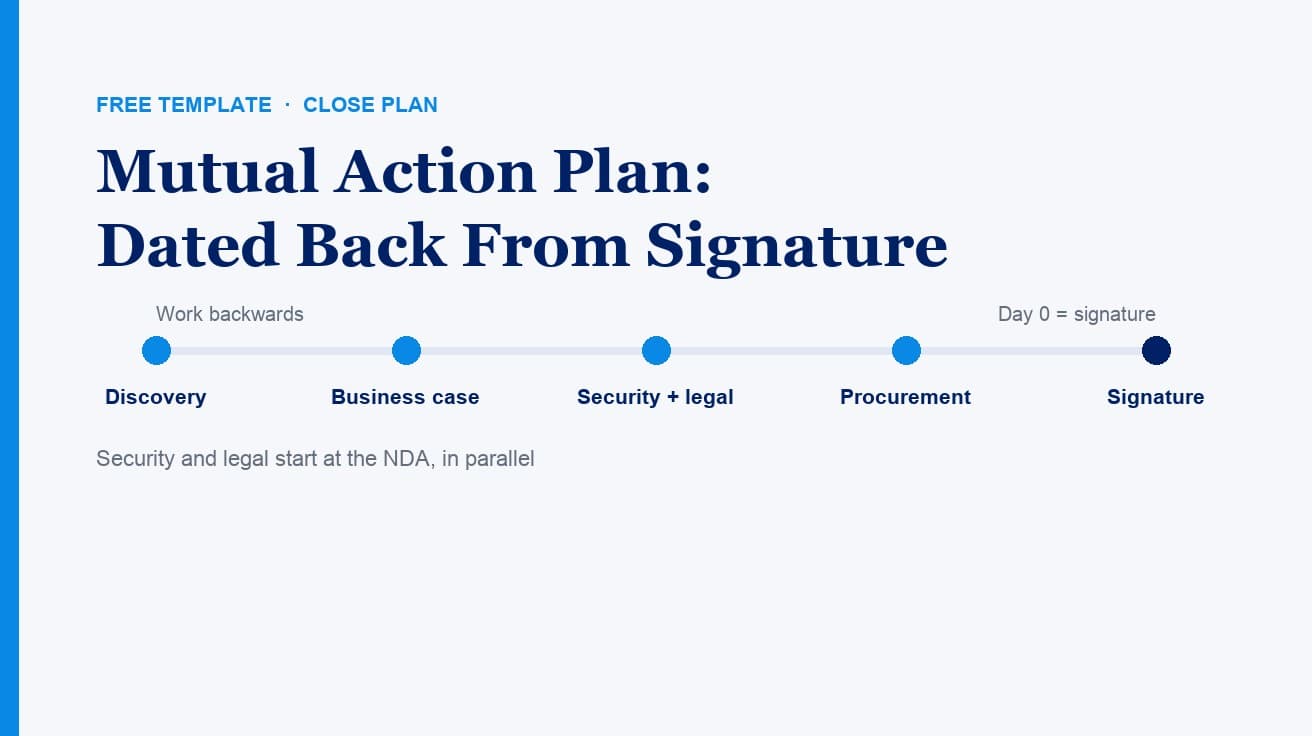
A mutual action plan (MAP) is a shared, dated list of every step the buyer and seller must complete between today and a signed contract, with an owner for each step. It is built backwards from the signature date, not forwards from today, and the buyer agrees to it. If the steps do not fit before the close date, the close date is wrong.
TL;DR: Start from the date the buyer needs the outcome, subtract the paper process (security, legal, procurement, budget approval, signature), and only then schedule evaluation steps. Put a buyer-side owner on every line. Start security and legal right after the NDA, in parallel with the evaluation, because that is where close dates slip. Download the template below.
What is a mutual action plan?
A mutual action plan, also called a close plan or mutual success plan, is a timeline the seller and buyer build together. It lists the decisions, reviews and approvals needed to reach a signed contract and a successful start, with a date and an owner for each. The word that matters is mutual. A plan that only lists your activities ("send proposal", "follow up") is a to-do list. A MAP is mostly the buyer's steps.
It does three jobs:
- It turns a close date into a sequence of events the buyer has agreed to, so a slip shows up weeks early instead of in the last week of the quarter.
- It surfaces the paper process (who signs, which reviews, what procurement needs) while there is still time to run it.
- It gives your champion a document to sell with. A dated plan is easier to forward to a boss than a proposal.
Why do close dates slip?
Most slips happen after the buyer has said yes in principle. The evaluation goes well, then the deal sits in legal, security or procurement for weeks nobody planned for. What should be a day or two becomes a week or two, because nobody asked who reviews the contract, how long the security questionnaire takes, or which budget the money comes from.
The other common cause is a close date that came from the seller's calendar. A deal dated to the last day of your quarter, with no buyer event behind it, is a forecast entry, not a plan. Gartner puts a complex B2B buying group at six to ten decision makers (via Salesloft), and every one of them can add a step you did not schedule.
How do you build a mutual action plan backwards from signature?
Six steps. The downloadable template has the rows pre-built.
1. Anchor on the buyer's date, not yours. Ask what has to be true, and by when, for the project to count as a success. Go-live before a peak season, a contract that expires, a budget that closes at fiscal year end, a board commitment. The guide to compelling events explains how to test the date.
2. Subtract the start-up time. If the buyer needs results by a date, the contract has to be signed early enough to implement. Work out the go-live lead time first, then put the signature date before it.
3. Map the paper process from the purchase order backwards. Ask: "Walk me through the last time you bought software of this size. Who signed, which reviews did it go through, and how long did each take?" Write down every step: security review, legal review, data protection, procurement onboarding, budget approval, signature authority.
4. Run security and legal in parallel, starting at the NDA. Send the security pack and your standard terms as soon as the NDA is signed. Treat them as streams that run alongside the evaluation, each with its own owner, not as gates that start after the buyer chooses you.
5. Schedule the evaluation into what is left. Demos, workshops, a proof of concept if one is needed, the business case review. If the evaluation does not fit, either the scope shrinks or the close date moves now, while everyone can still plan for it.
6. Agree it with your champion, then with the economic buyer. Share the plan as a document the buyer can edit. Ask your champion which step they are least sure about. That step is your biggest risk.
What goes in a mutual action plan template?
| Block | Rows | Owner examples |
|---|---|---|
| Header | Desired outcome, buyer's target date and why, signature date, go-live date | Champion |
| Evaluation | Discovery complete, solution workshop, proof of concept with success criteria, references | Champion, technical owner, your SE |
| Business case | Value model built with buyer data, reviewed by finance, approved by the economic buyer | Champion, finance |
| Security and data | Questionnaire, data protection review, sub-processor check | IT security, DPO |
| Legal | Contract redlines, order form | Legal on both sides |
| Procurement | Vendor onboarding, purchase order raised | Procurement |
| Signature | Named signer and date | Economic buyer |
| After signature | Kick-off, first value milestone | Champion, your CS lead |
Keep completed steps on the page, below a line, with the date each was done. The pace at which steps get completed tells you more about the deal than any probability field.
Free Mutual Action Plan Template
A close plan dated backwards from signature, with parallel security, legal and procurement streams and a buyer owner on every line. Excel and PDF.
No email required. Includes the plan and a worked example.

“With Salesmotion, you realize just how much time you were spending on low-value tasks. Now that our team isn't drowning in manual research, they can truly focus on execution, which is priceless for a startup.”
Adam Wainwright
Head of Revenue, Cacheflow
Example: dating a plan from a public company's fiscal year
Public filings tell you something most buyers will not volunteer early: when their financial year ends. Budget approvals, spending freezes and "use it or lose it" decisions cluster around that date.
Example built from public filings, 22 October 2026. Snowflake's recent reports on SEC EDGAR:
| Filing | Period covered | Filed |
|---|---|---|
| 10-K (annual report) | Year ended 31 January 2026 | 20 March 2026 |
| 10-Q (quarterly report) | Quarter ended 30 April 2026 | 29 May 2026 |
| 10-Q (quarterly report) | Quarter ended 31 July 2026 | 4 September 2026 |
So Snowflake's financial year runs February to January, and its quarters end on 30 April, 31 July, 31 October and 31 January. A seller planning a deal funded from this year's budget would work back from 31 January, not from 31 December. With, say, four weeks for legal and procurement and two for security in parallel, the business case needs the economic buyer's approval by early December, and the evaluation has to finish in November. A plan that assumed a calendar year would have the buyer approving the spend after their own deadline.
The same filings carry the risk factors and the strategy language management uses, which belongs in the business case row. The annual report guide for sellers shows where to look.
How do you introduce a mutual action plan without sounding scripted?
Introduce it as help, after the buyer has agreed there is a problem worth solving, never in a first meeting. Three lines that work:
- "Other teams like yours have told us the hard part is not choosing a vendor, it is getting the paperwork through. Can we map that now so it does not slow you down later?"
- "You mentioned this needs to be live before [their date]. If I work back from that, signature lands around [date]. Does that match how you see it?"
- "Who else needs to say yes before this is signed, and what will each of them want to see?"
If the buyer will not engage with dates at all, that is information. Interest without a timeline usually ends in no decision: Matthew Dixon and Ted McKenna found that 40% to 60% of deals are lost to customers who say they intend to buy and then do not act (HBR, 2022).
Know the buyer's calendar before you propose a close date
Salesmotion's agents read filings, earnings calls and news for every account you own, so your close plan starts from the buyer's real dates. See it in a 30-minute demo.
How do you keep a mutual action plan alive?
- Open every meeting with it. Two minutes: what was done, what is next, what moved.
- Ask "what has changed?" at the start of each call. New people, new priorities and new deadlines change the plan before they change the close date.
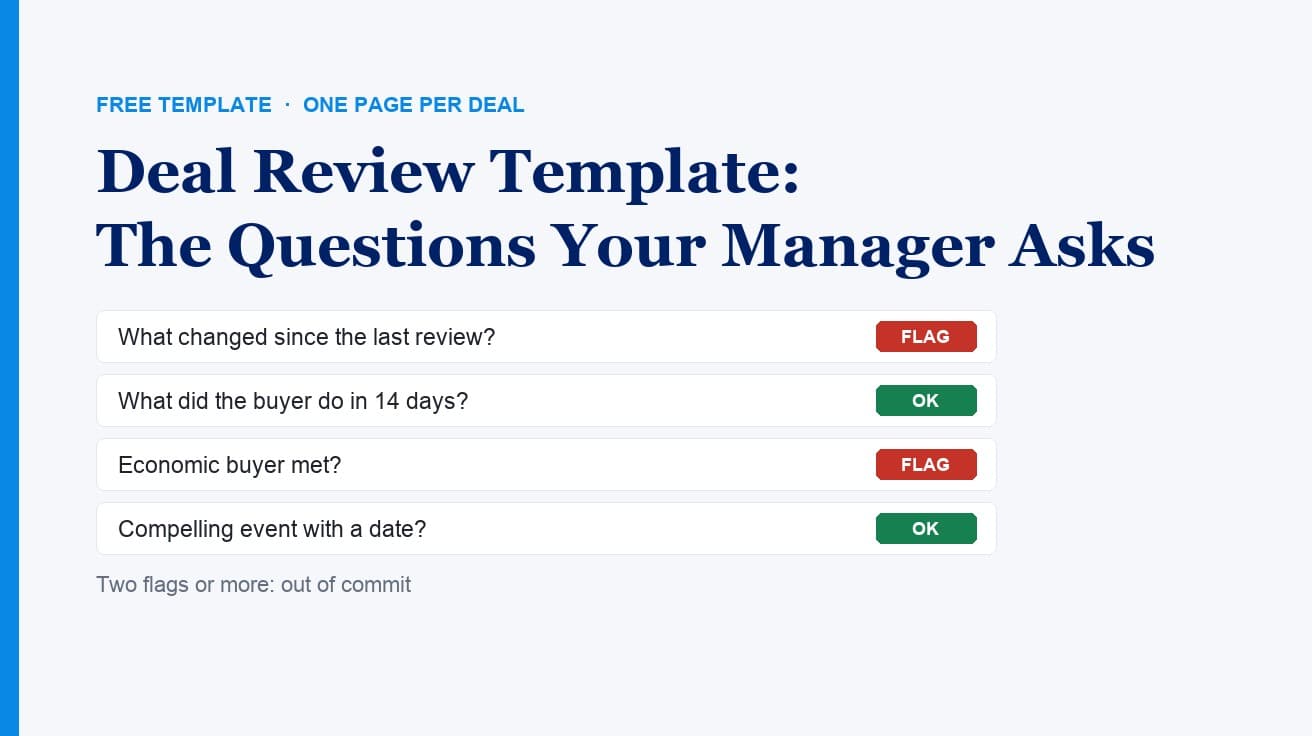
- Treat a missed buyer step as a signal, not a nuisance. One missed step is noise. Two in a row means the priority dropped, and your manager should hear it from you in the next deal review.
- Watch the account, not just the thread. A new executive, a reorganization or a cost program announced on an earnings call can stop a plan that looks healthy in your inbox.
Salesmotion's Take
It is never over until it is over, and that includes the signed contract and the issued purchase order. On every large deal the question I ask is not "what is the paper process?" but "when will you know it?" If the answer is "after they choose us", the close date is a guess.

Semir Jahic
CEO & Co-Founder, Salesmotion
Key takeaways
- A mutual action plan is a buyer-agreed sequence of steps to signature, dated backwards from the buyer's own deadline.
- Map the paper process from the purchase order back, and start security and legal at the NDA in parallel with the evaluation.
- Put a buyer-side owner on every line; a plan full of your own tasks is a to-do list.
- Public filings show the buyer's fiscal year end, which often decides when budget can be approved.
- A buyer who will not commit to dates is telling you the deal may end in no decision.
Frequently Asked Questions
What is the difference between a mutual action plan and a close plan?
They are usually the same thing. "Close plan" is often the seller's internal version kept in the CRM, while "mutual action plan" stresses that the buyer helped build it and agrees to the dates. The best close plans are mutual.
When should you introduce a mutual action plan?
After the buyer agrees there is a problem worth solving and before the evaluation starts in earnest, typically after discovery or the first solution meeting. Introducing it in a first call feels presumptuous; introducing it after the proposal is too late to run the paper process in parallel.
Should you share the mutual action plan with the buyer?
Yes. Share it as an editable document and ask the champion to correct it. A plan the buyer has never seen does not change their behavior, and the corrections they make are some of the most useful information you get in the deal.
What should a mutual action plan template include?
The buyer's desired outcome and target date, the signature and go-live dates, and dated rows with owners for evaluation, business case approval, security, legal, procurement, signature and kick-off. Keep completed steps visible with the date they were done. The free template on this page includes all of these.
How do you find a buyer's fiscal year end?
For public companies, the annual report (10-K in the US) states the period it covers, which ends on the fiscal year end. Earnings call dates and quarterly filings show the quarter ends. For private companies, ask your champion directly when budgets are set and approved.