A deal review is a 15 to 30 minute inspection of one large opportunity, run by your manager or a senior leader, that decides whether the deal stays in the forecast and what has to happen next. The rep who arrives with one written page (why now, who is in the buying group, a close plan dated backwards from signature, and the risks) gets help. The rep who arrives with a story gets questions.
TL;DR: Fill a one-page deal review sheet before every review of a deal above your size threshold. Answer six questions in writing: what changed, what the buyer did (not what you did), who you have met, whether the process was followed, what the urgent initiative is, and what the real amount is. Two red flags means the deal is at risk and should not sit in commit. Download the template below.
What is a deal review?
A deal review is a structured look at a single opportunity, usually one of the largest in a rep's pipeline, with the goal of improving the odds of winning it. It is different from a pipeline review, which scans every open deal for hygiene, and from a forecast call, which turns deals into a number. A good review ends with a dated next step, a decision on the forecast category, and a specific ask of someone senior.
Most teams run them weekly or fortnightly for deals above a size threshold, typically the top fifth of open deals by value. Below that line the cost of the meeting is higher than the risk it removes.
What questions will your manager ask in a deal review?
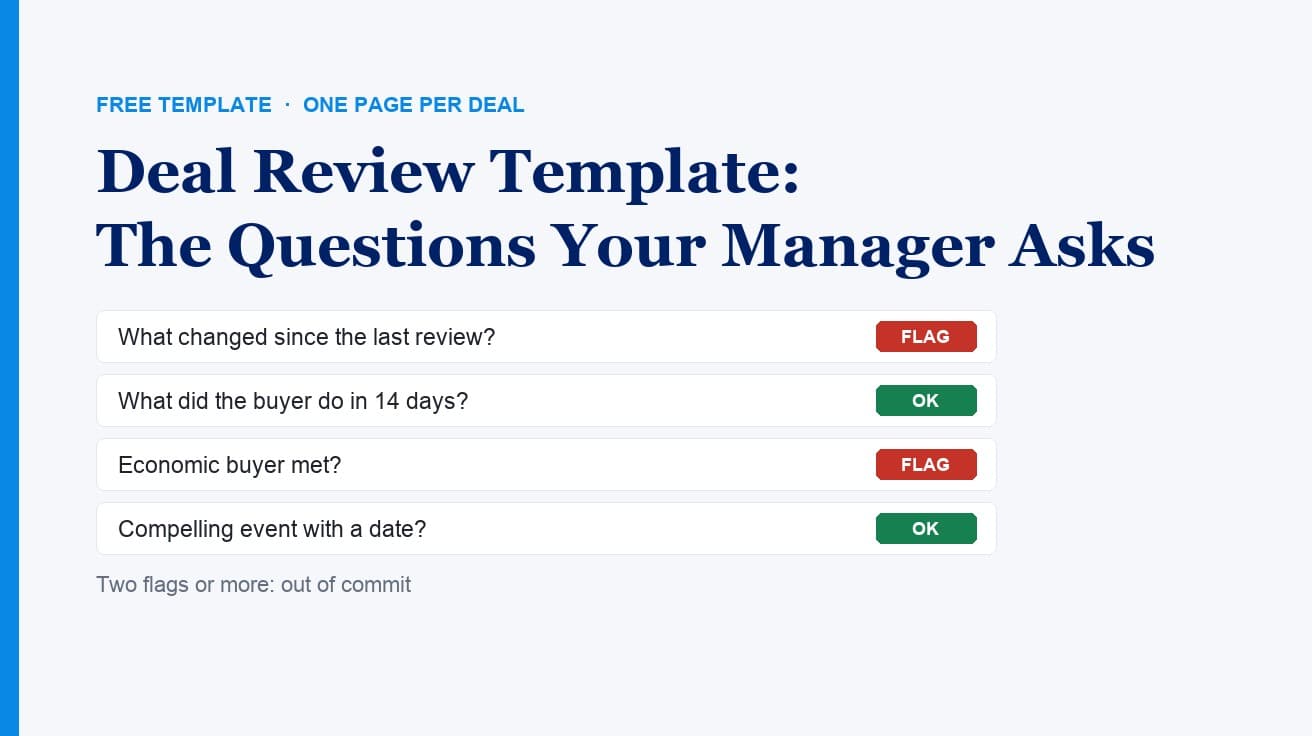
Almost every serious deal inspection comes back to six questions. Salesloft published a version of the list that many revenue teams still use: what has changed since the last meeting, how much activity there is and whether it is the right type, whether the team is building healthy relationships, whether the deal follows the sales process, whether it is tied to an urgent initiative, and what the real revenue is (Salesloft, 2022).
Here is what each one is really testing, and the answer that ends the discussion quickly:
| Question | What it tests | A strong answer sounds like |
|---|---|---|
| What changed since last time? | Whether the deal is moving at all | "Their CFO joined the second call and asked for a payback model by the 14th." |
| What did the buyer do? | Two-way activity, not your emails | "They booked the security review and sent their questionnaire." |
| Who have we met? | Coverage of the buying group | "Champion, economic buyer once, IT owner twice. Procurement not yet." |
| Did we follow our process? | Qualification evidence | "MEDDPICC fields complete except paper process, which I learn on Tuesday." |
| What is the urgent initiative? | A compelling event with a date | "Their current contract auto-renews on 31 March at a higher price." |
| What is the real amount? | Whether the value is the deal or the hope | "The proposal is for two business units. The other four are expansion, not this deal." |
"No change" is a legitimate answer, but it is a coaching point. A large deal that sounds the same for three reviews running is usually stalled, and the honest move is to say so before your manager does.
Which red flags put a deal at risk?
Score the deal against six flags before the meeting. Two or more flags means the deal is at risk and should come out of commit until they clear. This is a rule of thumb, not a statistic, but it forces the conversation onto evidence.
- Nothing changed since the last review.
- No reply or meeting from the buyer in the last two weeks. A month of silence is a watch; two months is a stale deal.
- Economic buyer not met, or only one contact engaged.
- Qualification fields blank or stage exit evidence missing.
- No compelling event with a date. If the buyer has no reason to act by a date, the close date is yours, not theirs.
- Close date or amount moved twice this quarter, or three pushes in total.
Flags 2, 3 and 5 are where account research changes the answer. A deal can look quiet in your inbox while the account is loud in public: a new executive, a reorganization, a cost program announced on the earnings call. That is the next section.
What should go on a one-page deal review sheet?
Five blocks, in this order. The downloadable template has all five with the flags pre-built.
1. Why this deal, why now (three lines). The business problem in the buyer's words, the compelling event and its date, and what happens to the buyer if they do nothing. If you cannot write the third line, you do not have a deal yet. The guide to compelling events shows how to test one.
2. The buying group. One row per role: economic buyer, champion, technical or security owner, procurement or legal, users. For each: met or not, stance (champion, neutral, blocker), and who on your side owns the relationship. Gartner puts a complex B2B buying group at six to ten decision makers (via Salesloft), so a table with two names in it is a finding. The economic buyer guide and multi-threading cover how to fill the gaps.
3. The business case. The value in numbers as the champion will present it internally, whether the champion has a one-page version they can forward, the alternatives the buyer is weighing (including doing nothing), and why you, in one sentence the buyer would use.
4. The close plan, dated backwards from signature. Technical and security sign-off, business case approved, commercial terms, legal and procurement, signature. Each step has an owner on the buyer side and a date. The mutual action plan template goes deeper on this block.
5. Decisions from this review. The next step with a date, the executive or sales engineer ask, the forecast category after the review, and the date of the next review.
Free Deal Review Template
The one-page sheet: why now, buying group, business case, reverse-dated close plan and the six-flag inspection. Excel and PDF.
No email required. Includes the sheet and a filled example.

“We're no longer fishing. We know who the right customers are, and we can qualify them quickly. Salesmotion has had a direct impact on pipeline quality.”
Andrew Giordano
VP of Global Commercial Operations, Analytic Partners
Which questions do senior leaders ask on the biggest deals?
Front-line managers check the six questions. A VP or CRO joining a review of a top-ten deal tends to go one level higher. Expect some version of these:
- Who sits above the decision maker? Titles like "transformation director" are often temporary project roles. The person who signs may be one level up and has never heard your name.
- Has our executive spoken to theirs? If your sales leader called the buyer's boss today and the answer were "who is this?", the deal is not ready to forecast this quarter.
- What are the politics? Who wants this to fail, and why? Which competing project is fighting for the same budget?
- Is the decision about must-haves or about extras? A deal decided on the margins is a deal decided on price.
- What does the annual report say? If the problem you solve is not connected to anything management has said publicly, the economic buyer will struggle to fund it.
- When will you know the paper process? Not "what is it", but when you will know it. Legal and procurement are where close dates go to die.
You can answer three of those six from public sources before the meeting: who the executives are and what changed, what management told investors, and whether there is a dated event. The example below shows how much one filing can answer.
Example: answering "what changed?" from public filings
Example built from public filings, 22 October 2026. Nike, a large public company, filed an 8-K on 1 October 2026 announcing a multi-year enterprise program called Pace. Here is what that one filing would change on a deal review sheet for a seller with an open opportunity there:
| What the filing says | Why it matters in a deal review |
|---|---|
| A move to a three-geography operating model and further cuts to organizational layers | The buying group may be about to change. Re-map who decides and who signs, and ask your champion whether their role or reporting line moves. |
| About $2.5 billion in expected cumulative savings through fiscal 2031, before charges | Spending is being judged against a public cost target. Frame the business case around cost and productivity, not nice-to-have capability. |
| About $1.0 billion in pre-tax charges, mostly severance, roughly $0.3 billion of it in fiscal 2027 | Teams are being restructured this year. Expect slower approvals and ask what the reorganization does to your timeline. |
| Builds on a cost realignment plan announced in March 2026 | The pressure is not new. If your deal predates March, check whether the original "why now" still holds. |
Nike's fiscal year ends on 31 May (per its SEC filings), so any budget decision for the current year has a fixed end point too. None of this would reach a rep's inbox on its own. Each row changes an answer on the sheet: the buying group (flag 3), the urgent initiative (flag 5), and how the business case is framed. A rep who walks into the review with this table answers "what changed?" in one sentence and spends the rest of the meeting on the ask.
Walk into every deal review knowing what changed
Salesmotion's agents watch your accounts across 1,000+ public sources and brief you on what moved. See it on your own deals in a 30-minute demo.
How do you prepare for a deal review in 20 minutes?
- Pull the account's last 30 days of signals and news. Note anything that changes who decides, what they care about, or when.
- Update the buying group table. Mark who you have met since the last review. If the list has not changed in a month, say so.
- Rewrite the "why now" line. If the compelling event has moved or vanished, the close date probably has too.
- Check the close plan against today's date. Any step past its date without being done is a slip, and the review should hear it from you.
- Write one ask. "I need our VP to call their COO before the 10th" is an ask. "Any help is welcome" is not.
- Score the six flags honestly. If you have two, propose moving the deal out of commit yourself. Managers trust reps who downgrade their own deals.
Salesmotion's Take
The best deal reviews I have sat in were short, because the rep had already written down the risk. There is always risk in a large deal. The rep who names it gets help with it. The rep who hides it gets a fire drill in week twelve.

Semir Jahic
CEO & Co-Founder, Salesmotion
Key takeaways
- A deal review inspects one large opportunity to raise the odds of winning it; it is not the forecast call.
- Six questions cover almost every review: what changed, buyer activity, relationships, process, urgency, real amount.
- Two or more red flags means the deal is at risk and should leave commit until they clear.
- Senior leaders go one level higher: who sits above the decision maker, executive-to-executive contact, politics, the annual report, the paper process.
- Public signals answer "what changed?" and "why now?" before the meeting starts.
Frequently Asked Questions
What is the difference between a deal review and a pipeline review?
A deal review inspects one opportunity in depth to improve the chance of winning it. A pipeline review scans all open deals for hygiene: stale deals, past close dates, missing amounts and new large deals. Most teams run the pipeline review weekly for the whole team and deal reviews only for opportunities above a size threshold.
How often should you run deal reviews?
Weekly or fortnightly for the largest open deals, usually the top fifth by value, and always before a deal moves into commit. Smaller deals are better covered in one-to-ones and the weekly pipeline review.
Who should attend a deal review?
The account executive who owns the deal, their manager, and the sales engineer if one is involved. For the largest deals add a senior sales leader, because many of the useful outcomes are executive asks, such as a call to the buyer's boss.
What is a deal review template?
A deal review template is a one-page sheet the rep fills before the meeting. It covers why the buyer must act now, the buying group, the business case, a close plan dated backwards from signature, a set of red flags the manager scores, and the decisions from the review. The free template on this page includes all six parts.
How does account intelligence help in a deal review?
It answers the questions a rep cannot answer from the CRM: what changed at the account, who joined or left the leadership team, what management told investors and whether there is a dated event driving the decision. Tools like Salesmotion collect those signals from public sources and summarize them per account.