
I talk to sales leaders almost every day. Different industries, different deal sizes, different team structures. The pattern is always the same. Pipeline is the number one problem. Inbound is softer than it used to be. And outbound, despite years of investment in tools and headcount, is not producing what it should.
I have a strong opinion on why. Most teams have built two thirds of the outbound stack and left the most important layer untouched. They have data. They have execution. They are missing the part that determines whether a prospect actually replies.
TL;DR: The outbound stack has three layers: data, execution, and intelligence. Most teams have solved the first two and left the third empty. Intelligence, the ability to know why a specific prospect should care about your message at this specific moment, is what separates a 3% reply rate from a 15% reply rate. It is the missing layer for most B2B sales teams in 2026.
The Three Layers of an Outbound Sales Strategy
Here is the framework I keep coming back to in every conversation with sales leaders. Every outbound function, whether it is one SDR or fifty, runs on three layers.
Layer 1: Data. Who to target. Contact info, firmographics, ICP fit. Tools like Apollo, ZoomInfo, and Leadsforge cover this well. Data became a commodity years ago. Every vendor has 200 million contacts. The differentiator is no longer access to data.
Layer 2: Execution. How to reach them. Sequences, deliverability, multi-channel cadences. Salesforge, Lemlist all handle this. Infrastructure is solved. With modern warmup tools and unlimited sender accounts, anyone can build a clean sending setup in an afternoon.
Layer 3: Intelligence. Why to reach them now. The reason this specific prospect should care about this specific message at this specific moment. This is the layer most teams are missing entirely.
| Layer | What it does | Status in 2026 |
|---|---|---|
| Data | Who to target: contacts, firmographics, ICP fit | Solved |
| Execution | How to reach them: sequences, deliverability, multi-channel | Solved |
| Intelligence | Why to reach them now: signals, context, timing, relevance | The missing layer for most teams |
The Outbound Stack
Three layers for successful outbound in 2026. Most miss the one at the top.
Intelligence
The missing layerWhich account and why now

Sprinklr CEO mentions Project Bearhug on Q3 earnings call
Earnings call analysis
CEO priorities, strategic initiatives, financial signals
Leadership changes
New hires, departures, promotions across your accounts
Deep account briefs
SWOT, talking points, value framework in one click
Hiring patterns
Role postings that reveal budget, priorities, and timing
Funding & M&A
Capital events that shift buying posture overnight
Clinical trial updates
Trial phases, site activity, regulatory milestones
Podcast appearances
Executive interviews and public commentary tracked
Compelling events
Product launches, rebrands, market expansions
Risk signals
Layoffs, cost-cutting, restructuring, and deal risk flags
Execution
SolvedHow to reach them


Data
SolvedWho to target


Most teams invest in layers 1 and 2. The top 1% invest in layer 3.
If you asked me five years ago which layer would be the hardest to crack, I would have said data. I was wrong. Data became a commodity. Execution became a commodity. The thing that still separates the top 1% of outbound teams is depth of understanding before they hit send.
See Salesmotion in action
Take a self-guided interactive tour — no signup required.
Why Outbound Is Stuck on Volume
For the past five years, most outbound advice has pointed in one direction. Send more. Add another channel. Buy more mailboxes. Warm them properly. Test more subject lines.
That advice was correct for a while. The bottleneck really was execution. But today, that bottleneck is gone. So why is pipeline still flat for so many teams?
The numbers tell the story. According to Instantly's 2026 Benchmark Report, the platform-wide average cold email reply rate sits at 3.43%. Campaigns targeting 500+ recipients see reply rates drop to 2.4%. Meanwhile, campaigns with advanced signal-based personalization, messages grounded in real account events like earnings calls, leadership changes, and hiring surges, achieve reply rates of 15-25% in mid-market and enterprise B2B sales, a 5x improvement over the generic average.
The send is fine. The message is the problem. And the message is broken because the intelligence behind it is missing.
Here is what makes this worse. According to Salesforce, sellers use an average of 8 tools to close deals, and 73% of teams report overlapping functionality. Reps are drowning in tools, spending 40% of their time just finding the right people to call, and only 30% of their week actually selling. The stack is deep on data and execution. It is almost empty on intelligence.
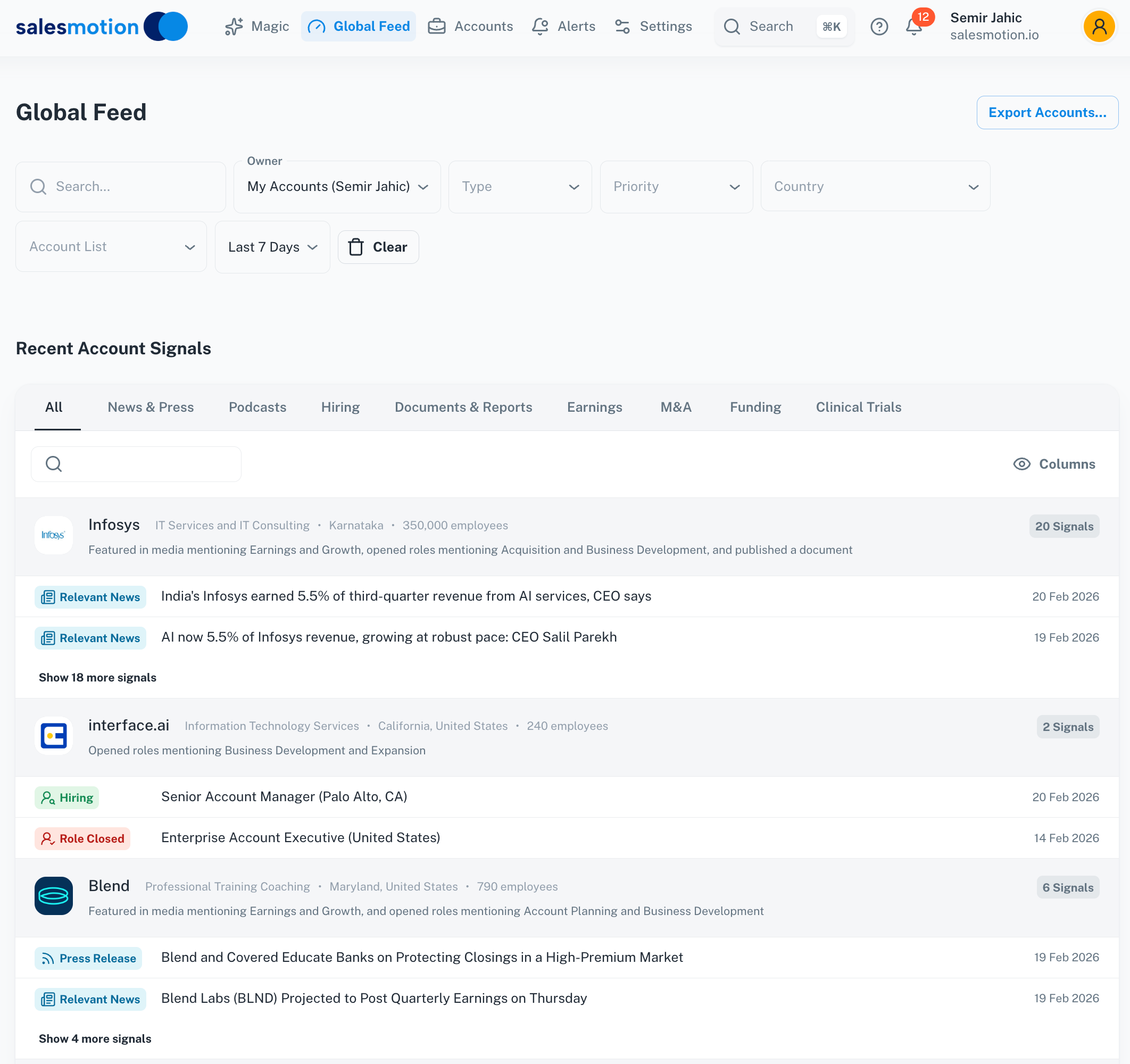 Real-time buying signals across your accounts: earnings calls, leadership changes, hiring patterns, and news, all in one feed.

“Salesmotion empowers me to cultivate a great buyer experience. I'm able to challenge prospects' thinking and be a trusted consultative seller. A major part of this is Salesmotion insights.”
Austin Friesen
Account Executive, FY25 #1 President's Club, Clari
The Intelligence Layer: What Most Teams Are Missing
The intelligence layer is not another database. It is not firmographic enrichment or contact verification. It is the continuous, real-time understanding of what is happening inside your target accounts right now.
A CEO mentions supply chain modernization as a top-three priority on an earnings call. A company posts five new SDR roles in two weeks. A VP of Sales joins from a competitor. A funding round closes. These events actually change a company's buying posture. They create windows of opportunity that open and close in weeks, not months.
The BizTech Reports' coverage of Gartner's 2026 sales survey found that 67% of B2B buyers now prefer a rep-free experience. The bar for earning a reply, let alone a meeting, has never been higher. Generic outreach does not clear that bar. Signal-grounded outreach does.
This is what the intelligence layer looks like in practice:
What gets deleted:
"Hi Sarah, I noticed Sprinklr is growing fast and wanted to see if you have a few minutes to chat about how we help teams like yours scale outbound..."
What gets a reply:
"Your CEO mentioned Project Bearhug as a top initiative on last quarter's earnings call, focused on deepening engagement with your top 700 customers. You have also posted four new enterprise AE roles in the past six weeks. Companies at that stage typically hit a vendor evaluation window within 90 days. Worth a 15-minute conversation?"
The first message is templated noise. The second is grounded in three real signals: a stated executive priority, a hiring pattern, and a timing hypothesis. The first one is what most outbound teams are sending today. The second one is what the top 1% of reps write manually for their highest-value accounts.
The challenge has always been doing that kind of research at volume. A good rep can spend 20 minutes researching one account, reading the recent earnings call, scanning LinkedIn for leadership changes, checking the careers page for hiring patterns. That same rep cannot do this for 200 accounts a week. Nobody can.
This is exactly why I built Salesmotion. When I was at Salesforce, I watched AEs making $200K+ wing enterprise meetings because they had spent their entire morning prepping for just one account. At Clari, same pattern. The best rep on the floor would spend 45 minutes before a single discovery call, reading the 10-K, scanning LinkedIn, checking Crunchbase, piecing together a story. Then she would walk into the next four calls with nothing because she had run out of time. The problem was never motivation. It was math. Layer one and layer two had mature tools behind them. Layer three had nothing. So we built a platform that does what that rep does for her top five accounts, but across your entire territory, 24/7. Continuous signal monitoring, deep account research from 1,000+ sources, and the context a rep needs to write outreach that sounds like they spent 30 minutes preparing, because the platform did it for them.
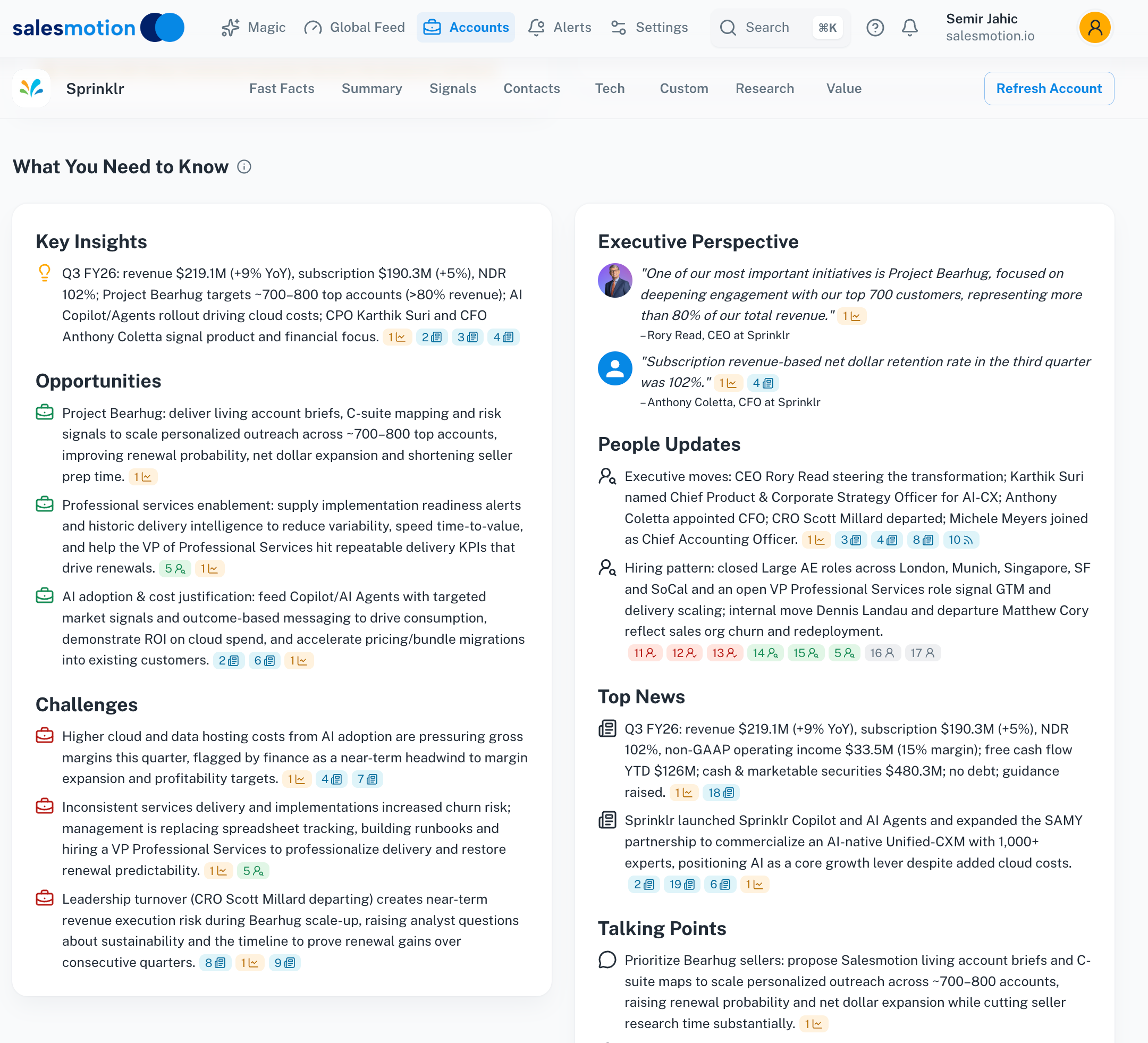 The intelligence layer in action: key insights, executive perspective, hiring patterns, opportunities, and tailored talking points, all generated from 1,000+ sources.
From Intelligence to Outreach: Closing the Loop
The intelligence layer only matters if it connects to action. Knowing that a target account just posted an earnings call mentioning a digital transformation initiative is valuable. Turning that into a personalized email that references the initiative, names the executive driving it, and ties it to a relevant business outcome is what books meetings.
This is where the three layers come together. Data tells you who. Execution gets the message delivered. Intelligence tells you what to say and when to say it.
I wrote about this framework recently in a guest post on the Salesforge blog, and the response from sales leaders confirmed what I have been seeing in conversations for months. Teams are not struggling with activity. They are struggling with relevance.
The numbers from teams that have added the intelligence layer back this up. Frontify's North America sales team saw a 42% increase in sales velocity and a 4x increase in self-sourced pipeline after wiring account intelligence into their outbound workflow. Their Head of Sales, Thomas Meichtry, put it simply: "We close more and we close faster with account intelligence." At Analytic Partners, a team of reps that used to spend 3 hours per account toggling across 5-10 different tools cut that to 15 minutes and grew qualified pipeline by 40% year-over-year. At Cacheflow, a 3-person AE team tripled their average deal size from $5-7K to $18-20K within six months, because every conversation started with real context instead of a generic pitch.
These are not outlier results. They are what happens when reps stop guessing and start every conversation knowing what the prospect actually cares about right now.
The teams that are winning in 2026 have wired their intelligence layer directly into their execution layer. Signals fire, context gets surfaced, and personalized outreach goes out, grounded in what the prospect actually cares about. Not a template with a merge field. A message that sounds like the rep did the work.
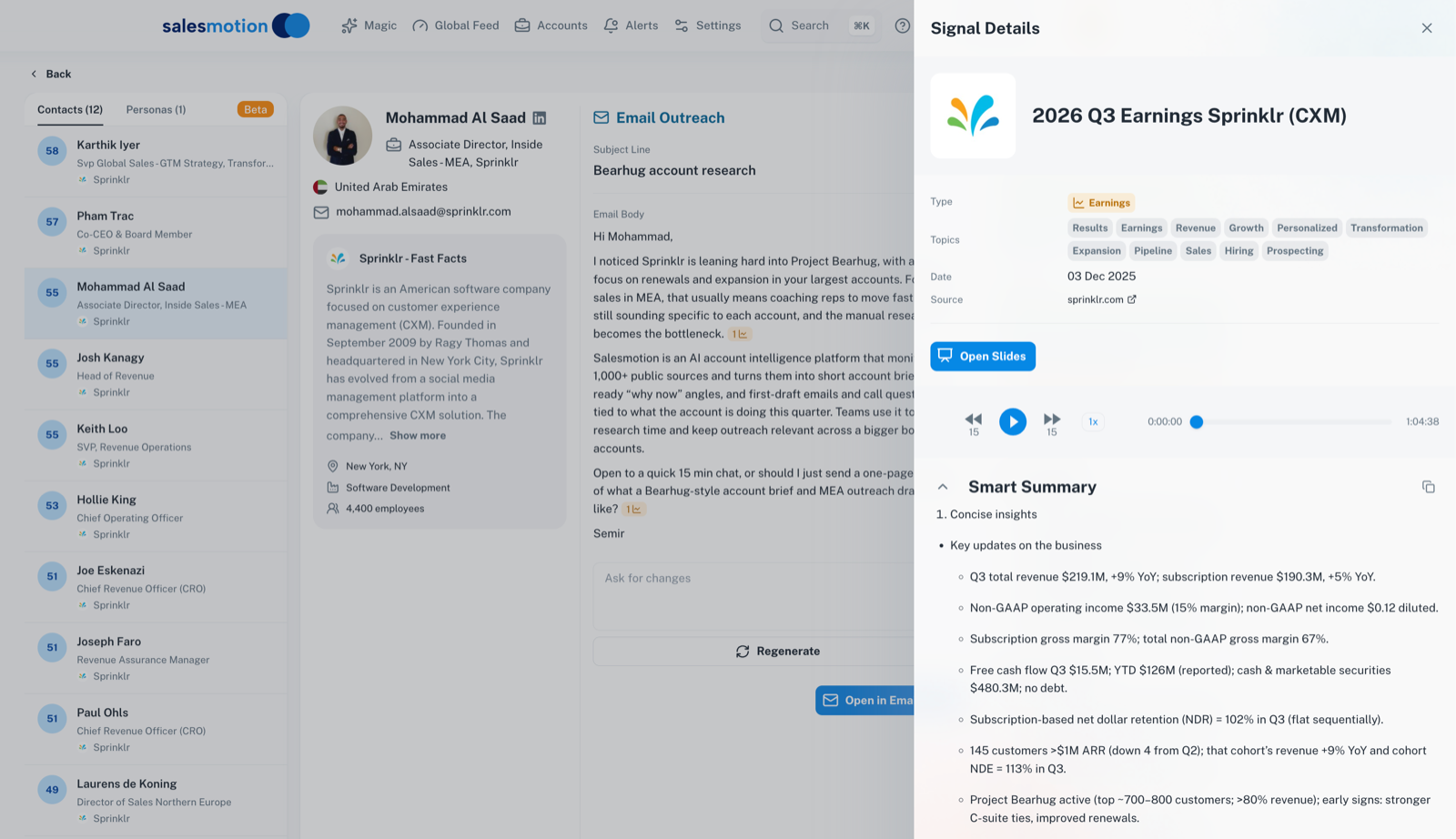 Intelligence meets execution: AI-generated outreach grounded in real earnings call data, not templates.

“We have very limited bandwidth, but Salesmotion was up and running in days. The template made it easy to load our accounts and embedding it in Salesforce was simple. It was one of the easiest rollouts we've done.”
Andrew Giordano
VP of Global Commercial Operations, Analytic Partners
How to Build the Intelligence Layer Into Your Stack
If I were building an outbound function from scratch today, I would not start with sequences. I would start with the intelligence layer and work backward. This is not a six-month transformation project. Most teams we work with are live within a week, and reps see value on day one.
Step 1: Continuous signal monitoring. Set up 24/7 tracking of buying signals across your target accounts: earnings calls, leadership changes, hiring surges, funding rounds, M&A activity, product launches, clinical trials, and competitive moves. This is the foundation. Without it, you are guessing at timing.
Step 2: Deep account research on demand. When a signal fires, you need instant access to the full account picture: the executive team, their stated priorities, recent initiatives, competitive landscape, and a SWOT-style view that tells the rep exactly where to anchor the conversation. This compresses multi-hour account research into minutes.
Step 3: Signal-to-outreach pipeline. Connect the intelligence layer to your execution tools. When a target account shows three or more signals in a 30-day window, that account gets flagged, the context gets packaged, and personalized outreach goes out. The best teams act on signals within 24 hours, seeing a 29% lift in opportunity creation versus slower responders.
Step 4: Measure signal-to-meeting, not emails sent. Stop measuring rep activity in emails sent. Measure it in qualified replies and meetings booked per signal type. If outreach tied to a specific signal (funding, hiring surge, exec change) is converting at 3x your baseline, you have proof the intelligence layer is working. Most teams that make this shift see reply rates double within 60 days while total send volume goes down. Frontify tracked this rigorously and saw self-sourced pipeline go from 4% to 16% of total pipeline within two quarters.
Is Volume-Based Outbound Dead?
No. But lazy outbound is.
The bar moved up. You can no longer get away with templated messages sent at scale. According to Instantly's benchmark data, campaigns targeting 21-50 recipients with deep personalization achieve a 6.2% reply rate, while campaigns blasting 500+ recipients with generic copy see just 2.4%. Buyers have seen the playbook and they delete on sight.
What still works is volume with relevance. High send volume is fine if every message is grounded in something real about the prospect. That is the difference between a team booking 30 meetings a month and a team booking three.
Forrester predicts that by 2026, at least one in five B2B sellers will be compelled to respond to AI-powered buyer agents. The buying side is getting smarter and faster. The selling side needs to match that with intelligence, not just volume.
What Outbound Teams Should Stop Doing
If you want to free up time and budget for the intelligence layer, here is what I would cut first.
Stop treating engagement as intent. A LinkedIn like is not a buying signal. A pricing page visit is curiosity, not commitment. Triggering a five-step sequence off these signals annoys prospects and trains them to ignore your domain. Real signals look different: an earnings call mentioning a strategic initiative, a hiring surge in a specific function, or a new executive joining from a competitor.
Stop sending five-touch sequences with the same message dressed up five ways. If touch one did not land, touch four will not save you. Reduce touches and increase the quality of each one.
Stop measuring activity instead of outcomes. Activity metrics encourage volume. Outcome metrics, qualified replies and meetings booked per signal type, encourage relevance.
Stop letting your account list go stale. The intelligence layer only works if your target accounts are current. Stale ICP lists generate stale outreach. Refresh your account list quarterly at minimum, and let signals tell you which accounts to prioritize.
Key Takeaways
- The outbound stack has three layers: data, execution, and intelligence. Most teams have invested heavily in the first two and left the third empty.
- Intelligence is the missing layer. Knowing why to reach a prospect now, grounded in real signals like earnings calls, leadership changes, and hiring patterns, is what separates a 3% reply rate from 15%+.
- Personalization at scale requires intelligence, not templates. You cannot fake relevance with merge fields. You need continuous signal monitoring and deep account research feeding directly into your outreach.
- Speed to signal matters. Teams that act on buying signals within 24 hours see a 29% lift in opportunity creation. Wire your intelligence layer to your execution tools so the loop closes fast.
- Volume is not dead, but lazy volume is. Campaigns with 21-50 deeply researched recipients outperform 500+ generic blasts by 2.6x on reply rates.
- Measure signal-to-meeting, not emails sent. The teams winning in 2026 track which signal types drive qualified meetings, then double down on those.
Frequently Asked Questions
What are the three layers of an outbound sales strategy?
The three layers are data (who to target), execution (how to reach them), and intelligence (why to reach them now). Data covers contacts and firmographics. Execution covers sequences, deliverability, and multi-channel cadences. Intelligence covers buying signals, account context, and timing, the layer that determines whether a prospect actually replies. Most teams in 2026 have solved the first two layers and are missing the third.
Why is cold email reply rate declining even though sending infrastructure has improved?
Because the bottleneck shifted. Five years ago, the constraint was deliverability and infrastructure. Today, tools like Salesforge and modern warmup solutions have solved that problem. The new constraint is relevance. According to Instantly's 2026 data, the average reply rate is 3.43%, but campaigns with signal-based personalization achieve 15-25%. The gap is not in how you send. It is in what you say and why you are saying it now.
How do buying signals improve outbound sales results?
Buying signals, such as earnings call mentions of strategic priorities, executive hires, funding rounds, and hiring surges, tell you when a company's buying posture has changed. Teams that act on these signals within 24 hours see a 29% lift in opportunity creation. Signal-qualified leads also drive 47% better conversion rates and 43% larger deal sizes compared to non-signal-based outreach.
What is the difference between engagement signals and buying signals?
Engagement signals (LinkedIn likes, pricing page visits, email opens) show curiosity. Buying signals show that a company's situation has materially changed in a way that creates a purchase window. A CEO mentioning a digital transformation initiative on an earnings call, a company posting five new SDR roles, or a VP of Sales joining from a competitor are buying signals. The first tells you someone clicked. The second tells you someone might buy.
Is volume-based outbound dead in 2026?
No, but volume without intelligence is. Instantly's benchmark data shows that campaigns targeting 21-50 recipients achieve 6.2% reply rates, while campaigns targeting 500+ recipients see just 2.4%. Volume still works when every message is grounded in real intelligence about the prospect. The winning formula in 2026 is high volume multiplied by high relevance, not one or the other.
Related
This framework was first published as a guest post on the Salesforge blog: The Outbound Sales Strategy That Still Works in 2026.