Sales reps spend an average of 28% of their week actually selling. The rest goes to CRM data entry (17%), internal meetings (15%), email and admin tasks (14%), scheduling (12%), and research (14%). That means for every 40-hour work week, roughly 11 hours involve direct buyer interaction. The math gets worse when you consider that not all "selling time" is equally productive: hours spent on low-fit accounts, unqualified leads, and poorly prepared calls dilute the impact of even those 11 hours. The highest-performing reps don't necessarily work longer hours. They protect their selling time more aggressively and spend it on higher-quality activities.
TL;DR: Top-performing sales reps spend 35-40% of their time selling (vs. 28% average) by ruthlessly protecting high-value activities: prepared calls, strategic account engagement, and deal advancement. They reduce time on three categories: manual research (automate with account intelligence), CRM administration (automate with activity capture), and unqualified activity (eliminate with signal-driven prioritization). The goal isn't more hours. It's more productive hours on the right accounts at the right time.
Where Sales Reps Actually Spend Their Time
Based on aggregated data from Salesforce, Gartner, and industry research:
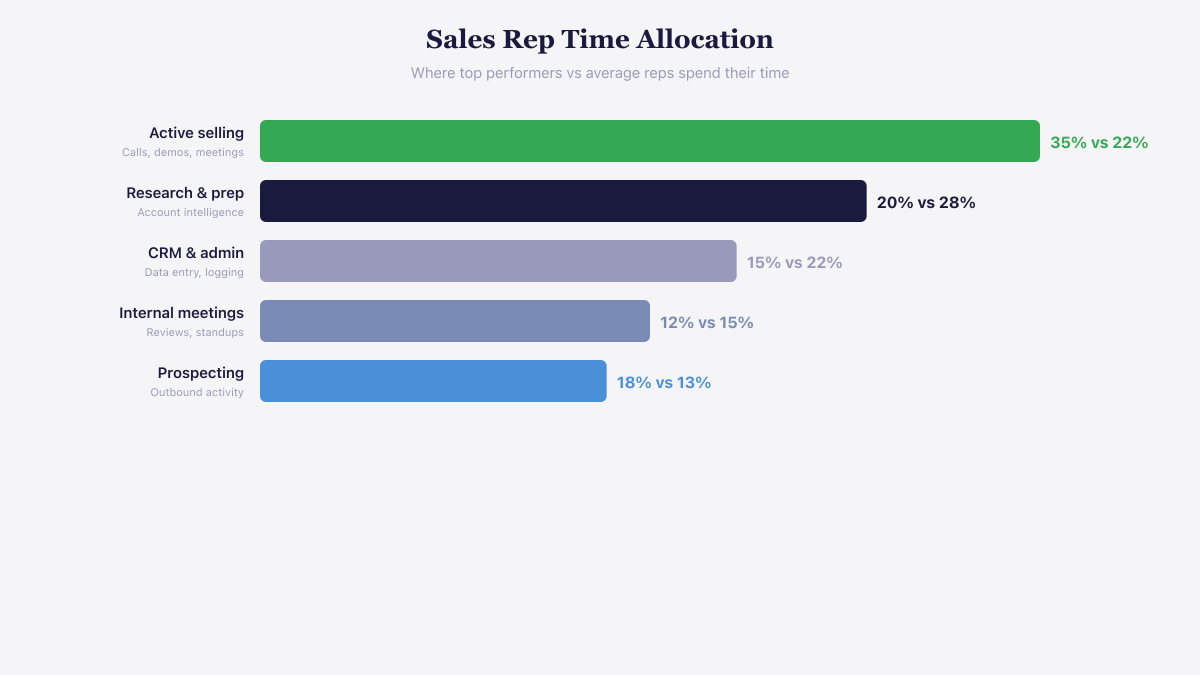 Top performers spend 60% more time on active selling by reducing research and admin overhead.
| Activity | Average % of Time | Top Performer % | Impact on Revenue |
|---|---|---|---|
| Direct selling (calls, meetings, demos) | 28% | 35-40% | Highest — direct correlation |
| Account research and preparation | 14% | 8-10% | High — improves call quality |
| CRM and data entry | 17% | 8-10% | Low — necessary but not productive |
| Internal meetings | 15% | 10-12% | Variable — some productive, most not |
| Email and admin | 14% | 10-12% | Low — maintenance activity |
| Scheduling and logistics | 12% | 8-10% | Low — automation opportunity |
The productivity gap: Top performers spend 7-12 percentage points more of their time selling. Across a year, that's the equivalent of 5-8 additional selling weeks. The difference isn't discipline alone. It's systems: top performers use tools that automate the non-selling tasks that consume average performers' time.
The Three Biggest Time Drains (And How to Fix Them)
Time Drain 1: Manual Account Research
The problem: Reps spend 1-3 hours per account on account research before outreach or calls. They toggle between LinkedIn, company websites, news sites, job boards, and SEC filings to piece together account context. Multiply by 5-10 accounts per week, and research consumes 5-30 hours of selling time.
The fix: Account intelligence platforms automate research by aggregating information from 1,000+ sources into a single account brief. Instead of spending 3 hours building a picture of an account's priorities, leadership changes, and competitive landscape, reps access a pre-built brief in minutes.
Time saved: 50-85% reduction in per-account research. At scale, this reclaims 3-20 hours per week depending on the rep's account volume and research intensity.
Real example: Analytic Partners cut account research from 3 hours to 15 minutes per account using Salesmotion. For a rep researching 10 accounts per week, that's 27.5 hours saved — nearly a full work week reclaimed for selling.
Time Drain 2: CRM Data Entry and Administration
The problem: Reps log calls, update deal stages, add contact information, and maintain opportunity records manually. Most organizations require detailed CRM hygiene, but the entry process is tedious and takes reps out of selling flow.
The fix: Activity capture tools (Gong, Outreach, Revenue Grid) automatically log calls, emails, and meetings to CRM records. AI-powered CRM features auto-populate fields from email and calendar data. Integration between sales engagement platforms and CRM eliminates double-entry.
Time saved: 30-50% reduction in CRM administration time. For a rep spending 7 hours/week on CRM, that's 2-3.5 hours reclaimed.
Implementation note: Activity capture only works if CRM workflows are clean. Adding automation on top of a messy CRM (duplicate records, unclear field requirements, manual approval processes) creates different problems. Clean the CRM before automating data entry.
Time Drain 3: Unqualified Activity
The problem: Reps spend significant time on accounts that won't convert: non-ICP-fit prospects, dormant accounts with no buying signals, and opportunities that should have been disqualified weeks ago. This isn't a time management problem. It's a prioritization problem — and a signal-based selling approach solves it by surfacing the accounts where intent is actually building, so reps stop spreading attention evenly across a flat list.
The fix: Combine ICP scoring with buying signal monitoring to create a dynamic account prioritization system:
- Tier 1 accounts (ICP fit + active signals): Spend 60% of selling time here
- Tier 2 accounts (ICP fit, no current signals): Spend 25% of time in warm nurture
- Tier 3 accounts (weak fit or no signals): Spend 15% of time in automated engagement only
Time saved: This isn't about saving hours. It's about redirecting existing selling hours toward higher-probability activities. Reps who spend 60% of selling time on Tier 1 accounts generate 2-3x more pipeline than reps who spread effort evenly across all tiers.
See the product in action
Take a self-guided tour of the Salesmotion platform — no signup required.
Daily Time Management Framework for Sales Reps
The 60/25/15 Rule
Structure each selling day around three activity tiers:
60% — High-Value Selling (approximately 3 hours/day)
- Prepared calls with Tier 1 accounts (accounts showing active buying signals)
- Discovery and demo meetings
- Deal advancement activities (proposals, stakeholder introductions, executive briefings)
- Strategic account planning for top opportunities
25% — Pipeline Building (approximately 1.5 hours/day)
- Outreach to Tier 1 and Tier 2 accounts
- Follow-up on existing conversations
- Multi-threading into new stakeholders at active accounts
- Content sharing and social engagement with prospects
15% — Operations (approximately 1 hour/day)
- CRM updates and deal stage management
- Internal meetings (1:1s, team meetings, pipeline reviews)
- Email triage and administrative tasks
- Planning and preparation for tomorrow's activities
Time Blocking Template
| Time Block | Activity | Duration |
|---|---|---|
| 8:00-8:30 | Review signals, prep for the day's calls | 30 min |
| 8:30-11:00 | Outbound calls and meetings (prime selling hours) | 2.5 hrs |
| 11:00-11:30 | CRM updates from morning activities | 30 min |
| 11:30-12:30 | Pipeline building outreach (email, LinkedIn) | 1 hr |
| 12:30-1:30 | Lunch and email triage | 1 hr |
| 1:30-3:30 | Afternoon meetings and demos | 2 hrs |
| 3:30-4:00 | Follow-ups from afternoon activities | 30 min |
| 4:00-4:30 | Internal meetings or coaching sessions | 30 min |
| 4:30-5:00 | Plan tomorrow, update pipeline, review signals | 30 min |
Key principle: Protect the two prime selling blocks (8:30-11:00 and 1:30-3:30) from internal meetings. These are when prospects are most available and reps are most energized.
What Sales Managers Can Do
Individual time management only goes so far. Managers control organizational factors that systematically waste rep time:
Reduce internal meeting load. Audit all recurring meetings involving reps. If a meeting doesn't directly help reps sell more effectively, eliminate it or make it optional. Many teams can cut 3-5 hours/week of meetings without losing any valuable information exchange.
Simplify CRM requirements. Every mandatory field is a tax on selling time. Audit CRM field requirements and eliminate anything that doesn't directly inform pipeline management, forecasting, or coaching decisions.
Invest in automation. The tools that save the most rep time — activity capture, automated research, signal-driven prioritization — have clear ROI. Calculate the cost of rep time on manual tasks and compare it to tool costs.
Coach on prioritization, not just skills. A rep with excellent calling skills who calls the wrong accounts wastes that talent. Coaching sessions should include account selection and signal response, not just technique.

“The Business Development team gets 80 to 90 percent of what they need in 15 minutes. That is a complete shift in how our reps work.”
Andrew Giordano
VP of Global Commercial Operations, Analytic Partners
Key Takeaways
- Average reps spend 28% of their time selling. Top performers spend 35-40%. The difference — equivalent to 5-8 additional selling weeks per year — comes from systematic automation of non-selling tasks.
- The three biggest time drains are manual research (1-3 hours per account), CRM data entry (7+ hours/week), and unqualified activity (time spent on non-ICP, no-signal accounts).
- Automate research with account intelligence (50-85% time reduction per account). Automate CRM with activity capture tools (30-50% time reduction). Eliminate unqualified activity with signal-driven prioritization.
- Use the 60/25/15 rule: 60% of selling time on high-value activities (Tier 1 account calls, meetings, deal advancement), 25% on pipeline building, 15% on operations.
- Protect prime selling blocks (mornings and early afternoons) from internal meetings. These are the hours when prospects are available and reps are most productive.
- Managers should audit meeting loads, simplify CRM requirements, and invest in automation tools rather than expecting individual time management to solve systemic productivity problems.
Frequently Asked Questions
How much time should a sales rep spend selling?
Industry benchmarks show average reps spend 28% of their time in direct selling activities (calls, meetings, demos). Top performers achieve 35-40% through systematic automation of non-selling tasks and aggressive protection of selling hours. The goal for most organizations should be moving from 28% to 35% — a 25% improvement in selling time that translates directly to pipeline and revenue growth.
What is the biggest time waster for sales reps?
Manual account research is the single largest discretionary time drain, consuming 1-3 hours per account for reps who prepare thoroughly. Unlike CRM entry (which has some automation solutions) or meetings (which are organizationally imposed), research time scales directly with account volume. A rep covering 200 accounts can spend 20+ hours per week on research alone. Automating research through account intelligence platforms produces the largest per-rep time savings.
How do top sales performers manage their time differently?
Top performers do three things differently: (1) they automate non-selling tasks rather than trying to do them faster, (2) they prioritize accounts based on buying signals and ICP fit rather than working lists sequentially, and (3) they protect prime selling hours (mornings and early afternoons) from internal meetings and administrative tasks. The combination means they have more selling hours and use those hours on higher-probability accounts.
How can sales managers improve team productivity?
The highest-leverage actions for managers are: reducing unnecessary internal meetings (audit and eliminate non-essential recurring meetings), simplifying CRM requirements (remove fields that don't inform pipeline management), investing in automation tools (activity capture, research automation, signal-driven prioritization), and coaching on account prioritization alongside selling skills. Systemic changes produce larger productivity improvements than individual time management coaching alone.