In today's B2B world, selling isn't about having the best pitch—it's about having the best timing. For sales managers, the pressure to hit revenue targets in complex deals with many stakeholders is intense. Old-school methods that rely on rep intuition and generic outreach just don't cut it. This approach creates a "research tax," wasting valuable selling time and leading to missed opportunities because the "why you, why now?" is missing.
The most effective sales manager strategies today are built on real-time account intelligence. They use signals—like new funding, executive moves, or hiring trends—to make sales proactive, not reactive. This guide gives you 10 actionable, research-backed strategies to help you coach with precision, prioritize with data, and build deals based on genuine buyer intent.
We'll explore how to use account intelligence from platforms like Salesmotion to eliminate guesswork, turning real-world business events into your team's most powerful asset for building pipeline. This is the professional, no-fluff playbook that sets top-performing sales teams apart. Let's dive into the strategies that will help you win more complex deals.
1. Account-Based Selling (ABS) with Signal-Driven Prioritization
Account-Based Selling (ABS) is a focused strategy where you treat high-value accounts like individual markets. Instead of casting a wide net, you concentrate your resources on a select group with personalized campaigns. Today's top sales manager strategies take this a step further by using signal-driven prioritization. This means using real-time account intelligence to spot buying triggers—like leadership changes, new funding, or major product launches—that signal an account is ready to talk.
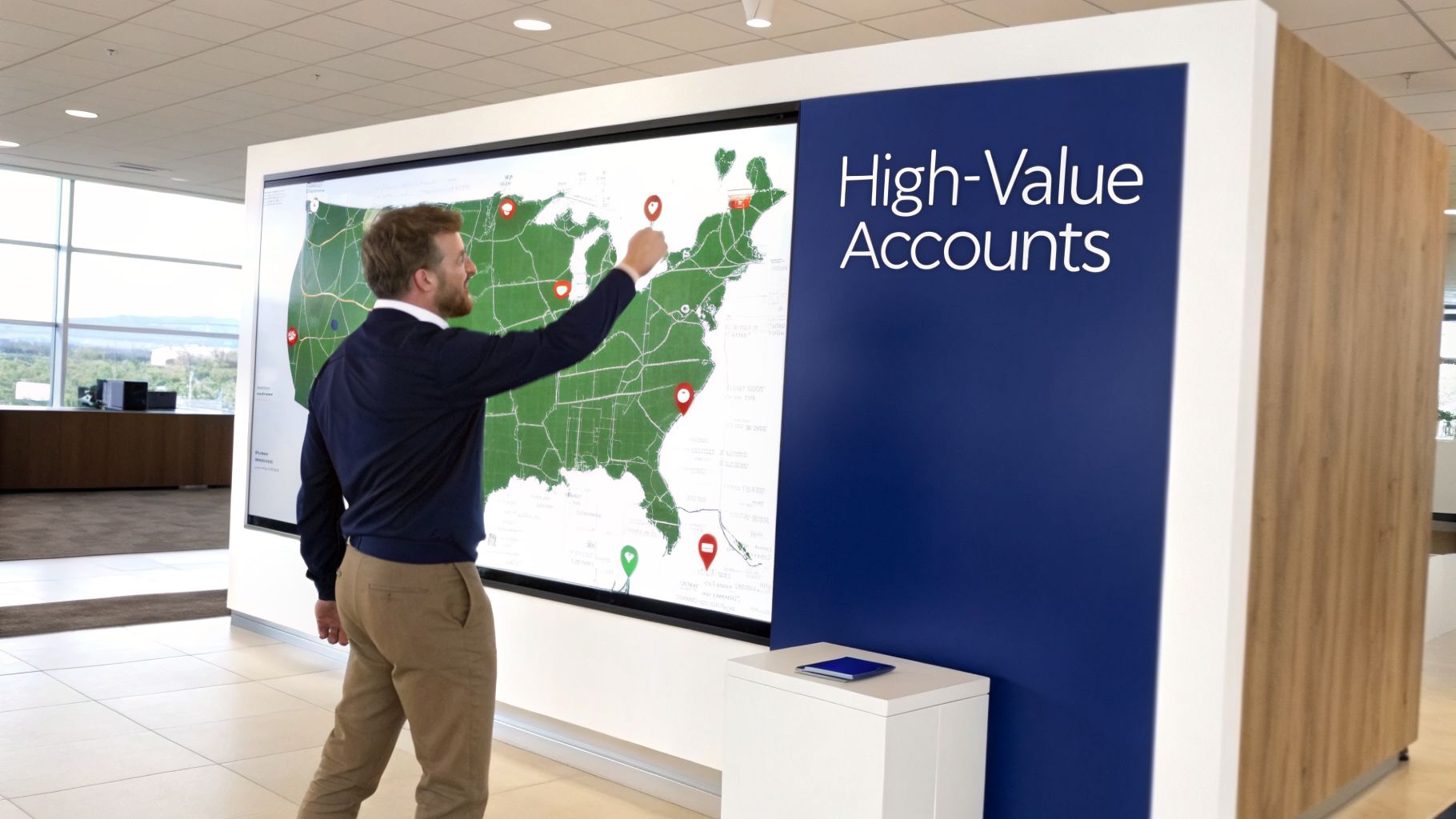
This method shifts your team from reacting to opportunities to proactively engaging with context. For example, imagine a tech company monitoring SaaS buyer signals. When a target account hires a new VP of Engineering, your team can immediately reach out with a message addressing challenges common to new leaders, like modernizing a tech stack. This creates a strong first impression because it shows you understand their current situation.
How to Implement Signal-Driven ABS
To make this work, you need a structured framework. Ditch the generic outreach and build a system around specific triggers.
- Start Small and Scale: Begin with a focused list of 20 to 50 named accounts. This lets your team master the process before expanding. Once you prove the ROI, you can grow the program.
- Establish Real-Time Alerts: Set up alerts in tools like Slack or email for key signals that matter to your business. A consulting firm might track strategic investment announcements, while a life sciences company could monitor clinical trial milestones.
- Create Signal-Based Playbooks: Define clear actions for specific triggers. A "New CIO Hired" signal should kick off a pre-defined outreach cadence with messaging about digital modernization. A "Competitor Lost a Major Client" signal could trigger a different playbook focused on capturing market share.
- Keep Your CRM Current: Make your CRM the central source of truth, updated with signal context. This allows anyone on your team to quickly understand an account's recent history and engage intelligently. For deeper insights, learn how to build a robust system for target account management.
See Salesmotion in action
Take a self-guided interactive tour — no signup required.
2. Real-Time Deal Velocity Management
Deal velocity is all about how fast opportunities move through your pipeline. Effective sales manager strategies enrich this process by adding real-time account intelligence. This lets you spot stalled deals, pinpoint bottlenecks, and intervene at the right moment. Instead of guessing, your team can use automated buying signals—like new funding or an organizational restructure—to identify the perfect time to advance a conversation.

This transforms deal management from a reactive, calendar-based task to a proactive, event-driven one. For instance, a SaaS sales team using funding round signals can cut their time to the first meaningful conversation from weeks to days. A consulting firm monitoring executive changes could escalate an opportunity to its partnership team within 48 hours of a new C-level hire, boosting deal velocity by a measurable 25%. It’s about acting on moments of change to create momentum.
How to Implement Real-Time Deal Velocity Management
To succeed, you need to establish clear metrics and automated workflows that show reps exactly how to act on different signals.
- Define Your Velocity Metrics: Start with clear benchmarks. Track days per stage, stage-to-stage conversion rates, and the impact of specific signal types on these numbers. This gives you a baseline to measure improvement.
- Create Signal-Triggered Playbooks: Don't leave your team guessing. Define what actions reps should take when a key signal appears. A "Series B funding" alert should trigger a specific outreach cadence, while a "company restructure" signal might activate a playbook focused on new departmental needs.
- Push Signals into Rep Workflows: Make sure real-time signals go directly into the tools your team already uses, like Slack or email. Making reps check a separate dashboard adds friction and slows them down.
- Conduct Weekly Velocity Reviews: In team meetings, review which signals correlate with faster pipeline movement and identify which stages are causing deals to stall.
- Coach for Speed and Precision: Train reps to act on signals within 24–48 hours to capitalize on the momentum. Recognize and celebrate wins to show what works and encourage swift action. To get started, you can learn more about how to calculate and improve pipeline velocity.

“The moment we turned on Salesmotion, it became essential. No more hours on LinkedIn or Google to figure out who we're talking to. It's just there, served up to you, so it's always 'go time.'”
Adam Wainwright
Head of Revenue, Cacheflow
3. Insight-Driven Coaching and Rep Enablement
Insight-driven coaching moves sales management beyond generic skill-building to personalized rep enablement. Instead of focusing on lagging indicators like call volume, this approach uses real-time account intelligence and behavioral data to create timely coaching moments. You can guide reps with specific, context-aware advice, linking feedback directly to account activity and showing them the "so what" behind business signals with clear next steps.
This method turns you into a strategic partner. For example, a life sciences sales manager sees a "clinical trial milestone" alert for a key prospect. They can immediately send the rep a one-minute brief with talking points on how that milestone creates buying urgency. This turns raw data into an actionable sales play, making coaching a direct contributor to pipeline velocity. This is one of the most effective sales manager strategies for complex deals.
How to Implement Insight-Driven Coaching
To make this strategy work, you need a system that connects signals to coaching actions. This means moving beyond traditional reviews and focusing on real-time, event-based guidance.
- Create Signal-to-Coaching Playbooks: Map each key business signal to a specific coaching moment and talking point. A "New CIO Hired" trigger should prompt a conversation about positioning your solution for tech modernization. An "Org Restructure" signal might start a coaching session on how to address talent consolidation.
- Focus 1-on-1s on Recent Signals: Use part of your weekly check-ins to discuss recent account signals and the rep's corresponding actions. Make it a conversation, asking reps how they interpreted the signal and what support they need.
- Build Rep "Signal Fluency": Train your team on what different signals mean, why they matter, and how to use them in discovery calls. Create a "signal interpretation guide" for your industry to document what each alert means for buyer readiness.
- Track Coaching ROI: Monitor which coaching conversations and signal types lead to tangible progress, like a new meeting booked or a stakeholder added to the deal. To deepen your team's skills, explore different sales coaching methods that align with this data-first approach.
4. Predictive Pipeline Management and Forecasting
Predictive pipeline management turns forecasting from a subjective art into a data-driven science. Instead of relying on a rep's gut feeling, this strategy uses AI and real-time behavioral signals to forecast revenue more accurately. You can analyze data points like buyer engagement, account activity, and competitive indicators to predict deal progression, identify at-risk opportunities, and allocate resources where they'll have the most impact. This transforms forecasting from a backward-looking chore into a proactive management practice.
This signal-informed approach gives you more reliable guidance for board reporting and internal planning. For example, a SaaS company might use a combination of signals like 'executive engagement + product trial activity + budget confirmation' to predict deal closure with 85% accuracy. This lets them create confident 90-day forecasts instead of uncertain 30-day ones. Sales managers can use advanced analytics that predict high-value leads in real-time to focus on opportunities with the highest chance of success.
How to Implement Predictive Forecasting
Building a predictive model requires a methodical approach that combines historical data with real-time signals. It helps you intervene earlier and coach reps more effectively on what actually moves deals forward.
- Define Deal Health Scores: Start by analyzing past wins and losses to see which signals correlate with success. Create a scoring system where positive signals (e.g., multiple stakeholder meetings) increase the score and negative signals (e.g., no activity for 14 days) reduce it.
- Use Scores to Guide Forecast Calls: Shift conversations away from debating percentages. Instead, reference the signals behind the score. Ask questions like, "The deal score dropped because we haven't engaged with the economic buyer. What's our plan to re-engage them this week?"
- Establish Early Warning Systems: Identify the top 3-5 signals that predict a deal will slip, like a key champion leaving the company. Create automated alerts that trigger your intervention when these signals appear.
- Combine Data with Rep Judgment: The goal isn't to replace a rep's intuition but to enhance it with data. The best forecasts combine quantitative signals with qualitative rep input. For more guidance, see these tips on how to improve forecast accuracy.
“Automatic account profile detail I can use to manage my territory. Using Salesmotion AI to generate value statements per persona, account, etc. Using Salesmotion to give me a starting point based on new hires, or news alerts is critical.”
Adam Wainwright
Head of Revenue, Cacheflow
5. Territory Design and Dynamic Workload Optimization
Great sales manager strategies go beyond coaching and pipeline management—they influence the very structure of your team's focus. Territory design is the strategic allocation of accounts to reps to maximize coverage and results. Modern approaches enrich this process with account intelligence and signal-driven scoring. This allows you to build territories based not just on geography or company size, but on real-time account potential, signal intensity, and buying timing.
This method turns territory planning from a static annual exercise into a dynamic system. It enables smart workload balancing, where reps with lighter pipelines can take on new high-signal accounts, and senior reps can focus on complex deals. For instance, a new rep could be assigned a small territory of 20 accounts all showing clear buying signals, like recent executive hires. This sets them up for early wins while your top performers tackle high-value accounts that require deep strategic effort.
How to Implement Dynamic Territory Design
You can use this approach to create fairer, more productive territories that adapt to market changes. The goal is to align rep skills and capacity with the best available opportunities at any given moment.
- Segment Accounts Multidimensionally: Go beyond basic firmographics. Group accounts by a combination of size, industry, current signal intensity, and deal complexity. This creates a richer view of your addressable market.
- Create Signal-Based Tiers: Identify which accounts are showing the most buying signals over the next 90 days. A consulting firm might route accounts with "organizational restructure" signals to reps skilled in change management, matching the opportunity to specific expertise.
- Balance Workloads and Skills: Monitor rep activity, pipeline health, and quota attainment. If a rep is overwhelmed, re-route new high-signal leads to another team member with more capacity. Conversely, assign accounts with C-level changes to reps who excel at executive engagement.
- Conduct Quarterly Territory Reviews: The market isn't static, and neither should your territories be. Use quarterly reviews to assess coverage, performance, and opportunity distribution. Make data-driven adjustments to ensure every rep has a fair shot at success.
6. Multi-Threaded Stakeholder Engagement and Deal Architecture
Multi-threaded engagement is the strategic practice of building relationships with multiple stakeholders at a target account. Relying on a single champion is a huge deal risk. This approach, combined with account intelligence, helps you guide your team to identify key decision-makers, influencers, and potential blockers. The goal is to understand what each person cares about and orchestrate coordinated, role-specific engagement that builds consensus and de-risks the sales cycle.

This method transforms reps from single-person sellers into consensus-builders. For example, an enterprise software team can orchestrate parallel conversations. The CTO is engaged on technical fit, the CFO on ROI, and the VP of Operations on implementation timelines. By addressing each stakeholder's unique concerns with a tailored value proposition, the team secures broad support and makes the deal more resilient to internal changes.
How to Implement Multi-Threaded Engagement
Effective sales manager strategies require a systematic approach to stakeholder mapping. Coach your reps to build a web of influence rather than a single thread of communication.
- Map the Buying Committee Quarterly: For each high-value account, conduct a quarterly review of the org chart and buying committee. Identify who holds influence, who controls the budget, and who will be the end-user.
- Use Signals as Threading Opportunities: Treat signals like executive moves as prime opportunities to expand your network. A "New Head of R&D" signal should prompt research into their background, leading to a call focused on their specific goals.
- Develop Role-Specific Talk Tracks: Prep your reps with different messaging for each stakeholder. The conversation with a CFO about ROI after a funding round will be very different from a discussion with a technical lead about product capabilities.
- Track Engagement Depth in Your CRM: Log all interactions by individual stakeholder in your CRM. This gives you a clear view of engagement coverage and highlights at-risk deals with only a single point of contact.
- Build a Consensus Checkpoint: Before advancing a deal to a later stage, create a formal checkpoint. Confirm that all key stakeholders have been engaged, their concerns have been addressed, and they are aligned on the proposed value.
7. Competitive Win/Loss Analysis and Market Intelligence
Competitive win/loss analysis is a systematic process for gathering insights from both won and lost deals. Its purpose is to understand your competitive position, reveal customer preferences, and map market trends. This becomes one of the most powerful sales manager strategies when combined with real-time account intelligence. This connection lets you correlate outcomes with specific account events, like a rival's new product launch, revealing early warning signs of competitive risk.
This approach transforms raw deal data into a strategic asset. For instance, if a software team notices losses are increasing shortly after a competitor announces a new partnership, they can pivot their sales strategy to highlight their own integration advantages. This data directly informs product development, messaging, and account strategies, helping your team proactively address competitive threats before they jeopardize a deal.
How to Implement Competitive Win/Loss Analysis
Effective sales managers build a formal system for gathering and acting on competitive intelligence. This moves the team beyond anecdotes and toward data-backed decisions.
- Conduct Prompt Post-Close Interviews: Reach out for win/loss calls within two to four weeks of a deal closing. Their memory will be fresh, leading to more candid feedback.
- Ask Standardized Questions: Create a consistent questionnaire. Key questions include: "Why did you ultimately choose us?" "What did competitors offer that was compelling?" and "What single factor would have made you choose a different provider?"
- Track Competitive Mentions: Systematically log which competitors appear most frequently in both won and lost deals. This helps you identify your biggest threats and where you stand out.
- Correlate Signals with Outcomes: Use account intelligence to connect competitive signals, like funding announcements, with your deal outcomes. This helps you find patterns. For example, you might see more losses correlated with a competitor’s new "free tier" offering.
- Build Scenario-Based Playbooks: Develop clear responses for common competitive scenarios. Create a playbook titled, "If a prospect mentions Competitor X's pricing, here's how we reframe the conversation around ROI."
- Share Insights Across Departments: Routinely share win/loss findings with your product and marketing teams. This feedback is critical for informing the product roadmap and adjusting market positioning.
8. RevOps-Enabled Sales Process Design and CRM Discipline
Revenue Operations (RevOps) brings strategic alignment to sales, marketing, and customer success by unifying processes, data, and technology to drive predictable growth. Partnering with RevOps is a cornerstone of modern sales manager strategies. This collaboration is key to designing and enforcing a disciplined sales process, where clear stages and data requirements create real-time pipeline visibility and more accurate forecasting. It's the operational backbone that makes account intelligence actionable.
RevOps provides the essential infrastructure—CRM configuration, data governance, and automation rules—that turns intelligence signals into real workflow actions. This disciplined approach ensures that a valuable signal, like a new funding round, becomes part of a rep's structured workflow instead of just being noise. It's the system that allows you to scale personalization and data-driven insights across the entire sales floor.
How to Implement RevOps-Driven Processes
Effective implementation hinges on a tight partnership between sales leadership and RevOps to build a system that reps trust and use. The goal is to make the CRM an indispensable assistant, not a data-entry burden.
- Start with a RevOps Audit: Map your current sales process to find bottlenecks. Work with RevOps to see where account intelligence signals can add efficiency, such as automating task creation.
- Define Signal-to-Workflow Rules: Clearly document which signals should trigger specific actions in your CRM. For instance, a "Series B funding" alert could automatically create a high-priority task and route a Slack notification to the account executive.
- Build in Data Governance: Establish clear rules for data management, including naming conventions and required fields for stage progression. A monthly data cleanup, led by RevOps, can ensure data remains accurate.
- Train Reps on the "Why": Help your team understand how CRM discipline and acting on signals directly help them hit quota. Use RevOps dashboards to show the correlation between high-quality data and advancing deals.
- Create Feedback Loops: The system must evolve. Regularly ask reps which signals are most useful and which workflows are helping them close deals faster. Use this feedback to refine your automation rules.
9. Outbound Campaign Strategy with Signal-Triggered Sequencing
An outbound campaign strategy is the systematic execution of prospecting sequences to generate pipeline. The best sales manager strategies evolve this by adding signal-triggered sequencing, a method that makes campaigns adaptive and highly relevant. Instead of pushing generic drip campaigns, sequences adjust in real-time based on account signals. This dramatically improves outbound effectiveness by enabling timely messaging that responds to actual business events.
For example, when a target account receives a new round of funding, the next email in the sequence can automatically address scaling challenges. If a key executive changes roles, the campaign can shift its messaging to emphasize priorities common to new leaders. This creates a responsive, intelligent outbound motion that respects the prospect's context and significantly boosts engagement rates by showing you've done your homework.
How to Implement Signal-Triggered Sequencing
Effective sales managers guide their teams by building a system that turns account intelligence into action. This means moving beyond static lists and creating dynamic campaigns that branch based on real-world triggers.
- Map Signals to Messaging: Identify the top 5-10 buying signals in your industry and create specific messaging frameworks for each. For a consulting firm, a signal like an "organizational restructure" should trigger content about change management.
- Build Campaigns with Decision Points: Structure your sequences with "if/then" logic. For instance, if an account shows a "high intent" signal (like visiting your pricing page), the sequence could accelerate and trigger a high-priority call task. If the account is cold, it remains in a low-touch nurturing track.
- Adjust Cadence Based on Signal Temperature: Use the timing and intensity of signals to inform your outreach frequency. A flurry of positive signals (e.g., new executive hire, recent funding) justifies a faster cadence. Conversely, if an account goes quiet, the cadence should automatically slow down.
- Measure and Refine: Continuously analyze which signals produce the highest response rates and which messaging resonates most effectively. This data-driven feedback loop is crucial for optimizing campaign performance and is a cornerstone of modern sales manager strategies.
10. Customer Success and Expansion Revenue Management
Effective sales manager strategies recognize that the most predictable revenue often comes from existing customers. Customer Success and Expansion Revenue Management formalizes this by turning post-sale relationships into a continuous source of growth. This discipline focuses on ensuring customers achieve their desired outcomes while using account intelligence to spot expansion opportunities. When informed by the right signals, Customer Success Managers (CSMs) can proactively identify accounts reaching key milestones, like usage peaks, and initiate conversations about additional value.
This approach bridges the gap between sales and customer success, creating a unified revenue team. For instance, a SaaS vendor can monitor feature adoption spikes and proactively offer a relevant expansion package when usage exceeds a threshold. Similarly, a company might detect a customer's new strategic initiative through public funding signals and coordinate a joint sales-CS outreach. This turns customer health monitoring into a proactive revenue engine.
How to Implement Customer Success and Expansion Revenue Management
Sales managers must work with CS leaders to build a system that identifies and acts on expansion signals. The goal is to make expansion a natural extension of delivering customer value.
- Define Expansion Triggers: Establish clear thresholds for what constitutes an expansion signal. This could be a customer exceeding a data limit, high adoption of a specific feature, or an external event like a merger.
- Create Expansion Playbooks: Develop standardized plays for common scenarios. An approaching renewal combined with high product usage should trigger a playbook focused on a multi-year deal with an upsell. A "New Department Using Product" signal might activate a playbook for a site-wide license.
- Establish Clear Handoffs: Set rules for collaboration between CSMs and Account Executives. When a CSM identifies a high-propensity expansion signal, there should be a clear, fast process for bringing a sales rep into the conversation.
- Integrate Product and CRM Data: Feed product usage data directly into your CRM. This ensures signals appear automatically within the account view, giving the entire revenue team a shared context. Platforms like Gainsight provide a deep framework for operationalizing customer success.
10-Point Sales Manager Strategy Comparison
| Strategy | Implementation complexity | Resource requirements | Expected outcomes | Ideal use cases | Key advantages |
|---|---|---|---|---|---|
| Account-Based Selling (ABS) with Signal-Driven Prioritization | High — needs data infrastructure and coordinated execution | Account intelligence platform, RevOps, cross-functional teams | Higher win rates, faster deal velocity, prioritized pipeline | Complex B2B SaaS, life sciences, enterprise accounts | Hyper-targeted, timely outreach; multi-stakeholder alignment |
| Real-Time Deal Velocity Management | Medium–High — requires signal integration and CRM hygiene | Signal feeds, dashboards, manager coaching time | Shorter sales cycles, improved forecast accuracy, fewer stalled deals | Fast-moving SaaS, fintech, venture-backed markets | Proactive interventions; measurable velocity metrics |
| Insight-Driven Coaching and Rep Enablement | Medium — coaching frameworks plus signal visibility | Manager time, enablement content, real-time alerts | Increased rep productivity, faster ramp, behavior change | Complex sales with multi-stakeholder reps needing guidance | Contextual, just-in-time coaching tied to signals |
| Predictive Pipeline Management and Forecasting | High — AI models and historical data required | Data science, quality historical CRM data, signal feeds | Better forecast accuracy, earlier risk detection, scenario planning | Long-cycle enterprise deals and revenue planning | Forward-looking deal scoring; early warning signals |
| Territory Design & Dynamic Workload Optimization | Medium–High — segmentation and dynamic allocation logic | Account mapping tools, signal data, clear communication | Improved quota attainment, balanced workloads, faster wins | Scaling teams, high-growth sales organizations | Dynamic allocation; optimized coverage and fairness |
| Multi-Threaded Stakeholder Engagement & Deal Architecture | Medium — stakeholder mapping and coordination | Research tools (LinkedIn/CRM), rep time, coordinated content | Lower deal risk, larger deal sizes, more reliable closes | Enterprise deals requiring consensus and buy-in | Builds consensus; sustains deals if champions change |
| Competitive Win/Loss Analysis & Market Intelligence | Medium — structured programs and correlation analysis | Interview program, intel tools, analytics capability | Better positioning, product insights, faster playbook updates | Highly competitive, fast-changing markets (SaaS, fintech) | Early threat detection; actionable competitive playbooks |
| RevOps-Enabled Sales Process Design & CRM Discipline | High — CRM reconfiguration and governance | RevOps team, integrations, training, automation tools | Scalable processes, reliable data, automated signal-to-action | Organizations scaling GTM operations and tooling | Ensures signals become actionable; predictable operations |
| Outbound Campaign Strategy with Signal-Triggered Sequencing | Medium–High — branching logic and testing required | Sequencing platform, content library, signal integrations | Higher response rates, faster meetings, improved ROI | High-volume outbound (SaaS, MarTech) and targeted prospecting | Real-time, relevant messaging; adaptive cadence |
| Customer Success & Expansion Revenue Management | Medium — product telemetry and SLAs needed | Product usage instrumentation, CSM playbooks, integrations | Increased net retention, proactive expansion, reduced churn | Subscription/SaaS and recurring-revenue businesses | Proactive expansion identification; aligned cross-functional plays |
Turn Signals into Wins: Your Next Steps
The shift from a good sales manager to a great one is marked by moving from reaction to anticipation. These ten sales manager strategies aren't isolated tactics; they represent a cohesive system for building a modern, high-performance sales organization. From using signal-driven prioritization to designing competitive win/loss programs, the common thread is intelligence. Each strategy replaces outdated, manual processes with a smarter, more precise approach fueled by real-time data.
This is the core of modern sales leadership: moving beyond just managing people to architecting a scalable revenue engine. It’s about equipping your team not just with a CRM and a phone, but with the context behind every action. When a rep knows a prospect’s company just launched a new product line or hired a key executive, their outreach becomes immediately relevant. This is the difference between making calls and starting meaningful conversations.
Key Takeaways for Immediate Action
To put these concepts into practice, don't get overwhelmed. Your goal isn't to implement all ten strategies by next quarter. The most effective sales manager strategies are those that are deeply integrated and consistently executed.
Focus on these central themes:
- Intelligence Over Effort: Your team’s most valuable resource is its time. Prioritize strategies that automate research and surface high-intent signals. This lets reps spend their best hours building relationships and closing deals.
- Process as a Product: Treat your sales process, playbooks, and coaching frameworks as internal products. They should be designed, tested, and continually refined based on performance data and feedback. A static process is a dying one.
- Coaching with Context: Shift your one-on-ones from reviewing yesterday's activity log to strategizing for tomorrow's opportunities. Use account intelligence to guide conversations, role-play specific scenarios, and help reps connect market signals to customer needs.
The ultimate goal is to create a sales environment where timely, actionable intelligence is the standard operational backbone. When your team trusts the data and the process, they perform with greater confidence and predictability.
Your Implementation Roadmap
Starting this journey requires focus. Don't try to do everything at once. Instead, pick one or two foundational strategies that will deliver the most immediate impact.
- Choose Your Starting Point: For many teams, Signal-Driven Prioritization (Strategy #1) and Insight-Driven Coaching (Strategy #3) offer the quickest path to value. These two work together to ensure your team is focused on the right accounts with the right messaging.
- Automate the Intelligence Layer: Manually tracking thousands of signals is impossible. Implement a dedicated platform to automate this process. It should not only gather the data but also deliver it into your reps' existing workflows (like CRM or Slack) with clear, actionable context.
- Build Your First Playbooks: Start with a few simple, signal-triggered playbooks. For example, create a specific outreach sequence for when a target account hires a new C-level executive or another for when a competitor is mentioned in negative press. Measure the results, get feedback, and refine them.
By mastering these foundational elements, you create a powerful feedback loop. Better signals lead to more effective coaching, which leads to smarter outreach, which generates more revenue—and more data to refine your process. This is how you build a resilient, predictable, and market-leading sales force. The future of B2B sales management isn't about working harder; it's about working smarter, guided by the clear signals your market is sending every day.
Ready to stop managing dashboards and start leading with intelligence? Salesmotion is the account intelligence platform designed to automate signal detection and deliver actionable context directly into your reps' workflows, making it easier than ever to implement these powerful sales manager strategies. See how you can build a more predictable revenue engine by visiting Salesmotion today.